With the amount of new subnets being added it can be hard to get up to date information across all subnets, so data may be slightly out of date from time to time
Core Problem: Fragmented AI Agent Infrastructure
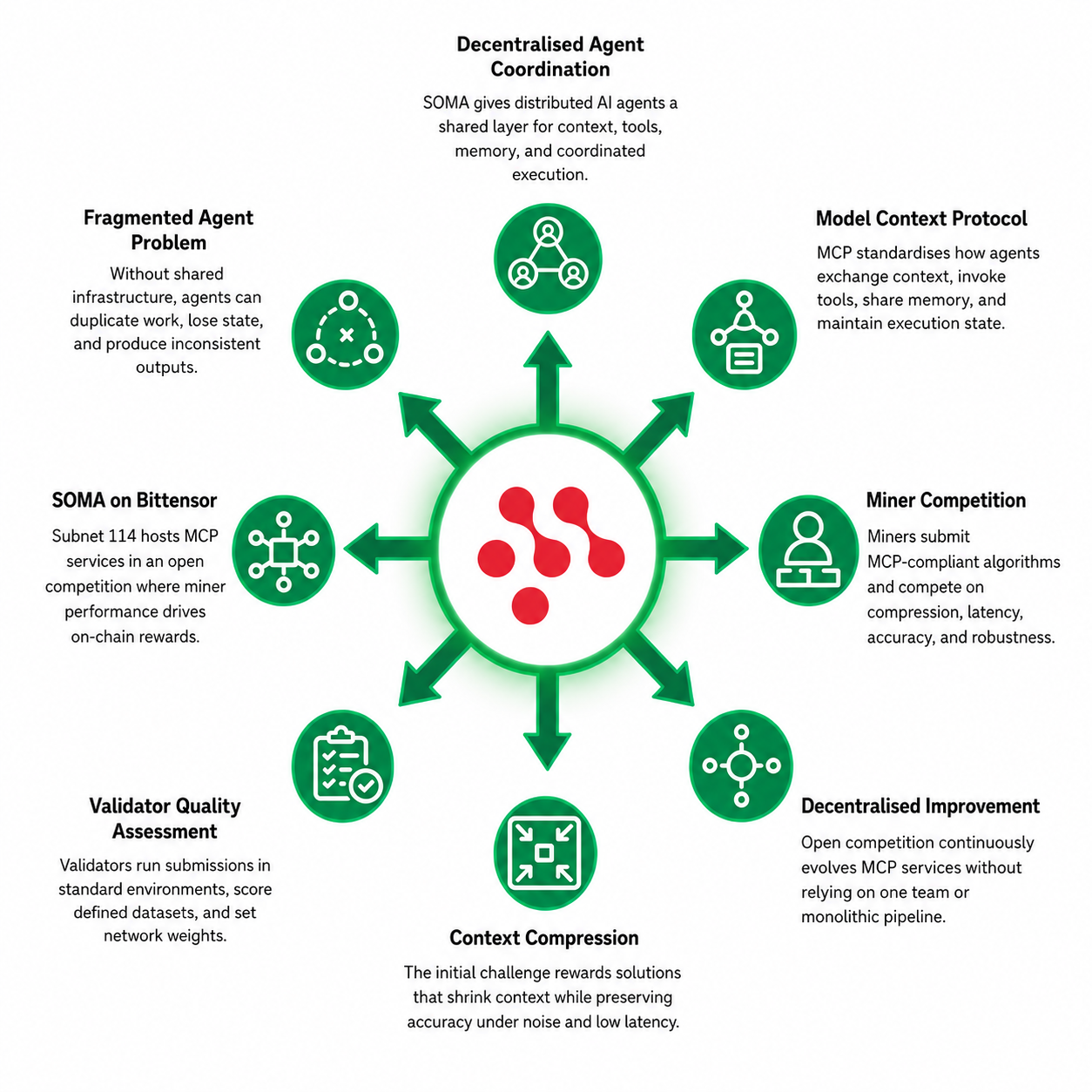
Distributed AI agents often produce uncoordinated outputs, resulting in inconsistent state, duplicated work, and no shared execution context—critical shortcomings for real-world deployments where reliability and coherence are paramount. Centralized pipelines attempt to mitigate this by enforcing fixed workflows and single-team oversight, but these solutions lack the flexibility and scalability required for multi-agent systems that must adapt rapidly to evolving demands.
Model Context Protocol (MCP)
MCP (Model Context Protocol) defines a standardized API and communication layer allowing AI agents to exchange contextual data, invoke external tools, and maintain shared execution state securely across services. By decoupling context management from model logic, MCP enables modular agents to collaborate, share memory, and leverage external APIs without bespoke integrations, dramatically reducing development overhead and increasing agent interoperability.
SOMA as a Bittensor Subnet
Built on Bittensor subnet 114, SOMA leverages the network’s incentive-driven architecture to host a fleet of MCP servers in a decentralized contest framework. Miners register a hotkey on netuid 114, submit algorithms or models to the central Platform, and validators fetch these submissions to score their performance, with results aggregated on-chain through Yuma consensus. This miner–validator–platform loop ensures continuous improvement via weekly competitions, aligning economic rewards with real usage metrics.
Miners: Competition on Performance
Miners design and implement MCP-compliant algorithms targeting active challenges—initially context compression—to maximize metrics such as compression ratio, latency, and accuracy under noise constraints. During each one-week cycle, miners may upload one submission per hotkey, competing to deliver the most robust, generalizable solutions rather than specialist heuristics.
Validators: Quality Assessment
Validators host standardized environments to fetch miner scripts from the Platform, execute them against predefined datasets, and score outputs based on competition criteria (e.g., token-level F1 under varied compression ratios). Validator scores are reported back to the Platform, which computes final rankings and on-chain weights, driving the dynamic allocation of TAO rewards.
Neurobiology Analogy
Inspired by the soma—or cell body—in neurobiology, SOMA’s MCP servers function as central integration points that aggregate dendritic inputs (agent requests), manage state, and trigger coordinated actions, mirroring biological signal integration before neural firing.
Decentralized vs. Centralized Approaches
Unlike centralized AI infrastructures that rely on single-team R&D cycles and monolithic deployment pipelines, SOMA’s decentralized model harnesses open competition to continuously benchmark and evolve MCP services—ensuring enterprise-grade reliability without sacrificing adaptability or cost efficiency.
Core Problem: Fragmented AI Agent Infrastructure
Distributed AI agents often produce uncoordinated outputs, resulting in inconsistent state, duplicated work, and no shared execution context—critical shortcomings for real-world deployments where reliability and coherence are paramount. Centralized pipelines attempt to mitigate this by enforcing fixed workflows and single-team oversight, but these solutions lack the flexibility and scalability required for multi-agent systems that must adapt rapidly to evolving demands.
Model Context Protocol (MCP)
MCP (Model Context Protocol) defines a standardized API and communication layer allowing AI agents to exchange contextual data, invoke external tools, and maintain shared execution state securely across services. By decoupling context management from model logic, MCP enables modular agents to collaborate, share memory, and leverage external APIs without bespoke integrations, dramatically reducing development overhead and increasing agent interoperability.
SOMA as a Bittensor Subnet
Built on Bittensor subnet 114, SOMA leverages the network’s incentive-driven architecture to host a fleet of MCP servers in a decentralized contest framework. Miners register a hotkey on netuid 114, submit algorithms or models to the central Platform, and validators fetch these submissions to score their performance, with results aggregated on-chain through Yuma consensus. This miner–validator–platform loop ensures continuous improvement via weekly competitions, aligning economic rewards with real usage metrics.
Miners: Competition on Performance
Miners design and implement MCP-compliant algorithms targeting active challenges—initially context compression—to maximize metrics such as compression ratio, latency, and accuracy under noise constraints. During each one-week cycle, miners may upload one submission per hotkey, competing to deliver the most robust, generalizable solutions rather than specialist heuristics.
Validators: Quality Assessment
Validators host standardized environments to fetch miner scripts from the Platform, execute them against predefined datasets, and score outputs based on competition criteria (e.g., token-level F1 under varied compression ratios). Validator scores are reported back to the Platform, which computes final rankings and on-chain weights, driving the dynamic allocation of TAO rewards.
Neurobiology Analogy
Inspired by the soma—or cell body—in neurobiology, SOMA’s MCP servers function as central integration points that aggregate dendritic inputs (agent requests), manage state, and trigger coordinated actions, mirroring biological signal integration before neural firing.
Decentralized vs. Centralized Approaches
Unlike centralized AI infrastructures that rely on single-team R&D cycles and monolithic deployment pipelines, SOMA’s decentralized model harnesses open competition to continuously benchmark and evolve MCP services—ensuring enterprise-grade reliability without sacrificing adaptability or cost efficiency.
Live Platform: Core Orchestration Layer
The SOMA Platform, live on subnet 114, orchestrates MCP services by registering miner hotkeys, managing an algorithm registry, and hosting a real-time analytics dashboard for performance insights. It automates submission validation, coordinates validator workloads, and finalizes quality assessments to compute on-chain weights and reward distributions.
SOMARIZER: Context Compression Engine
SOMARIZER is SOMA’s specialized MCP function for context compression, reducing input size while preserving semantics to lower inference costs and extend effective memory windows in agentic systems. By distilling noisy input into critical information, SOMARIZER accelerates response times and supports deeper reasoning in multi-agent workflows.
Technical Architecture
• MCP Server (Bridge): A high-performance, secure HTTP/MCP endpoint that injects credentials, handles streaming transports, and exposes standardized tool interfaces for AI agents.
• Platform Orchestration: Central service managing submissions, executing automated screening, coordinating validator tasks, and aggregating scores.
• Validator Scoring: Distributed workers fetch miner algorithms, run predefined evaluations, and report raw metrics to the Platform for on-chain weight calculation.
• Miner Submission Workflow: Miners clone the SOMA GitHub repo, implement MCP functions under docs/miner guidelines, register a hotkey, and push code during the submission window.
Weekly Competition Cycle
Each one-week cycle comprises:
1️⃣ Submission Window: Miners upload or update algorithms tied to registered hotkeys.
2️⃣ Screening & Qualification: Automated integrity checks and baseline performance filtering select top candidates for the main phase.
3️⃣ Competition Phase: Validators continuously evaluate qualified solutions under live conditions, reporting scores until final rankings are computed at cycle end.
Validator Hardware Requirements
• 4 CPU cores
• 16 GB RAM
• 200 GB SSD storage.
Metrics & Activity
The SOMA GitHub repo has 310 commits, 5 stars, and 4 forks, reflecting active development. As of May 2026, SN114 trades at ~$3.13 with a $1.23M market cap, 393K circulating supply, and 291.9% 24h volume-to-market-cap ratio.
Cross-Subnet Integrations & Developer APIs
While initial partnerships are forthcoming, SOMA is architected for seamless integration with subnets like Quasar and EvolAI. Developers can leverage the ModelContextProtocol SDK for TypeScript, Python, and LangChain to connect agents directly to SOMA’s MCP servers.
Live Platform: Core Orchestration Layer
The SOMA Platform, live on subnet 114, orchestrates MCP services by registering miner hotkeys, managing an algorithm registry, and hosting a real-time analytics dashboard for performance insights. It automates submission validation, coordinates validator workloads, and finalizes quality assessments to compute on-chain weights and reward distributions.
SOMARIZER: Context Compression Engine
SOMARIZER is SOMA’s specialized MCP function for context compression, reducing input size while preserving semantics to lower inference costs and extend effective memory windows in agentic systems. By distilling noisy input into critical information, SOMARIZER accelerates response times and supports deeper reasoning in multi-agent workflows.
Technical Architecture
• MCP Server (Bridge): A high-performance, secure HTTP/MCP endpoint that injects credentials, handles streaming transports, and exposes standardized tool interfaces for AI agents.
• Platform Orchestration: Central service managing submissions, executing automated screening, coordinating validator tasks, and aggregating scores.
• Validator Scoring: Distributed workers fetch miner algorithms, run predefined evaluations, and report raw metrics to the Platform for on-chain weight calculation.
• Miner Submission Workflow: Miners clone the SOMA GitHub repo, implement MCP functions under docs/miner guidelines, register a hotkey, and push code during the submission window.
Weekly Competition Cycle
Each one-week cycle comprises:
1️⃣ Submission Window: Miners upload or update algorithms tied to registered hotkeys.
2️⃣ Screening & Qualification: Automated integrity checks and baseline performance filtering select top candidates for the main phase.
3️⃣ Competition Phase: Validators continuously evaluate qualified solutions under live conditions, reporting scores until final rankings are computed at cycle end.
Validator Hardware Requirements
• 4 CPU cores
• 16 GB RAM
• 200 GB SSD storage.
Metrics & Activity
The SOMA GitHub repo has 310 commits, 5 stars, and 4 forks, reflecting active development. As of May 2026, SN114 trades at ~$3.13 with a $1.23M market cap, 393K circulating supply, and 291.9% 24h volume-to-market-cap ratio.
Cross-Subnet Integrations & Developer APIs
While initial partnerships are forthcoming, SOMA is architected for seamless integration with subnets like Quasar and EvolAI. Developers can leverage the ModelContextProtocol SDK for TypeScript, Python, and LangChain to connect agents directly to SOMA’s MCP servers.
About Dendrite
Dendrite is a technology company founded in 2022, entering the Bittensor ecosystem early and evolving into its primary infrastructure architect. Led by a global team of 50+ elite engineers and mathematicians, Dendrite specializes in designing high-performance mining infrastructure, launching proprietary subnets, and building end-user products like SimplyTao.
Ecosystem Contributions
Beyond SOMA, Dendrite has built SimplyTao—the first fiat-on-ramp for AI startup tokens—and supported multiple subnets including BitTranslate (SN?) and Gaia (SN57) with incentive mechanism design and operational tooling. Their expertise spans algorithm development, network security, and protocol enhancements.
Key Team Members
While specific founders remain semi-anonymous, Dendrite’s core leadership is represented by industry veterans in distributed systems and AI. Public contributors on the SOMA GitHub repo include members of the Dendrite engineering team and community experts, with over 310 commits driving ongoing innovation.
Launch & Community Standing
SOMA officially launched its first MCP competition, Context Compression, as subnet 114 in Q1 2026, quickly gaining traction with validators and miners across the ecosystem. Dendrite’s consistent engagement and transparent development have positioned SOMA as a community-driven, high-impact subnet.
About Dendrite
Dendrite is a technology company founded in 2022, entering the Bittensor ecosystem early and evolving into its primary infrastructure architect. Led by a global team of 50+ elite engineers and mathematicians, Dendrite specializes in designing high-performance mining infrastructure, launching proprietary subnets, and building end-user products like SimplyTao.
Ecosystem Contributions
Beyond SOMA, Dendrite has built SimplyTao—the first fiat-on-ramp for AI startup tokens—and supported multiple subnets including BitTranslate (SN?) and Gaia (SN57) with incentive mechanism design and operational tooling. Their expertise spans algorithm development, network security, and protocol enhancements.
Key Team Members
While specific founders remain semi-anonymous, Dendrite’s core leadership is represented by industry veterans in distributed systems and AI. Public contributors on the SOMA GitHub repo include members of the Dendrite engineering team and community experts, with over 310 commits driving ongoing innovation.
Launch & Community Standing
SOMA officially launched its first MCP competition, Context Compression, as subnet 114 in Q1 2026, quickly gaining traction with validators and miners across the ecosystem. Dendrite’s consistent engagement and transparent development have positioned SOMA as a community-driven, high-impact subnet.
Current MCP Challenge: Context Compression
The inaugural MCP competition focuses on evaluating how well miners preserve task-relevant information under constrained compression levels and injected noise, using multi-level token-level F1 scoring weighted by compression ratio.
Future Competition Types
Dendrite has hinted at upcoming MCP challenges including real-time tool orchestration, multi-agent workflow optimization, and secure execution under policy constraints. Community proposals will drive new server types via on-chain governance votes.
Community Governance & Bug Bounty
SOMA plans to introduce a decentralized governance model, allowing token holders to vote on new MCP functions, competition parameters, and integration priorities. A bug bounty program is slated to launch in mid-2026 to ensure platform security and validation integrity.
Cross-Subnet Partnerships
While no formal integrations are confirmed yet, Dendrite is actively collaborating with subnets like Quasar and EvolAI, aiming for live tool-sharing APIs by late 2026. Detailed announcements will appear on thesoma.ai and @SomaSubnet.
Long-Term Vision & Timeline
By 2026, SOMA targets universal AI tooling infrastructure status, supporting production workloads and inter-subnet workflows. Dendrite’s three-year roadmap outlines strategic TAO reserves, increased governance participation, and new product offerings through 2027 and beyond.
Recent Announcements
On thesoma.ai, the addition of SOMARIZER contextual compression indexing and upcoming private beta invites for custom MCP functions were announced in April 2026, signaling rapid feature expansion.
Current MCP Challenge: Context Compression
The inaugural MCP competition focuses on evaluating how well miners preserve task-relevant information under constrained compression levels and injected noise, using multi-level token-level F1 scoring weighted by compression ratio.
Future Competition Types
Dendrite has hinted at upcoming MCP challenges including real-time tool orchestration, multi-agent workflow optimization, and secure execution under policy constraints. Community proposals will drive new server types via on-chain governance votes.
Community Governance & Bug Bounty
SOMA plans to introduce a decentralized governance model, allowing token holders to vote on new MCP functions, competition parameters, and integration priorities. A bug bounty program is slated to launch in mid-2026 to ensure platform security and validation integrity.
Cross-Subnet Partnerships
While no formal integrations are confirmed yet, Dendrite is actively collaborating with subnets like Quasar and EvolAI, aiming for live tool-sharing APIs by late 2026. Detailed announcements will appear on thesoma.ai and @SomaSubnet.
Long-Term Vision & Timeline
By 2026, SOMA targets universal AI tooling infrastructure status, supporting production workloads and inter-subnet workflows. Dendrite’s three-year roadmap outlines strategic TAO reserves, increased governance participation, and new product offerings through 2027 and beyond.
Recent Announcements
On thesoma.ai, the addition of SOMARIZER contextual compression indexing and upcoming private beta invites for custom MCP functions were announced in April 2026, signaling rapid feature expansion.