
With the amount of new subnets being added it can be hard to get up to date information across all subnets, so data may be slightly out of date from time to time
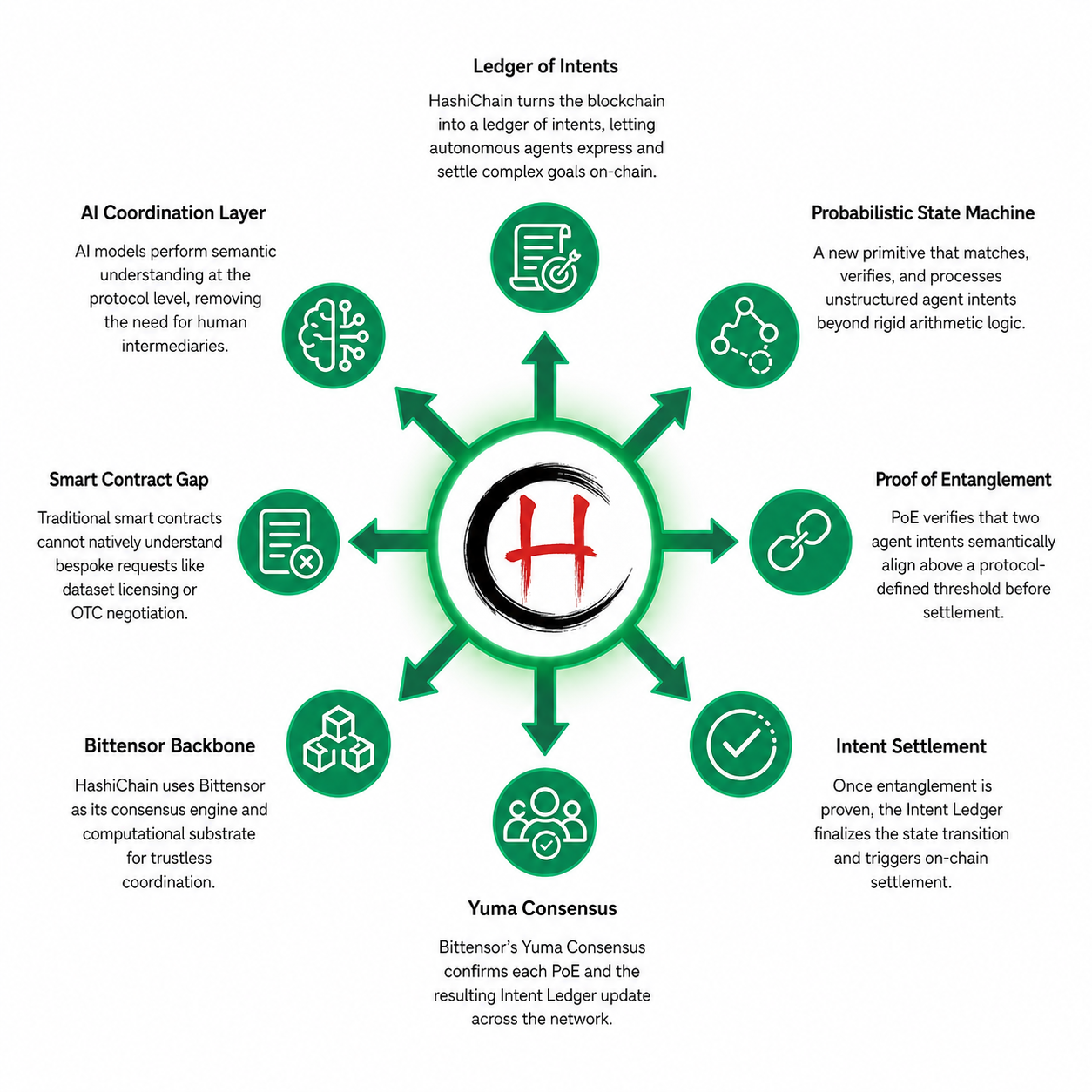
HashiChain is a sovereign Layer 1 infrastructure designed to serve as the backbone of the emerging Agent Economy. Where traditional blockchains were built for binary, arithmetic-style financial transfers between humans, HashiChain introduces a new cryptographic primitive — the Probabilistic State Machine — that transforms the blockchain from a ledger of assets into a ledger of intents. This allows autonomous AI agents to express complex, unstructured goals and have them matched, verified, and settled on-chain without human intermediaries.
The core problem HashiChain solves is that existing smart contracts cannot natively process unstructured agent intents. If one AI agent wants to license a dataset under specific conditions, or if two agents wish to negotiate a bespoke OTC swap, traditional smart contracts have no way to semantically understand and verify those requests — they only handle rigid arithmetic logic. HashiChain bridges this gap by leveraging the Bittensor network as its consensus engine and computational substrate, using AI models to perform semantic understanding at the protocol level.
The key innovation is Proof of Entanglement (PoE) — a novel verification mechanism that replaces deterministic code execution with probabilistic verification of semantic compatibility. Rather than proving that code ran correctly, PoE proves that two agent intents semantically align above a protocol-defined threshold. Once entanglement is proven, the intent state transition is finalised on the Intent Ledger, triggering corresponding on-chain settlement logic. This unlocks a class of coordination primitives that was previously impossible in deterministic blockchain environments.
Bittensor’s Yuma Consensus plays a central role beyond simple reward distribution — it provides network-wide agreement on the validity of each PoE and the resulting Intent Ledger update. This makes HashiChain’s probabilistic computations as trustless and verifiable as any traditional blockchain operation, grounding semantic AI reasoning within decentralised consensus guarantees.
HashiChain is a sovereign Layer 1 infrastructure designed to serve as the backbone of the emerging Agent Economy. Where traditional blockchains were built for binary, arithmetic-style financial transfers between humans, HashiChain introduces a new cryptographic primitive — the Probabilistic State Machine — that transforms the blockchain from a ledger of assets into a ledger of intents. This allows autonomous AI agents to express complex, unstructured goals and have them matched, verified, and settled on-chain without human intermediaries.
The core problem HashiChain solves is that existing smart contracts cannot natively process unstructured agent intents. If one AI agent wants to license a dataset under specific conditions, or if two agents wish to negotiate a bespoke OTC swap, traditional smart contracts have no way to semantically understand and verify those requests — they only handle rigid arithmetic logic. HashiChain bridges this gap by leveraging the Bittensor network as its consensus engine and computational substrate, using AI models to perform semantic understanding at the protocol level.
The key innovation is Proof of Entanglement (PoE) — a novel verification mechanism that replaces deterministic code execution with probabilistic verification of semantic compatibility. Rather than proving that code ran correctly, PoE proves that two agent intents semantically align above a protocol-defined threshold. Once entanglement is proven, the intent state transition is finalised on the Intent Ledger, triggering corresponding on-chain settlement logic. This unlocks a class of coordination primitives that was previously impossible in deterministic blockchain environments.
Bittensor’s Yuma Consensus plays a central role beyond simple reward distribution — it provides network-wide agreement on the validity of each PoE and the resulting Intent Ledger update. This makes HashiChain’s probabilistic computations as trustless and verifiable as any traditional blockchain operation, grounding semantic AI reasoning within decentralised consensus guarantees.
The HashiChain product is an intent-settlement infrastructure layer purpose-built for autonomous AI agents. At its core, it enables agents to submit encrypted, high-level intents — such as “I want to acquire compute at under X price for task Y” or “I will provide dataset Z under usage conditions W” — and have those intents semantically matched with compatible counterparties, verified by the network, and settled on-chain, all without any human-defined rulesets or rigid smart contract logic.
The architecture’s primary components are Solver Nodes (miners) and Validators. Miners operate distributed AI models inside Trusted Execution Environments (TEEs), which allow them to privately decrypt and semantically evaluate agent intent subsets without exposing the underlying data. They compute a semantic match probability between intent pairs — combining embedding cosine similarity, contextual policy checks, and domain-specific scoring — and emit a PoE proof if the probability meets the protocol threshold. Validators independently replay the TEE computation in sandboxed environments, confirm the score, and vote under Yuma Consensus to finalise the state transition.
Target users include AI agent developers building autonomous workflows — DeFi bots, data brokers, compute auction agents — as well as DeFi and TradFi protocols seeking dynamic, semantically-driven request routing that goes beyond fixed AMM curves. Enterprise deployments automating B2B service negotiations via AI are also a natural fit. The protocol’s chopstick philosophy enforces coordination: just as a single chopstick cannot seize food, a solitary agent cannot unilaterally capture value — all settlement requires mutual PoE between at least two parties’ intents, establishing a trustless coordination fabric for the agent economy.
Use cases enabled by HashiChain include autonomous agent marketplaces (data licensing, compute auctions, prediction markets), decentralised OTC settlement layers for bespoke swaps and options, and service-level agreement enforcement where AI-offered inference services or API calls are contracted via high-level intent and only paid out after semantic compliance is verified on-chain.
The subnet incentive structure aligns naturally with the product goal: miners earn rewards by accurately computing and proving semantic match quality, while validators earn for honest oversight of PoE verification. This creates an economic gradient that drives continuous improvement in the AI models deployed within TEEs, making the protocol’s semantic understanding sharper over time.
The HashiChain product is an intent-settlement infrastructure layer purpose-built for autonomous AI agents. At its core, it enables agents to submit encrypted, high-level intents — such as “I want to acquire compute at under X price for task Y” or “I will provide dataset Z under usage conditions W” — and have those intents semantically matched with compatible counterparties, verified by the network, and settled on-chain, all without any human-defined rulesets or rigid smart contract logic.
The architecture’s primary components are Solver Nodes (miners) and Validators. Miners operate distributed AI models inside Trusted Execution Environments (TEEs), which allow them to privately decrypt and semantically evaluate agent intent subsets without exposing the underlying data. They compute a semantic match probability between intent pairs — combining embedding cosine similarity, contextual policy checks, and domain-specific scoring — and emit a PoE proof if the probability meets the protocol threshold. Validators independently replay the TEE computation in sandboxed environments, confirm the score, and vote under Yuma Consensus to finalise the state transition.
Target users include AI agent developers building autonomous workflows — DeFi bots, data brokers, compute auction agents — as well as DeFi and TradFi protocols seeking dynamic, semantically-driven request routing that goes beyond fixed AMM curves. Enterprise deployments automating B2B service negotiations via AI are also a natural fit. The protocol’s chopstick philosophy enforces coordination: just as a single chopstick cannot seize food, a solitary agent cannot unilaterally capture value — all settlement requires mutual PoE between at least two parties’ intents, establishing a trustless coordination fabric for the agent economy.
Use cases enabled by HashiChain include autonomous agent marketplaces (data licensing, compute auctions, prediction markets), decentralised OTC settlement layers for bespoke swaps and options, and service-level agreement enforcement where AI-offered inference services or API calls are contracted via high-level intent and only paid out after semantic compliance is verified on-chain.
The subnet incentive structure aligns naturally with the product goal: miners earn rewards by accurately computing and proving semantic match quality, while validators earn for honest oversight of PoE verification. This creates an economic gradient that drives continuous improvement in the AI models deployed within TEEs, making the protocol’s semantic understanding sharper over time.
The HashiChain project is maintained under the GitHub organisation handle hashi115, which currently has one public repository. No individual team members, founders, or organisational affiliations have been publicly disclosed in the repository, documentation, or any known public channels. The project presents itself through its technical concept rather than through named leadership.
The GitHub contributor history shows a small number of contributors, none of whom have public bios or linked social profiles. HashiChain appears to be an early-stage project with a team that has chosen to remain pseudonymous — a pattern not uncommon in the Bittensor ecosystem, where many subnet teams operate without public founder disclosures during initial development phases.
If the HashiChain team makes public announcements or reveals team members in future, this section will be updated. For the latest information, the GitHub repository at github.com/hashi115/hashichain is the primary public-facing resource.
The HashiChain project is maintained under the GitHub organisation handle hashi115, which currently has one public repository. No individual team members, founders, or organisational affiliations have been publicly disclosed in the repository, documentation, or any known public channels. The project presents itself through its technical concept rather than through named leadership.
The GitHub contributor history shows a small number of contributors, none of whom have public bios or linked social profiles. HashiChain appears to be an early-stage project with a team that has chosen to remain pseudonymous — a pattern not uncommon in the Bittensor ecosystem, where many subnet teams operate without public founder disclosures during initial development phases.
If the HashiChain team makes public announcements or reveals team members in future, this section will be updated. For the latest information, the GitHub repository at github.com/hashi115/hashichain is the primary public-facing resource.
No formal public roadmap has been published by the HashiChain team at this time. The project’s GitHub repository — the sole public documentation source — contains a conceptual whitepaper-style README detailing the Probabilistic State Machine, Proof of Entanglement, and the Intent Ledger architecture, but no milestone timeline or phased development plan.
Based on the stated architecture, the natural progression for HashiChain would involve moving from concept to implementation: deploying working Solver Node software with TEE integration, releasing the intent submission protocol, and establishing live miner and validator participation on SN115. Domain-specific intent modules for initial use cases — such as compute auctions or data licensing markets — would likely represent early milestones, followed by broader integration with AI agent frameworks and DeFi protocols.
As HashiChain continues development, roadmap information is expected to emerge via the GitHub repository and any official communication channels the team establishes. Watch this space for updates as the project progresses.
No formal public roadmap has been published by the HashiChain team at this time. The project’s GitHub repository — the sole public documentation source — contains a conceptual whitepaper-style README detailing the Probabilistic State Machine, Proof of Entanglement, and the Intent Ledger architecture, but no milestone timeline or phased development plan.
Based on the stated architecture, the natural progression for HashiChain would involve moving from concept to implementation: deploying working Solver Node software with TEE integration, releasing the intent submission protocol, and establishing live miner and validator participation on SN115. Domain-specific intent modules for initial use cases — such as compute auctions or data licensing markets — would likely represent early milestones, followed by broader integration with AI agent frameworks and DeFi protocols.
As HashiChain continues development, roadmap information is expected to emerge via the GitHub repository and any official communication channels the team establishes. Watch this space for updates as the project progresses.