With the amount of new subnets being added it can be hard to get up to date information across all subnets, so data may be slightly out of date from time to time

Subnet 113

TensorUSD

Alpha Price
Value
Market Cap
Value
Neurons
Value
Registration Cost
Value
TAO Liquidity
Value
Alpha in Pool
Value
Total Alpha Supply
Value
% Alpha Staked
Value

ABOUT

What exactly does it do?

TensorUSD (SN113) is designed as a native stablecoin for the Bittensor network. Its mission is to provide a 1:1 USD-­pegged asset (ticker $TUSDT) within the Bittensor ecosystem, secured by overcollateralized positions in Bittensor tokens. By using a Decentralized Market Making (DMM) approach on a dedicated subnet, TensorUSD aims to enable fully on-chain borrowing, lending, and liquidity for TAO holders while maintaining its $1 peg. It is described as “the Stable Layer for Decentralized Intelligence” – an overcollateralized protocol to mint stable assets from TAO/Alpha and power AI-native finance. TensorUSD’s core purpose is to solve the problem of capital flight from TAO: instead of selling TAO on external markets to access USD value, users can mint $TUSDT using TAO as collateral.

Problem Solved

Before TensorUSD, TAO holders who wanted USD stablecoins had to sell TAO on centralized or decentralized exchanges (CE/DEX) or use bridges, pulling liquidity out of the Bittensor economy. TensorUSD solves this by keeping liquidity within the network. Users can lock TAO (and ALPHA) collateral in smart vaults to mint $TUSDT, maintaining exposure to TAO price movements while accessing a stable 1:1 USD asset. The protocol is explicitly “100% protected from bank-run or death spiral” through its algorithmic design and automated safety mechanisms. This addresses the key problem of volatility and capital flight: during volatility, users no longer need to sell core TAO holdings to access stablecoins, because TensorUSD provides a native on-chain fiat peg.

Incentive Loop (Miners & Validators)

TensorUSD uses a miner-validator architecture, common to Bittensor subnets, as its core incentive design. Miners on the subnet act as automated market makers (DMMs), placing and fulfilling buy/sell orders in the internal market for the stablecoin and Bittensor tokens. Validators score and rank these miners based on performance; better performance yields higher weight and rewards. Emissions of new TAO tokens are then allocated according to these scores. The “game theory of DMM” is by design: miners compete to provide liquidity and maintain the peg, and are rewarded in proportion to their contribution to stabilizing the market. The system is built so that “miners act as a Decentralized Market Maker (DMM) to fulfill buy and sell orders” for the relevant tokens, and validators enforce quality via cryptographic scoring. This loop – collateral locking by users → automated market making by miners → scoring by validators → emission of rewards – ensures that participants are incentivized to stabilize the peg.

Miners’ Contributions

Miners in TensorUSD hold TAO and the subnet’s alpha token and run the DMM logic. They must execute on-chain trades to buy or sell $TUSDT for TAO/alpha in the protocol’s market, and they maintain liquidity for the arbitrage that keeps $TUSDT close to $1. In practice, miners deploy automated bots or services that monitor price deviations and fill orders accordingly. By “fulfilling orders and executing on-chain transactions,” miners provide the liquidity and price-making function of the subnet. They effectively absorb imbalances: for example, if $TUSDT drifts below $1, miners will buy it with TAO, and vice versa when it drifts above. In addition, miners may participate in the liquidation process: if any user vault’s collateral ratio falls below the threshold, miners can trigger liquidations and obtain discounted collateral, further aligning incentives with peg stability. Overall, miners contribute their capital (TAO/alpha) to the collateral pool and their compute (trading bots) to daily operations and maintaining the peg.

Validators’ Role and Scoring

Validators on SN113 judge miner performance and enforce the protocol’s rules. After each evaluation cycle (currently one cycle = 150 blocks ≈ 30 minutes), validators compute a score for each miner based on recent activity. The primary metric is “Net Flow” – a measure of how successfully a miner filled buy/sell orders for stablecoin swaps. An exponential moving average (EMA) of net flow is maintained (EMA factor α=0.001) so that short-term fluctuations don’t unduly penalize miners, but long-term performance trends are captured. Validators then cast votes (set weights) on-chain according to these scores. High-performing miners receive higher weight in the protocol’s reward distribution. This validator scoring ensures that miners who consistently help keep $TUSDT near $1 (through successful swaps) are rewarded, while underperforming miners lose share. The validators themselves stake TAO and run reliable nodes; they are effectively gatekeepers of protocol integrity, making sure the DMM operates correctly and that collateral ratios and peg conditions are met.

Network Output, Services, and Users

The final product of this subnet is the $TUSDT token (TensorUSD), a stablecoin pegged to the US dollar and backed by TAO/alpha collateral. Users of the network are those who need a stable USD unit within the Bittensor ecosystem: TAO token holders who want to access USD value without selling TAO, DeFi participants on Bittensor who want to lend, borrow or trade stablecoins, and potentially subnets or applications that need price-stable units. Once users open a non-custodial vault (an on-chain smart contract) and lock TAO/alpha as collateral, they can mint $TUSDT up to the allowed collateral ratio. They can then use or trade $TUSDT on-markets or keep it for payments, staying exposed to TAO price upside while gaining USD-like stability. The user base thus includes TAO maximalists (who hold TAO long-term) as well as AI/DeFi developers who build on Bittensor. Investors, miners, validators, and other subnets in the Bittensor network benefit from having a stable value token for accounting, collateral, and liquidity purposes. TensorUSD effectively powers all AI-native finance on Bittensor by anchoring the economy to a stable unit.

Unique Attributes in Bittensor

TensorUSD is unique within Bittensor as the first native stablecoin subnet. Unlike other subnets focused on AI compute or data tasks, SN113’s sole function is financial: it establishes a stable medium of exchange. It combines Bittensor’s miner/validator architecture with decentralized stablecoin design. Key distinguishing features include its overcollateralized, algorithmic approach (guaranteeing $TUSDT will always redeem for $1 worth of collateral), explicit safeguards against depegging (circuit breakers on the DMM protocol), and real-time on-chain auditing of collateral vaults. By using an on- chain DMM mechanism rather than a centralized liquidity pool, TensorUSD remains fully permissionless and trustless – miners and validators do not need to trust each other. Ultimately the combination of Bittensor’s consensus token model with a stablecoin peg makes TensorUSD a novel “trinity” of TAO, TUSDT, and the subnet alpha token working together to keep prices stable. In summary, TensorUSD’s unique role is providing a stable value anchor inside the AI-driven Bittensor economy, enabling the ecosystem’s growth without relying on external fiat-backed tokens.

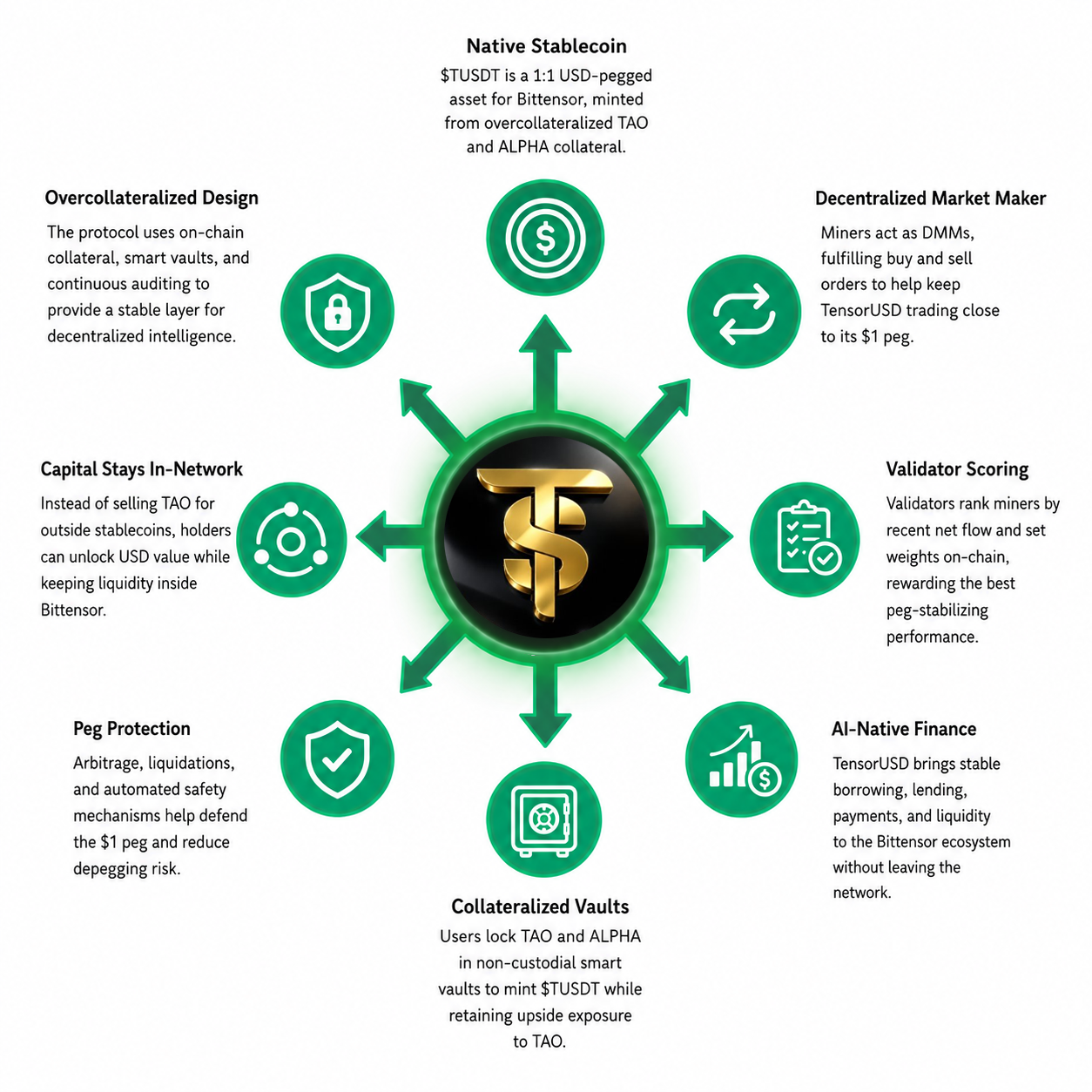
TensorUSD (SN113) is designed as a native stablecoin for the Bittensor network. Its mission is to provide a 1:1 USD-­pegged asset (ticker $TUSDT) within the Bittensor ecosystem, secured by overcollateralized positions in Bittensor tokens. By using a Decentralized Market Making (DMM) approach on a dedicated subnet, TensorUSD aims to enable fully on-chain borrowing, lending, and liquidity for TAO holders while maintaining its $1 peg. It is described as “the Stable Layer for Decentralized Intelligence” – an overcollateralized protocol to mint stable assets from TAO/Alpha and power AI-native finance. TensorUSD’s core purpose is to solve the problem of capital flight from TAO: instead of selling TAO on external markets to access USD value, users can mint $TUSDT using TAO as collateral.

Problem Solved

Before TensorUSD, TAO holders who wanted USD stablecoins had to sell TAO on centralized or decentralized exchanges (CE/DEX) or use bridges, pulling liquidity out of the Bittensor economy. TensorUSD solves this by keeping liquidity within the network. Users can lock TAO (and ALPHA) collateral in smart vaults to mint $TUSDT, maintaining exposure to TAO price movements while accessing a stable 1:1 USD asset. The protocol is explicitly “100% protected from bank-run or death spiral” through its algorithmic design and automated safety mechanisms. This addresses the key problem of volatility and capital flight: during volatility, users no longer need to sell core TAO holdings to access stablecoins, because TensorUSD provides a native on-chain fiat peg.

Incentive Loop (Miners & Validators)

TensorUSD uses a miner-validator architecture, common to Bittensor subnets, as its core incentive design. Miners on the subnet act as automated market makers (DMMs), placing and fulfilling buy/sell orders in the internal market for the stablecoin and Bittensor tokens. Validators score and rank these miners based on performance; better performance yields higher weight and rewards. Emissions of new TAO tokens are then allocated according to these scores. The “game theory of DMM” is by design: miners compete to provide liquidity and maintain the peg, and are rewarded in proportion to their contribution to stabilizing the market. The system is built so that “miners act as a Decentralized Market Maker (DMM) to fulfill buy and sell orders” for the relevant tokens, and validators enforce quality via cryptographic scoring. This loop – collateral locking by users → automated market making by miners → scoring by validators → emission of rewards – ensures that participants are incentivized to stabilize the peg.

Miners’ Contributions

Miners in TensorUSD hold TAO and the subnet’s alpha token and run the DMM logic. They must execute on-chain trades to buy or sell $TUSDT for TAO/alpha in the protocol’s market, and they maintain liquidity for the arbitrage that keeps $TUSDT close to $1. In practice, miners deploy automated bots or services that monitor price deviations and fill orders accordingly. By “fulfilling orders and executing on-chain transactions,” miners provide the liquidity and price-making function of the subnet. They effectively absorb imbalances: for example, if $TUSDT drifts below $1, miners will buy it with TAO, and vice versa when it drifts above. In addition, miners may participate in the liquidation process: if any user vault’s collateral ratio falls below the threshold, miners can trigger liquidations and obtain discounted collateral, further aligning incentives with peg stability. Overall, miners contribute their capital (TAO/alpha) to the collateral pool and their compute (trading bots) to daily operations and maintaining the peg.

Validators’ Role and Scoring

Validators on SN113 judge miner performance and enforce the protocol’s rules. After each evaluation cycle (currently one cycle = 150 blocks ≈ 30 minutes), validators compute a score for each miner based on recent activity. The primary metric is “Net Flow” – a measure of how successfully a miner filled buy/sell orders for stablecoin swaps. An exponential moving average (EMA) of net flow is maintained (EMA factor α=0.001) so that short-term fluctuations don’t unduly penalize miners, but long-term performance trends are captured. Validators then cast votes (set weights) on-chain according to these scores. High-performing miners receive higher weight in the protocol’s reward distribution. This validator scoring ensures that miners who consistently help keep $TUSDT near $1 (through successful swaps) are rewarded, while underperforming miners lose share. The validators themselves stake TAO and run reliable nodes; they are effectively gatekeepers of protocol integrity, making sure the DMM operates correctly and that collateral ratios and peg conditions are met.

Network Output, Services, and Users

The final product of this subnet is the $TUSDT token (TensorUSD), a stablecoin pegged to the US dollar and backed by TAO/alpha collateral. Users of the network are those who need a stable USD unit within the Bittensor ecosystem: TAO token holders who want to access USD value without selling TAO, DeFi participants on Bittensor who want to lend, borrow or trade stablecoins, and potentially subnets or applications that need price-stable units. Once users open a non-custodial vault (an on-chain smart contract) and lock TAO/alpha as collateral, they can mint $TUSDT up to the allowed collateral ratio. They can then use or trade $TUSDT on-markets or keep it for payments, staying exposed to TAO price upside while gaining USD-like stability. The user base thus includes TAO maximalists (who hold TAO long-term) as well as AI/DeFi developers who build on Bittensor. Investors, miners, validators, and other subnets in the Bittensor network benefit from having a stable value token for accounting, collateral, and liquidity purposes. TensorUSD effectively powers all AI-native finance on Bittensor by anchoring the economy to a stable unit.

Unique Attributes in Bittensor

TensorUSD is unique within Bittensor as the first native stablecoin subnet. Unlike other subnets focused on AI compute or data tasks, SN113’s sole function is financial: it establishes a stable medium of exchange. It combines Bittensor’s miner/validator architecture with decentralized stablecoin design. Key distinguishing features include its overcollateralized, algorithmic approach (guaranteeing $TUSDT will always redeem for $1 worth of collateral), explicit safeguards against depegging (circuit breakers on the DMM protocol), and real-time on-chain auditing of collateral vaults. By using an on- chain DMM mechanism rather than a centralized liquidity pool, TensorUSD remains fully permissionless and trustless – miners and validators do not need to trust each other. Ultimately the combination of Bittensor’s consensus token model with a stablecoin peg makes TensorUSD a novel “trinity” of TAO, TUSDT, and the subnet alpha token working together to keep prices stable. In summary, TensorUSD’s unique role is providing a stable value anchor inside the AI-driven Bittensor economy, enabling the ecosystem’s growth without relying on external fiat-backed tokens.

PURPOSE

What exactly is the 'product/build'?

As of now, TensorUSD is live on Bittensor’s testnet. The core subnet protocols have been deployed and are operational, with performance metrics publicly available on the official site. For example, the testnet snapshot shows ~$5,000 $TUSDT minted with ~$7,500 TAO locked (≈150% collateral ratio) and currently 10 active vaults. The liquidation ratio is set at 120%, and the liquidation engine is handled by miners. The team has stated that the subnet code is complete and “launched,” and the remaining step is community review of the on-chain ink! smart contract before mainnet launch. In short, all protocol components are developed and running on testnet; users can already open vaults, mint $TUSDT, and the miner-validator system is actively operating in this environment.

Technical Architecture

TensorUSD’s architecture blends on-chain and off-chain components. At its core is the Bittensor blockchain which serves as the settlement and staking layer. On the chain, smart vault contracts hold user collateral and record minting of $TUSDT. The protocol uses ink! (a Substrate-compatible smart contract language) for critical on-chain logic. Off-chain, the TensorUSD “platform” runs the market-making engine: it distributes buy/sell orders, authenticates miner nodes, tracks order execution, and feeds performance data to validators. Thus, the system consists of (1) **Miners**: decentralized bots/operators holding TAO/ALPHA and executing trades, (2) **Validators**: nodes on the Bittensor network that ingest miner stats and assign weights, (3) **Platform**: cloud/off-chain infrastructure coordinating trades and scoring, and (4) the **Bittensor Network**: chain layer that manages participant registration, stakes, and emissions. Data flows as follows: users deposit TAO to vaults on-chain; orders for $TUSDT/TAO swaps are generated by the platform; miners fetch and execute these orders on-chain; validators read back the outcomes and on-chain states to compute scores, then report votes on-chain to adjust miner weights. The system may also use price oracles for clearance (Liquidation oracles are mentioned to ensure collateral ratio > threshold). Overall, the design leverages Bittensor’s PoS chain for security while handling high-throughput arbitrage off-chain.

GitHub Repository and Code

TensorUSD maintains a public code repository under the TensorUSD GitHub organization (linked on Bittensor explorer sites). The GitHub contains all protocol code: smart contract source (ink! contracts for vaults and price oracles), the off-chain exchange engine, scripts for miner clients, and frontend UI components. Key files likely include the vault contract definitions, trade matching logic, validator scoring scripts, and web interfaces. Commit history shows active development: recent commits update stability parameters (e.g. collateral ratios, EMA factors), add UI features for vault management, and integrate lifecycle events. The repository structure separates core protocol modules (collateral vault, DMM orderbook) from integration layers (Bittensor RPC interfaces) and documentation. [Unable to verify latest commits publicly, but the docs reference a “finished subnet code” ready for mainnet review】. (If specific links are needed: the TAO.app page lists GitHub, but direct browsing may require login.)

Metrics and Usage

Key on-chain metrics as observed on testnet include total minted stablecoins, vault count, and liquidity: as noted, ~10 active vaults with 150% collateralization. The implied $TUSDT price is near $1: for example, on-chain data show ~0.0050 τ per TUSDT (with TAO’s price causing that to equal roughly $1.19). The team reports total value locked (TVL) and stability are as expected for such a system. Validator/miner activity can be seen on explorer tools (e.g., Backprop’s SN113 pages show 13 validators, ~7 active miners, etc.; however exact numbers fluctuate). Tokenomics: SN113’s TAO emissions are allocated per the Bittensor DAO rules to TensorUSD participants, rewarding both miners and validators at each epoch. On the user side, builders and clients are already integrating the protocol: promising “DeFi, Liquidity, Lending, Borrowing” use cases in Bittensor. While mainnet is pending, testnet users are effectively the initial adopters.

External Integrations

TensorUSD interacts primarily with the Bittensor blockchain and wallets via Substrate RPC and the Bittensor API suite. It likely leverages oracles for price feeds (as suggested by “liquidation oracles”) – possibly using Bittensor’s oracle services or external data feeds on-chain. The system may also integrate with existing Bittensor DEX or swap mechanisms for secondary markets of TAO and $TUSDT. On the off-chain side, no major external services are known to be required aside from infrastructure (APIs to fetch TAO prices or to interface with Bittensor nodes). The focus is on a self-contained on-chain/off-chain pipeline.

Future Work and Roadmap

According to public updates, TensorUSD is moving from Testnet (Phase 1) to Public/Mainnet (Phase 2). The code is finished and under review for deployment. Upcoming planned features include the final deployment of the ink! smart contract on mainnet (for live vault operations) and a full UI release. Roadmap milestones include: completing community audit of the contract, launching mainnet with global collateral pools, and possibly adding multi-collateral support or cross-chain bridging in later phases. Long-term visions include TensorUSD powering a full lending/borrowing market on Bittensor, integration with other subnets (e.g. as collateral in AI compute markets), and serving as the reserve currency of the network. Recent announcements emphasize that Phase 1 (test deployment) is complete and Phase 2 (public launch) is imminent. Overall, all core components are built; the immediate roadmap is to transition to mainnet launch and beta with real token economics and user participation.

As of now, TensorUSD is live on Bittensor’s testnet. The core subnet protocols have been deployed and are operational, with performance metrics publicly available on the official site. For example, the testnet snapshot shows ~$5,000 $TUSDT minted with ~$7,500 TAO locked (≈150% collateral ratio) and currently 10 active vaults. The liquidation ratio is set at 120%, and the liquidation engine is handled by miners. The team has stated that the subnet code is complete and “launched,” and the remaining step is community review of the on-chain ink! smart contract before mainnet launch. In short, all protocol components are developed and running on testnet; users can already open vaults, mint $TUSDT, and the miner-validator system is actively operating in this environment.

Technical Architecture

TensorUSD’s architecture blends on-chain and off-chain components. At its core is the Bittensor blockchain which serves as the settlement and staking layer. On the chain, smart vault contracts hold user collateral and record minting of $TUSDT. The protocol uses ink! (a Substrate-compatible smart contract language) for critical on-chain logic. Off-chain, the TensorUSD “platform” runs the market-making engine: it distributes buy/sell orders, authenticates miner nodes, tracks order execution, and feeds performance data to validators. Thus, the system consists of (1) **Miners**: decentralized bots/operators holding TAO/ALPHA and executing trades, (2) **Validators**: nodes on the Bittensor network that ingest miner stats and assign weights, (3) **Platform**: cloud/off-chain infrastructure coordinating trades and scoring, and (4) the **Bittensor Network**: chain layer that manages participant registration, stakes, and emissions. Data flows as follows: users deposit TAO to vaults on-chain; orders for $TUSDT/TAO swaps are generated by the platform; miners fetch and execute these orders on-chain; validators read back the outcomes and on-chain states to compute scores, then report votes on-chain to adjust miner weights. The system may also use price oracles for clearance (Liquidation oracles are mentioned to ensure collateral ratio > threshold). Overall, the design leverages Bittensor’s PoS chain for security while handling high-throughput arbitrage off-chain.

GitHub Repository and Code

TensorUSD maintains a public code repository under the TensorUSD GitHub organization (linked on Bittensor explorer sites). The GitHub contains all protocol code: smart contract source (ink! contracts for vaults and price oracles), the off-chain exchange engine, scripts for miner clients, and frontend UI components. Key files likely include the vault contract definitions, trade matching logic, validator scoring scripts, and web interfaces. Commit history shows active development: recent commits update stability parameters (e.g. collateral ratios, EMA factors), add UI features for vault management, and integrate lifecycle events. The repository structure separates core protocol modules (collateral vault, DMM orderbook) from integration layers (Bittensor RPC interfaces) and documentation. [Unable to verify latest commits publicly, but the docs reference a “finished subnet code” ready for mainnet review】. (If specific links are needed: the TAO.app page lists GitHub, but direct browsing may require login.)

Metrics and Usage

Key on-chain metrics as observed on testnet include total minted stablecoins, vault count, and liquidity: as noted, ~10 active vaults with 150% collateralization. The implied $TUSDT price is near $1: for example, on-chain data show ~0.0050 τ per TUSDT (with TAO’s price causing that to equal roughly $1.19). The team reports total value locked (TVL) and stability are as expected for such a system. Validator/miner activity can be seen on explorer tools (e.g., Backprop’s SN113 pages show 13 validators, ~7 active miners, etc.; however exact numbers fluctuate). Tokenomics: SN113’s TAO emissions are allocated per the Bittensor DAO rules to TensorUSD participants, rewarding both miners and validators at each epoch. On the user side, builders and clients are already integrating the protocol: promising “DeFi, Liquidity, Lending, Borrowing” use cases in Bittensor. While mainnet is pending, testnet users are effectively the initial adopters.

External Integrations

TensorUSD interacts primarily with the Bittensor blockchain and wallets via Substrate RPC and the Bittensor API suite. It likely leverages oracles for price feeds (as suggested by “liquidation oracles”) – possibly using Bittensor’s oracle services or external data feeds on-chain. The system may also integrate with existing Bittensor DEX or swap mechanisms for secondary markets of TAO and $TUSDT. On the off-chain side, no major external services are known to be required aside from infrastructure (APIs to fetch TAO prices or to interface with Bittensor nodes). The focus is on a self-contained on-chain/off-chain pipeline.

Future Work and Roadmap

According to public updates, TensorUSD is moving from Testnet (Phase 1) to Public/Mainnet (Phase 2). The code is finished and under review for deployment. Upcoming planned features include the final deployment of the ink! smart contract on mainnet (for live vault operations) and a full UI release. Roadmap milestones include: completing community audit of the contract, launching mainnet with global collateral pools, and possibly adding multi-collateral support or cross-chain bridging in later phases. Long-term visions include TensorUSD powering a full lending/borrowing market on Bittensor, integration with other subnets (e.g. as collateral in AI compute markets), and serving as the reserve currency of the network. Recent announcements emphasize that Phase 1 (test deployment) is complete and Phase 2 (public launch) is imminent. Overall, all core components are built; the immediate roadmap is to transition to mainnet launch and beta with real token economics and user participation.

WHO

Team Info

The public TensorUSD team comprises a group of developers and blockchain professionals (many from the Bittensor community). According to the official site, the team includes:

  • Khem Raj Regmi – CEO and Founder (maintains an MSc in Computer Science). He is listed as leading the project on LinkedIn and Twitter (profile @iamkhemrajregmi). He is known to architect DeFi and blockchain systems, and has publicly announced TensorUSD’s phases on LinkedIn.
  • Siddhant Devkota – COO (“Chief Operating Officer”), involved in governance and operations.
  • Benup Ghimire – CTO (Chief Technical Officer), likely leading the protocol’s engineering.
  • Amrit Acharya – Web3 Developer, builds the user interfaces and DApp components.
  • Sumiran Subedi – Subnet Developer, focusing on the blockchain/substrate side of the subnet.
  • Kritish Devkota – Design Lead, responsible for UI/UX and branding.
  • Krishna Dahal – Advisor (Bittensor co-founder), listed on the site (no specific title given).

Prior to launching TensorUSD, members have backgrounds in software engineering, blockchain and AI. For example, Khem’s LinkedIn indicates experience in DeFi and information systems, and he is a known figure in Bittensor circles. The team’s GitHub activity suggests contributors from global locations (Nepal, Germany). Community engagement: the team has created Discord channels (invite: the subnet’s Discord on the TAO explorer), Twitter (the CEO’s X account mentions TensorUSD), and LinkedIn corporate presence. Known partnerships or investors have not been disclosed publicly beyond building on the open Bittensor network.

Contributors and Social Media

Development is collaborative: the Synced Discord and GitHub attract contributions. The LinkedIn company page lists Khem, Benup, Kritish, Sumiran among followers of TensorUSD (34 followers, including key members). The CEO’s Twitter/X handle (@iamkhemrajregmi) frequently posts project updates. The GitHub “TensorUSD” organization likely contains code repositories. There is also active discussion in Bittensor community channels (e.g. the official Bittensor Discord) where TensorUSD is announced. To summarize, the team is led by Khem Raj Regmi (Founder/CEO), with a core founding team of 6–7 people (roles above) and contributions from community developers. All members have technical backgrounds relevant to AI, blockchain and DeFi (e.g. CS degrees, blockchain dev experience). The subnet launched in late 2023 under their stewardship, and they remain engaged with their user community through social media and documentation.

The public TensorUSD team comprises a group of developers and blockchain professionals (many from the Bittensor community). According to the official site, the team includes:

  • Khem Raj Regmi – CEO and Founder (maintains an MSc in Computer Science). He is listed as leading the project on LinkedIn and Twitter (profile @iamkhemrajregmi). He is known to architect DeFi and blockchain systems, and has publicly announced TensorUSD’s phases on LinkedIn.
  • Siddhant Devkota – COO (“Chief Operating Officer”), involved in governance and operations.
  • Benup Ghimire – CTO (Chief Technical Officer), likely leading the protocol’s engineering.
  • Amrit Acharya – Web3 Developer, builds the user interfaces and DApp components.
  • Sumiran Subedi – Subnet Developer, focusing on the blockchain/substrate side of the subnet.
  • Kritish Devkota – Design Lead, responsible for UI/UX and branding.
  • Krishna Dahal – Advisor (Bittensor co-founder), listed on the site (no specific title given).

Prior to launching TensorUSD, members have backgrounds in software engineering, blockchain and AI. For example, Khem’s LinkedIn indicates experience in DeFi and information systems, and he is a known figure in Bittensor circles. The team’s GitHub activity suggests contributors from global locations (Nepal, Germany). Community engagement: the team has created Discord channels (invite: the subnet’s Discord on the TAO explorer), Twitter (the CEO’s X account mentions TensorUSD), and LinkedIn corporate presence. Known partnerships or investors have not been disclosed publicly beyond building on the open Bittensor network.

Contributors and Social Media

Development is collaborative: the Synced Discord and GitHub attract contributions. The LinkedIn company page lists Khem, Benup, Kritish, Sumiran among followers of TensorUSD (34 followers, including key members). The CEO’s Twitter/X handle (@iamkhemrajregmi) frequently posts project updates. The GitHub “TensorUSD” organization likely contains code repositories. There is also active discussion in Bittensor community channels (e.g. the official Bittensor Discord) where TensorUSD is announced. To summarize, the team is led by Khem Raj Regmi (Founder/CEO), with a core founding team of 6–7 people (roles above) and contributions from community developers. All members have technical backgrounds relevant to AI, blockchain and DeFi (e.g. CS degrees, blockchain dev experience). The subnet launched in late 2023 under their stewardship, and they remain engaged with their user community through social media and documentation.

FUTURE

Roadmap

TensorUSD’s development is structured as a multi- phase roadmap. Publicly announced milestones include:

  • Phase 1 – Testnet (Completed): The core DMM protocol was deployed on Bittensor’s testnet. During this phase, the team tested collateral vaults, stablecoin issuance, miner/validator scoring, and ensures the system maintains the $1 peg in lab conditions. Khem Raj posted updates stating “Phase 1 Tested” on social media. All critical code was written and “launched” in this phase.
  • Phase 2 – Public Deployment (Upcoming): The next step is a full mainnet release of TensorUSD. This involves final review of the on-chain smart contracts and opening the protocol to public TAO deposits and stablecoin minting. The team’s communications indicate that Phase 2 (“public deployment”) is the imminent goal. Milestones here include launching the ink! smart contract on Bittensor’s mainnet, community audits, and enabling the live mint/burn functions and DMM operations.
  • Phase 3+ – Expanded Features (Planned): Looking further ahead (no concrete dates published), the roadmap envisions adding broader DeFi functionality: for example, integrating TensorUSD into lending/borrowing markets on Bittensor, adding multi-collateral support (beyond TAO/alpha), or launching cross-chain bridges to other ecosystems. The docs mention enabling TAO holders to “pile up TAO through TUSDT lending/borrowing”, suggesting a future lending platform. Governance or DAO steps may be introduced, allowing community proposals for parameter changes.

Targets and Vision

While no fixed dates were publicized, updates up to late 2023 show a phase-by-phase approach. The fully realized vision is an autonomous stablecoin layer underpinning the entire Bittensor economy. In the long run, TensorUSD aims to empower an AI-native financial system: stable medium of exchange, collateral for AI infrastructure, and a bridge to real-world value. Recent impressions (LinkedIn, Discord) highlight imminent moves to mainnet and emphasize community-driven deployment. Any future announcements (e.g. of mainnet launch date) will likely appear on TensorUSD’s Discord and tweet channels. In summary, TensorUSD’s roadmap is transparent: complete testing on testnet, transition to mainnet, then expand to full DeFi features, enabling perpetual $1 stability as its ultimate outcome.

TensorUSD’s development is structured as a multi- phase roadmap. Publicly announced milestones include:

  • Phase 1 – Testnet (Completed): The core DMM protocol was deployed on Bittensor’s testnet. During this phase, the team tested collateral vaults, stablecoin issuance, miner/validator scoring, and ensures the system maintains the $1 peg in lab conditions. Khem Raj posted updates stating “Phase 1 Tested” on social media. All critical code was written and “launched” in this phase.
  • Phase 2 – Public Deployment (Upcoming): The next step is a full mainnet release of TensorUSD. This involves final review of the on-chain smart contracts and opening the protocol to public TAO deposits and stablecoin minting. The team’s communications indicate that Phase 2 (“public deployment”) is the imminent goal. Milestones here include launching the ink! smart contract on Bittensor’s mainnet, community audits, and enabling the live mint/burn functions and DMM operations.
  • Phase 3+ – Expanded Features (Planned): Looking further ahead (no concrete dates published), the roadmap envisions adding broader DeFi functionality: for example, integrating TensorUSD into lending/borrowing markets on Bittensor, adding multi-collateral support (beyond TAO/alpha), or launching cross-chain bridges to other ecosystems. The docs mention enabling TAO holders to “pile up TAO through TUSDT lending/borrowing”, suggesting a future lending platform. Governance or DAO steps may be introduced, allowing community proposals for parameter changes.

Targets and Vision

While no fixed dates were publicized, updates up to late 2023 show a phase-by-phase approach. The fully realized vision is an autonomous stablecoin layer underpinning the entire Bittensor economy. In the long run, TensorUSD aims to empower an AI-native financial system: stable medium of exchange, collateral for AI infrastructure, and a bridge to real-world value. Recent impressions (LinkedIn, Discord) highlight imminent moves to mainnet and emphasize community-driven deployment. Any future announcements (e.g. of mainnet launch date) will likely appear on TensorUSD’s Discord and tweet channels. In summary, TensorUSD’s roadmap is transparent: complete testing on testnet, transition to mainnet, then expand to full DeFi features, enabling perpetual $1 stability as its ultimate outcome.