
With the amount of new subnets being added it can be hard to get up to date information across all subnets, so data may be slightly out of date from time to time
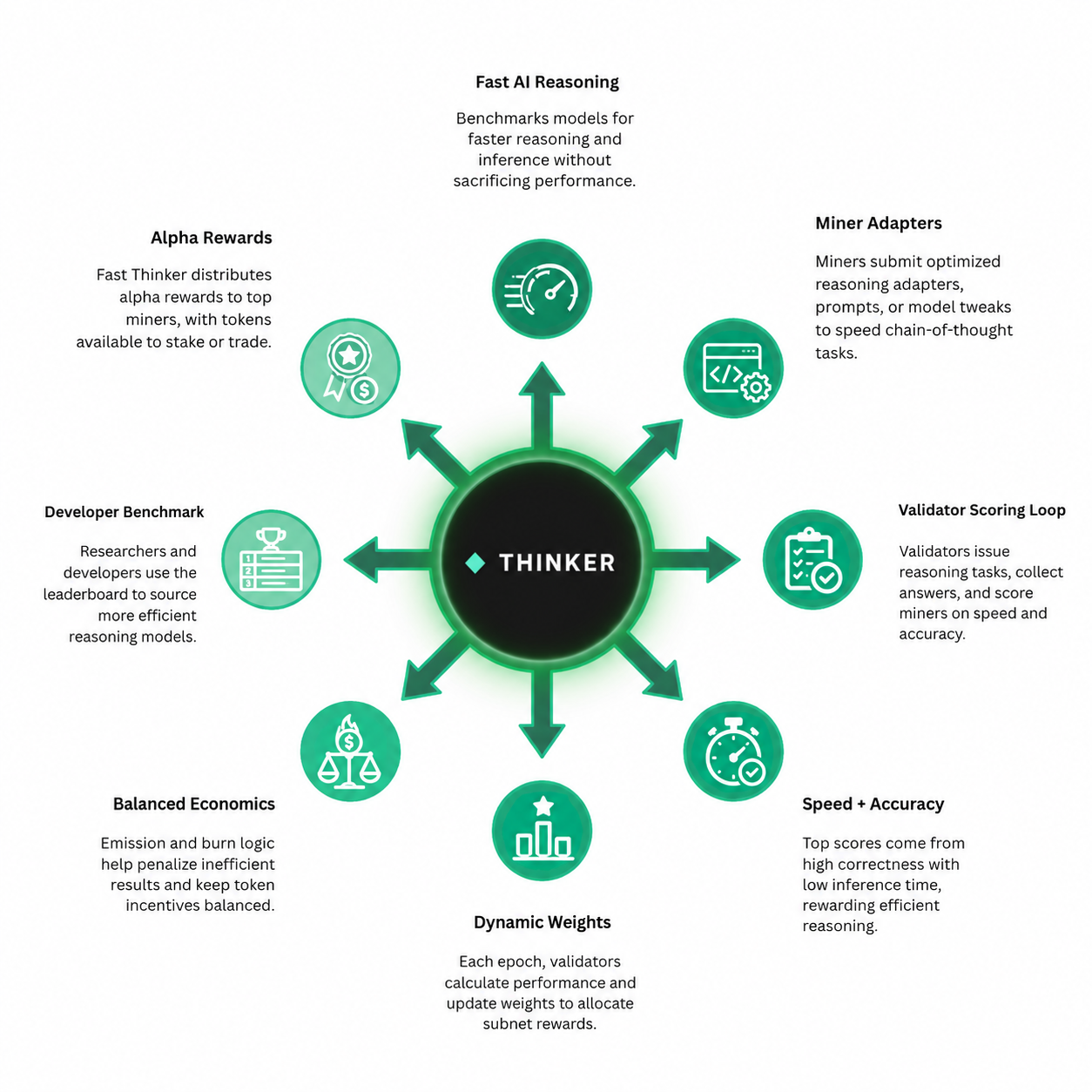
Core Mission: Fast Thinker (Subnet 16 on Bittensor) aims to accelerate AI reasoning by benchmarking models for speed without losing accuracy. Its motto is “making reasoning models faster, leaner, and more efficient without sacrificing performance”. Originally launched as BitAds (a decentralized marketing network), the project now focuses on inference and chain-of-thought tasks. In practice, Fast Thinker “runs a live ranking system where miners submit reasoning adapters that are scored on speed and efficiency without losing accuracy”. This means it solves the core problem of optimizing large language model reasoning: miners propose model optimizations or specialized adapters, and the network rewards those that achieve faster inference at full performance.
Operation as a Bittensor Subnet: Like all Bittensor subnets, Fast Thinker operates a miner/validator loop. Miners operate AI models that process reasoning tasks (e.g., chain-of-thought prompts), and validators aggregate results and set “weights” based on performance. The official documentation (still labeled BitAds) describes a single validator mechanism that periodically synchronizes with the network, fetches tasks, computes scores, and submits weights. In BitAds these steps involved sales data; under Fast Thinker, validators would analogously ask reasoning queries and compute efficiency scores. Core components – such as dynamic configuration, a score calculator, a burn calculator, and a score sink – are used to ensure fair scoring and token emission. Effectively, each epoch the validators gather miners’ results, calculate how much faster (or more efficient) each model was, and allocate rewards accordingly, burning any excess in tokens to maintain the economic balance as in the BitAds algorithm.
Miners and Validators: In this subnet, miners contribute by running inference on reasoning problems. They load a base model, attach a “reasoning adapter” (e.g. an optimized prompt strategy or adapter network), and compute answers quickly. The miners’ stake and compute power go into delivering high-speed responses. Validators, on the other hand, act as the adjudicators: they issue the reasoning tasks, collect answers, and score each miner’s performance. They typically measure both correctness and speed: miners with high accuracy and low inference time score highest. The SN16 site (still describing BitAds) implies miners are scored via a normalized metric (previously sales/P95); now the metric likely rewards models that approach the 95th-percentile accuracy while minimizing work. Essentially, miners are rewarded Δ = 0.85·(speed score) + 0.15·(accuracy score) in the original formula (with a burn penalty for slow cases), so Fast Thinker likely replaces “sales” with “reasoning steps or run-time.”
Output to Users/Investors: The end product of Fast Thinker is two-fold. For AI practitioners (researchers, developers), it is a leaderboard or benchmark resource: a ranking of models/adapters by efficiency. As dTAOscan notes, Fast Thinker lets “researchers and developers use [the subnet] to benchmark and source more efficient reasoning models”. In effect it serves as a live marketplace of model optimizations – showing which approaches enable faster chain-of-thought reasoning. For investors or network participants, the output is the Alpha (subnet) token and mining rewards. Fast Thinker emits around 5,888 α/day (~$11,106/day), distributed to miners based on those scores. Token holders can stake or trade α; currently SN16 has thin liquidity (~$213K TAO in pool) setting the implied α price (~0.0088 TAO ≈ $1.89). In sum, the user experience is a combination of checking the Fast Thinker dashboard (e.g. via HuggingFace space) for model rankings and staking/trading SN16 tokens in the Bittensor ecosystem.
Core Mission: Fast Thinker (Subnet 16 on Bittensor) aims to accelerate AI reasoning by benchmarking models for speed without losing accuracy. Its motto is “making reasoning models faster, leaner, and more efficient without sacrificing performance”. Originally launched as BitAds (a decentralized marketing network), the project now focuses on inference and chain-of-thought tasks. In practice, Fast Thinker “runs a live ranking system where miners submit reasoning adapters that are scored on speed and efficiency without losing accuracy”. This means it solves the core problem of optimizing large language model reasoning: miners propose model optimizations or specialized adapters, and the network rewards those that achieve faster inference at full performance.
Operation as a Bittensor Subnet: Like all Bittensor subnets, Fast Thinker operates a miner/validator loop. Miners operate AI models that process reasoning tasks (e.g., chain-of-thought prompts), and validators aggregate results and set “weights” based on performance. The official documentation (still labeled BitAds) describes a single validator mechanism that periodically synchronizes with the network, fetches tasks, computes scores, and submits weights. In BitAds these steps involved sales data; under Fast Thinker, validators would analogously ask reasoning queries and compute efficiency scores. Core components – such as dynamic configuration, a score calculator, a burn calculator, and a score sink – are used to ensure fair scoring and token emission. Effectively, each epoch the validators gather miners’ results, calculate how much faster (or more efficient) each model was, and allocate rewards accordingly, burning any excess in tokens to maintain the economic balance as in the BitAds algorithm.
Miners and Validators: In this subnet, miners contribute by running inference on reasoning problems. They load a base model, attach a “reasoning adapter” (e.g. an optimized prompt strategy or adapter network), and compute answers quickly. The miners’ stake and compute power go into delivering high-speed responses. Validators, on the other hand, act as the adjudicators: they issue the reasoning tasks, collect answers, and score each miner’s performance. They typically measure both correctness and speed: miners with high accuracy and low inference time score highest. The SN16 site (still describing BitAds) implies miners are scored via a normalized metric (previously sales/P95); now the metric likely rewards models that approach the 95th-percentile accuracy while minimizing work. Essentially, miners are rewarded Δ = 0.85·(speed score) + 0.15·(accuracy score) in the original formula (with a burn penalty for slow cases), so Fast Thinker likely replaces “sales” with “reasoning steps or run-time.”
Output to Users/Investors: The end product of Fast Thinker is two-fold. For AI practitioners (researchers, developers), it is a leaderboard or benchmark resource: a ranking of models/adapters by efficiency. As dTAOscan notes, Fast Thinker lets “researchers and developers use [the subnet] to benchmark and source more efficient reasoning models”. In effect it serves as a live marketplace of model optimizations – showing which approaches enable faster chain-of-thought reasoning. For investors or network participants, the output is the Alpha (subnet) token and mining rewards. Fast Thinker emits around 5,888 α/day (~$11,106/day), distributed to miners based on those scores. Token holders can stake or trade α; currently SN16 has thin liquidity (~$213K TAO in pool) setting the implied α price (~0.0088 TAO ≈ $1.89). In sum, the user experience is a combination of checking the Fast Thinker dashboard (e.g. via HuggingFace space) for model rankings and staking/trading SN16 tokens in the Bittensor ecosystem.
Current Status: Fast Thinker is live on Bittensor mainnet (Subnet 16), with open registration and staking. Its alpha token trades (thinly) on TaoSwap at roughly 0.005–0.0089 TAO per α (≈$0.90–$1.89). Emission is active (~5,888 α/day). According to Bittensor analytics, the network has generated modest activity: developers note that up to ~58 commits were made in the last 30 days, indicating active development. The existing validator/miner code (originally ‘BitAds’) appears only recently updated: the old BitAds repo shows “0 commits in 30d”, while a new “fast-thinker/fast-thinker” repo has ongoing changes. The project has at least a basic HuggingFace interface: a “Fast Thinker Dashboard” space is already running to show live rankings.
Technical Architecture: Technically, Fast Thinker builds on Bittensor’s Python framework. The GitHub organization appears to use a modular validator code: a Python class orchestrates steps such as fetching the Subtensor metagraph, syncing epoch/tempo, loading tasks and configurations, computing performance stats, and then writing weights back to chain. Key components include a campaign/task source, a statistics provider, a percentile (“P95”) calculator, a score calculator, and a burn calculation node. While those were originally written for marketing campaigns and sales data, they likely now wrap around reasoning query APIs or predefined logic problems. The miner side probably leverages standard Bittensor neuron libraries (models on HuggingFace or local) to answer queries. Some external integrations seem present: the HuggingFace Space suggests use of HF models or APIs, and the GitHub may call out to TAO’s RPC for on-chain data. No other external APIs are publicly documented, implying the system is largely self-contained within Bittensor plus HuggingFace. Logging and metrics are exposed via Prometheus as in BitAds code, facilitating monitoring of epoch loops and performance.
Repository and Code: The Fast Thinker codebase is public (GitHub: fast-thinker/fast-thinker). According to GitHub stats, it’s a Python project with 2 contributors (the development appears driven by a small team). The Bittensor.ai subnet page still shows the old ‘FirstTensorLabs/BitAds’ repo (dormant), but the SubnetRadar notes indicate heavy recent commits to the new code. The repository likely contains the validator logic (scripts for scoring, weight submissions, burn routines) along with any helper tools. Without direct access to the code, we infer from the documentation that it follows BitAds’ structure. There are no known web apps or data feeds beyond the HF dashboard and on-chain explorer.
Endpoints and Integrations: As for APIs or integrations, Fast Thinker exposes its results via on-chain weights (visible on Subtensor block explorers like taostats), and the HuggingFace Dashboard pulls data presumably from the chain or project’s APIs. It does not appear to have a commercial API or off-chain service except for the dashboard. Likely it uses the Bittensor RPC interface for wallets/manipulation and possibly HuggingFace’s APIs for model serving. Overall, it seems self-contained: miners run PyTorch/Transformers code, validators run Python to score, and output is recorded on-chain.
End Users / Customers: The “customers” of Fast Thinker are primarily AI researchers and the Bittensor community itself. Researchers can query the dashboard to identify efficient reasoning model variants; developers might integrate those findings into AI products to reduce inference costs. The other major user group is the miner/validator community – those who stake TAO to run nodes and earn α rewards. Investors also indirectly “use” the subnet by trading or staking SN16 tokens. There is no traditional product (e.g. no hosted API for external use); instead, the output is the α token and the open leaderboard. In short, Fast Thinker’s users are those wanting to benchmark LLM reasoning speed and those participating in the Bittensor network for yield, rather than external end-customers. (For comparison, BitAds aimed at marketers/affiliates, but that on-chain marketplace has effectively been repurposed.)
Current Status: Fast Thinker is live on Bittensor mainnet (Subnet 16), with open registration and staking. Its alpha token trades (thinly) on TaoSwap at roughly 0.005–0.0089 TAO per α (≈$0.90–$1.89). Emission is active (~5,888 α/day). According to Bittensor analytics, the network has generated modest activity: developers note that up to ~58 commits were made in the last 30 days, indicating active development. The existing validator/miner code (originally ‘BitAds’) appears only recently updated: the old BitAds repo shows “0 commits in 30d”, while a new “fast-thinker/fast-thinker” repo has ongoing changes. The project has at least a basic HuggingFace interface: a “Fast Thinker Dashboard” space is already running to show live rankings.
Technical Architecture: Technically, Fast Thinker builds on Bittensor’s Python framework. The GitHub organization appears to use a modular validator code: a Python class orchestrates steps such as fetching the Subtensor metagraph, syncing epoch/tempo, loading tasks and configurations, computing performance stats, and then writing weights back to chain. Key components include a campaign/task source, a statistics provider, a percentile (“P95”) calculator, a score calculator, and a burn calculation node. While those were originally written for marketing campaigns and sales data, they likely now wrap around reasoning query APIs or predefined logic problems. The miner side probably leverages standard Bittensor neuron libraries (models on HuggingFace or local) to answer queries. Some external integrations seem present: the HuggingFace Space suggests use of HF models or APIs, and the GitHub may call out to TAO’s RPC for on-chain data. No other external APIs are publicly documented, implying the system is largely self-contained within Bittensor plus HuggingFace. Logging and metrics are exposed via Prometheus as in BitAds code, facilitating monitoring of epoch loops and performance.
Repository and Code: The Fast Thinker codebase is public (GitHub: fast-thinker/fast-thinker). According to GitHub stats, it’s a Python project with 2 contributors (the development appears driven by a small team). The Bittensor.ai subnet page still shows the old ‘FirstTensorLabs/BitAds’ repo (dormant), but the SubnetRadar notes indicate heavy recent commits to the new code. The repository likely contains the validator logic (scripts for scoring, weight submissions, burn routines) along with any helper tools. Without direct access to the code, we infer from the documentation that it follows BitAds’ structure. There are no known web apps or data feeds beyond the HF dashboard and on-chain explorer.
Endpoints and Integrations: As for APIs or integrations, Fast Thinker exposes its results via on-chain weights (visible on Subtensor block explorers like taostats), and the HuggingFace Dashboard pulls data presumably from the chain or project’s APIs. It does not appear to have a commercial API or off-chain service except for the dashboard. Likely it uses the Bittensor RPC interface for wallets/manipulation and possibly HuggingFace’s APIs for model serving. Overall, it seems self-contained: miners run PyTorch/Transformers code, validators run Python to score, and output is recorded on-chain.
End Users / Customers: The “customers” of Fast Thinker are primarily AI researchers and the Bittensor community itself. Researchers can query the dashboard to identify efficient reasoning model variants; developers might integrate those findings into AI products to reduce inference costs. The other major user group is the miner/validator community – those who stake TAO to run nodes and earn α rewards. Investors also indirectly “use” the subnet by trading or staking SN16 tokens. There is no traditional product (e.g. no hosted API for external use); instead, the output is the α token and the open leaderboard. In short, Fast Thinker’s users are those wanting to benchmark LLM reasoning speed and those participating in the Bittensor network for yield, rather than external end-customers. (For comparison, BitAds aimed at marketers/affiliates, but that on-chain marketplace has effectively been repurposed.)
Core Team: Fast Thinker succeeds BitAds, originally built by co-founders Albert and Eseck. These individuals (associated with the FirstTensor Labs validator group) were featured on the Bittensor Guru podcast discussing SN16 in May 2024. They remain the public faces of the project, though specific roles (e.g. lead developer, architect) aren’t formally listed. On-chain, the owner’s coldkey (5G69VL…cxoBCB) belongs to FirstTensor Labs, which suggests that the same team controls the subnet.. The GitHub repo ‘fast-thinker/fast-thinker’ shows 2 contributors, implying at least one other developer (possibly the opportunely mentioned “daanisharif” on social media) has joined them. Unfortunately, no detailed bios or LinkedIn profiles are publicly linked, so their AI or blockchain backgrounds are largely unknown outside community circles.
FirstTensor Labs: The project is backed by FirstTensor Labs – a known Bittensor validator organization (related to Albert and Eseck). FirstTensor runs validators across Bittensor and was instrumental in launching BitAds. This gives Fast Thinker some institutional experience with the ecosystem, but it also means the core team is small. No other formal partnerships or institutional investors have been announced. Fast Thinker’s online presence is limited; there’s no official Telegram or Twitter, and community discussion is mostly on the Bittensor Discord.
Core Team: Fast Thinker succeeds BitAds, originally built by co-founders Albert and Eseck. These individuals (associated with the FirstTensor Labs validator group) were featured on the Bittensor Guru podcast discussing SN16 in May 2024. They remain the public faces of the project, though specific roles (e.g. lead developer, architect) aren’t formally listed. On-chain, the owner’s coldkey (5G69VL…cxoBCB) belongs to FirstTensor Labs, which suggests that the same team controls the subnet.. The GitHub repo ‘fast-thinker/fast-thinker’ shows 2 contributors, implying at least one other developer (possibly the opportunely mentioned “daanisharif” on social media) has joined them. Unfortunately, no detailed bios or LinkedIn profiles are publicly linked, so their AI or blockchain backgrounds are largely unknown outside community circles.
FirstTensor Labs: The project is backed by FirstTensor Labs – a known Bittensor validator organization (related to Albert and Eseck). FirstTensor runs validators across Bittensor and was instrumental in launching BitAds. This gives Fast Thinker some institutional experience with the ecosystem, but it also means the core team is small. No other formal partnerships or institutional investors have been announced. Fast Thinker’s online presence is limited; there’s no official Telegram or Twitter, and community discussion is mostly on the Bittensor Discord.
Phases and Milestones: As of mid-2026, the Fast Thinker team has not published a detailed public roadmap. The project is live (open for staking and mining) and appears to be in active development, but no formal ‘phases’ (e.g. alpha, beta, v1.0) have been announced. SubnetRadar’s brief notes mention only weekly activity (e.g. heavy commits, market moves). We don’t see announcements of product releases, partnerships, or new features on any official channel. Therefore, any specific milestone timeline is speculative.
2026 and Beyond: Without official targets, we infer the near-term plans focus on refining the mechanism and growing the network. Ongoing tasks likely include finalizing the scoring logic for reasoning tasks, populating the dashboard, and encouraging more miners/validators to join. One concrete timeline fact is that SN16 has its alpha emission half-life in ~2030, meaning post-2026 its emission rate will stay steady until around year 2030 when it halves. Beyond that, the fully-realized vision would be a robust AI inference benchmarking platform: a stable community of developers using the subnet’s rankings to optimize models, with the SN16 token gaining utility among AI tool builders. In practice, “fully realized” might mean a public API or suite of datasets for efficient reasoning (though none is currently deployed), as well as strong adoption by LLM researchers.
Recent Developments: The only notable recent updates were technical. The GitHub commits (58 in the last 30 days) suggest the team is rapidly iterating on the code. The SN16 token price has fluctuated), but there have been no strategic announcements tied to these moves. No new advisors, funding rounds, or alliances (e.g. with other AI or blockchain projects) have been announced. In summary, outside continuous code work, Fast Thinker’s roadmap remains internal; participants should watch its GitHub and dashboard for implicit progress, as there is no formal public timeline released.
Phases and Milestones: As of mid-2026, the Fast Thinker team has not published a detailed public roadmap. The project is live (open for staking and mining) and appears to be in active development, but no formal ‘phases’ (e.g. alpha, beta, v1.0) have been announced. SubnetRadar’s brief notes mention only weekly activity (e.g. heavy commits, market moves). We don’t see announcements of product releases, partnerships, or new features on any official channel. Therefore, any specific milestone timeline is speculative.
2026 and Beyond: Without official targets, we infer the near-term plans focus on refining the mechanism and growing the network. Ongoing tasks likely include finalizing the scoring logic for reasoning tasks, populating the dashboard, and encouraging more miners/validators to join. One concrete timeline fact is that SN16 has its alpha emission half-life in ~2030, meaning post-2026 its emission rate will stay steady until around year 2030 when it halves. Beyond that, the fully-realized vision would be a robust AI inference benchmarking platform: a stable community of developers using the subnet’s rankings to optimize models, with the SN16 token gaining utility among AI tool builders. In practice, “fully realized” might mean a public API or suite of datasets for efficient reasoning (though none is currently deployed), as well as strong adoption by LLM researchers.
Recent Developments: The only notable recent updates were technical. The GitHub commits (58 in the last 30 days) suggest the team is rapidly iterating on the code. The SN16 token price has fluctuated), but there have been no strategic announcements tied to these moves. No new advisors, funding rounds, or alliances (e.g. with other AI or blockchain projects) have been announced. In summary, outside continuous code work, Fast Thinker’s roadmap remains internal; participants should watch its GitHub and dashboard for implicit progress, as there is no formal public timeline released.