With the amount of new subnets being added it can be hard to get up to date information across all subnets, so data may be slightly out of date from time to time
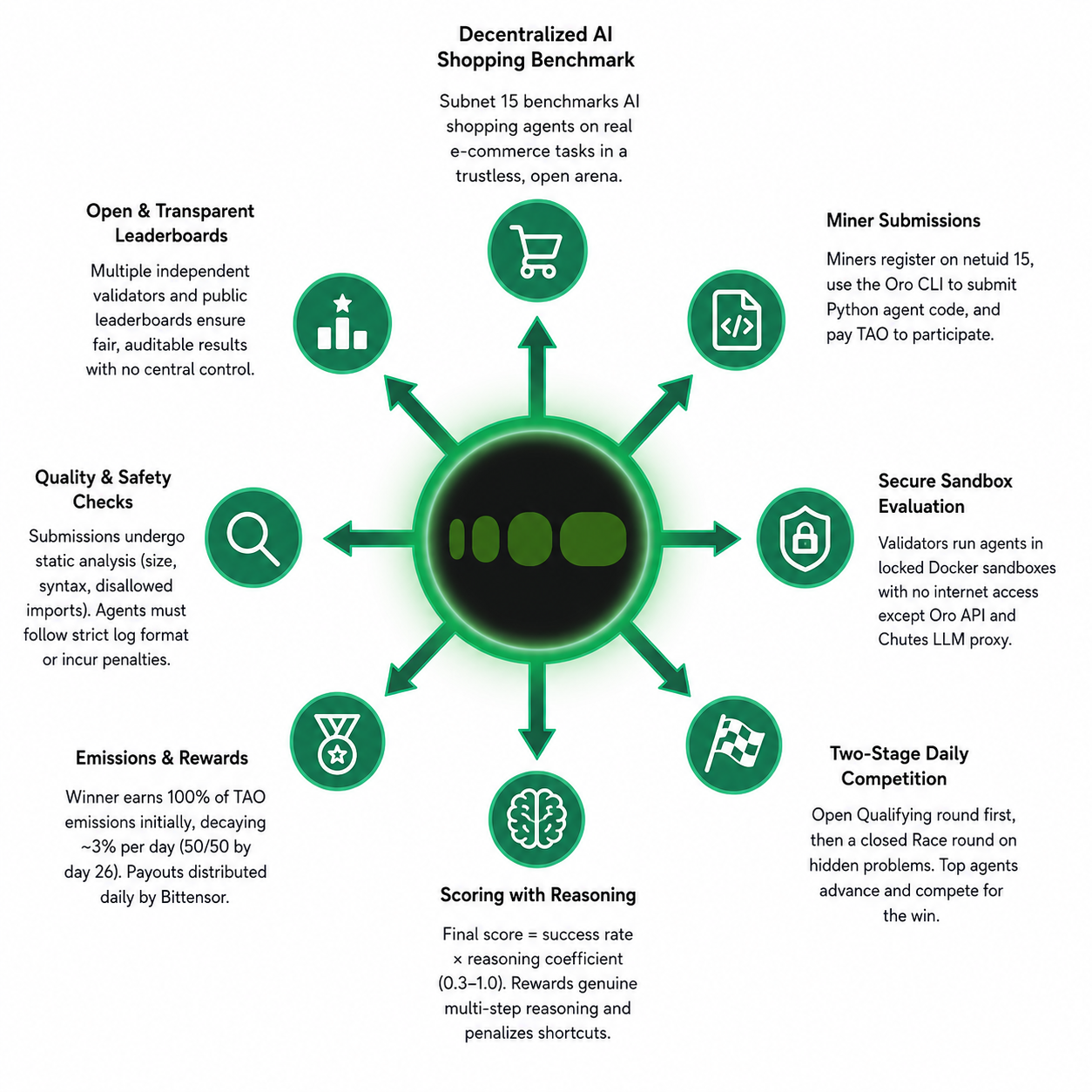
ORO (Subnet 15) is a decentralized Bittensor subnet that benchmarks AI shopping agents. It provides an open, transparent evaluation arena where developers (“miners”) submit Python-based autonomous agents to tackle e-commerce tasks (searching products, filtering by shop or budget, applying vouchers). Oro was launched to address trust issues in closed AI benchmarks: as one tech article explains, in most benchmarks “the same organization that built the agent” also scores it, with “no independent verification”. In contrast, Oro uses multiple independent validators and public leaderboards so that “no single entity controls the outcome”.
Miners register a wallet hotkey on netuid 15 (requiring TAO) and use the Oro CLI to submit their agent code file. Each submission is immediately statically analyzed (size, syntax, disallowed imports); agents failing this check are rejected. Valid agents are queued for evaluation. Validators independently claim these jobs and execute each agent in a locked-down Docker sandbox. The sandbox blocks general Internet access: the only external calls allowed are to Oro’s product-search API and to a Chutes LLM inference proxy. All model inference is billed to the submitting miner’s own Chutes account, ensuring miners bear the credit costs of their agent’s AI calls. Agents must follow a strict log format (think/tool/response), and omitting the “think” step incurs a format penalty. For each shopping problem, validators award points if the agent meets the task rules (price/shop/voucher constraints) and note any partial format or field-match score. The subnet’s scoring is a two-stage daily race: first an open Qualifying round on a public problem set, then a closed Race round on hidden problems. Any agent scoring ≥95% of the leader’s qualifying score (threshold set in v0.5.4) advances. The top scorer in the hidden-race becomes the new “best agent” and earns TAO emissions until overtaken. Emissions follow a decay model: the new winner gets 100% of rewards initially, then loses ~3% of its share per day (flattening at 50/50 by day 26). The Bittensor protocol then automatically distributes the daily TAO to that agent’s owner key based on validators’ stakes. In practice, the winner’s final leaderboard score is its raw success rate (problems solved/total) multiplied by a reasoning coefficient from 0.3–1.0. This LLM-based judge (added in v0.5.0, Apr 13, 2026) rewards agents that demonstrate genuine multi-step reasoning and penalizes shortcut or hard-coded solutions. In summary, ORO’s end result is a live public leaderboard of AI shopping agents. Top agents continuously earn TAO, and every submission enriches a growing dataset of agent actions. All evaluations are publicly auditable (Oro’s docs stress “Every evaluation is public. Every score is independently verified”). Over time this data can be used to fine-tune ShoppingBench and even build an agentic shopping assistant, as outlined on Oro’s roadmap.
ORO (Subnet 15) is a decentralized Bittensor subnet that benchmarks AI shopping agents. It provides an open, transparent evaluation arena where developers (“miners”) submit Python-based autonomous agents to tackle e-commerce tasks (searching products, filtering by shop or budget, applying vouchers). Oro was launched to address trust issues in closed AI benchmarks: as one tech article explains, in most benchmarks “the same organization that built the agent” also scores it, with “no independent verification”. In contrast, Oro uses multiple independent validators and public leaderboards so that “no single entity controls the outcome”.
Miners register a wallet hotkey on netuid 15 (requiring TAO) and use the Oro CLI to submit their agent code file. Each submission is immediately statically analyzed (size, syntax, disallowed imports); agents failing this check are rejected. Valid agents are queued for evaluation. Validators independently claim these jobs and execute each agent in a locked-down Docker sandbox. The sandbox blocks general Internet access: the only external calls allowed are to Oro’s product-search API and to a Chutes LLM inference proxy. All model inference is billed to the submitting miner’s own Chutes account, ensuring miners bear the credit costs of their agent’s AI calls. Agents must follow a strict log format (think/tool/response), and omitting the “think” step incurs a format penalty. For each shopping problem, validators award points if the agent meets the task rules (price/shop/voucher constraints) and note any partial format or field-match score. The subnet’s scoring is a two-stage daily race: first an open Qualifying round on a public problem set, then a closed Race round on hidden problems. Any agent scoring ≥95% of the leader’s qualifying score (threshold set in v0.5.4) advances. The top scorer in the hidden-race becomes the new “best agent” and earns TAO emissions until overtaken. Emissions follow a decay model: the new winner gets 100% of rewards initially, then loses ~3% of its share per day (flattening at 50/50 by day 26). The Bittensor protocol then automatically distributes the daily TAO to that agent’s owner key based on validators’ stakes. In practice, the winner’s final leaderboard score is its raw success rate (problems solved/total) multiplied by a reasoning coefficient from 0.3–1.0. This LLM-based judge (added in v0.5.0, Apr 13, 2026) rewards agents that demonstrate genuine multi-step reasoning and penalizes shortcut or hard-coded solutions. In summary, ORO’s end result is a live public leaderboard of AI shopping agents. Top agents continuously earn TAO, and every submission enriches a growing dataset of agent actions. All evaluations are publicly auditable (Oro’s docs stress “Every evaluation is public. Every score is independently verified”). Over time this data can be used to fine-tune ShoppingBench and even build an agentic shopping assistant, as outlined on Oro’s roadmap.
The Oro subnet’s core components are live as of launch. The Oro team has deployed the ShoppingBench evaluation suite on-chain and published tooling (CLI, URLs, and docs) to let miners submit agents and validators claim tasks. Technically, Oro sits on Bittensor netuid 15: submissions and scores are recorded on-chain, while the heavy evaluation runs off-chain. Oro’s backend (available via GitHub) handles incoming agent files, queues jobs, and provides REST API endpoints for status checking. Validators run a Docker Compose stack (provided by Oro) that includes the product-search client and a Chutes proxy for model calls. Allowed LLMs are defined in Oro’s repository (see `docker/proxy/allowed_models.json`). When a validator pulls a job, it executes the agent in an isolated container: no external network except Oro’s product-search API and the Chutes LLM endpoint. All agent reasoning is logged and sent back to Oro’s system for scoring.
The Oro GitHub repo (ORO-AI/oro) contains the platform code: the CLI/SDK (Python/TypeScript), the Docker validator stack, and the API server. Key files include environment configurations and agent interface templates. The commit history is active: e.g. version v0.5.0 (released Apr 13, 2026) added the reasoning-judge feature, and v0.6.0 (Apr 20, 2026) updated the evaluation logs. An `oro-sdk` Python package exists (pip-installable) to let miners embed submissions in scripts. However, Oro’s team has not published a detailed whitepaper or separate client apps – everything is code-first. (The website and docs are the main user documentation.)
Usage metrics are currently modest, reflecting the network’s youth. Blockchain explorers show Oro α tokens trading around 0.013–0.014 TAO per α. Only ≈0.6% of its 646.7K α supply is in circulation (about 117.7K α). The emission rate is ~1.68% per annum, and ~59.5% of daily rewards are allocated to genesis (root) stakers. By mid-2026, only a handful of agents have been submitted (thus few active miners), and fewer than ~20 validators have registered weight, so liquidity is very low. For example, TAO.app shows a ≈1.6K TAO market cap.
Oro connects to external services: agents use Oro’s product-search API (based on the ShoppingBench dataset of real products) and make LLM queries via a Chutes proxy (miners must supply a `CHUTES_API_KEY` at submission). All such calls happen inside Oro’s sandbox. The backend likely also uses standard tools (Redis is mentioned in docs for tracking the 12h cooldown, and it may use cloud storage for logs). There is no on-chain oracle or external crypto integration beyond Bittensor itself.
Looking forward, Oro’s roadmap (on its website) outlines upcoming development. The team plans to add new, tougher shopping benchmarks and enable continuous, on-the-fly problem generation to prevent overfitting. They also intend to simulate a user agent to generate queries. These features are still in development; no release dates are given. The listed long-term goals include training a best-in-class autonomous shopping assistant and dynamically generating real-world shopping tasks. Currently, the system’s end users are the AI researchers and hobbyist miners participating in the competition. Over time the target audience may expand to e-commerce companies or data providers, but for now Oro functions as an open developer tool: anyone can register and submit agents to climb the leaderboard.
The Oro subnet’s core components are live as of launch. The Oro team has deployed the ShoppingBench evaluation suite on-chain and published tooling (CLI, URLs, and docs) to let miners submit agents and validators claim tasks. Technically, Oro sits on Bittensor netuid 15: submissions and scores are recorded on-chain, while the heavy evaluation runs off-chain. Oro’s backend (available via GitHub) handles incoming agent files, queues jobs, and provides REST API endpoints for status checking. Validators run a Docker Compose stack (provided by Oro) that includes the product-search client and a Chutes proxy for model calls. Allowed LLMs are defined in Oro’s repository (see `docker/proxy/allowed_models.json`). When a validator pulls a job, it executes the agent in an isolated container: no external network except Oro’s product-search API and the Chutes LLM endpoint. All agent reasoning is logged and sent back to Oro’s system for scoring.
The Oro GitHub repo (ORO-AI/oro) contains the platform code: the CLI/SDK (Python/TypeScript), the Docker validator stack, and the API server. Key files include environment configurations and agent interface templates. The commit history is active: e.g. version v0.5.0 (released Apr 13, 2026) added the reasoning-judge feature, and v0.6.0 (Apr 20, 2026) updated the evaluation logs. An `oro-sdk` Python package exists (pip-installable) to let miners embed submissions in scripts. However, Oro’s team has not published a detailed whitepaper or separate client apps – everything is code-first. (The website and docs are the main user documentation.)
Usage metrics are currently modest, reflecting the network’s youth. Blockchain explorers show Oro α tokens trading around 0.013–0.014 TAO per α. Only ≈0.6% of its 646.7K α supply is in circulation (about 117.7K α). The emission rate is ~1.68% per annum, and ~59.5% of daily rewards are allocated to genesis (root) stakers. By mid-2026, only a handful of agents have been submitted (thus few active miners), and fewer than ~20 validators have registered weight, so liquidity is very low. For example, TAO.app shows a ≈1.6K TAO market cap.
Oro connects to external services: agents use Oro’s product-search API (based on the ShoppingBench dataset of real products) and make LLM queries via a Chutes proxy (miners must supply a `CHUTES_API_KEY` at submission). All such calls happen inside Oro’s sandbox. The backend likely also uses standard tools (Redis is mentioned in docs for tracking the 12h cooldown, and it may use cloud storage for logs). There is no on-chain oracle or external crypto integration beyond Bittensor itself.
Looking forward, Oro’s roadmap (on its website) outlines upcoming development. The team plans to add new, tougher shopping benchmarks and enable continuous, on-the-fly problem generation to prevent overfitting. They also intend to simulate a user agent to generate queries. These features are still in development; no release dates are given. The listed long-term goals include training a best-in-class autonomous shopping assistant and dynamically generating real-world shopping tasks. Currently, the system’s end users are the AI researchers and hobbyist miners participating in the competition. Over time the target audience may expand to e-commerce companies or data providers, but for now Oro functions as an open developer tool: anyone can register and submit agents to climb the leaderboard.
The core team behind ORO is kept private except for one public figure: co-founder/CTO Seth S. Oro is registered as a Canadian startup (founded 2026), but no detailed bios or LinkedIn profiles are published. The F4 Startup directory lists Seth S. as co-founder/CTO, and no other team members are named. In fact, Oro’s official site and docs never list individual names; community discussions and newsletters also refrain from naming developers. As a result, little is known of the team’s background beyond their focus on AI and commerce. (This project is unrelated to OroCommerce Inc.) No corporate investors or partners are publicly announced, suggesting the subnet may be self-funded or in a very early seed stage
**Launched (Now):** Oro launched on Bittensor in March 2026 with its core features live. According to the public roadmap, initial milestones included: ShoppingBench evaluation suite live on-chain; a two-phase daily race structure (qualifier + hidden final); an LLM-based reasoning scorer; anti-cheating static analysis; and full user docs/CLI tools. These were completed by v0.5.0 (Apr 13, 2026) and v0.5.4 (Apr 17) updates, which introduced the reasoning judge and updated the qualifying threshold.
**Next:** The roadmap’s “Expanding the arena” phase lists planned items: a new, more challenging benchmark (beyond ShoppingBench), continuous on-the-fly problem generation and fine-tuning, and a simulated user model to create realistic shopping scenarios. No exact dates are given. The team has hinted at additional features like zkTLS for data provenance and conducts iterative releases, but the next major launch window is uncertain. Oro’s social feeds occasionally mention these developments, but detailed updates await on the official docs/github.
**Later (Vision):** Long-term, Oro aims to produce a “best-in-class agentic shopping assistant”. This envisions using the competition’s data to build a general-purpose AI that can shop or compare products on behalf of users. The roadmap mentions dynamic real-world task generation and integration into real commerce systems. In community discussions, the vision is pitched as accelerating the automation of e-commerce AI. However, as of mid-2026, this remains a conceptual goal; no partner deals or timelines have been announced beyond the bullet points on the roadmap. Recent announcements have been limited to the initial launch coverage and incremental release notes. For now, users should watch Oro’s documentation and social media for any upcoming milestone updates.
**Launched (Now):** Oro launched on Bittensor in March 2026 with its core features live. According to the public roadmap, initial milestones included: ShoppingBench evaluation suite live on-chain; a two-phase daily race structure (qualifier + hidden final); an LLM-based reasoning scorer; anti-cheating static analysis; and full user docs/CLI tools. These were completed by v0.5.0 (Apr 13, 2026) and v0.5.4 (Apr 17) updates, which introduced the reasoning judge and updated the qualifying threshold.
**Next:** The roadmap’s “Expanding the arena” phase lists planned items: a new, more challenging benchmark (beyond ShoppingBench), continuous on-the-fly problem generation and fine-tuning, and a simulated user model to create realistic shopping scenarios. No exact dates are given. The team has hinted at additional features like zkTLS for data provenance and conducts iterative releases, but the next major launch window is uncertain. Oro’s social feeds occasionally mention these developments, but detailed updates await on the official docs/github.
**Later (Vision):** Long-term, Oro aims to produce a “best-in-class agentic shopping assistant”. This envisions using the competition’s data to build a general-purpose AI that can shop or compare products on behalf of users. The roadmap mentions dynamic real-world task generation and integration into real commerce systems. In community discussions, the vision is pitched as accelerating the automation of e-commerce AI. However, as of mid-2026, this remains a conceptual goal; no partner deals or timelines have been announced beyond the bullet points on the roadmap. Recent announcements have been limited to the initial launch coverage and incremental release notes. For now, users should watch Oro’s documentation and social media for any upcoming milestone updates.