With the amount of new subnets being added it can be hard to get up to date information across all subnets, so data may be slightly out of date from time to time
Bittensor Subnet 17 is empowering individuals to create worlds and games through simple descriptions, thereby democratizing 3D content creation, enabling anyone to develop virtual worlds, games, and AR/VR/XR experiences. This subnet utilizes a diverse array of existing Open Source 3D generative models, including Gaussian Splatting, Neural Radiance Fields, 3D Diffusion Models, and Point-Cloud approaches.
By integrating these models into decentralized incentive-based networks via Bittensor, the subnet aims to foster innovation. Its goal is to initiate a gaming revolution centered around AI-native games, utilizing the broader Bittensor ecosystem to enable real-time generation of assets, voice, and sound. This approach empowers creative individuals, even those without coding or game development experience, to simply describe their game ideas and see them materialize instantly.
The subnet focuses on generating high-quality 3D models for use in gaming, digital twins, virtual environments, and more. It uses advanced AI technologies, including Gaussian splats, to create realistic 3D objects and worlds in an efficient and cost-effective manner.
Bittensor Subnet 17 is empowering individuals to create worlds and games through simple descriptions, thereby democratizing 3D content creation, enabling anyone to develop virtual worlds, games, and AR/VR/XR experiences. This subnet utilizes a diverse array of existing Open Source 3D generative models, including Gaussian Splatting, Neural Radiance Fields, 3D Diffusion Models, and Point-Cloud approaches.
By integrating these models into decentralized incentive-based networks via Bittensor, the subnet aims to foster innovation. Its goal is to initiate a gaming revolution centered around AI-native games, utilizing the broader Bittensor ecosystem to enable real-time generation of assets, voice, and sound. This approach empowers creative individuals, even those without coding or game development experience, to simply describe their game ideas and see them materialize instantly.
The subnet focuses on generating high-quality 3D models for use in gaming, digital twins, virtual environments, and more. It uses advanced AI technologies, including Gaussian splats, to create realistic 3D objects and worlds in an efficient and cost-effective manner.
Three Gen is specifically built to address the challenges faced by industries such as gaming, film, VFX, and digital twins when creating 3D content. This subnet uses a novel AI-driven approach, combining neural networks and Gaussian splats, a more efficient alternative to traditional 3D rendering techniques like meshes and neural radiance fields (nerfs).
The subnet aims to democratize content creation by providing high-quality, AI-generated 3D assets at a fraction of the cost and time it would traditionally take, making it accessible to both large AAA studios and indie game developers.
Early Development & Foundation:
Transition to Bit Tensor & Incentive Design:
Core Technology and Use Cases:
Third-Party Integration and Open-Source Data:
Refining the Technology & Expanding the Reach:
Widening Applications and Industry Adoption:
Future Outlook and Community Engagement:
Three Gen is specifically built to address the challenges faced by industries such as gaming, film, VFX, and digital twins when creating 3D content. This subnet uses a novel AI-driven approach, combining neural networks and Gaussian splats, a more efficient alternative to traditional 3D rendering techniques like meshes and neural radiance fields (nerfs).
The subnet aims to democratize content creation by providing high-quality, AI-generated 3D assets at a fraction of the cost and time it would traditionally take, making it accessible to both large AAA studios and indie game developers.
Early Development & Foundation:
Transition to Bit Tensor & Incentive Design:
Core Technology and Use Cases:
Third-Party Integration and Open-Source Data:
Refining the Technology & Expanding the Reach:
Widening Applications and Industry Adoption:
Future Outlook and Community Engagement:
Founder/CEO: Ben James is the founder who started the company that later became Subnet 17. His background in research and collaboration with the gaming and VFX industries plays a significant role in building the subnet.
Tech Lead: Max, who oversees the technical direction of the subnet. He plays a key role in shaping the technology that powers the subnet and its integration with the Bittensor network.
Marketing & Business Development Lead: Monica, responsible for the marketing and business development aspects, ensuring the technology reaches the right audience.
Team Size: Around 10 people. The team primarily comes from research, with experience in 3D technology, gaming, VFX, and virtual worlds.
Background: The team has deep expertise in both Web 2.0 and 3D content creation, specifically in areas like VFX, gaming, and metaverses. They have a history of working with large developers and studios, especially in Europe, and have leveraged EU research funding to develop their technology. Their experience spans building virtual worlds using image processing and computer vision in the gaming sector.
Founder/CEO: Ben James is the founder who started the company that later became Subnet 17. His background in research and collaboration with the gaming and VFX industries plays a significant role in building the subnet.
Tech Lead: Max, who oversees the technical direction of the subnet. He plays a key role in shaping the technology that powers the subnet and its integration with the Bittensor network.
Marketing & Business Development Lead: Monica, responsible for the marketing and business development aspects, ensuring the technology reaches the right audience.
Team Size: Around 10 people. The team primarily comes from research, with experience in 3D technology, gaming, VFX, and virtual worlds.
Background: The team has deep expertise in both Web 2.0 and 3D content creation, specifically in areas like VFX, gaming, and metaverses. They have a history of working with large developers and studios, especially in Europe, and have leveraged EU research funding to develop their technology. Their experience spans building virtual worlds using image processing and computer vision in the gaming sector.
Launched tools: The Unity plugin (v0.4.0) and Blender add-on (v0.9.0) are live (early 2025 releases). The Discord bot has been available longer, and the integration was officially announced as a Verified Solution in Unity’s Asset Store. The team continues to update these: for instance, the guide notes that mesh-export options are “coming soon” for the Blender extension. Unity’s technical evaluation in April 2025 even led to tweaks in 404—GEN’s AI dependencies to ensure industrial-grade output.
Dataset milestones: In April 2025 404—GEN released a 21.5 million model open-source 3D dataset (touting it as “by far the largest” such dataset). This dataset (built via subnet mining) includes metadata linking each model to its prompt and creator. As of writing, the full dataset is available on request to researchers, with samples on Hugging Face. The subnet is also building tooling (“decentralized storage” and a data front end) so that over time anyone can browse or query this asset corpus. In essence, 404—GEN’s short-term roadmap has been to prove the concept: launch easy generation tools and amass a large content library.
Mid-term goals: 404—GEN’s whitepaper and interviews outline a vision of using these datasets to kickstart AI-native games. For example, they plan to align synthetic asset collections with specific game genres (“modding and vertical creation around a specific game genre and/or art style”). These initial asset packs will seed simple games or mods. Over the next year they intend to expand their front-end interfaces (better GUI, more developer plugins) and foster partnerships so game developers can quickly build prototype games.
Long-term vision: Ultimately, 404—GEN aims to become a foundational creative engine for entertainment. As viral AI-made games appear, the subnet will gain traction and spur network effects. The whitepaper sketches a future where entire virtual worlds are made on-the-fly: a user describes a game in plain language and the combination of Gen 404 (3D), voice subnets, and others generates the whole experience instantly. While such an “AI-native game OS” is still far off, 404—GEN’s roadmap (and recent progress) signals steady movement toward that goal.
Summary: In summary, Bittensor Subnet 17 – Gen 404 is a decentralized text-to-3D AI subnet whose goal is to open up 3D worldbuilding to everyone. It does so by running a permissionless network of miners/validators that continually generate and validate AI-created 3D assets. The subnet is already functional: it offers Unity, Blender and Discord interfaces, has garnered press attention (from GamesBeat to BlockchainGamer), and is building a massive open dataset. Its role in the Bittensor ecosystem is to provide the 3D content “leg” of a future fully-AI-driven metaverse, interoperating with other subnets for voice, text, and beyond.
Launched tools: The Unity plugin (v0.4.0) and Blender add-on (v0.9.0) are live (early 2025 releases). The Discord bot has been available longer, and the integration was officially announced as a Verified Solution in Unity’s Asset Store. The team continues to update these: for instance, the guide notes that mesh-export options are “coming soon” for the Blender extension. Unity’s technical evaluation in April 2025 even led to tweaks in 404—GEN’s AI dependencies to ensure industrial-grade output.
Dataset milestones: In April 2025 404—GEN released a 21.5 million model open-source 3D dataset (touting it as “by far the largest” such dataset). This dataset (built via subnet mining) includes metadata linking each model to its prompt and creator. As of writing, the full dataset is available on request to researchers, with samples on Hugging Face. The subnet is also building tooling (“decentralized storage” and a data front end) so that over time anyone can browse or query this asset corpus. In essence, 404—GEN’s short-term roadmap has been to prove the concept: launch easy generation tools and amass a large content library.
Mid-term goals: 404—GEN’s whitepaper and interviews outline a vision of using these datasets to kickstart AI-native games. For example, they plan to align synthetic asset collections with specific game genres (“modding and vertical creation around a specific game genre and/or art style”). These initial asset packs will seed simple games or mods. Over the next year they intend to expand their front-end interfaces (better GUI, more developer plugins) and foster partnerships so game developers can quickly build prototype games.
Long-term vision: Ultimately, 404—GEN aims to become a foundational creative engine for entertainment. As viral AI-made games appear, the subnet will gain traction and spur network effects. The whitepaper sketches a future where entire virtual worlds are made on-the-fly: a user describes a game in plain language and the combination of Gen 404 (3D), voice subnets, and others generates the whole experience instantly. While such an “AI-native game OS” is still far off, 404—GEN’s roadmap (and recent progress) signals steady movement toward that goal.
Summary: In summary, Bittensor Subnet 17 – Gen 404 is a decentralized text-to-3D AI subnet whose goal is to open up 3D worldbuilding to everyone. It does so by running a permissionless network of miners/validators that continually generate and validate AI-created 3D assets. The subnet is already functional: it offers Unity, Blender and Discord interfaces, has garnered press attention (from GamesBeat to BlockchainGamer), and is building a massive open dataset. Its role in the Bittensor ecosystem is to provide the 3D content “leg” of a future fully-AI-driven metaverse, interoperating with other subnets for voice, text, and beyond.
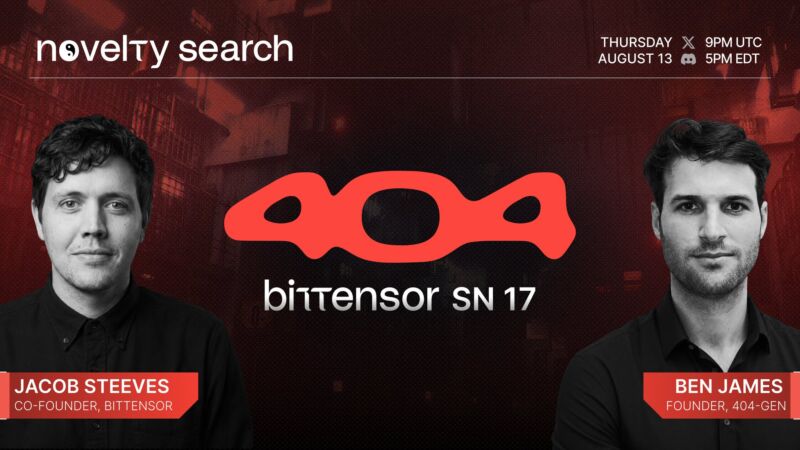
A big thank you to Tao Stats for producing these insightful videos in the Novelty Search series. We appreciate the opportunity to dive deep into the groundbreaking work being done by Subnets within Bittensor! Check out some of their other videos HERE.
In this session, the team behind Subnet 17 discusses their innovative AI-powered subnet built on Bittensor, designed to revolutionize 3D content creation for industries like gaming, VFX, architecture, and digital twins. The conversation highlights the subnet’s unique approach to generating high-quality, scalable 3D models using Gaussian splats—an efficient alternative to traditional 3D representation methods like meshes and neural radiance fields. They dive into the team’s background, the challenges they aim to solve, and the technology’s potential to democratize 3D content creation for both indie developers and large studios. The discussion also covers the subnet’s incentive design, validation mechanism, and the real-world applications of their technology, from gaming to high-profile art exhibitions like the Venice Architecture Biennale. The session showcases the rapid evolution of the subnet and its impact on virtual worlds, with insights into future developments and user-driven features like 2D-to-3D model generation.
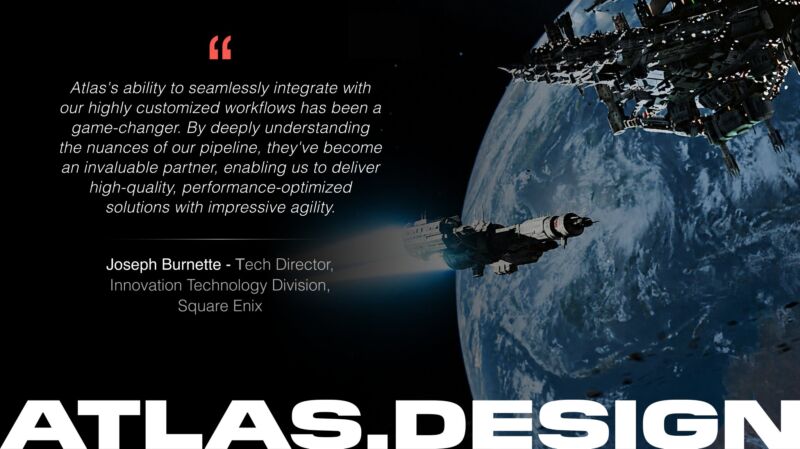
“Atlas's ability to seamlessly integrate with our highly customized workflows has been a game-changer.”
- Joseph Burnette, Technical Director at SQUARE ENIX
Couldn’t have said it better.
Atlas helps professional studios generate and refine 3D models at scale, with quality
We prioritize creator convenience, which is why we brought the full 3D generation workflow directly into tools like Blender.
With the 404 Blender Add-on, creators can generate 3D assets from text prompts or images.
They can convert Gaussian Splats into textured meshes in about
The Add-on brings generation, editing, optimisation, and mesh conversion into one workflow.
With 404 in Blender, you can:
• Generate 3D assets from text or image prompts
• View and edit Gaussian Splats natively
• Convert splats into production-ready meshes with texture baking
This integration helps creators and developers produce 3D assets faster without modelling everything from scratch, while keeping the control needed to refine the final result.
You should try it out yourself.
Follow the installation and user guide here:
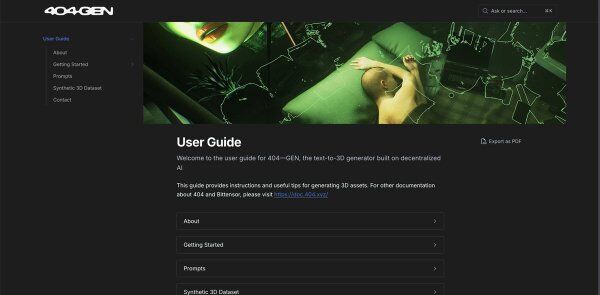
404—GEN User Guide | 404—GEN Guide
Welcome to the 404—GEN User Guide.
guide.404.xyz
We have pushed 3D generation across three representations, and now we are moving toward something bigger.
Through our next competition, we will use Bittensor’s miner competition to build the 3D foundation for WORLD MODELS.
LLMs understand text but world models are meant to
We built Atlas to give creators, studios, and enterprises a production interface for 3D generation.
One of the models inside Atlas is Titan v1, our image-to-3D mesh model built through Bittensor’s distributed miner network.
It is shaped for studio use with cleaner geometry,
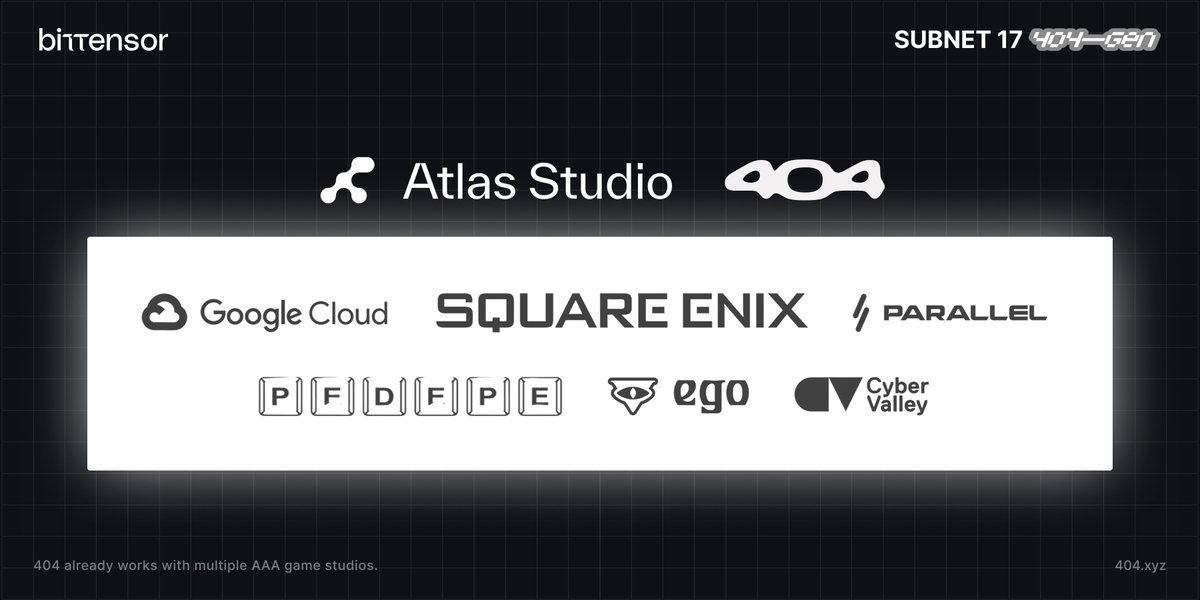
.@404gen_ just launched Atlas, its AI workflow platform for 3D production.
They already work with multiple AAA game studios like Square Enix. And Parralel's Colony goes live this month with real-time asset generation powered by Atlas.
How Bittensor powers 404’s 3D stack:
We’re pleased to announce that 404 (Subnet 17) will be joining @const_reborn for this week’s Novelty Search.
We’ll be discussing Titan v1, our latest open-weights model that turns images into production-ready 3D assets end-to-end in around 30 seconds, and how SN17 is pushing
Every day brings a new opportunity to build worlds of your own.
404 has made 3D generation easier, faster, and more accessible.
All you need is your imagination to give the model a text or image prompt, and you can start creating in seconds.
404 is powered by a decentralised