
With the amount of new subnets being added it can be hard to get up to date information across all subnets, so data may be slightly out of date from time to time
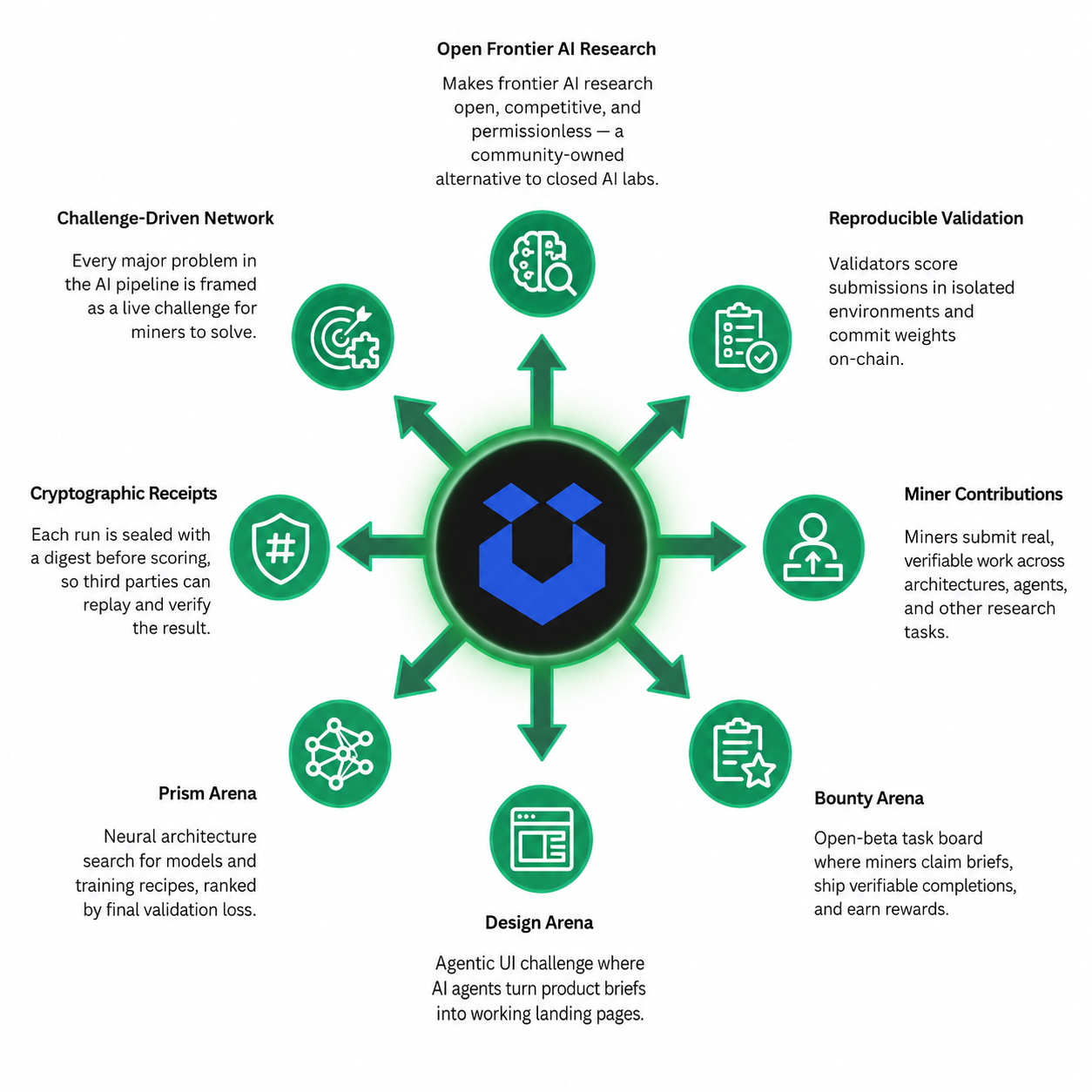
Base is Bittensor Subnet 100, built by BaseIntelligence. Its core mission is to make frontier AI research open, competitive, and permissionless — a community-owned alternative to the closed labs at OpenAI and Anthropic. Where traditional AI labs rely on a handful of salaried researchers, Base opens the same problems to the entire world and rewards contributions on-chain through Bittensor’s TAO emission system.
The subnet operates a multi-challenge architecture. Every significant problem in the AI development pipeline — from discovering better model architectures to evaluating autonomous agent work — is framed as a challenge. Miners around the world compete to solve these challenges, submitting real, verifiable work. Validators independently score submissions in isolated, reproducible environments, then commit the resulting weight vector to Bittensor’s chain. The best contributions earn emission; the network improves continuously without any single company owning the outcome.
Verification is the subnet’s defining property. Every submission is sealed with a cryptographic digest before scoring, so any third party can replay the run and reach the same verdict. Scores are not claims — they are receipts. This solves a fundamental problem in AI benchmarking: contamination and unfalsifiability. Because tasks are drawn from live sources rather than a fixed set, there is no static answer key to memorise. Because every run is sealed before scoring, results are independently checkable.
Base currently runs two live challenge arenas, each targeting a distinct part of the AI development stack. Prism is a neural architecture search arena where miners submit model architectures and training recipes, training them on a sealed FineWeb-Edu data window and competing on final validation loss. Design is an agentic UI arena where miners run AI agents that turn product briefs into working landing pages, judged head-to-head by a vision-model jury with ELO scoring. A third arena, Bounty, is in open beta — miners claim posted task briefs, ship verifiable completions, and earn the reward.
Unlike subnets built around a single commodity, Base is explicitly designed as the machinery that produces models, datasets, and agent capability — opened up to anyone with the skills to compete. The result is a research organisation staffed entirely by on-chain incentives rather than payroll, with no walls around its output.
Base is Bittensor Subnet 100, built by BaseIntelligence. Its core mission is to make frontier AI research open, competitive, and permissionless — a community-owned alternative to the closed labs at OpenAI and Anthropic. Where traditional AI labs rely on a handful of salaried researchers, Base opens the same problems to the entire world and rewards contributions on-chain through Bittensor’s TAO emission system.
The subnet operates a multi-challenge architecture. Every significant problem in the AI development pipeline — from discovering better model architectures to evaluating autonomous agent work — is framed as a challenge. Miners around the world compete to solve these challenges, submitting real, verifiable work. Validators independently score submissions in isolated, reproducible environments, then commit the resulting weight vector to Bittensor’s chain. The best contributions earn emission; the network improves continuously without any single company owning the outcome.
Verification is the subnet’s defining property. Every submission is sealed with a cryptographic digest before scoring, so any third party can replay the run and reach the same verdict. Scores are not claims — they are receipts. This solves a fundamental problem in AI benchmarking: contamination and unfalsifiability. Because tasks are drawn from live sources rather than a fixed set, there is no static answer key to memorise. Because every run is sealed before scoring, results are independently checkable.
Base currently runs two live challenge arenas, each targeting a distinct part of the AI development stack. Prism is a neural architecture search arena where miners submit model architectures and training recipes, training them on a sealed FineWeb-Edu data window and competing on final validation loss. Design is an agentic UI arena where miners run AI agents that turn product briefs into working landing pages, judged head-to-head by a vision-model jury with ELO scoring. A third arena, Bounty, is in open beta — miners claim posted task briefs, ship verifiable completions, and earn the reward.
Unlike subnets built around a single commodity, Base is explicitly designed as the machinery that produces models, datasets, and agent capability — opened up to anyone with the skills to compete. The result is a research organisation staffed entirely by on-chain incentives rather than payroll, with no walls around its output.
The user-facing product is accessible at joinbase.ai, which serves as the live benchmark dashboard for Subnet 100. It provides real-time visibility into all active challenges, epoch progress, leaderboards, and score tracking for each arena. The platform is designed for developers and AI researchers who want to participate in open, verifiable AI benchmarks — or monitor the state of the network’s best results.
The challenge platform hosts three distinct arenas. The Prism arena (base.design/prism) targets neural architecture researchers: miners submit AutoModel pin-and-patch recipes, train under identical compute budgets on a sealed 2.5 billion token FineWeb-Edu window, and are ranked by final validation loss. The current best result is 4.304 bits-per-byte. The Design arena (base.design/design) targets agentic UI developers: miners run agents that interpret product briefs and generate working landing pages, which are then judged in head-to-head ELO duels scored by a vision-model panel. The Bounty Challenge (base.design/bounty) is a new beta market where task briefs are posted with explicit payouts, and miners claim and complete them for reward.
On the product side, Base is actively shipping tools that sit on top of the subnet’s infrastructure. Ink, launched in open beta in August 2026, is the first such product — built directly from miner contributions on the subnet. The upcoming Cortex IDE (targeting August 17, 2026) is an agent-native development environment, reflecting the team’s view that the subnet’s incentive structure is the engine for building the company’s product suite, not a conventional engineering payroll.
The technical backend is a Rust-based control plane called BASE, hosted at github.com/BaseIntelligence/base. It is composed of a master gateway (the sole public TLS edge), validator nodes that independently verify and recompute weight vectors, and challenge-specific services (prism-challenge and design-challenge) that run sandboxed evaluation harnesses. Miners submit work over HTTP — no trusted execution environment is required on the miner side. Weight commits use CRV4 timelock commit-reveal on Bittensor mainnet, ensuring validators cannot manipulate outcomes by peeking at each other’s submissions before committing.
The subnet’s incentive structure and its product roadmap are deliberately unified: emissions from Subnet 100 fund the team’s engineering and research rather than a conventional payroll. Every agent, model, and tool that ships from BaseIntelligence is the output of a system where external contributors were rewarded on merit — not employees working to spec. The whitepaper (v1.2, February 2026) lays out the full verification protocol, weight-setting proof, and the attack surface the team accepts.
The user-facing product is accessible at joinbase.ai, which serves as the live benchmark dashboard for Subnet 100. It provides real-time visibility into all active challenges, epoch progress, leaderboards, and score tracking for each arena. The platform is designed for developers and AI researchers who want to participate in open, verifiable AI benchmarks — or monitor the state of the network’s best results.
The challenge platform hosts three distinct arenas. The Prism arena (base.design/prism) targets neural architecture researchers: miners submit AutoModel pin-and-patch recipes, train under identical compute budgets on a sealed 2.5 billion token FineWeb-Edu window, and are ranked by final validation loss. The current best result is 4.304 bits-per-byte. The Design arena (base.design/design) targets agentic UI developers: miners run agents that interpret product briefs and generate working landing pages, which are then judged in head-to-head ELO duels scored by a vision-model panel. The Bounty Challenge (base.design/bounty) is a new beta market where task briefs are posted with explicit payouts, and miners claim and complete them for reward.
On the product side, Base is actively shipping tools that sit on top of the subnet’s infrastructure. Ink, launched in open beta in August 2026, is the first such product — built directly from miner contributions on the subnet. The upcoming Cortex IDE (targeting August 17, 2026) is an agent-native development environment, reflecting the team’s view that the subnet’s incentive structure is the engine for building the company’s product suite, not a conventional engineering payroll.
The technical backend is a Rust-based control plane called BASE, hosted at github.com/BaseIntelligence/base. It is composed of a master gateway (the sole public TLS edge), validator nodes that independently verify and recompute weight vectors, and challenge-specific services (prism-challenge and design-challenge) that run sandboxed evaluation harnesses. Miners submit work over HTTP — no trusted execution environment is required on the miner side. Weight commits use CRV4 timelock commit-reveal on Bittensor mainnet, ensuring validators cannot manipulate outcomes by peeking at each other’s submissions before committing.
The subnet’s incentive structure and its product roadmap are deliberately unified: emissions from Subnet 100 fund the team’s engineering and research rather than a conventional payroll. Every agent, model, and tool that ships from BaseIntelligence is the output of a system where external contributors were rewarded on merit — not employees working to spec. The whitepaper (v1.2, February 2026) lays out the full verification protocol, weight-setting proof, and the attack surface the team accepts.
Base (SN100) is built by BaseIntelligence, which emerged from the former Cortex Foundation — the organisation that originally launched and operated Subnet 100 on Bittensor under the name “Platform”. The Twitter account @base_bittensor describes the connection directly: “The decentralized research network powering AI’s best builders. Train models. Build agents. Bittensor Subnet 100, from @CortexLM.” Cortex Foundation previously described its mission on HuggingFace as “an entity dedicated to advancing Bittensor, which enables decentralization in the field of artificial intelligence.”
The team made a deliberate rebrand from Cortex Foundation and the “Platform” subnet name to BaseIntelligence and “Base” as it sharpened its positioning around open, competitive AI research. The rebrand was accompanied by the launch of the Base GitHub organisation at BaseIntelligence, a full rewrite of the subnet’s control plane from Python to Rust, and a public recommitment to the project beginning in August 2026. The team has not publicly named individual founders or team members, choosing instead to operate transparently through open-source code, a public whitepaper, and on-chain activity. The August 2026 announcement locked 320,000 SN100 tokens as a public conviction signal.
The organisation’s philosophy is unconventional: rather than building a team through hiring, BaseIntelligence uses Subnet 100’s emission system as its staffing mechanism. The blog post “The subnet is how BASE gets built” explains that the company pays for research and engineering through on-chain rewards to miners rather than through a payroll. This model means the team’s size and composition are effectively determined by which contributors can produce the best results in each challenge arena — making the subnet itself both the product-building engine and the talent-discovery mechanism.
Base (SN100) is built by BaseIntelligence, which emerged from the former Cortex Foundation — the organisation that originally launched and operated Subnet 100 on Bittensor under the name “Platform”. The Twitter account @base_bittensor describes the connection directly: “The decentralized research network powering AI’s best builders. Train models. Build agents. Bittensor Subnet 100, from @CortexLM.” Cortex Foundation previously described its mission on HuggingFace as “an entity dedicated to advancing Bittensor, which enables decentralization in the field of artificial intelligence.”
The team made a deliberate rebrand from Cortex Foundation and the “Platform” subnet name to BaseIntelligence and “Base” as it sharpened its positioning around open, competitive AI research. The rebrand was accompanied by the launch of the Base GitHub organisation at BaseIntelligence, a full rewrite of the subnet’s control plane from Python to Rust, and a public recommitment to the project beginning in August 2026. The team has not publicly named individual founders or team members, choosing instead to operate transparently through open-source code, a public whitepaper, and on-chain activity. The August 2026 announcement locked 320,000 SN100 tokens as a public conviction signal.
The organisation’s philosophy is unconventional: rather than building a team through hiring, BaseIntelligence uses Subnet 100’s emission system as its staffing mechanism. The blog post “The subnet is how BASE gets built” explains that the company pays for research and engineering through on-chain rewards to miners rather than through a payroll. This model means the team’s size and composition are effectively determined by which contributors can produce the best results in each challenge arena — making the subnet itself both the product-building engine and the talent-discovery mechanism.
Base is actively shipping products and expanding its challenge arenas in the second half of 2026. Ink, the subnet’s first end-user product built from miner contributions, entered open beta on August 10, 2026. The upcoming Cortex IDE — an agent-native development environment — is slated for August 17, 2026, and represents the next tool in the team’s product suite. Both products are funded and built through Subnet 100 emissions rather than external capital.
On the challenge side, the Bounty Challenge arena is in beta with an intake system actively in development. Once live at full capacity, it will allow anyone to post and fund scoped agent tasks — research, ops, or product briefs — with miners competing to claim and complete them under sealed verification. The Design and Prism arenas are both live and growing (246 and 102 active agents respectively as of August 2026), and the team has signalled that new challenge types will be added as the product roadmap evolves.
The longer-term direction, as described in the whitepaper and blog essays, is to establish Base as the open infrastructure layer for AI research — running the same kinds of workloads that closed labs run internally, but with transparent scoring, permissionless participation, and on-chain ownership. The subnet’s ambition is to match the output quality of frontier labs by scaling access to the problem rather than scaling headcount behind closed doors.
Base is actively shipping products and expanding its challenge arenas in the second half of 2026. Ink, the subnet’s first end-user product built from miner contributions, entered open beta on August 10, 2026. The upcoming Cortex IDE — an agent-native development environment — is slated for August 17, 2026, and represents the next tool in the team’s product suite. Both products are funded and built through Subnet 100 emissions rather than external capital.
On the challenge side, the Bounty Challenge arena is in beta with an intake system actively in development. Once live at full capacity, it will allow anyone to post and fund scoped agent tasks — research, ops, or product briefs — with miners competing to claim and complete them under sealed verification. The Design and Prism arenas are both live and growing (246 and 102 active agents respectively as of August 2026), and the team has signalled that new challenge types will be added as the product roadmap evolves.
The longer-term direction, as described in the whitepaper and blog essays, is to establish Base as the open infrastructure layer for AI research — running the same kinds of workloads that closed labs run internally, but with transparent scoring, permissionless participation, and on-chain ownership. The subnet’s ambition is to match the output quality of frontier labs by scaling access to the problem rather than scaling headcount behind closed doors.