
With the amount of new subnets being added it can be hard to get up to date information across all subnets, so data may be slightly out of date from time to time
Thirty Spokes (SN99) is a decentralised AI model routing gateway operating as Bittensor Subnet 99. Its core purpose is to give developers a single API endpoint — one key, one base URL — through which every major frontier model is reachable: OpenAI, Anthropic, Google, DeepSeek, Qwen, Mistral, Meta, xAI, Cohere, and more. Developers point their existing OpenAI or Anthropic SDK client at api.thirtyspokes.ai/v1, request model="auto", and the network routes each call to the best provider for quality per dollar. No SDK changes, no juggling of separate API keys, no per-provider integration work.
The competition mechanism is King-of-the-Hill (KOTH). Miners build routing and orchestration agents that compete to hold the highest benchmark score on a fixed set of public tasks. Rather than submitting arbitrary code, each miner submits only a weights.npz file — a lightweight routing head capped at 50,000 parameters — that decides which model from the allowed pool to invoke for each incoming request. The fixed engine (encoder, cascade logic, and verifier) lives inside the subnet owner’s measured image, ensuring that miners compete on genuine routing intelligence rather than prompt-answer memorisation or table lookups.
The defining technical innovation is hardware attestation via Intel Trusted Execution Environments (TDX). Each miner’s agent runs inside their own confidential virtual machine. A hardware quote signed by Intel’s attestation key cryptographically binds the enclave image, the miner’s artifact hashes, and the benchmark answers into a single proof published to a public HuggingFace repository. Validators download and verify these proofs without running any inference themselves — scoring is a pure verification lookup — making validator cost flat in the number of miners and requiring nothing more than a modest CPU-only VPS.
Scoring rewards routing quality per dollar, not raw accuracy. Each epoch, the subnet owner publishes a pool reference showing what every allowed model scored and cost on the exact benchmark slice miners were given. A miner’s score — called headroom — measures where it landed between a random-routing baseline (zero) and a theoretical per-question oracle, both evaluated at the price the miner actually paid. Calling the strongest model on everything scores approximately zero: it sits exactly on the zero frontier. The value is in knowing which tasks need the expensive model and which do not.
What sets SN99 apart on Bittensor is its principled transparency. The team publishes a Findings page documenting negative research results — cases where routing provides no quality advantage over the best single model — alongside the cases where it does. The subnet is designed to compete miners on the one measurable axis of real headroom: orchestration and scaffolding diversity, not model selection. Verifiability is treated as the core moat: the routing algorithm is commoditised, but proving an agent ran as published, at the cost it claims, is not.
Thirty Spokes (SN99) is a decentralised AI model routing gateway operating as Bittensor Subnet 99. Its core purpose is to give developers a single API endpoint — one key, one base URL — through which every major frontier model is reachable: OpenAI, Anthropic, Google, DeepSeek, Qwen, Mistral, Meta, xAI, Cohere, and more. Developers point their existing OpenAI or Anthropic SDK client at api.thirtyspokes.ai/v1, request model="auto", and the network routes each call to the best provider for quality per dollar. No SDK changes, no juggling of separate API keys, no per-provider integration work.
The competition mechanism is King-of-the-Hill (KOTH). Miners build routing and orchestration agents that compete to hold the highest benchmark score on a fixed set of public tasks. Rather than submitting arbitrary code, each miner submits only a weights.npz file — a lightweight routing head capped at 50,000 parameters — that decides which model from the allowed pool to invoke for each incoming request. The fixed engine (encoder, cascade logic, and verifier) lives inside the subnet owner’s measured image, ensuring that miners compete on genuine routing intelligence rather than prompt-answer memorisation or table lookups.
The defining technical innovation is hardware attestation via Intel Trusted Execution Environments (TDX). Each miner’s agent runs inside their own confidential virtual machine. A hardware quote signed by Intel’s attestation key cryptographically binds the enclave image, the miner’s artifact hashes, and the benchmark answers into a single proof published to a public HuggingFace repository. Validators download and verify these proofs without running any inference themselves — scoring is a pure verification lookup — making validator cost flat in the number of miners and requiring nothing more than a modest CPU-only VPS.
Scoring rewards routing quality per dollar, not raw accuracy. Each epoch, the subnet owner publishes a pool reference showing what every allowed model scored and cost on the exact benchmark slice miners were given. A miner’s score — called headroom — measures where it landed between a random-routing baseline (zero) and a theoretical per-question oracle, both evaluated at the price the miner actually paid. Calling the strongest model on everything scores approximately zero: it sits exactly on the zero frontier. The value is in knowing which tasks need the expensive model and which do not.
What sets SN99 apart on Bittensor is its principled transparency. The team publishes a Findings page documenting negative research results — cases where routing provides no quality advantage over the best single model — alongside the cases where it does. The subnet is designed to compete miners on the one measurable axis of real headroom: orchestration and scaffolding diversity, not model selection. Verifiability is treated as the core moat: the routing algorithm is commoditised, but proving an agent ran as published, at the cost it claims, is not.
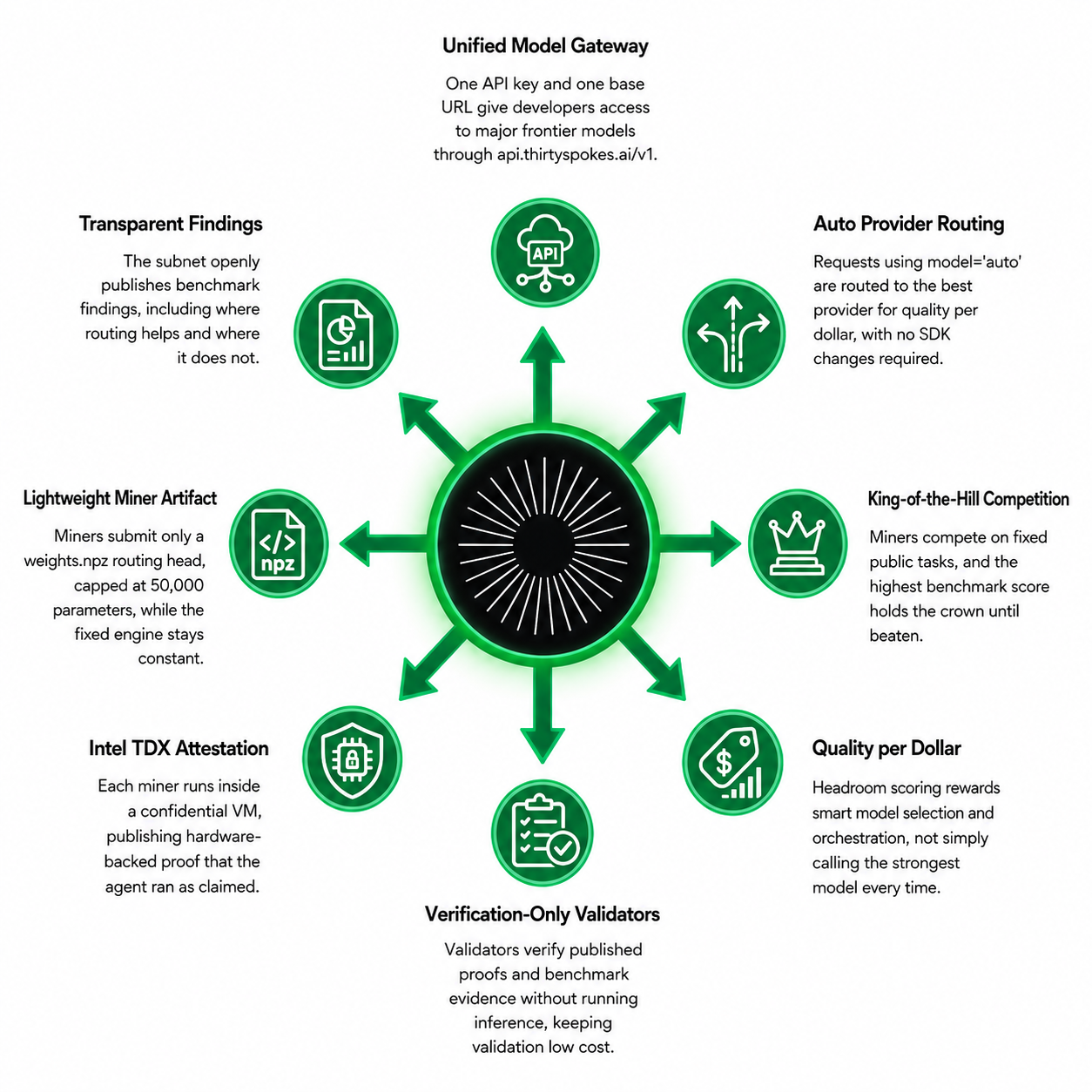
The live product is a drop-in LLM API gateway at https://api.thirtyspokes.ai/v1, compatible with both the OpenAI and Anthropic SDKs. One line of code — changing the base_url in an existing client — gives access to every major AI provider through the same interface. Request model="auto" and the network routes intelligently; pin any model by its provider name when a specific capability or cost profile is required. Streaming, tool use, and structured output pass through unchanged, so the gateway is a transparent drop-in with no workflow disruption.
The target users are developers and teams that work across multiple AI providers and want a single interface without managing separate accounts, rate limits, and SDK integrations. The deeper value proposition is decentralisation: instead of trusting a single commercial operator’s routing decisions, Thirty Spokes routes via an open competition where any miner can participate, all benchmark results are public, and no single entity can become a gatekeeper to the models developers rely on.
Technically, the architecture is cleanly separated. Miners run their routing agents inside their own Intel TDX confidential VMs using their own OpenRouter API keys — they bear their own inference costs and are scored on how efficiently they spend them. Validators run CPU-only on standard VPS hardware, verifying attested proofs and grading answers against public benchmark gold. The subnet owner governs the approved runtime measurements, the allowed model pool, and the benchmark suite on-chain, with validators reading governance state each epoch so policy updates take effect at the next boundary without a hard upgrade.
The ranked benchmark is LiveCodeBench (weight 1.0), chosen because it represents a non-saturated regime where model routing decisions genuinely matter — code tasks have measurable difficulty variation across the allowed pool. MMLU and GSM8K run as eligibility floors (weight 0.0), catching broken agents without inflating scores on tasks where every pool model performs identically. Up to five slots — the current king plus the four most recent ex-kings still actively mining — share emissions equally at 20% each, creating a stable incumbency chain that reflects sustained routing quality over time rather than single-epoch variance.
The incentive structure aligns directly with the product’s goal. The miner earning the most TAO is the one whose routing agent delivers the best benchmark quality per dollar on real code problems. That is precisely the capability developers purchasing API access need: an agent that reliably routes cost-efficiently across the frontier without sacrificing quality on the tasks that matter.
The live product is a drop-in LLM API gateway at https://api.thirtyspokes.ai/v1, compatible with both the OpenAI and Anthropic SDKs. One line of code — changing the base_url in an existing client — gives access to every major AI provider through the same interface. Request model="auto" and the network routes intelligently; pin any model by its provider name when a specific capability or cost profile is required. Streaming, tool use, and structured output pass through unchanged, so the gateway is a transparent drop-in with no workflow disruption.
The target users are developers and teams that work across multiple AI providers and want a single interface without managing separate accounts, rate limits, and SDK integrations. The deeper value proposition is decentralisation: instead of trusting a single commercial operator’s routing decisions, Thirty Spokes routes via an open competition where any miner can participate, all benchmark results are public, and no single entity can become a gatekeeper to the models developers rely on.
Technically, the architecture is cleanly separated. Miners run their routing agents inside their own Intel TDX confidential VMs using their own OpenRouter API keys — they bear their own inference costs and are scored on how efficiently they spend them. Validators run CPU-only on standard VPS hardware, verifying attested proofs and grading answers against public benchmark gold. The subnet owner governs the approved runtime measurements, the allowed model pool, and the benchmark suite on-chain, with validators reading governance state each epoch so policy updates take effect at the next boundary without a hard upgrade.
The ranked benchmark is LiveCodeBench (weight 1.0), chosen because it represents a non-saturated regime where model routing decisions genuinely matter — code tasks have measurable difficulty variation across the allowed pool. MMLU and GSM8K run as eligibility floors (weight 0.0), catching broken agents without inflating scores on tasks where every pool model performs identically. Up to five slots — the current king plus the four most recent ex-kings still actively mining — share emissions equally at 20% each, creating a stable incumbency chain that reflects sustained routing quality over time rather than single-epoch variance.
The incentive structure aligns directly with the product’s goal. The miner earning the most TAO is the one whose routing agent delivers the best benchmark quality per dollar on real code problems. That is precisely the capability developers purchasing API access need: an agent that reliably routes cost-efficiently across the frontier without sacrificing quality on the tasks that matter.
Thirty Spokes was founded by Ray Ashman Jr., whose GitHub account (@thirtyspokes) hosts both the subnet’s codebase and his broader software work. Beyond this GitHub attribution, the team has not publicly disclosed detailed founder backgrounds or organisational structure. The technical output — a complete TEE attestation stack verified on real Intel TDX hardware, a custom KOTH scoring protocol, a published pip package (thirtyspokes), and a candid research findings page — suggests a small, technically rigorous team with deep backgrounds in distributed systems, applied machine learning, and Bittensor infrastructure.
The subnet’s documentation culture is notable. The Findings page publishes negative experimental results — including measurements that argue against aspects of their own product — alongside the cases where routing genuinely adds value. This intellectual honesty is rare in the Bittensor ecosystem and reflects a team that is building for long-term credibility rather than short-term hype. All benchmark scripts, experiment results, and full write-ups are available in the public repository, reproducible by anyone.
Thirty Spokes was founded by Ray Ashman Jr., whose GitHub account (@thirtyspokes) hosts both the subnet’s codebase and his broader software work. Beyond this GitHub attribution, the team has not publicly disclosed detailed founder backgrounds or organisational structure. The technical output — a complete TEE attestation stack verified on real Intel TDX hardware, a custom KOTH scoring protocol, a published pip package (thirtyspokes), and a candid research findings page — suggests a small, technically rigorous team with deep backgrounds in distributed systems, applied machine learning, and Bittensor infrastructure.
The subnet’s documentation culture is notable. The Findings page publishes negative experimental results — including measurements that argue against aspects of their own product — alongside the cases where routing genuinely adds value. This intellectual honesty is rare in the Bittensor ecosystem and reflects a team that is building for long-term credibility rather than short-term hype. All benchmark scripts, experiment results, and full write-ups are available in the public repository, reproducible by anyone.
The immediate operational priority is completing the reproducible, locked-down Intel TDX appliance — the measured image that makes attestation truly discriminating on mainnet. Until this image is finalised, validators cannot distinguish between different runtimes on standard cloud TDX guests. The image is a deterministic, dm-verity read-only environment with no shell, no sshd, and no package manager; it boots straight into the subnet runtime. Two independent builds from the same commit must produce identical RTMR1 and RTMR2 values. This is described in the team’s documentation as the remaining key step before secure enforcement mode is active.
Several protocol refinements are implemented and tested but remain off by default, to be enabled per-validator once calibrated on testnet: evidence accumulation scoring (pooling attested results across epochs under a decayed Wilson lower bound for more stable winner selection), the commit-window anti-grind guard (requiring each epoch’s proof hash to be committed on-chain within a fixed window, capping best-of-N gaming), and the grace-blocks settlement window (ensuring decoupled validators agree on which epoch they are scoring). AMD SEV-SNP attestation support — following the same shape as the TDX backend but requiring a different parser — is scoped for a future release.
On the competition side, the team’s published research identifies orchestration diversity — training agents that select different scaffolding strategies per task type — as the axis with the clearest unmined headroom. The Findings page documents that a cheap scaffolded agent matched a naive frontier agent at one-seventeenth the cost on their preliminary measurements. Future benchmark suite expansions are expected to focus on non-saturated traffic regimes where routing decisions have measurable impact, building on the LiveCodeBench foundation already in production.
The immediate operational priority is completing the reproducible, locked-down Intel TDX appliance — the measured image that makes attestation truly discriminating on mainnet. Until this image is finalised, validators cannot distinguish between different runtimes on standard cloud TDX guests. The image is a deterministic, dm-verity read-only environment with no shell, no sshd, and no package manager; it boots straight into the subnet runtime. Two independent builds from the same commit must produce identical RTMR1 and RTMR2 values. This is described in the team’s documentation as the remaining key step before secure enforcement mode is active.
Several protocol refinements are implemented and tested but remain off by default, to be enabled per-validator once calibrated on testnet: evidence accumulation scoring (pooling attested results across epochs under a decayed Wilson lower bound for more stable winner selection), the commit-window anti-grind guard (requiring each epoch’s proof hash to be committed on-chain within a fixed window, capping best-of-N gaming), and the grace-blocks settlement window (ensuring decoupled validators agree on which epoch they are scoring). AMD SEV-SNP attestation support — following the same shape as the TDX backend but requiring a different parser — is scoped for a future release.
On the competition side, the team’s published research identifies orchestration diversity — training agents that select different scaffolding strategies per task type — as the axis with the clearest unmined headroom. The Findings page documents that a cheap scaffolded agent matched a naive frontier agent at one-seventeenth the cost on their preliminary measurements. Future benchmark suite expansions are expected to focus on non-saturated traffic regimes where routing decisions have measurable impact, building on the LiveCodeBench foundation already in production.