
With the amount of new subnets being added it can be hard to get up to date information across all subnets, so data may be slightly out of date from time to time
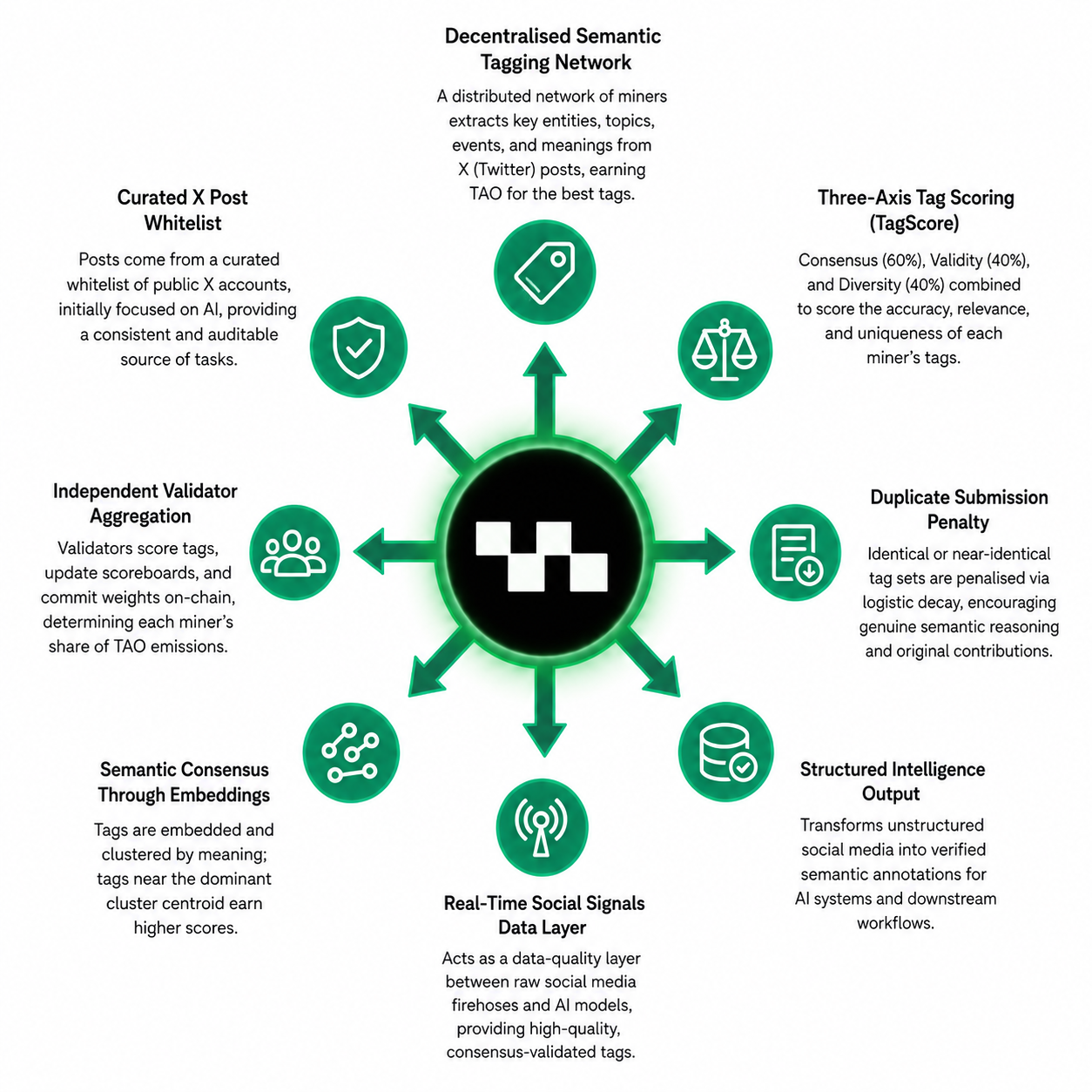
Tag101 is Bittensor Subnet 101 (SN101) — a decentralised semantic tagging network that transforms unstructured social media posts into structured, machine-readable intelligence. Miners on the subnet receive individual X (Twitter) posts and produce a compact set of tags identifying the key entities, topics, events, and contextual meanings within each post. Rather than relying on a single centralised model, Tag101 lets a distributed network of independent miners compete to produce the most accurate and semantically rich tags, with the best contributors rewarded in TAO emissions.
Each miner’s tags are scored along three axes, combined into a final TagScore: Consensus (60% weight) — tags are embedded and clustered by semantic similarity; a tag scores higher when it lands near the centroid of a large, dominant cluster, reflecting how strongly it aligns with the network’s collective interpretation of the post. Validity (factored at 40%) — measures relevance to the original post and basic formatting compliance, mapped into discrete tiers (0, 0.3, 0.6, 1.0) to keep scoring stable against marginal or malformed submissions. Diversity (also factored at 40%) — penalises semantic redundancy within a miner’s own tag set, rewarding miners who provide distinct, non-overlapping coverage of the post’s meaning.
A miner’s final task score is the average TagScore across all submitted tags, then adjusted by a duplicate-submission penalty. When many miners submit identical tag sets, a logistic decay function progressively reduces each miner’s score — discouraging copy-paste strategies and incentivising genuine semantic reasoning. Over time, validators aggregate task-level performance into exponentially weighted scoreboards, which drive on-chain weight updates and determine each miner’s share of TAO emissions.
Posts flow from a curated whitelist of public X accounts, giving the subnet a consistent domain for evaluating miner performance. In the initial phase, the whitelist focuses on AI-related accounts, forming a coherent topic season. Validators query this centralised post database via API and distribute individual posts as independent tagging tasks, creating a transparent and auditable source of ground-truth content. The whitelist can be rotated as the subnet matures, allowing Tag101 to expand into new domains over time.
What makes Tag101 distinctive within the Bittensor ecosystem is its application of decentralised consensus to a concrete data-labelling problem. Instead of producing raw model outputs or predictions, SN101 produces verified semantic annotations — a form of collective intelligence where each tag’s value is validated against the agreement of independent peers. This positions Tag101 as a data-quality layer for real-time social signals, sitting between raw social media firehoses and the downstream AI workflows that consume structured data.
Tag101 is Bittensor Subnet 101 (SN101) — a decentralised semantic tagging network that transforms unstructured social media posts into structured, machine-readable intelligence. Miners on the subnet receive individual X (Twitter) posts and produce a compact set of tags identifying the key entities, topics, events, and contextual meanings within each post. Rather than relying on a single centralised model, Tag101 lets a distributed network of independent miners compete to produce the most accurate and semantically rich tags, with the best contributors rewarded in TAO emissions.
Each miner’s tags are scored along three axes, combined into a final TagScore: Consensus (60% weight) — tags are embedded and clustered by semantic similarity; a tag scores higher when it lands near the centroid of a large, dominant cluster, reflecting how strongly it aligns with the network’s collective interpretation of the post. Validity (factored at 40%) — measures relevance to the original post and basic formatting compliance, mapped into discrete tiers (0, 0.3, 0.6, 1.0) to keep scoring stable against marginal or malformed submissions. Diversity (also factored at 40%) — penalises semantic redundancy within a miner’s own tag set, rewarding miners who provide distinct, non-overlapping coverage of the post’s meaning.
A miner’s final task score is the average TagScore across all submitted tags, then adjusted by a duplicate-submission penalty. When many miners submit identical tag sets, a logistic decay function progressively reduces each miner’s score — discouraging copy-paste strategies and incentivising genuine semantic reasoning. Over time, validators aggregate task-level performance into exponentially weighted scoreboards, which drive on-chain weight updates and determine each miner’s share of TAO emissions.
Posts flow from a curated whitelist of public X accounts, giving the subnet a consistent domain for evaluating miner performance. In the initial phase, the whitelist focuses on AI-related accounts, forming a coherent topic season. Validators query this centralised post database via API and distribute individual posts as independent tagging tasks, creating a transparent and auditable source of ground-truth content. The whitelist can be rotated as the subnet matures, allowing Tag101 to expand into new domains over time.
What makes Tag101 distinctive within the Bittensor ecosystem is its application of decentralised consensus to a concrete data-labelling problem. Instead of producing raw model outputs or predictions, SN101 produces verified semantic annotations — a form of collective intelligence where each tag’s value is validated against the agreement of independent peers. This positions Tag101 as a data-quality layer for real-time social signals, sitting between raw social media firehoses and the downstream AI workflows that consume structured data.
The product at tag101.ai packages SN101’s decentralised output as a real-time semantic intelligence feed. The pipeline runs in four stages: Ingest — curated posts are pulled from a vetted whitelist of social accounts; Label — the miner network applies distributed tagging, with each miner generating its own set of structured tags per post; Cluster — tags from all miners are embedded and grouped into semantic clusters, surfacing the dominant interpretation of each post; Score — validated clusters become structured semantic signals, ranked by consensus strength and filtered for quality.
The intended customers are organisations that need to make sense of high-volume, unstructured social conversation: social media analytics companies, market research divisions, hedge funds monitoring sentiment, and AI developers building training datasets or retrieval-augmented systems. Tag101 addresses a core problem in all these use cases — keyword-based search and single-model tagging are brittle and opinionated, while Tag101’s consensus mechanism produces labels that reflect how the broader information ecosystem actually interprets a post, making them more robust and generalisable.
On the technical side, each miner runs a lightweight HTTP server (MinerServer) that listens for signed task envelopes over a FastAPI endpoint. The reference miner implementation uses OpenAI’s chat completion API to generate tags from the post text, but miners can substitute any language model or custom logic. Validators run a continuous loop — leasing task batches, querying miners in parallel, scoring responses through the consensus/validity/diversity pipeline, updating a local scoreboard, and periodically submitting signed weight vectors on-chain. The entire stack ships with Docker and PM2 deployment configurations for straightforward node operation.
Bittensor’s incentive layer aligns miner behaviour directly with product quality. Miners that consistently produce high-quality, novel, and semantically accurate tags earn greater TAO rewards, while those submitting redundant or irrelevant tags are progressively down-weighted. This creates a self-organising quality-control system: as the miner ecosystem grows, the consensus mechanism becomes harder to game and the resulting semantic signals become more reliable — improving the product for downstream users without central coordination.
A planned Open Intelligence API (Roadmap Phase 4) will expose scored semantic signals as public endpoints for builders, analysts, and autonomous agents, positioning Tag101 as an infrastructure layer for social-media-derived knowledge rather than just an internal data pipeline.
The product at tag101.ai packages SN101’s decentralised output as a real-time semantic intelligence feed. The pipeline runs in four stages: Ingest — curated posts are pulled from a vetted whitelist of social accounts; Label — the miner network applies distributed tagging, with each miner generating its own set of structured tags per post; Cluster — tags from all miners are embedded and grouped into semantic clusters, surfacing the dominant interpretation of each post; Score — validated clusters become structured semantic signals, ranked by consensus strength and filtered for quality.
The intended customers are organisations that need to make sense of high-volume, unstructured social conversation: social media analytics companies, market research divisions, hedge funds monitoring sentiment, and AI developers building training datasets or retrieval-augmented systems. Tag101 addresses a core problem in all these use cases — keyword-based search and single-model tagging are brittle and opinionated, while Tag101’s consensus mechanism produces labels that reflect how the broader information ecosystem actually interprets a post, making them more robust and generalisable.
On the technical side, each miner runs a lightweight HTTP server (MinerServer) that listens for signed task envelopes over a FastAPI endpoint. The reference miner implementation uses OpenAI’s chat completion API to generate tags from the post text, but miners can substitute any language model or custom logic. Validators run a continuous loop — leasing task batches, querying miners in parallel, scoring responses through the consensus/validity/diversity pipeline, updating a local scoreboard, and periodically submitting signed weight vectors on-chain. The entire stack ships with Docker and PM2 deployment configurations for straightforward node operation.
Bittensor’s incentive layer aligns miner behaviour directly with product quality. Miners that consistently produce high-quality, novel, and semantically accurate tags earn greater TAO rewards, while those submitting redundant or irrelevant tags are progressively down-weighted. This creates a self-organising quality-control system: as the miner ecosystem grows, the consensus mechanism becomes harder to game and the resulting semantic signals become more reliable — improving the product for downstream users without central coordination.
A planned Open Intelligence API (Roadmap Phase 4) will expose scored semantic signals as public endpoints for builders, analysts, and autonomous agents, positioning Tag101 as an infrastructure layer for social-media-derived knowledge rather than just an internal data pipeline.
Tag101 operates anonymously as of August 2026. Neither the GitHub organisation (tag101-ai) nor the Bittensor on-chain subnet registration discloses the names of the founders or team members. The GitHub repository carries a single contributor and no public team roster, bio, or linked social profiles. SubnetRadar flags SN101 as having no verifiable on-chain identity, which it treats as an elevated risk signal until a team publicly claims the subnet.
What can be inferred from the technical output is that the team has solid experience with both distributed systems and language model tooling. The codebase demonstrates familiarity with Bittensor’s internals — custom HTTP transport layers, signed task envelopes, nonce-based authentication, and on-chain scoreboard mechanics — alongside a well-structured scoring system grounded in semantic embedding and clustering. The reference miner leverages the OpenAI API, suggesting the team works comfortably across the LLM ecosystem. The project launched with a functioning subnet and a polished marketing site (tag101.ai) before any public team announcement, which is consistent with a technically proficient but privacy-conscious founding team.
There are no named founders, advisors, or backers disclosed in any public channel as of the time of writing. If you are associated with the Tag101 team and would like to update this page, please get in touch with Subnet Alpha.
Tag101 operates anonymously as of August 2026. Neither the GitHub organisation (tag101-ai) nor the Bittensor on-chain subnet registration discloses the names of the founders or team members. The GitHub repository carries a single contributor and no public team roster, bio, or linked social profiles. SubnetRadar flags SN101 as having no verifiable on-chain identity, which it treats as an elevated risk signal until a team publicly claims the subnet.
What can be inferred from the technical output is that the team has solid experience with both distributed systems and language model tooling. The codebase demonstrates familiarity with Bittensor’s internals — custom HTTP transport layers, signed task envelopes, nonce-based authentication, and on-chain scoreboard mechanics — alongside a well-structured scoring system grounded in semantic embedding and clustering. The reference miner leverages the OpenAI API, suggesting the team works comfortably across the LLM ecosystem. The project launched with a functioning subnet and a polished marketing site (tag101.ai) before any public team announcement, which is consistent with a technically proficient but privacy-conscious founding team.
There are no named founders, advisors, or backers disclosed in any public channel as of the time of writing. If you are associated with the Tag101 team and would like to update this page, please get in touch with Subnet Alpha.
Tag101’s public roadmap outlines four sequential milestones, two of which are already live. Phase 1 — Tag Consensus (Live): the foundational scoring mechanism is operational, with miners submitting tags, validators clustering and scoring them, and on-chain weights being updated accordingly. Phase 2 — LLM-Based Scoring (Planned): the team intends to augment or replace clustering-based consensus with advanced language model evaluation, enabling richer assessment of semantic relevance, contextual fit, and tag quality beyond what embedding similarity alone can capture.
Phase 3 — Insight Tags (Planned): the subnet will move beyond direct topic labelling toward higher-order semantic annotations — capturing implications, relationships between concepts, and latent meanings within social posts. This would elevate Tag101’s output from basic keyword extraction to genuine semantic intelligence. Phase 4 — Open Intelligence API (Planned): scored semantic signals will be exposed as accessible, public API endpoints for downstream builders, analysts, and autonomous agents, completing the transformation of SN101 into a live social-intelligence data product rather than a closed internal pipeline.
Beyond the formal roadmap, the architecture supports natural expansion through its whitelist rotation mechanism, which allows Tag101 to extend into new topic domains — financial news, sports, politics, science — as the miner ecosystem matures. The combination of a live consensus engine, a clear product roadmap, and an open-source miner framework positions Tag101 as an early entrant in the decentralised data-labelling space with a specific and defensible niche in social media semantics.
Tag101’s public roadmap outlines four sequential milestones, two of which are already live. Phase 1 — Tag Consensus (Live): the foundational scoring mechanism is operational, with miners submitting tags, validators clustering and scoring them, and on-chain weights being updated accordingly. Phase 2 — LLM-Based Scoring (Planned): the team intends to augment or replace clustering-based consensus with advanced language model evaluation, enabling richer assessment of semantic relevance, contextual fit, and tag quality beyond what embedding similarity alone can capture.
Phase 3 — Insight Tags (Planned): the subnet will move beyond direct topic labelling toward higher-order semantic annotations — capturing implications, relationships between concepts, and latent meanings within social posts. This would elevate Tag101’s output from basic keyword extraction to genuine semantic intelligence. Phase 4 — Open Intelligence API (Planned): scored semantic signals will be exposed as accessible, public API endpoints for downstream builders, analysts, and autonomous agents, completing the transformation of SN101 into a live social-intelligence data product rather than a closed internal pipeline.
Beyond the formal roadmap, the architecture supports natural expansion through its whitelist rotation mechanism, which allows Tag101 to extend into new topic domains — financial news, sports, politics, science — as the miner ecosystem matures. The combination of a live consensus engine, a clear product roadmap, and an open-source miner framework positions Tag101 as an early entrant in the decentralised data-labelling space with a specific and defensible niche in social media semantics.