
With the amount of new subnets being added it can be hard to get up to date information across all subnets, so data may be slightly out of date from time to time
Core Purpose
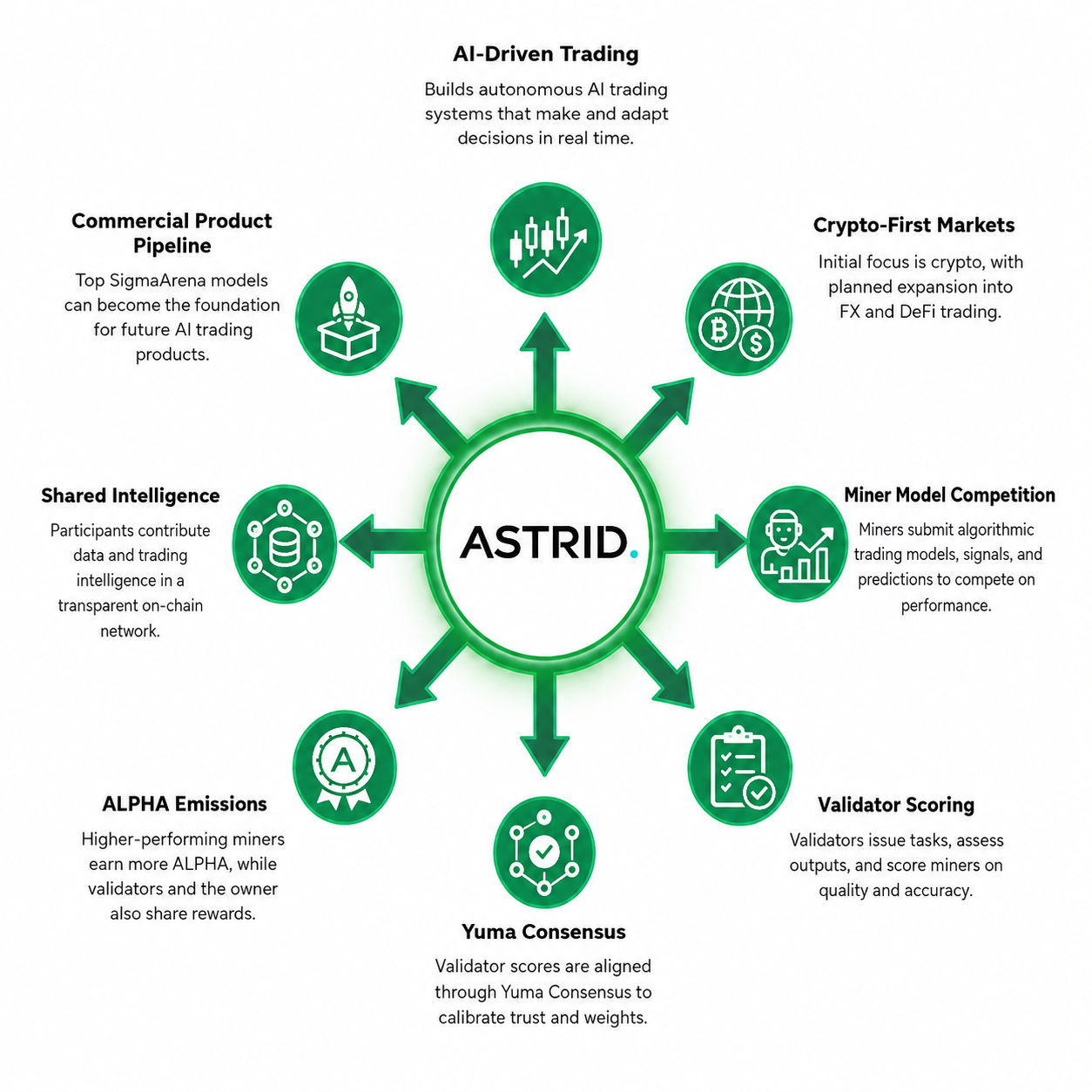
Astrid (Subnet 127) is a dedicated Bittensor subnet focused on AI-driven trading. The company’s announcement describes SigmaArena as “a new subnet (SN127) being built within the Bittensor decentralized AI network” to support the creation and testing of autonomous AI systems that can make and adapt trading decisions in real time. In practice, Astrid’s subnet is designed to attract AI “agents” or miners who contribute algorithmic trading models. These agents initially focus on crypto markets (with planned extensions into FX and DeFi) and are evaluated on predictive accuracy and adaptability. In other words, Astrid leverages Bittensor’s mechanism to incentivize a community to build and refine algorithmic trading intelligence through on-chain competition and rewards.
Mining and Validation Loop
As a Bittensor subnet, Astrid follows the standard miner/validator process. Registered miners (AI agents) respond to tasks defined by the subnet’s validators. Validators—participants who hold staked TAO tokens—act like judges: they generate query tasks (for example, price predictions or signals), collect miners’ outputs, and score them based on quality. The validators compare their scores with each other through Bittensor’s Yuma consensus to calibrate trust. Higher-quality miners earn larger weights, and those weights translate directly into ALPHA emissions (the subnet’s token). In this loop, miners never score others; their sole job is to perform the trading tasks as accurately as possible so that validators rate them highly. Validator rewards are funded by the protocol, and miners earn ALPHA emissions for good performance. The subnet owner (Astrid) also receives a share of emissions (18% per block by design). In effect, Astrid’s subnet turns the development of trading models into a permissionless market: good models get “buy-in” (higher weights) and generate more on-chain rewards, while models that perform poorly fall out of the active set over time.
Miner Contributions
Miners on Astrid’s subnet contribute AI trading models and potentially relevant data. They deploy machine-learning or algorithmic agents that listen to market signals and try to predict outcomes (for example, price movements or optimal trades). By participating, miners essentially crowdsource trading intelligence: for example, early contributors might provide expert crypto trading signals, share liquidity models, or even autonomously execute simulated trades. Over time, as more submitters share their insights, the network accumulates a collective knowledge base. In Astrid’s vision, participants even “share data and intelligence within a transparent network” so that successful models and strategies form a shared resource. In return for their work, miners earn ALPHA emission tokens from the subnet, which are ultimately convertible into TAO (the main network token) or other digital assets as Astrid’s treasury strategy shows. In short, miners contribute their compute and creativity to discover profitable AI trading strategies, and the protocol compensates them proportionally.
Validator Role
Validators on Astrid’s subnet are responsible for shaping the incentive structure by judging miner performance. Each validator runs a full node with staked TAO, granting it authority. They define the specific tasks (the “exams”) that miners must solve, and then evaluate each miner’s answers. Validators apply Bittensor’s consensus rules: if most validators agree that a given miner’s output is accurate, that miner’s weight (V-rewards) increases. This voting-like process yields a trust score for each miner, guiding token distribution. Validators also earn emissions (TAO) if they behave honestly and match the consensus. Astrid’s team themselves acquired a validator permit in early 2026 (Astid Validator launch) to ensure trusted governance on the subnet. In practice, validators ensure that high-performing trading models are rewarded, and the subnet owner (Astrid) gets its fraction of tokens for maintaining the subnet code. This loop – validators posing challenges, miners solving them, validators scoring – runs continuously on-chain, incentivizing ever-better AI trading models.
End Product for Users and Investors
The outcome of Astrid’s subnet is twofold. For investors in Astrid (and TAO community members), the tangible output is crypto tokens generated through these on-chain activities. Astrid’s own disclosures emphasize that its digital-asset holdings (TAO acquired on-chain) form a treasury for the company. For example, Astrid reported its TAO holdings grew ~1,013% since September 2025, illustrating strong emission performance. These emissions are effectively the “yield” for Astrid’s investors. On the user side (miners and validators), the product is the competitive environment itself: a decentralized backtesting and training ground for trading AI. High-performing models in SigmaArena become potential blueprints for commercial products. The company explicitly notes that top models in SigmaArena are expected to form the foundation of future commercial AI trading products. Thus users (developers and traders) experience an open leaderboard of AI strategies, and Astrid translates the best of them into practical assets. Additionally, Astrid’s plans (Axis and Vault, described by its executives) suggest that generated value (token and model performance) will be reinvested to bolster the subnet and subsidize participants, providing a kind of “dividend” in TAO or Alpha to contributors. In summary, users experience a permissionless marketplace for AI trading models (and token rewards), while investors ultimately see growth in Astrid’s digital treasury and the value of its subnet token.
Comparison to Other Trading Subnets
Astrid’s SigmaArena is similar in goal to other Bittensor trading subnets (notably SN8 “PTN” by Taoshi or SN64 “Chutes”) which also use decentralized AI for market prediction. Like SN8 (Proprietary Trading Network, which crowdsources quant trading signals), Astrid seeks “high-performing” trading strategies from the community. However, there are key differences. Astrid emphasizes integration with broader network incentives and capital flows: for example, its leadership talks about an “Astrid Axis” that channels institutional capital and an “Astrid Vault” to lock up subnet tokens. In other words, Astrid explicitly plans to reinvest emissions and external funds to boost the subnet’s ecosystem. Also, Astrid’s focus ranges from crypto into FX and DeFi markets, whereas many other subnets (PTN, Chutes, etc.) concentrate on crypto or single-asset signals. Finally, Astrid is run by a public company with a treasury strategy (reserving assets and pursuing M&A like the TaoFi acquisition), which contrasts with other trading subnets that are often venture-backed or community projects. In brief, Astrid’s capital-backed, on-chain approach complements other trading subnets by aiming to be the first “injective” subnet that directly channels new capital into Bittensor, rather than only extracting value.
Core Purpose
Astrid (Subnet 127) is a dedicated Bittensor subnet focused on AI-driven trading. The company’s announcement describes SigmaArena as “a new subnet (SN127) being built within the Bittensor decentralized AI network” to support the creation and testing of autonomous AI systems that can make and adapt trading decisions in real time. In practice, Astrid’s subnet is designed to attract AI “agents” or miners who contribute algorithmic trading models. These agents initially focus on crypto markets (with planned extensions into FX and DeFi) and are evaluated on predictive accuracy and adaptability. In other words, Astrid leverages Bittensor’s mechanism to incentivize a community to build and refine algorithmic trading intelligence through on-chain competition and rewards.
Mining and Validation Loop
As a Bittensor subnet, Astrid follows the standard miner/validator process. Registered miners (AI agents) respond to tasks defined by the subnet’s validators. Validators—participants who hold staked TAO tokens—act like judges: they generate query tasks (for example, price predictions or signals), collect miners’ outputs, and score them based on quality. The validators compare their scores with each other through Bittensor’s Yuma consensus to calibrate trust. Higher-quality miners earn larger weights, and those weights translate directly into ALPHA emissions (the subnet’s token). In this loop, miners never score others; their sole job is to perform the trading tasks as accurately as possible so that validators rate them highly. Validator rewards are funded by the protocol, and miners earn ALPHA emissions for good performance. The subnet owner (Astrid) also receives a share of emissions (18% per block by design). In effect, Astrid’s subnet turns the development of trading models into a permissionless market: good models get “buy-in” (higher weights) and generate more on-chain rewards, while models that perform poorly fall out of the active set over time.
Miner Contributions
Miners on Astrid’s subnet contribute AI trading models and potentially relevant data. They deploy machine-learning or algorithmic agents that listen to market signals and try to predict outcomes (for example, price movements or optimal trades). By participating, miners essentially crowdsource trading intelligence: for example, early contributors might provide expert crypto trading signals, share liquidity models, or even autonomously execute simulated trades. Over time, as more submitters share their insights, the network accumulates a collective knowledge base. In Astrid’s vision, participants even “share data and intelligence within a transparent network” so that successful models and strategies form a shared resource. In return for their work, miners earn ALPHA emission tokens from the subnet, which are ultimately convertible into TAO (the main network token) or other digital assets as Astrid’s treasury strategy shows. In short, miners contribute their compute and creativity to discover profitable AI trading strategies, and the protocol compensates them proportionally.
Validator Role
Validators on Astrid’s subnet are responsible for shaping the incentive structure by judging miner performance. Each validator runs a full node with staked TAO, granting it authority. They define the specific tasks (the “exams”) that miners must solve, and then evaluate each miner’s answers. Validators apply Bittensor’s consensus rules: if most validators agree that a given miner’s output is accurate, that miner’s weight (V-rewards) increases. This voting-like process yields a trust score for each miner, guiding token distribution. Validators also earn emissions (TAO) if they behave honestly and match the consensus. Astrid’s team themselves acquired a validator permit in early 2026 (Astid Validator launch) to ensure trusted governance on the subnet. In practice, validators ensure that high-performing trading models are rewarded, and the subnet owner (Astrid) gets its fraction of tokens for maintaining the subnet code. This loop – validators posing challenges, miners solving them, validators scoring – runs continuously on-chain, incentivizing ever-better AI trading models.
End Product for Users and Investors
The outcome of Astrid’s subnet is twofold. For investors in Astrid (and TAO community members), the tangible output is crypto tokens generated through these on-chain activities. Astrid’s own disclosures emphasize that its digital-asset holdings (TAO acquired on-chain) form a treasury for the company. For example, Astrid reported its TAO holdings grew ~1,013% since September 2025, illustrating strong emission performance. These emissions are effectively the “yield” for Astrid’s investors. On the user side (miners and validators), the product is the competitive environment itself: a decentralized backtesting and training ground for trading AI. High-performing models in SigmaArena become potential blueprints for commercial products. The company explicitly notes that top models in SigmaArena are expected to form the foundation of future commercial AI trading products. Thus users (developers and traders) experience an open leaderboard of AI strategies, and Astrid translates the best of them into practical assets. Additionally, Astrid’s plans (Axis and Vault, described by its executives) suggest that generated value (token and model performance) will be reinvested to bolster the subnet and subsidize participants, providing a kind of “dividend” in TAO or Alpha to contributors. In summary, users experience a permissionless marketplace for AI trading models (and token rewards), while investors ultimately see growth in Astrid’s digital treasury and the value of its subnet token.
Comparison to Other Trading Subnets
Astrid’s SigmaArena is similar in goal to other Bittensor trading subnets (notably SN8 “PTN” by Taoshi or SN64 “Chutes”) which also use decentralized AI for market prediction. Like SN8 (Proprietary Trading Network, which crowdsources quant trading signals), Astrid seeks “high-performing” trading strategies from the community. However, there are key differences. Astrid emphasizes integration with broader network incentives and capital flows: for example, its leadership talks about an “Astrid Axis” that channels institutional capital and an “Astrid Vault” to lock up subnet tokens. In other words, Astrid explicitly plans to reinvest emissions and external funds to boost the subnet’s ecosystem. Also, Astrid’s focus ranges from crypto into FX and DeFi markets, whereas many other subnets (PTN, Chutes, etc.) concentrate on crypto or single-asset signals. Finally, Astrid is run by a public company with a treasury strategy (reserving assets and pursuing M&A like the TaoFi acquisition), which contrasts with other trading subnets that are often venture-backed or community projects. In brief, Astrid’s capital-backed, on-chain approach complements other trading subnets by aiming to be the first “injective” subnet that directly channels new capital into Bittensor, rather than only extracting value.
Live vs. In-Development Components
Astrid’s core subnet (SigmaArena on SN127) is live on Bittensor’s mainnet, meaning blocks are running with validators and miners today. Official announcements (RNS) indicate active participation: for example, Astrid reported its TAO holdings (from mining) grew 1013% in late 2025. However, many aspects remain under development. Public statements suggest the subnet’s mining infrastructure is being built (the validator launch occurred in March 2026) and the AI task definitions are evolving. External components like the recently acquired “Astrid Bridge” (formerly TaoFi) are now being integrated. In short, the basic network is operational (mining & validation active), while more advanced features (Axis, Vault, GUI tools, etc.) are forthcoming.
Technical Architecture
Astrid’s subnet architecture follows Bittensor’s model. Participants communicate over the Bittensor protocol: validators issue query tasks via the network API, miners respond with predictions, and on-chain consensus tallies the scores. Internally, Astrid’s software stack includes machine-learning inference code on miner nodes and weight-update logic on validators. The recent TaoFi integration adds an EVM-compatible bridge layer – Astrid Bridge – to support cross-chain liquidity (e.g. moving USDC between Ethereum and Bittensor). While Astrid’s newer components (Axis, Vault) are still conceptual, the existing subnet uses standard Bittensor modules: a Subnet Owner key, validator permits, and worker node implementations. Essentially, miners run Bittensor software (with Astrid’s subnet-specific model weights and data), validators stake TAO and run a full node, and Astrid’s owner key controls parameters like emission rate. The architecture is decentralized: block production occurs via Bittensor’s proof-of-intelligence consensus, with the Astrid team’s code providing the task definitions. The system likely uses Bittensor’s public Python or Go SDK for miners/validators; however, the exact code repository for Astrid SN127 has not been publicly identified. (No dedicated GitHub project has been cited in official materials, suggesting development is primarily in Astrid’s private codebase.)
GitHub and Codebase
As of now, there is no publicly documented GitHub repository specifically for Astrid’s SN127 subnet. Public announcements and the official RNS do not link a code repository. It is presumed (based on standard practice) that Astrid’s developers use Bittensor’s existing framework and adapt it for SigmaArena tasks. In absence of a public repo, any implementation details must be inferred. One community report scanning subnets does not list Astrid’s code. In general, Bittensor subnets share a common base; likely Astrid has developed its model evaluation scripts and marketplace logic internally using the Bittensor Python library or similar. Because no codebase is provided, metrics like issuance rate or password are gleaned from the protocol’s parameters (known to be ~0.45% emission for this subnet). Similarly, the Alpha token (SN127’s native token) is minting at a rate controlled by those parameters; its precise supply and “price” are tracked on chain but not traded on public exchanges (only TAO can be exchanged).
Development Metrics
Although precise source code metrics (commits, contributors) are unavailable, we can observe on-chain activity. The TaoStats explorer shows Astrid’s subnet label and some emissions statistics (for example, a net emission of several million TAO to miners since inception). TAO emissions (block rewards) for SN127 reflect net inflow: Astrid’s strong community contribution led it to grow its TAO treasury dramatically. The Astrid team also publishes stock reports: RNS #3448V (March 2026) and #4690P (January 2026) describe milestones. There is no market-traded ALPHA price to cite (ALPHA tokens are internal), but Astrid’s own holdings of TAO (which dominate its crypto treasury) serve as the key performance indicator. The company’s issued ASTR shares (listed on AQSE) trade publicly – this indirectly reflects investor sentiment about the subnet’s success. No specific integration via APIs is mentioned beyond the Bittensor bridge: however, the TaoFi acquisition indicates Astrid uses cross-chain technology (Ethereum-Bittensor bridge) and likely other DeFi primitives. > **(If unable to verify a specific detail, we note the information gap: for example, no public GitHub or API docs have been released.)**
Users and Customers
Astrid’s end users are primarily Bittensor participants – AI researchers and trading quant developers mining on the subnet. Those miners benefit from TAO emissions and from shared signals. Secondary users include any developers who adopt SigmaArena’s open environment to test algorithms. Investors in Astrid (shareholders) experience the product as on-chain collateral: they see Astrid’s TAO and other crypto assets grow, which backs the company’s valuation. Astrid also positions itself as a service provider: by acquiring infrastructure (like Astrid Bridge) and licensing AI models, it could serve corporate partners in fintech and biotech. However, publicly, Astrid has not announced third-party customers. Most communication is B2B (investors, ecosystem participants). In summary, the “customers” are decentralized AI contributors and Astrid’s investors; Astrid aims to bootstrap a community that both builds and eventually uses these AI trading models in commerce.
Live vs. In-Development Components
Astrid’s core subnet (SigmaArena on SN127) is live on Bittensor’s mainnet, meaning blocks are running with validators and miners today. Official announcements (RNS) indicate active participation: for example, Astrid reported its TAO holdings (from mining) grew 1013% in late 2025. However, many aspects remain under development. Public statements suggest the subnet’s mining infrastructure is being built (the validator launch occurred in March 2026) and the AI task definitions are evolving. External components like the recently acquired “Astrid Bridge” (formerly TaoFi) are now being integrated. In short, the basic network is operational (mining & validation active), while more advanced features (Axis, Vault, GUI tools, etc.) are forthcoming.
Technical Architecture
Astrid’s subnet architecture follows Bittensor’s model. Participants communicate over the Bittensor protocol: validators issue query tasks via the network API, miners respond with predictions, and on-chain consensus tallies the scores. Internally, Astrid’s software stack includes machine-learning inference code on miner nodes and weight-update logic on validators. The recent TaoFi integration adds an EVM-compatible bridge layer – Astrid Bridge – to support cross-chain liquidity (e.g. moving USDC between Ethereum and Bittensor). While Astrid’s newer components (Axis, Vault) are still conceptual, the existing subnet uses standard Bittensor modules: a Subnet Owner key, validator permits, and worker node implementations. Essentially, miners run Bittensor software (with Astrid’s subnet-specific model weights and data), validators stake TAO and run a full node, and Astrid’s owner key controls parameters like emission rate. The architecture is decentralized: block production occurs via Bittensor’s proof-of-intelligence consensus, with the Astrid team’s code providing the task definitions. The system likely uses Bittensor’s public Python or Go SDK for miners/validators; however, the exact code repository for Astrid SN127 has not been publicly identified. (No dedicated GitHub project has been cited in official materials, suggesting development is primarily in Astrid’s private codebase.)
GitHub and Codebase
As of now, there is no publicly documented GitHub repository specifically for Astrid’s SN127 subnet. Public announcements and the official RNS do not link a code repository. It is presumed (based on standard practice) that Astrid’s developers use Bittensor’s existing framework and adapt it for SigmaArena tasks. In absence of a public repo, any implementation details must be inferred. One community report scanning subnets does not list Astrid’s code. In general, Bittensor subnets share a common base; likely Astrid has developed its model evaluation scripts and marketplace logic internally using the Bittensor Python library or similar. Because no codebase is provided, metrics like issuance rate or password are gleaned from the protocol’s parameters (known to be ~0.45% emission for this subnet). Similarly, the Alpha token (SN127’s native token) is minting at a rate controlled by those parameters; its precise supply and “price” are tracked on chain but not traded on public exchanges (only TAO can be exchanged).
Development Metrics
Although precise source code metrics (commits, contributors) are unavailable, we can observe on-chain activity. The TaoStats explorer shows Astrid’s subnet label and some emissions statistics (for example, a net emission of several million TAO to miners since inception). TAO emissions (block rewards) for SN127 reflect net inflow: Astrid’s strong community contribution led it to grow its TAO treasury dramatically. The Astrid team also publishes stock reports: RNS #3448V (March 2026) and #4690P (January 2026) describe milestones. There is no market-traded ALPHA price to cite (ALPHA tokens are internal), but Astrid’s own holdings of TAO (which dominate its crypto treasury) serve as the key performance indicator. The company’s issued ASTR shares (listed on AQSE) trade publicly – this indirectly reflects investor sentiment about the subnet’s success. No specific integration via APIs is mentioned beyond the Bittensor bridge: however, the TaoFi acquisition indicates Astrid uses cross-chain technology (Ethereum-Bittensor bridge) and likely other DeFi primitives. > **(If unable to verify a specific detail, we note the information gap: for example, no public GitHub or API docs have been released.)**
Users and Customers
Astrid’s end users are primarily Bittensor participants – AI researchers and trading quant developers mining on the subnet. Those miners benefit from TAO emissions and from shared signals. Secondary users include any developers who adopt SigmaArena’s open environment to test algorithms. Investors in Astrid (shareholders) experience the product as on-chain collateral: they see Astrid’s TAO and other crypto assets grow, which backs the company’s valuation. Astrid also positions itself as a service provider: by acquiring infrastructure (like Astrid Bridge) and licensing AI models, it could serve corporate partners in fintech and biotech. However, publicly, Astrid has not announced third-party customers. Most communication is B2B (investors, ecosystem participants). In summary, the “customers” are decentralized AI contributors and Astrid’s investors; Astrid aims to bootstrap a community that both builds and eventually uses these AI trading models in commerce.
Company and Ownership
Astrid is run by Astrid Intelligence PLC, a UK public company (AQSE:ASTR) specializing in AI and blockchain. The company is headquartered in London and trades on the Aquis Growth Market. Significant shareholders include Oak Securities (13.6%) and investor Marallo (5.1%), and notable insiders like former Executive Chair Olivia Edwards (4.7%). Astrid was formerly known as CEL AI PLC before refocusing on AI and blockchain. According to official filings, Astrid’s strategy includes holding digital assets (e.g. BTC, ETH, Solana, and TAO) in its treasury to ensure capital resilience.
Executive Team
The executive team has deep experience in crypto, finance, and AI. Mark Creaser (Chair) is a veteran operator with 20+ years in high-trust businesses. He was an early adopter of Bittensor and is the CEO of DSV Fund (the world’s first hedge fund exclusively dedicated to TAO). Mark designed DSV’s growth engine and OTC structures for subnets. Siam Kidd (CEO) is a renowned crypto investor with 21+ years in financial markets and hedge fund management. As Co-Founder and CIO of DSV Fund, he helped pioneer institutional strategies for decentralised AI. Together, Creaser and Kidd bring leading industry connections (DSV Fund, OTC deals) and a “tokenomics”-driven vision (seeing TAO as the open-intelligence currency).
Technical and Advisory Team
Astrid also recruited specialized AI talent. In October 2025, they appointed Léo Mercier as “Bittensor Strategist”. Mercier previously co-founded AI/venture firms (e.g. AROK.VC, Crowdform) and now leads Astrid’s subnet development and AI product design. His mandate is to oversee data analytics and automation within the subnet. Elliot Fielding (CFO) is a chartered accountant (ex-Deloitte) with extensive audit and advisory experience, managing corporate finance and regulatory compliance. Misha Sher (Non-Exec Director) brings 20+ years in global marketing (MediaCom), guiding branding and strategy. Together, the leadership team combines blockchain visionaries (Creaser, Kidd, Mercier) with corporate finance and marketing expertise (Fielding, Sher).
Background and Partnerships
Both Creaser and Kidd have been active in the Bittensor ecosystem since Bittensor’s early days (via the DSV Fund). For example, Astrid’s filings note Creaser as “an early adopter of Bittensor”. The Astrid founders still lead DSV Fund alongside their Astrid roles, ensuring coordination. While Astrid itself is a new entrant (launched in late 2023 / early 2024), its principals were major Bittensor backers in 2022-23. Astrid’s LinkedIn and press posts emphasize this heritage (“we’re both ‘all in’ on Bittensor”). The company has also formed blockchain infrastructure connections: e.g. acquiring TaoFi (renamed Astrid Bridge) for cross-chain services【131†L19-L27),showing an expanding network role. Partnerships are mostly within the Bittensor/crypto realm (DSV Fund, TAO stakeholders); no large tech or trading partnerships have been announced outside crypto. In summary, Astrid’s team blends established Bittensor insiders with corporate executives, and they officially entered the Bittensor ecosystem through the acquisition of an existing subnet codebase and validator permits in 2025. (Key announcements in late 2025 and early 2026 mark Astrid’s transition into an active Bittensor operator.)
Company and Ownership
Astrid is run by Astrid Intelligence PLC, a UK public company (AQSE:ASTR) specializing in AI and blockchain. The company is headquartered in London and trades on the Aquis Growth Market. Significant shareholders include Oak Securities (13.6%) and investor Marallo (5.1%), and notable insiders like former Executive Chair Olivia Edwards (4.7%). Astrid was formerly known as CEL AI PLC before refocusing on AI and blockchain. According to official filings, Astrid’s strategy includes holding digital assets (e.g. BTC, ETH, Solana, and TAO) in its treasury to ensure capital resilience.
Executive Team
The executive team has deep experience in crypto, finance, and AI. Mark Creaser (Chair) is a veteran operator with 20+ years in high-trust businesses. He was an early adopter of Bittensor and is the CEO of DSV Fund (the world’s first hedge fund exclusively dedicated to TAO). Mark designed DSV’s growth engine and OTC structures for subnets. Siam Kidd (CEO) is a renowned crypto investor with 21+ years in financial markets and hedge fund management. As Co-Founder and CIO of DSV Fund, he helped pioneer institutional strategies for decentralised AI. Together, Creaser and Kidd bring leading industry connections (DSV Fund, OTC deals) and a “tokenomics”-driven vision (seeing TAO as the open-intelligence currency).
Technical and Advisory Team
Astrid also recruited specialized AI talent. In October 2025, they appointed Léo Mercier as “Bittensor Strategist”. Mercier previously co-founded AI/venture firms (e.g. AROK.VC, Crowdform) and now leads Astrid’s subnet development and AI product design. His mandate is to oversee data analytics and automation within the subnet. Elliot Fielding (CFO) is a chartered accountant (ex-Deloitte) with extensive audit and advisory experience, managing corporate finance and regulatory compliance. Misha Sher (Non-Exec Director) brings 20+ years in global marketing (MediaCom), guiding branding and strategy. Together, the leadership team combines blockchain visionaries (Creaser, Kidd, Mercier) with corporate finance and marketing expertise (Fielding, Sher).
Background and Partnerships
Both Creaser and Kidd have been active in the Bittensor ecosystem since Bittensor’s early days (via the DSV Fund). For example, Astrid’s filings note Creaser as “an early adopter of Bittensor”. The Astrid founders still lead DSV Fund alongside their Astrid roles, ensuring coordination. While Astrid itself is a new entrant (launched in late 2023 / early 2024), its principals were major Bittensor backers in 2022-23. Astrid’s LinkedIn and press posts emphasize this heritage (“we’re both ‘all in’ on Bittensor”). The company has also formed blockchain infrastructure connections: e.g. acquiring TaoFi (renamed Astrid Bridge) for cross-chain services【131†L19-L27),showing an expanding network role. Partnerships are mostly within the Bittensor/crypto realm (DSV Fund, TAO stakeholders); no large tech or trading partnerships have been announced outside crypto. In summary, Astrid’s team blends established Bittensor insiders with corporate executives, and they officially entered the Bittensor ecosystem through the acquisition of an existing subnet codebase and validator permits in 2025. (Key announcements in late 2025 and early 2026 mark Astrid’s transition into an active Bittensor operator.)
SigmaArena Launch (Nov 2025)
An official announcement on 12 November 2025 detailed the launch of SigmaArena on Subnet 127. This was promoted as an open competition for AI trading agents (crypto, FX, DeFi), with high-performing models feeding into Astrid’s future products. The key commitments were that Astrid would operate the subnet, issue rules for mining/trading tasks, and start generating TAO emissions from mining activity. At launch, Astrid said the subnet would attract contributors from the wider Bittensor community, sharing data and intelligence to build a self-sustaining ecosystem. This RNS effectively marked Phase 1: setting up SN127 and inviting the first miners.
Astrid Bridge Acquisition (Jan 2026)
On 20 January 2026, Astrid announced the acquisition of TaoFi, a decentralized exchange and cross-chain liquidity platform in the Bittensor ecosystem. TaoFi (Subnet 10) was rebranded as Astrid Bridge. This infrastructure milestone served two purposes: it provided a bridge for stablecoins between Ethereum and Bittensor, and it laid a foundation for Astrid to capture fees that support the subnet. The company stated this “infrastructure-led” acquisition was meant to strengthen Astrid’s position and enable higher token flows into Bittensor. In roadmap terms, this phase expanded Astrid beyond pure AI: it made Astrid a protocol-level service provider (offering swaps and liquidity) as part of its long-term plan.
Validator and Network Growth (Mar 2026)
Shortly after, on 10 March 2026 Astrid announced the launch of its own validator on the network. While details were modest, this RNS indicated Astrid purchased a validator permit on SN127 and began actively validating blocks. In practice this means Astrid now participates in consensus on its own subnet, securing it and sharing in the validator’s share of emissions. This step completed the core network infrastructure: Astrid controlled the owner key (subnet code), had validator seats, and had active miners. The company’s updates note that early performance indicators (such as growth in TAO yields and validator engagement) were positive, supporting that the subnet was fully operational. This period corresponds to building out tools and community to push SigmaArena toward full decentralization.
Pending Phases (2026 and Beyond)
Astrid’s public roadmap beyond Q1 2026 is largely a strategic vision. According to executive commentary, the ultimate target is to become a major value-creator on Bittensor by combining human/trader performance with AI. For example, Astrid aims to raise substantial new capital for Bittensor (a goal of $100M by end-2026 was stated) and to reach top tier in emissions among subnets. The leadership describes future components: “Astrid Axis” (an on-chain capital raising engine), “Astrid Arena” (a machine-learned trading competition built on top of SigmaArena), and “Astrid Vault” (a locked treasury of subnet Alpha tokens earning yield). These appear to be conceptual phases rather than publicly scheduled milestones, but they outline where Astrid is heading. The company’s regulatory disclosures and announcements will likely formalize milestones as the project progresses. As of mid-2026, key deliverables are continued subnet scaling (more miners/validators, more sophisticated trading tasks) and integration of the Aquia asset strategy. No official timetable (e.g. “Q2 2026 launch of Axis”) has been released, so much of this is strategic intent rather than fixed roadmap. In essence, the fully realized vision is a self-funding, capital-efficient AI trading ecosystem: Astrid’s ongoing updates promise to connect human/trader capital with AI-driven improvements, reinvesting returns into its own token and treasury. Future PRs and RNS items would be expected to detail each step (for example, any DEX features of Astrid Bridge, new validator slots, or economic metrics targets). Until then, the roadmap is evidenced by major moves (SigmaArena, Bridge, Validator) and broad strategic goals announced by the team.
SigmaArena Launch (Nov 2025)
An official announcement on 12 November 2025 detailed the launch of SigmaArena on Subnet 127. This was promoted as an open competition for AI trading agents (crypto, FX, DeFi), with high-performing models feeding into Astrid’s future products. The key commitments were that Astrid would operate the subnet, issue rules for mining/trading tasks, and start generating TAO emissions from mining activity. At launch, Astrid said the subnet would attract contributors from the wider Bittensor community, sharing data and intelligence to build a self-sustaining ecosystem. This RNS effectively marked Phase 1: setting up SN127 and inviting the first miners.
Astrid Bridge Acquisition (Jan 2026)
On 20 January 2026, Astrid announced the acquisition of TaoFi, a decentralized exchange and cross-chain liquidity platform in the Bittensor ecosystem. TaoFi (Subnet 10) was rebranded as Astrid Bridge. This infrastructure milestone served two purposes: it provided a bridge for stablecoins between Ethereum and Bittensor, and it laid a foundation for Astrid to capture fees that support the subnet. The company stated this “infrastructure-led” acquisition was meant to strengthen Astrid’s position and enable higher token flows into Bittensor. In roadmap terms, this phase expanded Astrid beyond pure AI: it made Astrid a protocol-level service provider (offering swaps and liquidity) as part of its long-term plan.
Validator and Network Growth (Mar 2026)
Shortly after, on 10 March 2026 Astrid announced the launch of its own validator on the network. While details were modest, this RNS indicated Astrid purchased a validator permit on SN127 and began actively validating blocks. In practice this means Astrid now participates in consensus on its own subnet, securing it and sharing in the validator’s share of emissions. This step completed the core network infrastructure: Astrid controlled the owner key (subnet code), had validator seats, and had active miners. The company’s updates note that early performance indicators (such as growth in TAO yields and validator engagement) were positive, supporting that the subnet was fully operational. This period corresponds to building out tools and community to push SigmaArena toward full decentralization.
Pending Phases (2026 and Beyond)
Astrid’s public roadmap beyond Q1 2026 is largely a strategic vision. According to executive commentary, the ultimate target is to become a major value-creator on Bittensor by combining human/trader performance with AI. For example, Astrid aims to raise substantial new capital for Bittensor (a goal of $100M by end-2026 was stated) and to reach top tier in emissions among subnets. The leadership describes future components: “Astrid Axis” (an on-chain capital raising engine), “Astrid Arena” (a machine-learned trading competition built on top of SigmaArena), and “Astrid Vault” (a locked treasury of subnet Alpha tokens earning yield). These appear to be conceptual phases rather than publicly scheduled milestones, but they outline where Astrid is heading. The company’s regulatory disclosures and announcements will likely formalize milestones as the project progresses. As of mid-2026, key deliverables are continued subnet scaling (more miners/validators, more sophisticated trading tasks) and integration of the Aquia asset strategy. No official timetable (e.g. “Q2 2026 launch of Axis”) has been released, so much of this is strategic intent rather than fixed roadmap. In essence, the fully realized vision is a self-funding, capital-efficient AI trading ecosystem: Astrid’s ongoing updates promise to connect human/trader capital with AI-driven improvements, reinvesting returns into its own token and treasury. Future PRs and RNS items would be expected to detail each step (for example, any DEX features of Astrid Bridge, new validator slots, or economic metrics targets). Until then, the roadmap is evidenced by major moves (SigmaArena, Bridge, Validator) and broad strategic goals announced by the team.