With the amount of new subnets being added it can be hard to get up to date information across all subnets, so data may be slightly out of date from time to time

Subnet 128

ByteLeap

Alpha Price
Value
Market Cap
Value
Neurons
Value
Registration Cost
Value
TAO Liquidity
Value
Alpha in Pool
Value
Total Alpha Supply
Value
% Alpha Staked
Value

ABOUT

What exactly does it do?

ByteLeap (Subnet 128 on the Bittensor network) is a decentralized cloud computing platform focused on AI workloads. It provides an alternative to traditional centralized cloud providers by connecting distributed high-performance GPU servers to users who need AI model inference and training capacity. In essence, ByteLeap blends high-performance computing resources with blockchain-based incentives to create a fully decentralized public cloud for AI – allowing AI tasks to run on a network of independent GPU nodes rather than on a single company’s infrastructure. This approach aims to make AI compute more accessible, cost-efficient, and trustless, since participants are rewarded via Bittensor’s token economics for contributing real computational power.

Instead of relying on a single data center, ByteLeap’s network taps into many bare-metal servers and GPU clusters distributed across multiple internet data centers (IDCs). Each server operator (miner) provides computing power to the subnet and in return earns TAO token rewards proportionate to the work done. All coordination happens on-chain through Bittensor’s consensus: tasks (such as AI model training or inference jobs) are submitted to the network and assigned to these GPU nodes, and results are validated in a decentralized manner. By combining blockchain governance with top-tier hardware, ByteLeap can deliver performance close to conventional cloud services while ensuring transparency and fairness in how resources are allocated and paid for. Ultimately, ByteLeap’s purpose is to serve as a decentralized “public cloud” for AI, where anyone can deploy or request AI computations and trust that the network will execute them efficiently without a central authority.


ByteLeap (Subnet 128 on the Bittensor network) is a decentralized cloud computing platform focused on AI workloads. It provides an alternative to traditional centralized cloud providers by connecting distributed high-performance GPU servers to users who need AI model inference and training capacity. In essence, ByteLeap blends high-performance computing resources with blockchain-based incentives to create a fully decentralized public cloud for AI – allowing AI tasks to run on a network of independent GPU nodes rather than on a single company’s infrastructure. This approach aims to make AI compute more accessible, cost-efficient, and trustless, since participants are rewarded via Bittensor’s token economics for contributing real computational power.

Instead of relying on a single data center, ByteLeap’s network taps into many bare-metal servers and GPU clusters distributed across multiple internet data centers (IDCs). Each server operator (miner) provides computing power to the subnet and in return earns TAO token rewards proportionate to the work done. All coordination happens on-chain through Bittensor’s consensus: tasks (such as AI model training or inference jobs) are submitted to the network and assigned to these GPU nodes, and results are validated in a decentralized manner. By combining blockchain governance with top-tier hardware, ByteLeap can deliver performance close to conventional cloud services while ensuring transparency and fairness in how resources are allocated and paid for. Ultimately, ByteLeap’s purpose is to serve as a decentralized “public cloud” for AI, where anyone can deploy or request AI computations and trust that the network will execute them efficiently without a central authority.


PURPOSE

What exactly is the 'product/build'?

ByteLeap’s product is essentially a distributed compute network built on Bittensor that connects GPU providers with those needing AI computation, underpinned by custom miner and validator software. Technically, ByteLeap functions as a platform where independent operators run ByteLeap Miner nodes to aggregate GPU resources and handle AI tasks, while a ByteLeap Validator node coordinates the network and enforces the rules. The Miner software allows an operator to register their hardware (GPUs, servers) into the ByteLeap subnet and start providing compute; multiple “worker” processes handle the actual AI tasks on each GPU, and the miner orchestrates them. The Validator software, on the other hand, is the brain of the subnet: it verifies the results of computations, scores the performance of miners, and updates weights (reputation) on the Bittensor chain. Together, this miner–validator system forms ByteLeap’s core product – an open-source compute marketplace where GPU power is supplied and consumed in a decentralized fashion. (Both the miner and validator code are openly available under an MIT license on the project’s GitHub.)

Technical Architecture: ByteLeap’s architecture is designed for performance and flexibility, combining several layers of computing infrastructure:

Bare-Metal Nodes: Physical GPU servers with no virtualization, yielding near-native speed and ultra-low latency for intensive workloads. These are ideal for heavy AI training jobs or any tasks that demand maximum throughput and minimal overhead.

Virtual Machine (VM) Nodes: GPU-equipped VMs (using KVM virtualization with PCIe GPU passthrough) that offer isolation and scalability. This allows ByteLeap to partition hardware into multiple secure environments, giving flexibility to run different tasks or clients on the same physical machine while still delivering close-to-hardware performance.

Container Deployments: Lightweight Docker/Kubernetes containers running on either bare-metal or VMs for fast-deploy tasks like inference services. Containers enable rapid startup and efficient resource usage for short-duration jobs or microservices, making it easy to scale out many instances for serving AI models.

Kubernetes Orchestration: A Kubernetes layer oversees the containerized workloads, handling auto-scaling, load balancing, rolling updates, and failover across the distributed nodes. This ensures high availability and fault tolerance – if one node goes down, the workload can shift to others seamlessly. It also simplifies managing a cluster spread across multiple regions.

API Access Layer: Standardized interfaces (RESTful APIs, gRPC endpoints) through which developers and third-party applications can submit compute jobs, track their status, and retrieve results. This means users can interact with ByteLeap’s cloud similar to a traditional cloud service – programmatically sending AI tasks – and the platform handles scheduling them on the decentralized GPU pool. The API layer also ties into the reward system, so contributors can claim rewards for completed jobs.

All these components work in concert. For example, if a user submits an AI inference request via the API, ByteLeap might spin up containerized workers on available bare-metal or VM nodes, orchestrated by Kubernetes, to handle the task. The ByteLeap Validator will then validate the outputs and measure performance. Hardware-wise, ByteLeap has partnered with major data centers to secure a fleet of high-end GPUs – including NVIDIA H200, H100, A100 data-center cards and top-tier RTX 5090/4090 models – deployed in multiple regions. These data center partnerships provide reliable power, cooling, and networking, giving the subnet a professional-grade infrastructure backbone. The communication between nodes is encrypted, and a virtual private cloud (VPC) network links the different data centers, which boosts security and low-latency connectivity across continents.

Blockchain Integration & Incentives: ByteLeap is deeply integrated with Bittensor’s dynamic TAO (dTAO) system, meaning its own subnet token (“α” for SN128) and TAO rewards are tied to performance and usage. In February 2025, Bittensor introduced dynamic TAO which allows each subnet to have an independent token supply (α) and a portion of daily TAO emissions based on the subnet’s contribution. ByteLeap leverages this by rewarding miners primarily for doing real AI work (serving leases) and secondarily for staying online and proving their capacity through cryptographic challenges. The scoring mechanism works as follows: ByteLeap miners earn 70% of their score from lease revenue, i.e. actually performing AI compute jobs for clients, and the remaining 30% from challenge performance when idle. The ByteLeap Validator periodically issues matrix multiplication “challenge” tasks to any idle worker nodes as a way to benchmark their computational integrity and prevent cheating. These challenges use a two-phase commit (workers first commit a hashed result, then reveal it) so the validator can randomly sample and verify correctness, ensuring nodes can’t fake their performance. Miners that consistently participate in challenges and perform well earn higher scores (though the system rewards regular reliable performance over just spiky high performance). Additionally, there’s an availability multiplier – miners need to stay online ~169 hours out of the last week to avoid penalties, incentivizing reliable uptime. The ByteLeap validator tracks all these metrics (using a Postgres database for detailed logging) and periodically updates each miner’s weight (reputation) on-chain. Higher weight leads to more TAO rewards from the network’s emission. This whole design – combining on-chain governance, a Proof-of-Intelligence consensus (via tasks and validation), and off-chain high-performance compute – is what ByteLeap’s build delivers. In short, the product is a fully decentralized GPU cloud service where usage and contributions are transparently measured and rewarded via blockchain, and where developers can run demanding AI workloads without trusting any single provider.

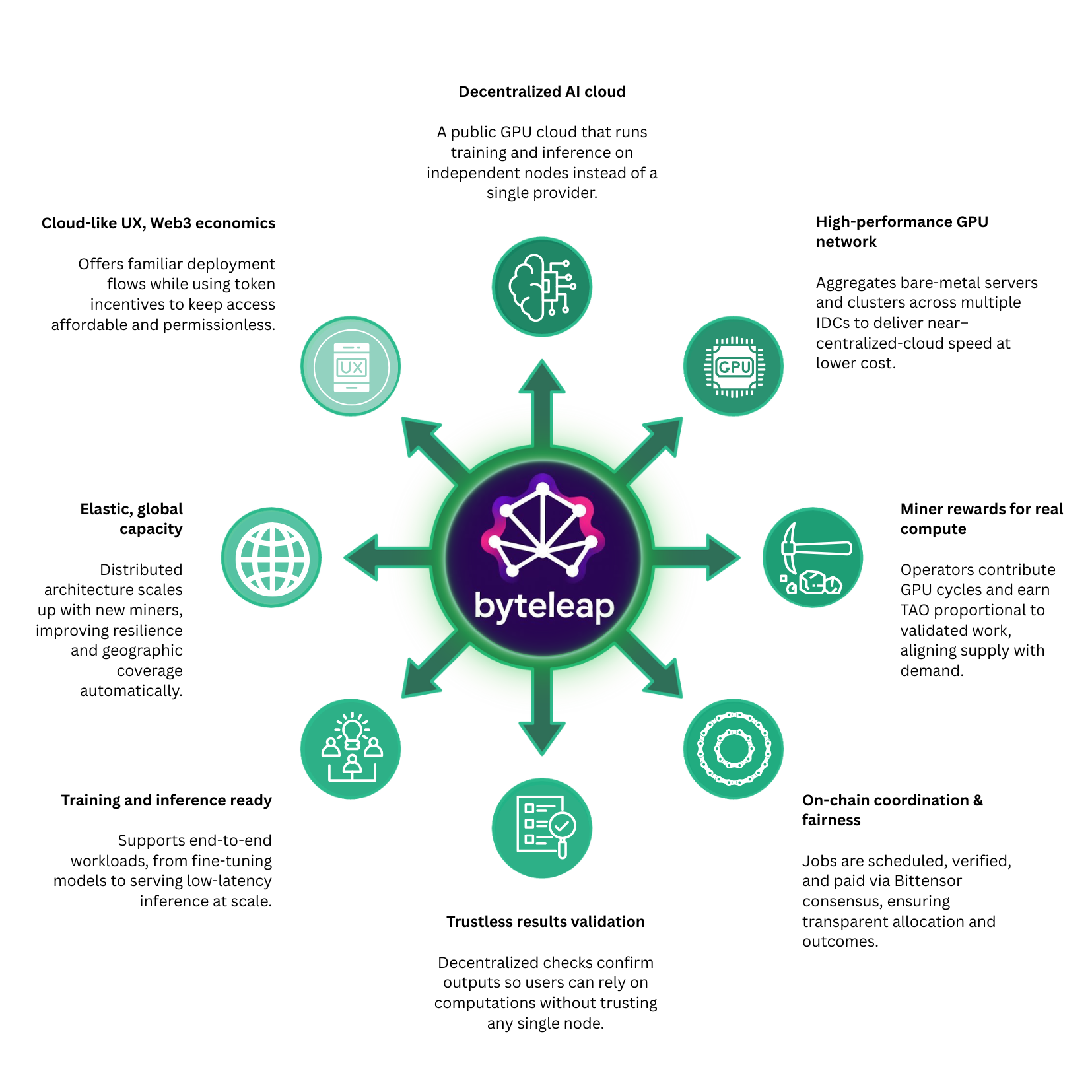
 

ByteLeap’s product is essentially a distributed compute network built on Bittensor that connects GPU providers with those needing AI computation, underpinned by custom miner and validator software. Technically, ByteLeap functions as a platform where independent operators run ByteLeap Miner nodes to aggregate GPU resources and handle AI tasks, while a ByteLeap Validator node coordinates the network and enforces the rules. The Miner software allows an operator to register their hardware (GPUs, servers) into the ByteLeap subnet and start providing compute; multiple “worker” processes handle the actual AI tasks on each GPU, and the miner orchestrates them. The Validator software, on the other hand, is the brain of the subnet: it verifies the results of computations, scores the performance of miners, and updates weights (reputation) on the Bittensor chain. Together, this miner–validator system forms ByteLeap’s core product – an open-source compute marketplace where GPU power is supplied and consumed in a decentralized fashion. (Both the miner and validator code are openly available under an MIT license on the project’s GitHub.)

Technical Architecture: ByteLeap’s architecture is designed for performance and flexibility, combining several layers of computing infrastructure:

Bare-Metal Nodes: Physical GPU servers with no virtualization, yielding near-native speed and ultra-low latency for intensive workloads. These are ideal for heavy AI training jobs or any tasks that demand maximum throughput and minimal overhead.

Virtual Machine (VM) Nodes: GPU-equipped VMs (using KVM virtualization with PCIe GPU passthrough) that offer isolation and scalability. This allows ByteLeap to partition hardware into multiple secure environments, giving flexibility to run different tasks or clients on the same physical machine while still delivering close-to-hardware performance.

Container Deployments: Lightweight Docker/Kubernetes containers running on either bare-metal or VMs for fast-deploy tasks like inference services. Containers enable rapid startup and efficient resource usage for short-duration jobs or microservices, making it easy to scale out many instances for serving AI models.

Kubernetes Orchestration: A Kubernetes layer oversees the containerized workloads, handling auto-scaling, load balancing, rolling updates, and failover across the distributed nodes. This ensures high availability and fault tolerance – if one node goes down, the workload can shift to others seamlessly. It also simplifies managing a cluster spread across multiple regions.

API Access Layer: Standardized interfaces (RESTful APIs, gRPC endpoints) through which developers and third-party applications can submit compute jobs, track their status, and retrieve results. This means users can interact with ByteLeap’s cloud similar to a traditional cloud service – programmatically sending AI tasks – and the platform handles scheduling them on the decentralized GPU pool. The API layer also ties into the reward system, so contributors can claim rewards for completed jobs.

All these components work in concert. For example, if a user submits an AI inference request via the API, ByteLeap might spin up containerized workers on available bare-metal or VM nodes, orchestrated by Kubernetes, to handle the task. The ByteLeap Validator will then validate the outputs and measure performance. Hardware-wise, ByteLeap has partnered with major data centers to secure a fleet of high-end GPUs – including NVIDIA H200, H100, A100 data-center cards and top-tier RTX 5090/4090 models – deployed in multiple regions. These data center partnerships provide reliable power, cooling, and networking, giving the subnet a professional-grade infrastructure backbone. The communication between nodes is encrypted, and a virtual private cloud (VPC) network links the different data centers, which boosts security and low-latency connectivity across continents.

Blockchain Integration & Incentives: ByteLeap is deeply integrated with Bittensor’s dynamic TAO (dTAO) system, meaning its own subnet token (“α” for SN128) and TAO rewards are tied to performance and usage. In February 2025, Bittensor introduced dynamic TAO which allows each subnet to have an independent token supply (α) and a portion of daily TAO emissions based on the subnet’s contribution. ByteLeap leverages this by rewarding miners primarily for doing real AI work (serving leases) and secondarily for staying online and proving their capacity through cryptographic challenges. The scoring mechanism works as follows: ByteLeap miners earn 70% of their score from lease revenue, i.e. actually performing AI compute jobs for clients, and the remaining 30% from challenge performance when idle. The ByteLeap Validator periodically issues matrix multiplication “challenge” tasks to any idle worker nodes as a way to benchmark their computational integrity and prevent cheating. These challenges use a two-phase commit (workers first commit a hashed result, then reveal it) so the validator can randomly sample and verify correctness, ensuring nodes can’t fake their performance. Miners that consistently participate in challenges and perform well earn higher scores (though the system rewards regular reliable performance over just spiky high performance). Additionally, there’s an availability multiplier – miners need to stay online ~169 hours out of the last week to avoid penalties, incentivizing reliable uptime. The ByteLeap validator tracks all these metrics (using a Postgres database for detailed logging) and periodically updates each miner’s weight (reputation) on-chain. Higher weight leads to more TAO rewards from the network’s emission. This whole design – combining on-chain governance, a Proof-of-Intelligence consensus (via tasks and validation), and off-chain high-performance compute – is what ByteLeap’s build delivers. In short, the product is a fully decentralized GPU cloud service where usage and contributions are transparently measured and rewarded via blockchain, and where developers can run demanding AI workloads without trusting any single provider.


WHO

Team Info

The ByteLeap team has not publicly revealed individual members or founders, but their communications emphasize a strong background in high-performance computing and AI infrastructure. According to project information, the team possesses deep expertise in GPU tuning, virtualization stacks, and monitoring systems – all critical skills for maintaining a stable, scalable compute network. This expertise is evident in ByteLeap’s technical design (e.g. advanced GPU passthrough and multi-datacenter orchestration), suggesting that the contributors are seasoned engineers in cloud or AI fields.

While specific names and profiles aren’t listed in official materials, the project’s professional approach (partnerships with major data centers and frequent technical updates) implies an experienced and dedicated group. The ByteLeap developers engage with the community via X (Twitter) and Discord, where they share progress and invite collaboration. For instance, the team has openly invited GPU vendors, data center operators, researchers, and AI developers to partner with ByteLeap by co-deploying nodes and integrating services. This collaborative stance hints that the team is well-connected in both the blockchain and AI industry. It’s also notable that ByteLeap’s code repositories (miner and validator) are maintained under the GitHub organization “byteleapai” and carry an MIT open-source license, reflecting the team’s commitment to transparency and community contribution. In summary, although individual team members remain behind the scenes in public documentation, their collective skill set in enterprise-scale computing and their active outreach to partners give a clear picture of a capable team driving ByteLeap’s development.

The ByteLeap team has not publicly revealed individual members or founders, but their communications emphasize a strong background in high-performance computing and AI infrastructure. According to project information, the team possesses deep expertise in GPU tuning, virtualization stacks, and monitoring systems – all critical skills for maintaining a stable, scalable compute network. This expertise is evident in ByteLeap’s technical design (e.g. advanced GPU passthrough and multi-datacenter orchestration), suggesting that the contributors are seasoned engineers in cloud or AI fields.

While specific names and profiles aren’t listed in official materials, the project’s professional approach (partnerships with major data centers and frequent technical updates) implies an experienced and dedicated group. The ByteLeap developers engage with the community via X (Twitter) and Discord, where they share progress and invite collaboration. For instance, the team has openly invited GPU vendors, data center operators, researchers, and AI developers to partner with ByteLeap by co-deploying nodes and integrating services. This collaborative stance hints that the team is well-connected in both the blockchain and AI industry. It’s also notable that ByteLeap’s code repositories (miner and validator) are maintained under the GitHub organization “byteleapai” and carry an MIT open-source license, reflecting the team’s commitment to transparency and community contribution. In summary, although individual team members remain behind the scenes in public documentation, their collective skill set in enterprise-scale computing and their active outreach to partners give a clear picture of a capable team driving ByteLeap’s development.

FUTURE

Roadmap

ByteLeap has outlined a clear three-phase roadmap to roll out its decentralized cloud platform in a matter of months:

Phase One (Months 1–2): Stand up the core infrastructure and prove functionality. This involves deploying the first bare-metal servers, setting up virtual machines and container environments, validating that GPU hardware integration (e.g. passthrough and drivers) works correctly, and testing the incentive models in practice. Essentially, in the first couple of months the team focuses on getting the basic compute modes online, running internal workloads to ensure that miners, workers, and the validator can communicate and that the reward mechanics (leases and challenges) function as designed.

Phase Two (Month 3): Launch a baseline release of the network and move toward public testing. By month 3, ByteLeap aims to finalize its platform’s initial version, which includes completing all critical features and fixes identified in Phase One. The plan is to run thorough tests on Bittensor’s testnet and even limited mainnet operations to vet performance under real conditions. Another key deliverable in this phase is to open-source the codebase and publish deployment documentation. This means the broader community can review the ByteLeap miner/validator code and even start running nodes, fostering transparency and early adoption.

Phase Three (Months 4–6): Scale up and integrate with the broader ecosystem. In this stage, ByteLeap focuses on growing the network’s capacity and robustness. Practically, that means onboarding more nodes across different geographic regions (to improve global coverage and reduce latency), optimizing latency and throughput as the load increases, and refining the incentive parameters or trust scoring models based on test results. By months 4–6, the team also plans to enhance stability (ensuring high uptime and fault tolerance as more users join) and to launch partnerships for real-world usage. This could include integrating with AI service providers or enabling pilot customers to run jobs on ByteLeap. The roadmap’s culmination is a fully functional decentralized cloud with a growing user base and possibly the beginning of revenue-generating workloads on the subnet.

According to this roadmap, ByteLeap’s development cycle is very rapid – roughly half a year from inception to a scalable product. As of the latest updates (late 2025), the project is well underway executing these phases. The aggressive timeline underscores the team’s intention to deliver value quickly and iterate. By Phase Three, not only will the technology be in place, but ByteLeap should also have fostered an ecosystem of collaborators (from GPU hardware partners to AI developers leveraging the platform). This phased approach ensures that ByteLeap moves from a prototype to a fully operational decentralized AI cloud in a controlled, tested manner, setting the stage for it to become a key infrastructure in the Bittensor ecosystem.


ByteLeap has outlined a clear three-phase roadmap to roll out its decentralized cloud platform in a matter of months:

Phase One (Months 1–2): Stand up the core infrastructure and prove functionality. This involves deploying the first bare-metal servers, setting up virtual machines and container environments, validating that GPU hardware integration (e.g. passthrough and drivers) works correctly, and testing the incentive models in practice. Essentially, in the first couple of months the team focuses on getting the basic compute modes online, running internal workloads to ensure that miners, workers, and the validator can communicate and that the reward mechanics (leases and challenges) function as designed.

Phase Two (Month 3): Launch a baseline release of the network and move toward public testing. By month 3, ByteLeap aims to finalize its platform’s initial version, which includes completing all critical features and fixes identified in Phase One. The plan is to run thorough tests on Bittensor’s testnet and even limited mainnet operations to vet performance under real conditions. Another key deliverable in this phase is to open-source the codebase and publish deployment documentation. This means the broader community can review the ByteLeap miner/validator code and even start running nodes, fostering transparency and early adoption.

Phase Three (Months 4–6): Scale up and integrate with the broader ecosystem. In this stage, ByteLeap focuses on growing the network’s capacity and robustness. Practically, that means onboarding more nodes across different geographic regions (to improve global coverage and reduce latency), optimizing latency and throughput as the load increases, and refining the incentive parameters or trust scoring models based on test results. By months 4–6, the team also plans to enhance stability (ensuring high uptime and fault tolerance as more users join) and to launch partnerships for real-world usage. This could include integrating with AI service providers or enabling pilot customers to run jobs on ByteLeap. The roadmap’s culmination is a fully functional decentralized cloud with a growing user base and possibly the beginning of revenue-generating workloads on the subnet.

According to this roadmap, ByteLeap’s development cycle is very rapid – roughly half a year from inception to a scalable product. As of the latest updates (late 2025), the project is well underway executing these phases. The aggressive timeline underscores the team’s intention to deliver value quickly and iterate. By Phase Three, not only will the technology be in place, but ByteLeap should also have fostered an ecosystem of collaborators (from GPU hardware partners to AI developers leveraging the platform). This phased approach ensures that ByteLeap moves from a prototype to a fully operational decentralized AI cloud in a controlled, tested manner, setting the stage for it to become a key infrastructure in the Bittensor ecosystem.


NEWS

Announcements

Load More