
With the amount of new subnets being added it can be hard to get up to date information across all subnets, so data may be slightly out of date from time to time
Core Problem and Solution
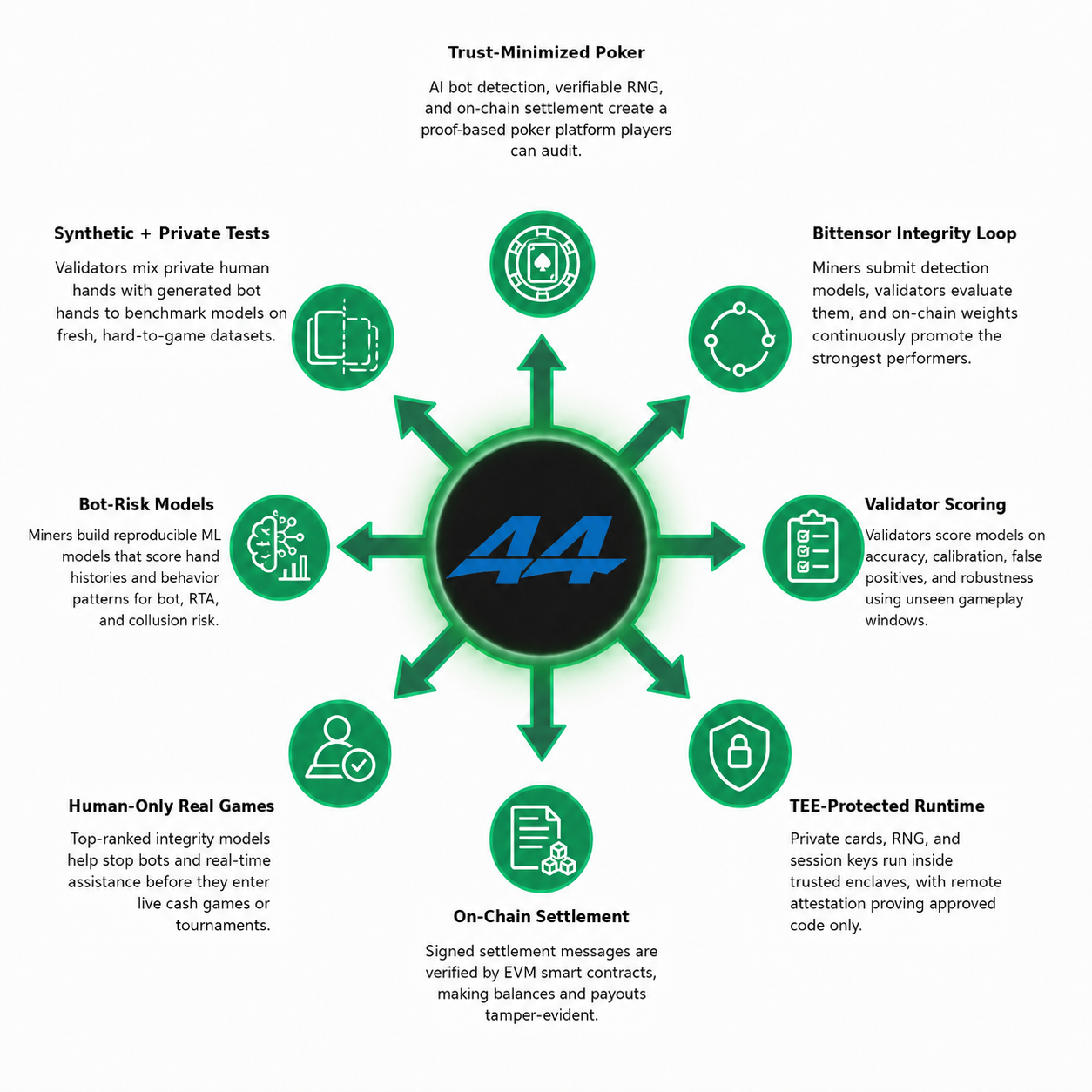
Online poker has long suffered from issues of integrity and trust. Automated bots, real-time assistance (RTA), and collusion undermine game quality and erode player confidence, while centralized operators require players to trust that the house cannot view private cards or manipulate outcomes. Poker44 addresses these problems by combining AI-driven bot detection, verifiable random number generation (RNG) integrity, and on-chain settlement to create a trust-minimized poker platform. Through a decentralized integrity loop, Poker44 ensures that only human players participate in Real Games and that every hand outcome and payout can be audited without relying on a single authority.
Decentralized Integrity Loop on Bittensor
Poker44 operates as a Bittensor subnet (netuid 126), leveraging the Bittensor protocol to coordinate competition between miners (model authors) and validators (model evaluators). Miners submit reproducible bot-detection models to the subnet, while validators execute these models against live game signals in batch evaluations. Validator outcomes set on-chain weights for each miner via a commit-reveal process, promoting top-performing models into production. This continuous competition and weight adjustment form the Integrity Loop that drives ever-improving detection quality and game integrity.
Miner Roles and Model Construction
Miners in Poker44 build machine learning models designed to predict bot-risk scores based on behavioral patterns and hand histories. They train these models on publicly available human hand datasets and synthetically generated bot hand data using the hands_generator module, which includes a compressed human corpus (`hands_generator/human_hands/poker_hands_combined.json.gz`) and scripts to generate bot data (`hands_generator/bot_hands/generate_poker_data.py`). Each miner publishes a versioned, deterministic artifact to the subnet, ensuring transparency and reproducibility of model submissions.
Validator Evaluation and Scoring
Validators accumulate recent gameplay signals, mixing private human hands (from `POKER44_HUMAN_JSON_PATH`) with generated bot hands to build N-hand evaluation windows. Under strict resource limits, each validator queries eligible miners for `risk_scores` on each chunk, scoring models on accuracy, calibration, false-positive rates, and robustness. After each cycle, validators invoke `set_weights` on-chain to reflect miner performance, with the highest-weighted models deployed to protect Real Games. This mechanism creates synthetic benchmarks of unseen hands, preventing overfitting and dataset leakage common in static, centralized systems.
Trusted Execution Environment (TEE) Integration
Central to Poker44’s security model is the use of Trusted Execution Environments (TEEs) for game runtime. All core logic—including private hand encryption, RNG, and session keys—runs inside hardware-isolated enclaves. Remote attestation proves that only approved code executes in the enclave, while sealed secrets remain protected from the host. This architecture prevents infrastructure operators from accessing sensitive game data, restoring player trust in the integrity of gameplay.
Player Experience and Output
From the player’s perspective, Poker44 looks and feels like a conventional poker platform. Users join cash tables or tournaments, place bets, and view hands in real time. Behind the scenes, detection models filter out bots before they can join Real Games, and each hand produces cryptographic proof of RNG commitments and model-based integrity checks. At session end or defined checkpoints, signed settlement messages are submitted to an EVM-based smart contract, which verifies proofs before updating on-chain balances. This ensures that deposits and withdrawals are verifiable and tamper-evident.
Comparison to Centralized Platforms
Unlike traditional online poker sites, Poker44 removes single points of failure and opaque internal processes. Centralized platforms rely on a trusted operator to prevent cheating, but offer no external verification of RNG or model efficacy. Poker44’s decentralized subnet executes integrity logic publicly, publishes model weights on-chain, and settles financial flows via auditable smart contracts. This architecture fundamentally shifts poker from a trust-based to a proof-based system, setting a new standard for verifiable, human-only online poker.
Core Problem and Solution
Online poker has long suffered from issues of integrity and trust. Automated bots, real-time assistance (RTA), and collusion undermine game quality and erode player confidence, while centralized operators require players to trust that the house cannot view private cards or manipulate outcomes. Poker44 addresses these problems by combining AI-driven bot detection, verifiable random number generation (RNG) integrity, and on-chain settlement to create a trust-minimized poker platform. Through a decentralized integrity loop, Poker44 ensures that only human players participate in Real Games and that every hand outcome and payout can be audited without relying on a single authority.
Decentralized Integrity Loop on Bittensor
Poker44 operates as a Bittensor subnet (netuid 126), leveraging the Bittensor protocol to coordinate competition between miners (model authors) and validators (model evaluators). Miners submit reproducible bot-detection models to the subnet, while validators execute these models against live game signals in batch evaluations. Validator outcomes set on-chain weights for each miner via a commit-reveal process, promoting top-performing models into production. This continuous competition and weight adjustment form the Integrity Loop that drives ever-improving detection quality and game integrity.
Miner Roles and Model Construction
Miners in Poker44 build machine learning models designed to predict bot-risk scores based on behavioral patterns and hand histories. They train these models on publicly available human hand datasets and synthetically generated bot hand data using the hands_generator module, which includes a compressed human corpus (`hands_generator/human_hands/poker_hands_combined.json.gz`) and scripts to generate bot data (`hands_generator/bot_hands/generate_poker_data.py`). Each miner publishes a versioned, deterministic artifact to the subnet, ensuring transparency and reproducibility of model submissions.
Validator Evaluation and Scoring
Validators accumulate recent gameplay signals, mixing private human hands (from `POKER44_HUMAN_JSON_PATH`) with generated bot hands to build N-hand evaluation windows. Under strict resource limits, each validator queries eligible miners for `risk_scores` on each chunk, scoring models on accuracy, calibration, false-positive rates, and robustness. After each cycle, validators invoke `set_weights` on-chain to reflect miner performance, with the highest-weighted models deployed to protect Real Games. This mechanism creates synthetic benchmarks of unseen hands, preventing overfitting and dataset leakage common in static, centralized systems.
Trusted Execution Environment (TEE) Integration
Central to Poker44’s security model is the use of Trusted Execution Environments (TEEs) for game runtime. All core logic—including private hand encryption, RNG, and session keys—runs inside hardware-isolated enclaves. Remote attestation proves that only approved code executes in the enclave, while sealed secrets remain protected from the host. This architecture prevents infrastructure operators from accessing sensitive game data, restoring player trust in the integrity of gameplay.
Player Experience and Output
From the player’s perspective, Poker44 looks and feels like a conventional poker platform. Users join cash tables or tournaments, place bets, and view hands in real time. Behind the scenes, detection models filter out bots before they can join Real Games, and each hand produces cryptographic proof of RNG commitments and model-based integrity checks. At session end or defined checkpoints, signed settlement messages are submitted to an EVM-based smart contract, which verifies proofs before updating on-chain balances. This ensures that deposits and withdrawals are verifiable and tamper-evident.
Comparison to Centralized Platforms
Unlike traditional online poker sites, Poker44 removes single points of failure and opaque internal processes. Centralized platforms rely on a trusted operator to prevent cheating, but offer no external verification of RNG or model efficacy. Poker44’s decentralized subnet executes integrity logic publicly, publishes model weights on-chain, and settles financial flows via auditable smart contracts. This architecture fundamentally shifts poker from a trust-based to a proof-based system, setting a new standard for verifiable, human-only online poker.
Current Live Features and Development Status
Poker44’s V0 stage has delivered a hybrid operating model combining centralized components with decentralized evaluation loops. The current platform supports Integrity Labs—an opt-in environment where humans and bots play with explicit labeling and incentives—and Real Games protected by top-ranked integrity models. In parallel, the subnet evaluation pipeline runs on validator infrastructure, scoring submitted models and updating on-chain weights every 40-block epoch. V1 is in progress, focusing on moving gameplay into a remote-attested TEE runtime and enabling artifact-based miner submissions, while V2 and V3 remain planned for ground-truth enhancements and full verifiable settlement.
Technical Architecture Details
The Poker44 platform consists of four core layers: (1) A TEE-encrypted runtime where game logic, private cards, and RNG reside; (2) A Bittensor subnet (netuid 126) handling decentralized model evaluation; (3) AI bot-detection models continuously updated via the Integrity Loop; and (4) EVM-based smart contracts for provable payouts and dispute resolution. Gameplay data and hand histories are transiently held within TEEs to preserve confidentiality, while settlement proofs are stored on-chain. The open-source pipeline leverages Python neurons in the `neurons/validator.py` and `neurons/miner.py` scripts, and environment-driven PM2 scripts for production deployments.
GitHub Repository Overview
The Poker44-subnet GitHub repository (62 commits, 0 stars, 0 forks, 1 contributor) contains key directories: `docs` (Validator, Miner, and Roadmap guides), `hands_generator` (training and synthetic data), `neurons` (validator and miner code), and `scripts` (setup/run scripts). Developers can clone the repo, install requirements via `pip install -r requirements.txt`, and follow environment-driven scripts (`scripts/validator/run/run_vali.sh` and `scripts/miner/run/run_miner.sh`) to participate as a validator or miner.
hands_generator and Bot Detection Workflow
The `hands_generator` module includes `human_hands/poker_hands_combined.json.gz` for public human data and `bot_hands/generate_poker_data.py` for synthetic bot data generation. Miners train models on features extracted from these datasets and submit them as serialized artifacts. Validators sanitize payloads to remove label leakage, query miners with `DetectionSynapse(chunks=…)`, and expect miners to return `risk_scores` (floats in [0,1]) and optional `predictions`. This ensures robust, privacy-preserving evaluations without centralized data dependencies.
Metrics and Tokenomics
As of March 2026, Poker44-subnet has 62 commits, 1 contributor, and 0 stars on GitHub. The subnet’s alpha token trades at approximately 0.0065 TAO per alpha, with a Serving Rate Limit of 50 alpha per block and 40 blocks per epoch (mining emissions currently paused at 0 alpha/day). These parameters reflect the subnet’s early stage and evolving integrity model.
Validator Scoring Mechanism and Integration Points
Validator scoring evaluates models on accuracy, calibration, low false-positive rates, and robustness under evolving adversarial signals. On-chain weights are set via Bittensor’s `btcli subnet` commands, enabling miners to earn alpha rewards proportionally. Integration points include the Bittensor CLI (`bittensor-cli` package), Python SDK for custom extensions, and EVM smart-contract interfaces for settlement and dispute resolution. Developers can integrate Poker44’s integrity pipeline into broader DeFi and gaming ecosystems by using these tools and APIs.
Current Live Features and Development Status
Poker44’s V0 stage has delivered a hybrid operating model combining centralized components with decentralized evaluation loops. The current platform supports Integrity Labs—an opt-in environment where humans and bots play with explicit labeling and incentives—and Real Games protected by top-ranked integrity models. In parallel, the subnet evaluation pipeline runs on validator infrastructure, scoring submitted models and updating on-chain weights every 40-block epoch. V1 is in progress, focusing on moving gameplay into a remote-attested TEE runtime and enabling artifact-based miner submissions, while V2 and V3 remain planned for ground-truth enhancements and full verifiable settlement.
Technical Architecture Details
The Poker44 platform consists of four core layers: (1) A TEE-encrypted runtime where game logic, private cards, and RNG reside; (2) A Bittensor subnet (netuid 126) handling decentralized model evaluation; (3) AI bot-detection models continuously updated via the Integrity Loop; and (4) EVM-based smart contracts for provable payouts and dispute resolution. Gameplay data and hand histories are transiently held within TEEs to preserve confidentiality, while settlement proofs are stored on-chain. The open-source pipeline leverages Python neurons in the `neurons/validator.py` and `neurons/miner.py` scripts, and environment-driven PM2 scripts for production deployments.
GitHub Repository Overview
The Poker44-subnet GitHub repository (62 commits, 0 stars, 0 forks, 1 contributor) contains key directories: `docs` (Validator, Miner, and Roadmap guides), `hands_generator` (training and synthetic data), `neurons` (validator and miner code), and `scripts` (setup/run scripts). Developers can clone the repo, install requirements via `pip install -r requirements.txt`, and follow environment-driven scripts (`scripts/validator/run/run_vali.sh` and `scripts/miner/run/run_miner.sh`) to participate as a validator or miner.
hands_generator and Bot Detection Workflow
The `hands_generator` module includes `human_hands/poker_hands_combined.json.gz` for public human data and `bot_hands/generate_poker_data.py` for synthetic bot data generation. Miners train models on features extracted from these datasets and submit them as serialized artifacts. Validators sanitize payloads to remove label leakage, query miners with `DetectionSynapse(chunks=…)`, and expect miners to return `risk_scores` (floats in [0,1]) and optional `predictions`. This ensures robust, privacy-preserving evaluations without centralized data dependencies.
Metrics and Tokenomics
As of March 2026, Poker44-subnet has 62 commits, 1 contributor, and 0 stars on GitHub. The subnet’s alpha token trades at approximately 0.0065 TAO per alpha, with a Serving Rate Limit of 50 alpha per block and 40 blocks per epoch (mining emissions currently paused at 0 alpha/day). These parameters reflect the subnet’s early stage and evolving integrity model.
Validator Scoring Mechanism and Integration Points
Validator scoring evaluates models on accuracy, calibration, low false-positive rates, and robustness under evolving adversarial signals. On-chain weights are set via Bittensor’s `btcli subnet` commands, enabling miners to earn alpha rewards proportionally. Integration points include the Bittensor CLI (`bittensor-cli` package), Python SDK for custom extensions, and EVM smart-contract interfaces for settlement and dispute resolution. Developers can integrate Poker44’s integrity pipeline into broader DeFi and gaming ecosystems by using these tools and APIs.
Team and Contributor Overview
Poker44 is developed and maintained by the Poker44 Team, led by the primary GitHub contributor `apaor` (sacha). The open-source nature of the project encourages community contributions, though to date all code commits originate from this core contributor. The team emphasizes transparency and reproducibility in model pipelines and runtime operations.
Social and Community Presence
Poker44 maintains an active presence on X (formerly Twitter) under the handle @poker44subnet, where it engages with the Bittensor and broader blockchain communities. As of March 2026, the account has 287 followers and follows 2 accounts, promoting updates on network performance, roadmap progress, and integration guides under the bio “Building trust infrastructure for online poker. Bot detection, real gameplay, fair tables — decentralized poker starts here. Bittensor Subnet 126.”.
Background in Poker, AI, and Blockchain
While individual team member biographies are not publicly detailed, Poker44’s whitepaper and technical stacks demonstrate deep expertise in confidential compute (TEEs), decentralized model evaluation (Bittensor), smart-contract settlement (EVM), and AI-based bot detection. This multidisciplinary approach reflects a background bridging advanced machine learning research and scalable blockchain infrastructure.
Bittensor Ecosystem Integration
Poker44 joined the Bittensor ecosystem as Subnet 126, positioning itself among earlier subnets such as Chutes (SN64) and Targon (SN4) as a specialized integrity layer for gaming. Its focus on continuous, adversarial model competition distinguishes it from more established compute or inference subnets, and it remains open for collaboration with other Bittensor participants and subnets for auxiliary compute or tooling enhancements.
Partnerships and Community Engagement
To date, Poker44 has not publicly announced formal partnerships or external backers. Community engagement primarily occurs through GitHub issues for technical discussions, X for announcements, and live validator/miner participation on Subnet 126. As the project transitions into V1 and beyond, the team anticipates broader developer adoption and potential collaborations with infrastructure and DeFi projects seeking trust-minimized gaming solutions.
Team and Contributor Overview
Poker44 is developed and maintained by the Poker44 Team, led by the primary GitHub contributor `apaor` (sacha). The open-source nature of the project encourages community contributions, though to date all code commits originate from this core contributor. The team emphasizes transparency and reproducibility in model pipelines and runtime operations.
Social and Community Presence
Poker44 maintains an active presence on X (formerly Twitter) under the handle @poker44subnet, where it engages with the Bittensor and broader blockchain communities. As of March 2026, the account has 287 followers and follows 2 accounts, promoting updates on network performance, roadmap progress, and integration guides under the bio “Building trust infrastructure for online poker. Bot detection, real gameplay, fair tables — decentralized poker starts here. Bittensor Subnet 126.”.
Background in Poker, AI, and Blockchain
While individual team member biographies are not publicly detailed, Poker44’s whitepaper and technical stacks demonstrate deep expertise in confidential compute (TEEs), decentralized model evaluation (Bittensor), smart-contract settlement (EVM), and AI-based bot detection. This multidisciplinary approach reflects a background bridging advanced machine learning research and scalable blockchain infrastructure.
Bittensor Ecosystem Integration
Poker44 joined the Bittensor ecosystem as Subnet 126, positioning itself among earlier subnets such as Chutes (SN64) and Targon (SN4) as a specialized integrity layer for gaming. Its focus on continuous, adversarial model competition distinguishes it from more established compute or inference subnets, and it remains open for collaboration with other Bittensor participants and subnets for auxiliary compute or tooling enhancements.
Partnerships and Community Engagement
To date, Poker44 has not publicly announced formal partnerships or external backers. Community engagement primarily occurs through GitHub issues for technical discussions, X for announcements, and live validator/miner participation on Subnet 126. As the project transitions into V1 and beyond, the team anticipates broader developer adoption and potential collaborations with infrastructure and DeFi projects seeking trust-minimized gaming solutions.
V0 · Delivered (Foundation Loop and Discovery)
The initial V0 phase established Poker44’s core operating loop between the game runtime and the integrity subnet. Key deliverables included the hybrid platform + subnet closed-loop architecture, an internal evaluation pipeline for integrity models, provider registration and discovery, and standardized telemetry for reproducible scoring. The V0 Phase Gate validated end-to-end model evaluation and provider discovery operations on netuid 126.
V1 · In Progress (Attested Runtime and Production Deployment)
Currently in progress, V1 focuses on migrating integrity from research to production-grade operations with concrete TEE-based guarantees. Deliverables include a fully remote-attested TEE Poker Runtime, artifact-based miner submission workflows, deployment of top integrity models in Real Games, and enforcement of a human-only policy. The V1 Phase Gate requires successful remote attestation and policy enforcement within production environments.
V2 · Planned (Ground Truth Engine and Validator Accountability)
V2 introduces mechanisms to improve label quality and validator accountability through explicit economic incentives and enforcement controls. Planned features include hybrid tournaments with real-prize incentives, cross-attestation between providers and validators, bonding/slashing policies to penalize invalid runtime behavior, and large-scale provably fair RNG commitments. The V2 Phase Gate will deliver an economically enforced integrity model featuring cross-attestation and broad RNG verification.
V3 · Planned (Full Verifiable Settlement and Transparency)
In V3, Poker44 will finalize its trust-minimized economic layer and mature transparency standards for both operators and players. Scope items include smart-contract settlement on a selected EVM network, dispute tooling with per-hand verification artifacts, public transparency reports for integrity enforcement, and robust operator/player audit workflows. The V3 Phase Gate marks the transition to fully externally auditable settlement and dispute operations.
Timeline and Future Vision
While exact dates remain fluid, V1 activities are prioritized for completion in Q2 2026, focusing on remote-attested runtimes and on-chain policy enforcement. Subsequent phases will roll out V2 features through late 2026, followed by V3 maturity in early 2027. The fully realized vision foresees a global, decentralized poker platform where every game, model evaluation, and payout is verifiable by any participant, eliminating reliance on trusted third parties and setting a new standard for fairness in online gaming.
Recent Announcements
Updates are regularly posted on the Poker44 X account (@poker44subnet), including progress on TEE runtime attestation, validator onboarding milestones, and upcoming alpha releases. Community members are encouraged to follow the subnet’s X feed and GitHub Roadmap for the latest developments and opportunities to participate.
V0 · Delivered (Foundation Loop and Discovery)
The initial V0 phase established Poker44’s core operating loop between the game runtime and the integrity subnet. Key deliverables included the hybrid platform + subnet closed-loop architecture, an internal evaluation pipeline for integrity models, provider registration and discovery, and standardized telemetry for reproducible scoring. The V0 Phase Gate validated end-to-end model evaluation and provider discovery operations on netuid 126.
V1 · In Progress (Attested Runtime and Production Deployment)
Currently in progress, V1 focuses on migrating integrity from research to production-grade operations with concrete TEE-based guarantees. Deliverables include a fully remote-attested TEE Poker Runtime, artifact-based miner submission workflows, deployment of top integrity models in Real Games, and enforcement of a human-only policy. The V1 Phase Gate requires successful remote attestation and policy enforcement within production environments.
V2 · Planned (Ground Truth Engine and Validator Accountability)
V2 introduces mechanisms to improve label quality and validator accountability through explicit economic incentives and enforcement controls. Planned features include hybrid tournaments with real-prize incentives, cross-attestation between providers and validators, bonding/slashing policies to penalize invalid runtime behavior, and large-scale provably fair RNG commitments. The V2 Phase Gate will deliver an economically enforced integrity model featuring cross-attestation and broad RNG verification.
V3 · Planned (Full Verifiable Settlement and Transparency)
In V3, Poker44 will finalize its trust-minimized economic layer and mature transparency standards for both operators and players. Scope items include smart-contract settlement on a selected EVM network, dispute tooling with per-hand verification artifacts, public transparency reports for integrity enforcement, and robust operator/player audit workflows. The V3 Phase Gate marks the transition to fully externally auditable settlement and dispute operations.
Timeline and Future Vision
While exact dates remain fluid, V1 activities are prioritized for completion in Q2 2026, focusing on remote-attested runtimes and on-chain policy enforcement. Subsequent phases will roll out V2 features through late 2026, followed by V3 maturity in early 2027. The fully realized vision foresees a global, decentralized poker platform where every game, model evaluation, and payout is verifiable by any participant, eliminating reliance on trusted third parties and setting a new standard for fairness in online gaming.
Recent Announcements
Updates are regularly posted on the Poker44 X account (@poker44subnet), including progress on TEE runtime attestation, validator onboarding milestones, and upcoming alpha releases. Community members are encouraged to follow the subnet’s X feed and GitHub Roadmap for the latest developments and opportunities to participate.