
With the amount of new subnets being added it can be hard to get up to date information across all subnets, so data may be slightly out of date from time to time
ChronoSeek is Bittensor Subnet 20, providing decentralised semantic video moment retrieval. Rather than relying on titles, tags, or manual chapter markers, ChronoSeek lets users describe any scene in plain natural language — “the moment the booster lands,” “the scene where the crowd goes silent before the free kick” — and returns the precise timestamp, down to the millisecond, with a confidence score. It turns hours of footage into a queryable database without any manual pre-labelling or scrubbing.
The subnet addresses a systemic blind spot in the video era. Video traffic now accounts for 82% of all internet traffic, yet 90% of enterprise video content — meetings, lectures, surveillance feeds, training recordings, archived broadcasts — remains unstructured and effectively unsearchable. Existing tools are bottlenecked by metadata: they can surface a video, but they cannot tell you when something specific happens inside it. ChronoSeek’s decentralised AI network solves this by reasoning across the visual track, the audio track, and temporal context simultaneously.
Miners on the subnet download video content, run CLIP-based coarse-to-fine visual retrieval over extracted frames, optionally transcribe and score speech segments, and return ranked timestamp intervals with confidence scores. Vision is the primary signal; speech transcription acts as a secondary boost when audio is available and useful. This multimodal fusion approach allows queries like “when the alarm starts” to succeed as reliably as purely visual queries like “when the door opens.”
Validators provide the quality layer. They generate synthetic evaluation tasks drawn from the ActivityNet Captions dataset — a large-scale benchmark of human-annotated video moments — and score miner responses using best-match Intersection over Union (IoU), a continuous metric in [0, 1] that measures how precisely a predicted timestamp interval overlaps with the known ground-truth interval. Scores are maintained as moving averages and normalised into on-chain weights, so the most accurate miners earn the most $TAO. The incentive mechanism makes gaming effectively impossible: validators use synthetically generated ground truth, so miners cannot gain an edge by memorising organic user queries.
The network is currently fully functioning on testnet with a deployed developer-facing gateway already available for API access. Validators can optionally expose a protocol-compatible public API — supporting both synchronous and streaming search endpoints — that routes organic queries to the top-ranked responsive miners and returns aggregated, confidence-ranked timestamp results.
ChronoSeek is Bittensor Subnet 20, providing decentralised semantic video moment retrieval. Rather than relying on titles, tags, or manual chapter markers, ChronoSeek lets users describe any scene in plain natural language — “the moment the booster lands,” “the scene where the crowd goes silent before the free kick” — and returns the precise timestamp, down to the millisecond, with a confidence score. It turns hours of footage into a queryable database without any manual pre-labelling or scrubbing.
The subnet addresses a systemic blind spot in the video era. Video traffic now accounts for 82% of all internet traffic, yet 90% of enterprise video content — meetings, lectures, surveillance feeds, training recordings, archived broadcasts — remains unstructured and effectively unsearchable. Existing tools are bottlenecked by metadata: they can surface a video, but they cannot tell you when something specific happens inside it. ChronoSeek’s decentralised AI network solves this by reasoning across the visual track, the audio track, and temporal context simultaneously.
Miners on the subnet download video content, run CLIP-based coarse-to-fine visual retrieval over extracted frames, optionally transcribe and score speech segments, and return ranked timestamp intervals with confidence scores. Vision is the primary signal; speech transcription acts as a secondary boost when audio is available and useful. This multimodal fusion approach allows queries like “when the alarm starts” to succeed as reliably as purely visual queries like “when the door opens.”
Validators provide the quality layer. They generate synthetic evaluation tasks drawn from the ActivityNet Captions dataset — a large-scale benchmark of human-annotated video moments — and score miner responses using best-match Intersection over Union (IoU), a continuous metric in [0, 1] that measures how precisely a predicted timestamp interval overlaps with the known ground-truth interval. Scores are maintained as moving averages and normalised into on-chain weights, so the most accurate miners earn the most $TAO. The incentive mechanism makes gaming effectively impossible: validators use synthetically generated ground truth, so miners cannot gain an edge by memorising organic user queries.
The network is currently fully functioning on testnet with a deployed developer-facing gateway already available for API access. Validators can optionally expose a protocol-compatible public API — supporting both synchronous and streaming search endpoints — that routes organic queries to the top-ranked responsive miners and returns aggregated, confidence-ranked timestamp results.
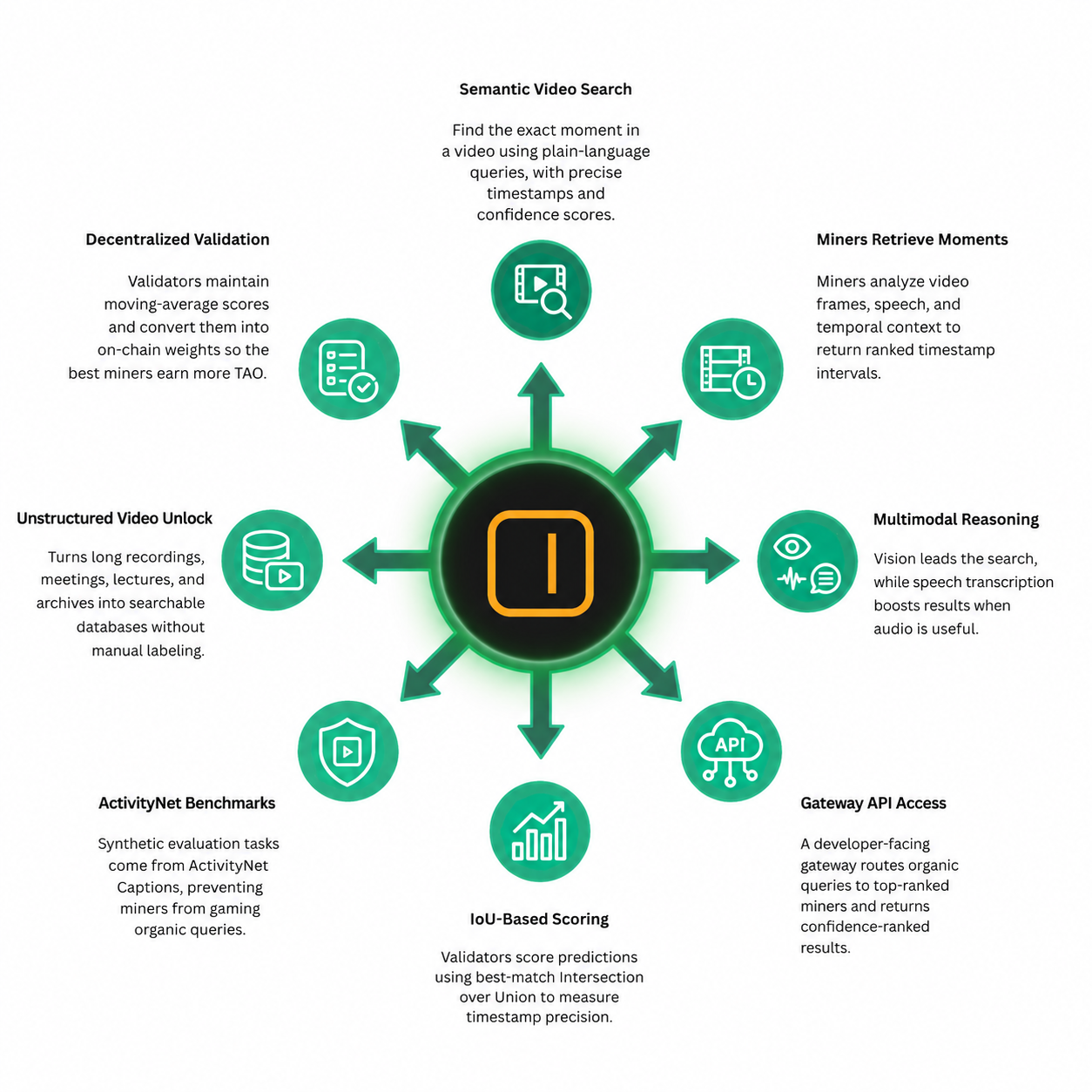
ChronoSeek’s primary product is a REST API that makes any video queryable through natural language. Developers send a video URL and a text description to api.chronoseek.org/v1/seek; the network returns a precise timestamp, a confidence score, and a surrounding time window. A single API call replaces hours of manual scrubbing. The API is already accessible through the developer-facing gateway run by validators on testnet, and it supports both synchronous responses (aggregating all miner results before replying) and streaming responses (server-sent events delivering miner results incrementally as they arrive).
The addressable market is large and growing rapidly. The global video analytics market is projected to reach $94.56 billion by 2034 at a 22.6% CAGR, and the AI video generation and editing segment is projected to reach $9.3 billion by 2033. ChronoSeek positions itself at the intersection of these sectors, targeting four primary customer segments: media and entertainment platforms that need deep catalog search; enterprise security and surveillance teams who must surface incidents from days of footage; educational platforms and e-learning providers whose students need to jump to specific explanations within long recordings; and AI agent developers who need to give autonomous systems temporal awareness over video data.
The competitive moat against established SaaS alternatives such as Twelve Labs and Vidrovr is structural. Centralised video AI companies charge high API rates, require data to be uploaded to their cloud infrastructure, and are constrained by vendor roadmaps. ChronoSeek, by running on Bittensor, enables market-driven pricing — miners compete on accuracy and cost, naturally surfacing the most efficient models — and supports privacy-preserving deployment where validators and miners can operate on private or locally-hosted video archives without exporting sensitive data to a third party.
The business model layers revenue-generating products on top of the decentralised protocol. A freemium API tier provides 1,000 free queries per month and charges per query above that threshold, with a fiat-to-TAO gateway abstracting blockchain complexity for enterprise customers. The subnet owner operates a high-availability validator as a secure enterprise gateway, allowing businesses to connect to the network’s retrieval capabilities via a standard API without managing any Bittensor infrastructure. A consumer-facing browser extension for YouTube and Twitch is also planned, enabling users to “Ctrl+F inside a video” using the subnet directly from their browser.
The Bittensor incentive structure aligns product quality with miner economics in a way that centralised architectures cannot replicate. Accuracy is the only way to earn $TAO; the leaderboard is the product roadmap. Miners update to state-of-the-art models instantly when a new paper drops in order to gain a competitive edge, whereas centralised vendors are constrained by internal R&D cycles. This creates a compounding quality loop: better models attract more organic users and enterprise traffic, which drives demand for subnet emissions, which increases the value of the incentive, which attracts more competitive miners.
ChronoSeek’s primary product is a REST API that makes any video queryable through natural language. Developers send a video URL and a text description to api.chronoseek.org/v1/seek; the network returns a precise timestamp, a confidence score, and a surrounding time window. A single API call replaces hours of manual scrubbing. The API is already accessible through the developer-facing gateway run by validators on testnet, and it supports both synchronous responses (aggregating all miner results before replying) and streaming responses (server-sent events delivering miner results incrementally as they arrive).
The addressable market is large and growing rapidly. The global video analytics market is projected to reach $94.56 billion by 2034 at a 22.6% CAGR, and the AI video generation and editing segment is projected to reach $9.3 billion by 2033. ChronoSeek positions itself at the intersection of these sectors, targeting four primary customer segments: media and entertainment platforms that need deep catalog search; enterprise security and surveillance teams who must surface incidents from days of footage; educational platforms and e-learning providers whose students need to jump to specific explanations within long recordings; and AI agent developers who need to give autonomous systems temporal awareness over video data.
The competitive moat against established SaaS alternatives such as Twelve Labs and Vidrovr is structural. Centralised video AI companies charge high API rates, require data to be uploaded to their cloud infrastructure, and are constrained by vendor roadmaps. ChronoSeek, by running on Bittensor, enables market-driven pricing — miners compete on accuracy and cost, naturally surfacing the most efficient models — and supports privacy-preserving deployment where validators and miners can operate on private or locally-hosted video archives without exporting sensitive data to a third party.
The business model layers revenue-generating products on top of the decentralised protocol. A freemium API tier provides 1,000 free queries per month and charges per query above that threshold, with a fiat-to-TAO gateway abstracting blockchain complexity for enterprise customers. The subnet owner operates a high-availability validator as a secure enterprise gateway, allowing businesses to connect to the network’s retrieval capabilities via a standard API without managing any Bittensor infrastructure. A consumer-facing browser extension for YouTube and Twitch is also planned, enabling users to “Ctrl+F inside a video” using the subnet directly from their browser.
The Bittensor incentive structure aligns product quality with miner economics in a way that centralised architectures cannot replicate. Accuracy is the only way to earn $TAO; the leaderboard is the product roadmap. Miners update to state-of-the-art models instantly when a new paper drops in order to gain a competitive edge, whereas centralised vendors are constrained by internal R&D cycles. This creates a compounding quality loop: better models attract more organic users and enterprise traffic, which drives demand for subnet emissions, which increases the value of the incentive, which attracts more competitive miners.
ChronoSeek is operated by a pseudonymous team that has not publicly identified individual members by name — a common practice in the Bittensor ecosystem. The team’s technical capability is evident from the depth and quality of the project’s public output: a fully functioning testnet deployment, a production-ready developer gateway, and a comprehensive documentation suite covering problem framing, system architecture, business logic, and incentive design. The codebase, written in Python with Poetry-managed dependencies, reflects familiarity with state-of-the-art video-language models, Bittensor’s neuron/axon protocol, and enterprise API design patterns.
The team’s research orientation is clear from the design choices made in the subnet. The scoring mechanism is grounded in published academic benchmarks — ActivityNet Captions — and the architectural roadmap explicitly references peer-reviewed papers on temporal video retrieval, including Moment-DETR and Time-R1. The integration of Chutes (Subnet 64) as a serverless inference backend demonstrates familiarity with the broader Bittensor subnet ecosystem and a pragmatic approach to solving the GPU cost problem for miners. The gateway architecture — with liveness health checks, confidence-weighted miner selection, and both synchronous and streaming endpoints — is the work of engineers with production API experience.
The WordPress entry for Subnet 20 was previously attributed to a project called GroundLayer, which appears to reflect legacy or incorrect data from an earlier population of that record. ChronoSeek’s own public documentation and GitHub history present it as a coherent, purpose-built semantic video retrieval project with no reference to a prior identity. The ChronoSeek brand and the chronoseek.org domain are the canonical identity for SN20 going forward.
ChronoSeek is operated by a pseudonymous team that has not publicly identified individual members by name — a common practice in the Bittensor ecosystem. The team’s technical capability is evident from the depth and quality of the project’s public output: a fully functioning testnet deployment, a production-ready developer gateway, and a comprehensive documentation suite covering problem framing, system architecture, business logic, and incentive design. The codebase, written in Python with Poetry-managed dependencies, reflects familiarity with state-of-the-art video-language models, Bittensor’s neuron/axon protocol, and enterprise API design patterns.
The team’s research orientation is clear from the design choices made in the subnet. The scoring mechanism is grounded in published academic benchmarks — ActivityNet Captions — and the architectural roadmap explicitly references peer-reviewed papers on temporal video retrieval, including Moment-DETR and Time-R1. The integration of Chutes (Subnet 64) as a serverless inference backend demonstrates familiarity with the broader Bittensor subnet ecosystem and a pragmatic approach to solving the GPU cost problem for miners. The gateway architecture — with liveness health checks, confidence-weighted miner selection, and both synchronous and streaming endpoints — is the work of engineers with production API experience.
The WordPress entry for Subnet 20 was previously attributed to a project called GroundLayer, which appears to reflect legacy or incorrect data from an earlier population of that record. ChronoSeek’s own public documentation and GitHub history present it as a coherent, purpose-built semantic video retrieval project with no reference to a prior identity. The ChronoSeek brand and the chronoseek.org domain are the canonical identity for SN20 going forward.
ChronoSeek 1.0 is fully deployed on testnet with a developer-facing gateway API already live. The immediate next milestone is the full multimodal upgrade: extending the current vision-plus-speech-transcript architecture to incorporate non-speech audio understanding, enabling queries that match applause, crashes, music cues, engine noise, animal sounds, and other acoustic events that transcripts miss entirely. Alongside this, the team plans to migrate the miner baseline from the current CLIP-based visual retrieval toward temporal-aware architectures such as Moment-DETR and VideoLlama-class systems that reason natively over time rather than treating video as a bag of frames.
On the evaluation and incentive side, the roadmap includes expanding beyond the deterministic ActivityNet dataset loop once more advanced generation and scoring mechanisms are proven reliable. This opens the door to richer synthetic task generation and more nuanced scoring that rewards temporal precision at finer granularities. The validator infrastructure will gain stronger caching layers and optional delegated inference backends to improve real-world testnet performance. A “Proof of Model” system is planned for 2.0+, in which miners commit their deployed model’s Chutes identifier on-chain and validators can directly verify the model’s latency and accuracy — reducing hop latency and ensuring the model actually running matches what was promised.
On the product side, the team is targeting a freemium API launch for external developers, an enterprise gateway offering for businesses that want managed access to the subnet’s retrieval capabilities, and a consumer browser extension that brings semantic video search directly to YouTube and Twitch. The subnet’s incentive design ensures these product milestones are self-reinforcing: as the API attracts more organic traffic and enterprise contracts, demand for subnet emissions rises, the miner competition intensifies, and retrieval quality compounds further — creating a flywheel that centralised alternatives cannot replicate.
ChronoSeek 1.0 is fully deployed on testnet with a developer-facing gateway API already live. The immediate next milestone is the full multimodal upgrade: extending the current vision-plus-speech-transcript architecture to incorporate non-speech audio understanding, enabling queries that match applause, crashes, music cues, engine noise, animal sounds, and other acoustic events that transcripts miss entirely. Alongside this, the team plans to migrate the miner baseline from the current CLIP-based visual retrieval toward temporal-aware architectures such as Moment-DETR and VideoLlama-class systems that reason natively over time rather than treating video as a bag of frames.
On the evaluation and incentive side, the roadmap includes expanding beyond the deterministic ActivityNet dataset loop once more advanced generation and scoring mechanisms are proven reliable. This opens the door to richer synthetic task generation and more nuanced scoring that rewards temporal precision at finer granularities. The validator infrastructure will gain stronger caching layers and optional delegated inference backends to improve real-world testnet performance. A “Proof of Model” system is planned for 2.0+, in which miners commit their deployed model’s Chutes identifier on-chain and validators can directly verify the model’s latency and accuracy — reducing hop latency and ensuring the model actually running matches what was promised.
On the product side, the team is targeting a freemium API launch for external developers, an enterprise gateway offering for businesses that want managed access to the subnet’s retrieval capabilities, and a consumer browser extension that brings semantic video search directly to YouTube and Twitch. The subnet’s incentive design ensures these product milestones are self-reinforcing: as the API attracts more organic traffic and enterprise contracts, demand for subnet emissions rises, the miner competition intensifies, and retrieval quality compounds further — creating a flywheel that centralised alternatives cannot replicate.