
With the amount of new subnets being added it can be hard to get up to date information across all subnets, so data may be slightly out of date from time to time
Overview and Core Problem
Blockmachine is a decentralized marketplace for blockchain RPC and archive node infrastructure, launched as Bittensor Subnet 19 (SN19). It addresses the dominance of centralized API providers—such as Alchemy and Infura—by enabling decentralized, verifiable, and market-driven access to blockchain data. By harnessing Bittensor’s incentive layer, Blockmachine ensures performance, correctness, and cost transparency through economic competition among nodes, thereby eliminating the opaque pricing and trust assumptions inherent in centralized services.
Mining and Validation Workflow
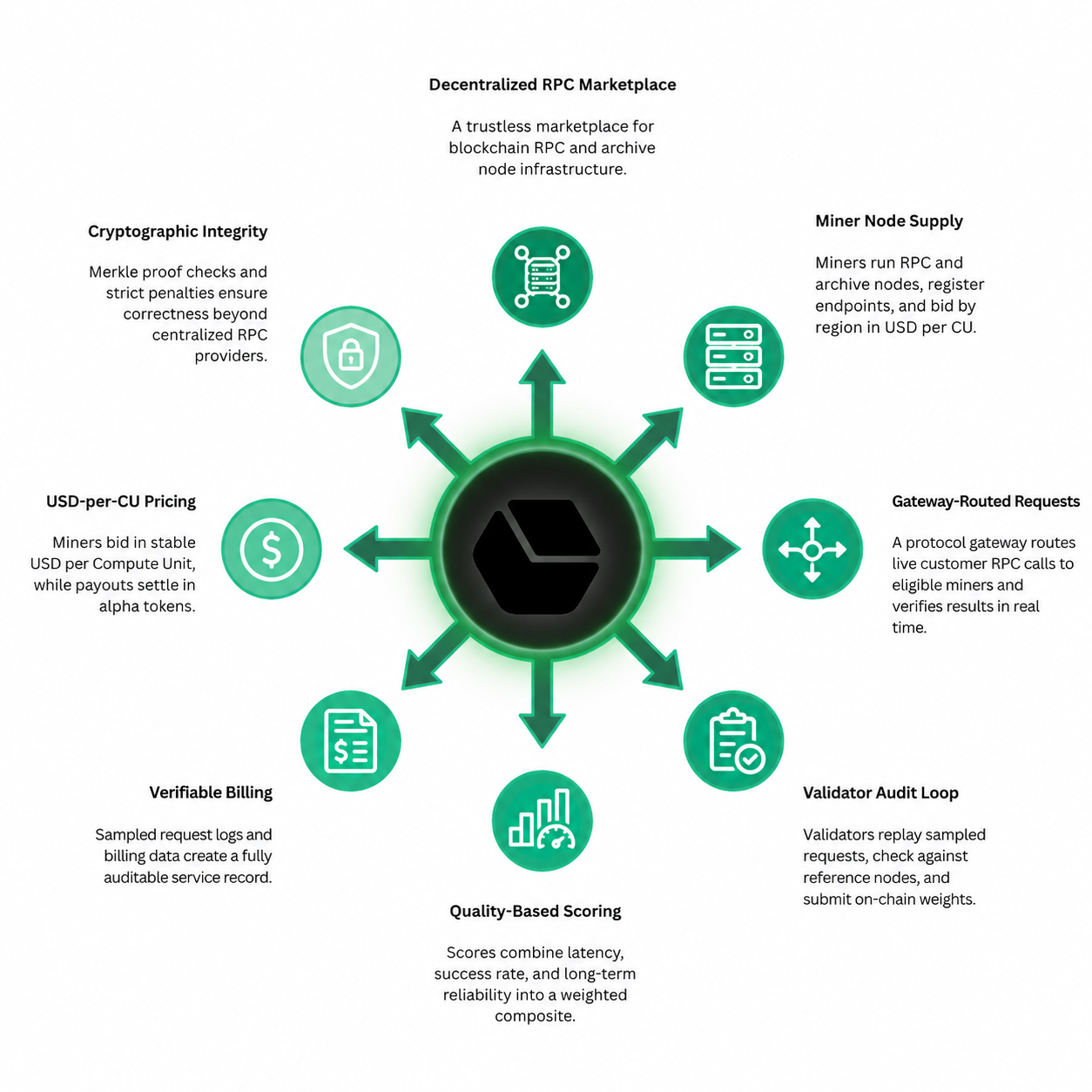
As a Bittensor subnet, Blockmachine introduces two key roles: Miners (suppliers) and Validators (auditors), coordinated by a protocol-operated gateway. During each epoch—360 Bittensor blocks (~72 minutes)—the gateway handles customer RPC requests, routes them to eligible miners, enforces real-time correctness via Merkle proof verification, and logs billing data. At epoch end, validators retrieve these logs, perform full coverage post-hoc audits by replaying sampled requests against reference infrastructure, compute quality metrics, and submit on-chain weight updates. This loop guarantees that only accurate, timely responses contribute to rewards.
Miner Responsibilities and Outputs
Miners operate RPC and archive nodes, register their endpoints with the protocol, and declare a per-epoch pricing bid (in USD per Compute Unit, or CU) for each geographic region. They then earn rewards by serving successful JSON-RPC requests routed by the gateway, where each method’s computational cost is normalized into CUs. Only HTTP 200 responses carrying valid JSON-RPC results incur CUs, ensuring failed or error responses produce neither charges nor miner rewards. In addition to serving live queries, the gateway writes sampled request logs and aggregated billing data to public storage, creating an auditable economic record.
Validator Responsibilities and Scoring
Validators download gateway logs, verify correctness by executing logged RPC calls against trusted reference nodes, and compute a quality score for each miner. The quality score combines latency (p95 response time), success rate (ratio of successful responses within the epoch), and long-term reliability (rolling average of success rates across epochs) into a weighted composite. Validators then submit on-chain weights reflecting both quality and price bids, enforcing consequences for any mismatches—including permanent bans for confirmed incorrect data.
Incentive Mechanism and Economic Integrity
Blockmachine decouples utility pricing from token volatility by having miners bid in stable USD per CU, with on-chain payouts settled in alpha tokens. A Protocol Stability Reserve (PSR) matches each alpha paid to miners with an on-chain market purchase, neutralizing sell pressure, while an emission burn sink removes unearned tokens. Payout weights derive exclusively from delivered work at the agreed market price, ensuring emissions flow only to real service provision.
Comparison to Centralized Alternatives
Unlike centralized RPC providers that control pricing, routing, and performance metrics, Blockmachine’s decentralized design enables customers to independently verify correctness, audit routing decisions, and trust economic calculations without intermediaries. Market-driven bidding aligns prices with actual infrastructure costs, while cryptographic verification and multi-layer correctness enforcement ensure data integrity far beyond what centralized services can guarantee.
Overview and Core Problem
Blockmachine is a decentralized marketplace for blockchain RPC and archive node infrastructure, launched as Bittensor Subnet 19 (SN19). It addresses the dominance of centralized API providers—such as Alchemy and Infura—by enabling decentralized, verifiable, and market-driven access to blockchain data. By harnessing Bittensor’s incentive layer, Blockmachine ensures performance, correctness, and cost transparency through economic competition among nodes, thereby eliminating the opaque pricing and trust assumptions inherent in centralized services.
Mining and Validation Workflow
As a Bittensor subnet, Blockmachine introduces two key roles: Miners (suppliers) and Validators (auditors), coordinated by a protocol-operated gateway. During each epoch—360 Bittensor blocks (~72 minutes)—the gateway handles customer RPC requests, routes them to eligible miners, enforces real-time correctness via Merkle proof verification, and logs billing data. At epoch end, validators retrieve these logs, perform full coverage post-hoc audits by replaying sampled requests against reference infrastructure, compute quality metrics, and submit on-chain weight updates. This loop guarantees that only accurate, timely responses contribute to rewards.
Miner Responsibilities and Outputs
Miners operate RPC and archive nodes, register their endpoints with the protocol, and declare a per-epoch pricing bid (in USD per Compute Unit, or CU) for each geographic region. They then earn rewards by serving successful JSON-RPC requests routed by the gateway, where each method’s computational cost is normalized into CUs. Only HTTP 200 responses carrying valid JSON-RPC results incur CUs, ensuring failed or error responses produce neither charges nor miner rewards. In addition to serving live queries, the gateway writes sampled request logs and aggregated billing data to public storage, creating an auditable economic record.
Validator Responsibilities and Scoring
Validators download gateway logs, verify correctness by executing logged RPC calls against trusted reference nodes, and compute a quality score for each miner. The quality score combines latency (p95 response time), success rate (ratio of successful responses within the epoch), and long-term reliability (rolling average of success rates across epochs) into a weighted composite. Validators then submit on-chain weights reflecting both quality and price bids, enforcing consequences for any mismatches—including permanent bans for confirmed incorrect data.
Incentive Mechanism and Economic Integrity
Blockmachine decouples utility pricing from token volatility by having miners bid in stable USD per CU, with on-chain payouts settled in alpha tokens. A Protocol Stability Reserve (PSR) matches each alpha paid to miners with an on-chain market purchase, neutralizing sell pressure, while an emission burn sink removes unearned tokens. Payout weights derive exclusively from delivered work at the agreed market price, ensuring emissions flow only to real service provision.
Comparison to Centralized Alternatives
Unlike centralized RPC providers that control pricing, routing, and performance metrics, Blockmachine’s decentralized design enables customers to independently verify correctness, audit routing decisions, and trust economic calculations without intermediaries. Market-driven bidding aligns prices with actual infrastructure costs, while cryptographic verification and multi-layer correctness enforcement ensure data integrity far beyond what centralized services can guarantee.
Live Deployment and Development Status
Blockmachine launched as a Bittensor subnet in early 2026, with core infrastructure—such as metering, routing, and monitoring—operational on mainnet. The first production integration has been completed, feeding real RPC traffic into TaoStats for performance analysis, and the network is actively serving Bittensor RPC requests. Concurrently, development efforts are underway to extend support to additional blockchains—including Ethereum and Binance Smart Chain—and to finalize contributor-facing onboarding documentation, example implementations, and comprehensive API references.
Technical Architecture
Blockmachine’s architecture centers on a protocol-operated gateway that functions as the sole ingress point for customer requests, handling authentication, rate limiting, CU accounting, and real-time correctness verification via Merkle proofs. Miners register endpoints and submit per-epoch USD bids, while validators independently score and audit logged requests at epoch boundaries before submitting on-chain weights. The system supports multiple regions—each acting as an independent market—and will scale to multiple chains by deploying chain-specific CU schedules and reference nodes.
GitHub Repository and Codebase
The official code repository resides at https://github.com/taostat/blockmachine, featuring an alpha-stage Python CLI package with 3 commits, 1 stargazer, and a single maintainer. The repository currently contains a README outlining development status, plans for miner and validator onboarding documentation, and a public roadmap for upcoming releases. Although full reference implementations are pending, developers can install the blockmachine CLI via PyPI (blockmachine 0.7.2) to operate mining and validation loops.
Key Metrics and Tokenomics
As of the latest data, the SN19 alpha token trades at approximately 0.01635 TAO ($3.92), with a market capitalization of 39.46K TAO (~$17.77M) and a 24-hour trading volume of 3.03K TAO (~$727K). The subnet’s emission rate is set at 2.29% per epoch, with a root proportion of 17.5%. Circulating alpha supply represents 11.5% of the 21 million token cap.
Validator Scoring Mechanism
Quality scoring is a composite function Q = wL·L + wS·S + wR·R, where L is the normalized p95 latency score, S is the epoch success rate, and R is long-term reliability across epochs. Configurable component weights ensure that both current performance and sustained track records influence routing eligibility and preference.
Developer APIs and Integration
Developers can interact with SN19 via the Bittensor SDK and CLI (btcli), extending standard Bittensor commands to specify netuid 19. The blockmachine PyPI package provides CLI subcommands for miner and validator operators, while future releases will include SDK bindings and RESTful interfaces for automated infrastructure management.
Live Deployment and Development Status
Blockmachine launched as a Bittensor subnet in early 2026, with core infrastructure—such as metering, routing, and monitoring—operational on mainnet. The first production integration has been completed, feeding real RPC traffic into TaoStats for performance analysis, and the network is actively serving Bittensor RPC requests. Concurrently, development efforts are underway to extend support to additional blockchains—including Ethereum and Binance Smart Chain—and to finalize contributor-facing onboarding documentation, example implementations, and comprehensive API references.
Technical Architecture
Blockmachine’s architecture centers on a protocol-operated gateway that functions as the sole ingress point for customer requests, handling authentication, rate limiting, CU accounting, and real-time correctness verification via Merkle proofs. Miners register endpoints and submit per-epoch USD bids, while validators independently score and audit logged requests at epoch boundaries before submitting on-chain weights. The system supports multiple regions—each acting as an independent market—and will scale to multiple chains by deploying chain-specific CU schedules and reference nodes.
GitHub Repository and Codebase
The official code repository resides at https://github.com/taostat/blockmachine, featuring an alpha-stage Python CLI package with 3 commits, 1 stargazer, and a single maintainer. The repository currently contains a README outlining development status, plans for miner and validator onboarding documentation, and a public roadmap for upcoming releases. Although full reference implementations are pending, developers can install the blockmachine CLI via PyPI (blockmachine 0.7.2) to operate mining and validation loops.
Key Metrics and Tokenomics
As of the latest data, the SN19 alpha token trades at approximately 0.01635 TAO ($3.92), with a market capitalization of 39.46K TAO (~$17.77M) and a 24-hour trading volume of 3.03K TAO (~$727K). The subnet’s emission rate is set at 2.29% per epoch, with a root proportion of 17.5%. Circulating alpha supply represents 11.5% of the 21 million token cap.
Validator Scoring Mechanism
Quality scoring is a composite function Q = wL·L + wS·S + wR·R, where L is the normalized p95 latency score, S is the epoch success rate, and R is long-term reliability across epochs. Configurable component weights ensure that both current performance and sustained track records influence routing eligibility and preference.
Developer APIs and Integration
Developers can interact with SN19 via the Bittensor SDK and CLI (btcli), extending standard Bittensor commands to specify netuid 19. The blockmachine PyPI package provides CLI subcommands for miner and validator operators, while future releases will include SDK bindings and RESTful interfaces for automated infrastructure management.
Core Contributor
Blockmachine is primarily developed by Mark Davison, who serves as the sole maintainer and principal contributor to the codebase. Mark Davison maintains the blockmachine CLI package on PyPI—joining Feb 24, 2026—and authored initial alpha releases published throughout March 2026.
GitHub and Release History
The code repository at https://github.com/taostat/blockmachine currently lists 3 commits, 1 star, and 1 contributor (Mark Davison). The PyPI project shows continuous alpha-stage releases from version 0.1.0 on Feb 24, 2026, through version 0.7.2 on Mar 21, 2026.
Community Identity
Blockmachine maintains a social presence on X (formerly Twitter) under @blockmachine_, providing update notifications and development chatter. Direct inquiries can be sent to [email protected], as listed on the SN19 subnet dashboard.
Core Contributor
Blockmachine is primarily developed by Mark Davison, who serves as the sole maintainer and principal contributor to the codebase. Mark Davison maintains the blockmachine CLI package on PyPI—joining Feb 24, 2026—and authored initial alpha releases published throughout March 2026.
GitHub and Release History
The code repository at https://github.com/taostat/blockmachine currently lists 3 commits, 1 star, and 1 contributor (Mark Davison). The PyPI project shows continuous alpha-stage releases from version 0.1.0 on Feb 24, 2026, through version 0.7.2 on Mar 21, 2026.
Community Identity
Blockmachine maintains a social presence on X (formerly Twitter) under @blockmachine_, providing update notifications and development chatter. Direct inquiries can be sent to [email protected], as listed on the SN19 subnet dashboard.
Build Phase
During the initial build phase, core gateway infrastructure for request metering, routing, and monitoring was completed to support real customer demand. This included development of real-time gates to enforce freshness, archive capabilities, and circuit breakers to handle node failures gracefully.
First Production Integration
Following foundational work, Blockmachine achieved its first production integration by routing live Bittensor RPC traffic through the portal into TaoStats, enabling public performance measurement, reliability tracking, and economic auditability.
Live as a Bittensor Subnet
With successful production traffic flows, Blockmachine officially launched as Subnet 19 on mainnet, opening miner slots, initiating validator cycles, and distributing alpha rewards against delivered work in real time.
Chain Expansion
Upcoming roadmap milestones include adding support for additional blockchains—starting with Ethereum and Binance Smart Chain—each with their own CU schedules and reference nodes. Subsequent phases will refine cross-chain routing logic and expand regional gateway deployments.
Developer Onboarding and Documentation
Future releases will deliver comprehensive miner and validator onboarding guides, reference implementations, example scripts, and RESTful API documentation to streamline subnet participation. The public roadmap will detail timelines for each documentation release.
Build Phase
During the initial build phase, core gateway infrastructure for request metering, routing, and monitoring was completed to support real customer demand. This included development of real-time gates to enforce freshness, archive capabilities, and circuit breakers to handle node failures gracefully.
First Production Integration
Following foundational work, Blockmachine achieved its first production integration by routing live Bittensor RPC traffic through the portal into TaoStats, enabling public performance measurement, reliability tracking, and economic auditability.
Live as a Bittensor Subnet
With successful production traffic flows, Blockmachine officially launched as Subnet 19 on mainnet, opening miner slots, initiating validator cycles, and distributing alpha rewards against delivered work in real time.
Chain Expansion
Upcoming roadmap milestones include adding support for additional blockchains—starting with Ethereum and Binance Smart Chain—each with their own CU schedules and reference nodes. Subsequent phases will refine cross-chain routing logic and expand regional gateway deployments.
Developer Onboarding and Documentation
Future releases will deliver comprehensive miner and validator onboarding guides, reference implementations, example scripts, and RESTful API documentation to streamline subnet participation. The public roadmap will detail timelines for each documentation release.