
With the amount of new subnets being added it can be hard to get up to date information across all subnets, so data may be slightly out of date from time to time
Decentralized Ad Optimization
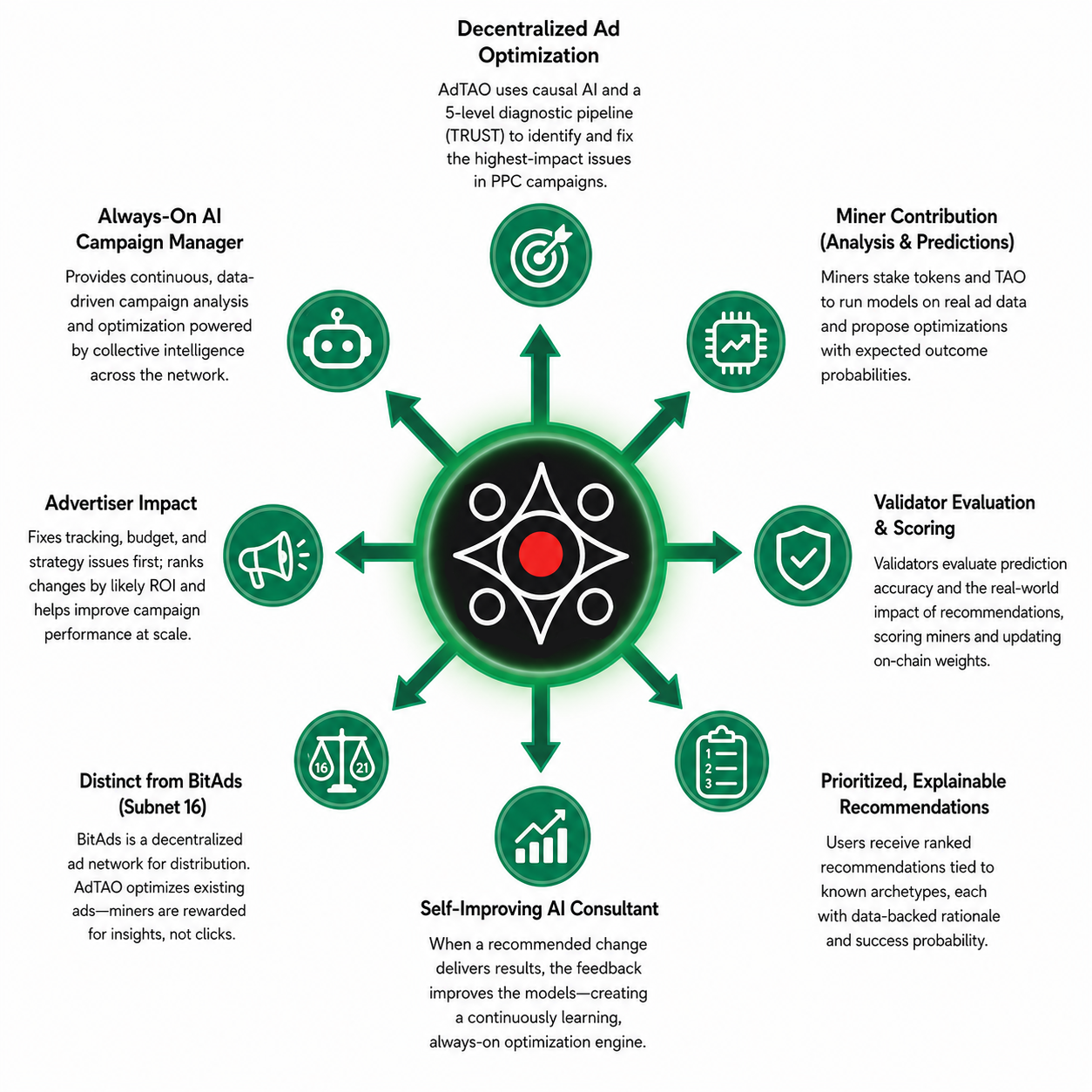
AdTAO tackles the challenge of optimizing pay-per-click ad campaigns by leveraging Bittensor’s decentralized AI network. It uses causal-inference models trained on aggregations of thousands of ad accounts to predict how changes will affect performance, rather than relying on fixed rules. The subnet implements a structured diagnostic pipeline (called TRUST) evaluating campaigns at five levels (Goals, Measurement, Strategy, Settings, Content) so that systemic issues (like faulty conversion tracking) are identified and fixed first. In other words, AdTAO provides an always-on Google Ads manager powered by collective intelligence, identifying the highest-impact fixes for campaigns.
Miner and Validator Roles
On AdTAO, miners participate by staking subnet tokens and TAO and running inference models on real ad data. Each miner analyzes advertisers’ campaign signals (impressions, clicks, budgets, etc.) and proposes optimizations with expected outcome probabilities. Validators then evaluate those outputs: they score miners based on how accurate the predictions turn out to be or how effectively the recommended changes improve results. This validator scoring feeds the Bittensor consensus, distributing rewards (both TAO and AdTAO alpha tokens) in proportion to contribution quality. In effect, miners feed in tactics and validators act as auditors confirming their benefit.
Advertiser Outputs
End users (advertisers/agencies) see the final output as prioritized, explainable recommendations. AdTAO never presents black-box advice – every suggested change is tied to a known diagnostic “archetype” and backed by data. For example, it might flag a missing conversion tag or a budget issue, rank fixes by likely ROI, and attach a success probability to each. Unlike manual audits or opaque AI tools, AdTAO’s recommendations can be reviewed and approved by the user. Essentially it acts as a self-improving AI campaign consultant: when a recommended fix produces a real gain, that success is fed back to improve the models. All this occurs continuously, providing advertisers with optimized campaign guidance on demand.
Comparison to Other Subnets
Within Bittensor’s ecosystem, AdTAO is distinct from other ad-focused subnets. For example, BitAds (Subnet 16) is a decentralized advertising network enabling permissionless ad placement and distribution – essentially a permissionless ad marketplace. BitAds ensures advertisers only pay for confirmed conversions; miners are rewarded for actual sales they generate. By contrast, AdTAO does not buy or display ads; it helps publishers improve their own ads. Its miners are rewarded for predictive accuracy and actionable insights rather than click volume. In short, BitAds redirects the affiliate model on-chain, while AdTAO acts as a decentralized optimization engine for PPC. No other Bittensor subnet offers the same focused PPC diagnostical AI.
Decentralized Ad Optimization
AdTAO tackles the challenge of optimizing pay-per-click ad campaigns by leveraging Bittensor’s decentralized AI network. It uses causal-inference models trained on aggregations of thousands of ad accounts to predict how changes will affect performance, rather than relying on fixed rules. The subnet implements a structured diagnostic pipeline (called TRUST) evaluating campaigns at five levels (Goals, Measurement, Strategy, Settings, Content) so that systemic issues (like faulty conversion tracking) are identified and fixed first. In other words, AdTAO provides an always-on Google Ads manager powered by collective intelligence, identifying the highest-impact fixes for campaigns.
Miner and Validator Roles
On AdTAO, miners participate by staking subnet tokens and TAO and running inference models on real ad data. Each miner analyzes advertisers’ campaign signals (impressions, clicks, budgets, etc.) and proposes optimizations with expected outcome probabilities. Validators then evaluate those outputs: they score miners based on how accurate the predictions turn out to be or how effectively the recommended changes improve results. This validator scoring feeds the Bittensor consensus, distributing rewards (both TAO and AdTAO alpha tokens) in proportion to contribution quality. In effect, miners feed in tactics and validators act as auditors confirming their benefit.
Advertiser Outputs
End users (advertisers/agencies) see the final output as prioritized, explainable recommendations. AdTAO never presents black-box advice – every suggested change is tied to a known diagnostic “archetype” and backed by data. For example, it might flag a missing conversion tag or a budget issue, rank fixes by likely ROI, and attach a success probability to each. Unlike manual audits or opaque AI tools, AdTAO’s recommendations can be reviewed and approved by the user. Essentially it acts as a self-improving AI campaign consultant: when a recommended fix produces a real gain, that success is fed back to improve the models. All this occurs continuously, providing advertisers with optimized campaign guidance on demand.
Comparison to Other Subnets
Within Bittensor’s ecosystem, AdTAO is distinct from other ad-focused subnets. For example, BitAds (Subnet 16) is a decentralized advertising network enabling permissionless ad placement and distribution – essentially a permissionless ad marketplace. BitAds ensures advertisers only pay for confirmed conversions; miners are rewarded for actual sales they generate. By contrast, AdTAO does not buy or display ads; it helps publishers improve their own ads. Its miners are rewarded for predictive accuracy and actionable insights rather than click volume. In short, BitAds redirects the affiliate model on-chain, while AdTAO acts as a decentralized optimization engine for PPC. No other Bittensor subnet offers the same focused PPC diagnostical AI.
Current Status
The AdTAO service appears live via PPC Rebel’s platform: their website offers an AI PPC manager for trial, but the underlying Bittensor alpha token and staking mechanics are not public. There is no official code repository – development seems proprietary. The subnet is registered (NetUID 21) on Bittensor, but no liquidity or exchange listings for its alpha token are known. In short, a beta version of the tool is in use, but the on-chain tokenization and distribution remain under development.
Technical Architecture
AdTAO runs on Bittensor’s standard miner/validator framework. Miners likely run Python-based ML models (e.g. PyTorch) implementing the TRUST diagnostic logic. These models consume campaign data from ad APIs (e.g. Google Ads API) and output ranked optimization suggestions. Validators then apply the subnet’s off-chain evaluation code (defined in its incentive repository) to score the miners’ results. An AdTAO alpha token would be paired with TAO in an automated market maker for staking as per Bittensor’s design, but we have no details of its issuance. The PPC Rebel website serves as the user interface; behind the scenes it likely calls smart contracts or off-chain services, but no details are exposed publicly.
Project Repository and Activity
No official GitHub or open-source code is available. Thus, GitHub activity, contributor lists, and code reviews cannot be assessed. Likewise, the alpha token’s market price and daily emissions (which drive TAO rewards) are unknown. One analysis noted AdTAO was “generating revenue at .0054”, hinting an early token valuation, but without an exchange listing this is unverified. In other words, public developer or market metrics for AdTAO are currently absent.
Integrations and APIs
The key external integration is likely with Google Ads (for campaign data ingestion) given AdTAO’s focus. The subnet might also evolve to incorporate other marketing channels (e.g. APIs from other ad platforms). By analogy, BitAds built a Shopify conversion-tracking app; AdTAO may similarly plan integrations (none announced). Beyond the Bittensor protocol, AdTAO does not list any public APIs. All user interactions appear to be through the PPC Rebel platform.
Users and Customers
AdTAO’s customers are advertisers and agencies using Google Ads. These buyers use the PPC Rebel interface to connect accounts and receive optimization reports. Publishers or media sites are not the target here (unlike some ad subnets focused on the sell side). Instead, AdTAO is aimed at marketing teams that pay for ads and want a data-driven edge. In practice this means ad accounts managers, e-commerce marketers, and PPC specialists. They get AI-generated insights automatically, rather than doing manual audits. In summary, the end users are the advertising buyers who subscribe to PPC Rebel’s service to gain decentralized AI management of their campaigns.
Current Status
The AdTAO service appears live via PPC Rebel’s platform: their website offers an AI PPC manager for trial, but the underlying Bittensor alpha token and staking mechanics are not public. There is no official code repository – development seems proprietary. The subnet is registered (NetUID 21) on Bittensor, but no liquidity or exchange listings for its alpha token are known. In short, a beta version of the tool is in use, but the on-chain tokenization and distribution remain under development.
Technical Architecture
AdTAO runs on Bittensor’s standard miner/validator framework. Miners likely run Python-based ML models (e.g. PyTorch) implementing the TRUST diagnostic logic. These models consume campaign data from ad APIs (e.g. Google Ads API) and output ranked optimization suggestions. Validators then apply the subnet’s off-chain evaluation code (defined in its incentive repository) to score the miners’ results. An AdTAO alpha token would be paired with TAO in an automated market maker for staking as per Bittensor’s design, but we have no details of its issuance. The PPC Rebel website serves as the user interface; behind the scenes it likely calls smart contracts or off-chain services, but no details are exposed publicly.
Project Repository and Activity
No official GitHub or open-source code is available. Thus, GitHub activity, contributor lists, and code reviews cannot be assessed. Likewise, the alpha token’s market price and daily emissions (which drive TAO rewards) are unknown. One analysis noted AdTAO was “generating revenue at .0054”, hinting an early token valuation, but without an exchange listing this is unverified. In other words, public developer or market metrics for AdTAO are currently absent.
Integrations and APIs
The key external integration is likely with Google Ads (for campaign data ingestion) given AdTAO’s focus. The subnet might also evolve to incorporate other marketing channels (e.g. APIs from other ad platforms). By analogy, BitAds built a Shopify conversion-tracking app; AdTAO may similarly plan integrations (none announced). Beyond the Bittensor protocol, AdTAO does not list any public APIs. All user interactions appear to be through the PPC Rebel platform.
Users and Customers
AdTAO’s customers are advertisers and agencies using Google Ads. These buyers use the PPC Rebel interface to connect accounts and receive optimization reports. Publishers or media sites are not the target here (unlike some ad subnets focused on the sell side). Instead, AdTAO is aimed at marketing teams that pay for ads and want a data-driven edge. In practice this means ad accounts managers, e-commerce marketers, and PPC specialists. They get AI-generated insights automatically, rather than doing manual audits. In summary, the end users are the advertising buyers who subscribe to PPC Rebel’s service to gain decentralized AI management of their campaigns.
Development Team
AdTAO is developed by the team at PPC Rebel, the company behind the PPC Rebel Google Ads platform. Public information about the team is scarce: no founders or developers are named. An external report describes the project as having an “experienced team…with multiple exits” in the ad industry, hinting at adtech veterans, but these claims are unverified and no profiles are published. Essentially, PPC Rebel and its unnamed staff own the subnet.
Online Presence
The only clear social link is PPCRebel’s Twitter/X (*@ppcrebel*), noted on their site. There is no dedicated AdTAO Discord, Telegram, or forum. Likewise, no GitHub organization for AdTAO or PPCRebel is publicly available. Any project discussions occur on general Bittensor channels, but AdTAO has no separate community. In short, there is no accessible list of contributors – the project appears privately run.
Expertise and Background
The PPC Rebel team’s background is in digital marketing and PPC. Their business (PPCRebel) analyzes thousands of accounts, suggesting expertise in Google Ads strategy. The claim of prior exits suggests some founders may have entrepreneurial history. However, we have not found confirmation of their AI/ML credentials or blockchain experience. They do not appear to have participated in core Bittensor development before; AdTAO is their entry into the ecosystem. Beyond marketing skills, any other technical expertise (e.g. data science) is not publicly documented.
Partnerships and Engagement
No partnerships or investors are announced for AdTAO. The team has not listed any collaborators or institutional backers. The subnet’s presence in the Bittensor ecosystem is purely its own registration – there is no governance council or multi-party sponsorship. We found no evidence of hackathon wins or external code contributions. The only community engagement is via the PPCRebel product itself. In sum, AdTAO is an in-house project of PPC Rebel with limited external engagement that is visible publicly.
Development Team
AdTAO is developed by the team at PPC Rebel, the company behind the PPC Rebel Google Ads platform. Public information about the team is scarce: no founders or developers are named. An external report describes the project as having an “experienced team…with multiple exits” in the ad industry, hinting at adtech veterans, but these claims are unverified and no profiles are published. Essentially, PPC Rebel and its unnamed staff own the subnet.
Online Presence
The only clear social link is PPCRebel’s Twitter/X (*@ppcrebel*), noted on their site. There is no dedicated AdTAO Discord, Telegram, or forum. Likewise, no GitHub organization for AdTAO or PPCRebel is publicly available. Any project discussions occur on general Bittensor channels, but AdTAO has no separate community. In short, there is no accessible list of contributors – the project appears privately run.
Expertise and Background
The PPC Rebel team’s background is in digital marketing and PPC. Their business (PPCRebel) analyzes thousands of accounts, suggesting expertise in Google Ads strategy. The claim of prior exits suggests some founders may have entrepreneurial history. However, we have not found confirmation of their AI/ML credentials or blockchain experience. They do not appear to have participated in core Bittensor development before; AdTAO is their entry into the ecosystem. Beyond marketing skills, any other technical expertise (e.g. data science) is not publicly documented.
Partnerships and Engagement
No partnerships or investors are announced for AdTAO. The team has not listed any collaborators or institutional backers. The subnet’s presence in the Bittensor ecosystem is purely its own registration – there is no governance council or multi-party sponsorship. We found no evidence of hackathon wins or external code contributions. The only community engagement is via the PPCRebel product itself. In sum, AdTAO is an in-house project of PPC Rebel with limited external engagement that is visible publicly.
Roadmap and Milestones
No official roadmap has been published for AdTAO. The PPCRebel site previously listed a closed beta waitlist, implying an initial testing phase, but beyond that no staged plan or timeline is disclosed. A cryptocurrency news snippet noted AdTAO “generating revenue at .0054”, perhaps indicating an early alpha token valuation, but this is not a roadmap announcement. In short, the creators have given no public release schedule or future milestones.
Future Plans
We have no official insight into upcoming phases. By analogy, similar projects have outlined expansions: for example, the BitAds subnet announced adding WooCommerce and other integrations. AdTAO might eventually broaden beyond Google Ads to other platforms, or roll out staking and token mechanics, but no specifics are provided. In the absence of announcements, any proposed timeline (e.g. for Q2 2026) would be speculation. As of now, the project appears focused on completing its core feature set.
Fully Realized Vision
In theory, the fully realized AdTAO would be an autonomous, decentralized PPC optimization service embedded in the Bittensor ecosystem. It would continuously train on cross-account data, refine ad strategies automatically, and support multiple advertising channels. Advertisers would essentially plug in any search marketing campaign and instantly get blockchain-verified improvement suggestions. However, these goals have not been formalized in public. The creators have not released a roadmap or made recent feature announcements. We have only the live product (as a trial service) and a few off-chain hints. Without further updates, the timeline for achieving this vision remains unknown.
Roadmap and Milestones
No official roadmap has been published for AdTAO. The PPCRebel site previously listed a closed beta waitlist, implying an initial testing phase, but beyond that no staged plan or timeline is disclosed. A cryptocurrency news snippet noted AdTAO “generating revenue at .0054”, perhaps indicating an early alpha token valuation, but this is not a roadmap announcement. In short, the creators have given no public release schedule or future milestones.
Future Plans
We have no official insight into upcoming phases. By analogy, similar projects have outlined expansions: for example, the BitAds subnet announced adding WooCommerce and other integrations. AdTAO might eventually broaden beyond Google Ads to other platforms, or roll out staking and token mechanics, but no specifics are provided. In the absence of announcements, any proposed timeline (e.g. for Q2 2026) would be speculation. As of now, the project appears focused on completing its core feature set.
Fully Realized Vision
In theory, the fully realized AdTAO would be an autonomous, decentralized PPC optimization service embedded in the Bittensor ecosystem. It would continuously train on cross-account data, refine ad strategies automatically, and support multiple advertising channels. Advertisers would essentially plug in any search marketing campaign and instantly get blockchain-verified improvement suggestions. However, these goals have not been formalized in public. The creators have not released a roadmap or made recent feature announcements. We have only the live product (as a trial service) and a few off-chain hints. Without further updates, the timeline for achieving this vision remains unknown.
Big shoutout to Gordon Frayne for his incredible work on his TAO Pill podcast! His deep dives into Bittensor Subnets break down the decentralized AI landscape like few others can. Head over to his YouTube channel to catch the full series for top-tier analysis and insights.
Recorded in April 2026. Gordon Frayne speaks with Rob Warner, founder of AdTow, Bittensor Subnet 21, about using decentralized prediction models to improve the performance of Google Ads campaigns. Rob explains how his background running and eventually selling successful Google Ads businesses gave him access to data across thousands of advertising accounts, revealing a fundamental problem in the industry: individual advertisers often have too little data to make statistically reliable optimization decisions, while platforms such as Google operate with enormous datasets. AdTow addresses this by aggregating and anonymising performance data across many accounts, structuring that information into hundreds of comparable data points and then using Bittensor miners to predict the likely impact of specific proposed changes before those changes are made. Rather than asking miners to decide what advertisers should do, AdTow provides a potential account change and asks miners to forecast its effect over a defined period, allowing the platform to prioritise the changes most likely to improve performance and eventually automate their execution. Rob discusses AdTow’s existing commercial traction, with paying customers already using its analytics and automation platform before the predictive subnet layer is fully deployed, while the longer-term goal is to use miner intelligence to make those recommendations substantially more valuable. The conversation also covers plans for revenue-linked alpha buybacks, initially through transparent monthly purchases before moving towards automated buybacks, alongside an affiliate model that could further incentivise alpha participation. Rob outlines AdTow’s wider roadmap, including aggressive customer growth once the predictive system is proven, expansion into Microsoft Ads, integrations with other Bittensor subnets, and a new landing-page optimization system capable of generating and testing pages based on aggregated performance data. The broader vision is to build an intelligent advertising optimization layer that replaces subjective account-management decisions with statistically informed predictions derived from data at scale, helping advertisers continuously make the changes most likely to improve results.