With the amount of new subnets being added it can be hard to get up to date information across all subnets, so data may be slightly out of date from time to time
The team behind the Zeus Subnet is doing some seriously impressive work within the Bittensor network. They’re using advanced AI models to forecast environmental data in a way that’s both decentralized and incentive-driven, which not only builds trust but also encourages constant technological progress. What’s really cool is that they’re tapping into ERA5 reanalysis data from the Climate Data Store—part of the EU’s Copernicus program. That dataset is massive, covering hourly measurements from 1940 to the present across hundreds of variables. Validators can even stream this data in real time, which allows miners to query terabytes of environmental information on the fly.
Traditionally, environmental forecasting has relied on physics-based numerical weather prediction (NWP). It’s accurate, sure—but it’s also incredibly expensive and time-consuming, often requiring huge amounts of compute and hours just to run a single simulation. What Zeus is doing instead is exploring data-driven AI models that are potentially faster, more accurate, and way more efficient in terms of cost and carbon output. They’ve built a system that incentivizes innovation in this space, pushing for new architectures that can handle the complexity of environmental data prediction. Over time, they’re enabling miners to take on harder and more meaningful challenges, which is exactly the kind of evolution you’d hope to see in a cutting-edge subnet.
The team behind the Zeus Subnet is doing some seriously impressive work within the Bittensor network. They’re using advanced AI models to forecast environmental data in a way that’s both decentralized and incentive-driven, which not only builds trust but also encourages constant technological progress. What’s really cool is that they’re tapping into ERA5 reanalysis data from the Climate Data Store—part of the EU’s Copernicus program. That dataset is massive, covering hourly measurements from 1940 to the present across hundreds of variables. Validators can even stream this data in real time, which allows miners to query terabytes of environmental information on the fly.
Traditionally, environmental forecasting has relied on physics-based numerical weather prediction (NWP). It’s accurate, sure—but it’s also incredibly expensive and time-consuming, often requiring huge amounts of compute and hours just to run a single simulation. What Zeus is doing instead is exploring data-driven AI models that are potentially faster, more accurate, and way more efficient in terms of cost and carbon output. They’ve built a system that incentivizes innovation in this space, pushing for new architectures that can handle the complexity of environmental data prediction. Over time, they’re enabling miners to take on harder and more meaningful challenges, which is exactly the kind of evolution you’d hope to see in a cutting-edge subnet.
The team behind Zeus is tackling one of the most critical challenges of our time—climate forecasting. Their work has major implications across industries like transportation, agriculture, energy, and public safety. Accurate climate predictions help decision-makers minimize risk and optimize their operations, and with climate change accelerating, the need for fast, reliable, and scalable forecasting has never been more urgent. What Zeus is doing stands out because they’re not just improving forecasts—they’re rethinking the entire forecasting pipeline using a decentralized, machine learning-first approach.
Traditionally, forecasting relies on numerical weather prediction (NWP) systems, which are incredibly powerful but also resource-intensive and slow. The standard process involves multiple stages: gathering vast streams of observational data, estimating the current atmospheric state, and then running complex physics-based models to simulate future conditions. After that, there’s still post-processing to generate usable local forecasts. This entire pipeline takes time, money, and top-tier expertise to maintain and improve, making it difficult to scale or evolve rapidly.
The Zeus team is taking a different route through machine learning-based weather prediction (MLWP). This method is quickly gaining ground as a viable alternative to traditional NWP. By training models on historical data, MLWP captures patterns and behaviors that are hard to express in equations, offering a way to generate faster and sometimes even more accurate forecasts using modern deep learning infrastructure. Zeus isn’t just keeping up with this trend—they’re pushing it forward. Their approach has already shown that it can rival and sometimes surpass legacy systems like ECMWF’s HRES in both accuracy and efficiency.
What Makes Zeus Unique
What really sets Zeus apart is how they’re applying Bittensor’s decentralized network to build a new kind of climate forecasting framework. It’s designed to be modular and adaptable, starting with a focus on forecasting 2-meter surface temperature (T2m) and eventually expanding to include more environmental variables. Engineers across the Zeus subnet compete to improve model performance under shared hardware and time constraints, driving innovation through network-wide collaboration and competition.
The system distributes forecasting challenges globally, encouraging participants to refine and optimize their models using the latest AI techniques. This creates a wide range of solutions and approaches, which is essential in a field as complex as climate modeling. As the subnet evolves, Zeus is able to dynamically respond to new data, shifting conditions, and user needs. It’s not just about building better models—it’s about building a system that can keep getting better on its own.
Zeus also brings transparency and accountability into the mix by recording key operations—like model updates and reward allocations—on Bittensor’s blockchain, Subtensor. This on-chain layer ensures that everything is publicly verifiable and securely tracked, which is huge for trust and long-term credibility.
Roles of Miners and Validators
The interaction between miners and validators is at the heart of how Zeus operates. Validators challenge miners with real forecasting tasks, targeting specific geographic areas and time windows. Miners receive a set of latitude-longitude coordinates, a start time, and a forecast window, and are expected to return hourly forecasts—initially focused on T2m values in degrees Kelvin. The task requires not just speed but precision, as forecasts must be tailored to both spatial and temporal constraints.
This setup creates a dynamic environment where miners are constantly adapting and optimizing their models to meet real-world demands. It’s a brilliant structure because it mirrors the challenges faced in operational climate forecasting—only here, it’s decentralized, open, and driven by incentives that reward innovation and accuracy.
The team behind Zeus is tackling one of the most critical challenges of our time—climate forecasting. Their work has major implications across industries like transportation, agriculture, energy, and public safety. Accurate climate predictions help decision-makers minimize risk and optimize their operations, and with climate change accelerating, the need for fast, reliable, and scalable forecasting has never been more urgent. What Zeus is doing stands out because they’re not just improving forecasts—they’re rethinking the entire forecasting pipeline using a decentralized, machine learning-first approach.
Traditionally, forecasting relies on numerical weather prediction (NWP) systems, which are incredibly powerful but also resource-intensive and slow. The standard process involves multiple stages: gathering vast streams of observational data, estimating the current atmospheric state, and then running complex physics-based models to simulate future conditions. After that, there’s still post-processing to generate usable local forecasts. This entire pipeline takes time, money, and top-tier expertise to maintain and improve, making it difficult to scale or evolve rapidly.
The Zeus team is taking a different route through machine learning-based weather prediction (MLWP). This method is quickly gaining ground as a viable alternative to traditional NWP. By training models on historical data, MLWP captures patterns and behaviors that are hard to express in equations, offering a way to generate faster and sometimes even more accurate forecasts using modern deep learning infrastructure. Zeus isn’t just keeping up with this trend—they’re pushing it forward. Their approach has already shown that it can rival and sometimes surpass legacy systems like ECMWF’s HRES in both accuracy and efficiency.
What Makes Zeus Unique
What really sets Zeus apart is how they’re applying Bittensor’s decentralized network to build a new kind of climate forecasting framework. It’s designed to be modular and adaptable, starting with a focus on forecasting 2-meter surface temperature (T2m) and eventually expanding to include more environmental variables. Engineers across the Zeus subnet compete to improve model performance under shared hardware and time constraints, driving innovation through network-wide collaboration and competition.
The system distributes forecasting challenges globally, encouraging participants to refine and optimize their models using the latest AI techniques. This creates a wide range of solutions and approaches, which is essential in a field as complex as climate modeling. As the subnet evolves, Zeus is able to dynamically respond to new data, shifting conditions, and user needs. It’s not just about building better models—it’s about building a system that can keep getting better on its own.
Zeus also brings transparency and accountability into the mix by recording key operations—like model updates and reward allocations—on Bittensor’s blockchain, Subtensor. This on-chain layer ensures that everything is publicly verifiable and securely tracked, which is huge for trust and long-term credibility.
Roles of Miners and Validators
The interaction between miners and validators is at the heart of how Zeus operates. Validators challenge miners with real forecasting tasks, targeting specific geographic areas and time windows. Miners receive a set of latitude-longitude coordinates, a start time, and a forecast window, and are expected to return hourly forecasts—initially focused on T2m values in degrees Kelvin. The task requires not just speed but precision, as forecasts must be tailored to both spatial and temporal constraints.
This setup creates a dynamic environment where miners are constantly adapting and optimizing their models to meet real-world demands. It’s a brilliant structure because it mirrors the challenges faced in operational climate forecasting—only here, it’s decentralized, open, and driven by incentives that reward innovation and accuracy.
Zeus is brought to life by a dedicated team combining hands-on Bittensor experience with deep domain expertise from leading academic institutions. They are passionate about decentralization and building practical solutions to real-world challenges.
Wouter Haringhuizen – Co-Founder & Machine Learning Engineer
Travis – Co-Founder & Partner
Egill – Business Developer
Eric – Machine Learning Engineer
Vasilis – Machine Learning Engineer
Zeus is brought to life by a dedicated team combining hands-on Bittensor experience with deep domain expertise from leading academic institutions. They are passionate about decentralization and building practical solutions to real-world challenges.
Wouter Haringhuizen – Co-Founder & Machine Learning Engineer
Travis – Co-Founder & Partner
Egill – Business Developer
Eric – Machine Learning Engineer
Vasilis – Machine Learning Engineer
They’ve designed the subnet with flexibility at its core, so as climate forecasting needs evolve, Zeus is ready to scale and integrate new environmental variables with ease. Whether it’s adapting to new technologies or responding to real-world demands, they’ve built a framework that can grow into something far more expansive—delivering forecasts that are not only more accurate, but also more accessible, all while staying ahead of the curve.
With the weather forecasting market expected to grow rapidly in the coming years, Zeus is in a strong position to disrupt the space by decentralizing a process that’s traditionally been expensive and tightly controlled. Their adaptability opens the door to all kinds of practical applications—from early disaster warnings to smarter grid management—which makes the subnet highly relevant across multiple industries. On top of that, their ability to support flexible grid sizes and adjust based on validator input means they can continue delivering timely, reliable forecasts that are actually shaped by user demand. It’s this blend of scalability, precision, and market awareness that gives Zeus the potential not just to lead in innovation, but to create real-world impact—and real economic value—in the climate forecasting space.
They’ve designed the subnet with flexibility at its core, so as climate forecasting needs evolve, Zeus is ready to scale and integrate new environmental variables with ease. Whether it’s adapting to new technologies or responding to real-world demands, they’ve built a framework that can grow into something far more expansive—delivering forecasts that are not only more accurate, but also more accessible, all while staying ahead of the curve.
With the weather forecasting market expected to grow rapidly in the coming years, Zeus is in a strong position to disrupt the space by decentralizing a process that’s traditionally been expensive and tightly controlled. Their adaptability opens the door to all kinds of practical applications—from early disaster warnings to smarter grid management—which makes the subnet highly relevant across multiple industries. On top of that, their ability to support flexible grid sizes and adjust based on validator input means they can continue delivering timely, reliable forecasts that are actually shaped by user demand. It’s this blend of scalability, precision, and market awareness that gives Zeus the potential not just to lead in innovation, but to create real-world impact—and real economic value—in the climate forecasting space.
A special thanks to Mark Jeffrey for his amazing Hash Rate series! In this series, he provides valuable insights into Bittensor Subnets and the world of decentralized AI. Be sure to check out the full series on his YouTube channel for more expert analysis and deep dives.
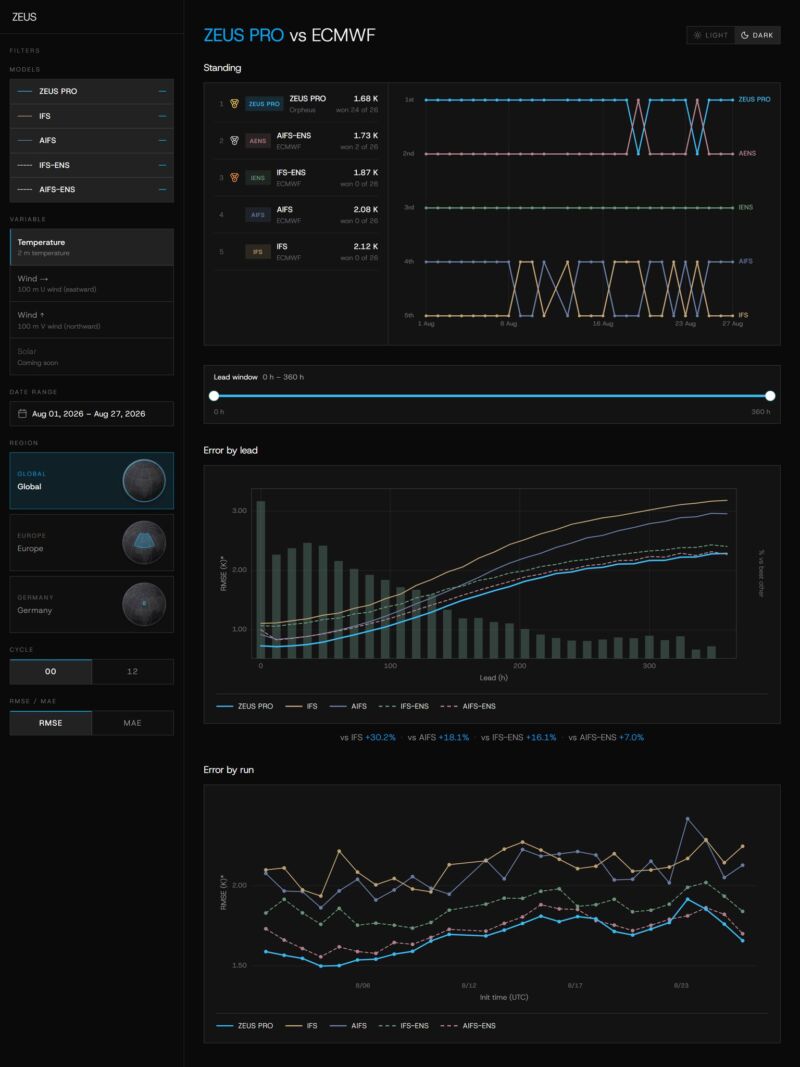
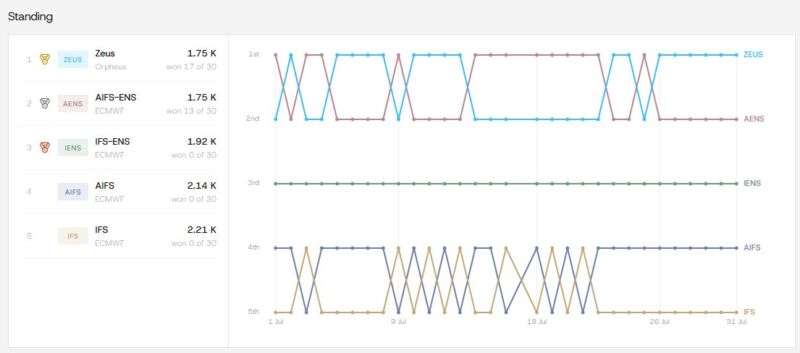
Recorded in July 2025, this episode of Hash Rate features Mark Jeffrey in conversation with Voter from Zeus, a Bittensor subnet focused on ultra-precise weather forecasting. Voter explains how Zeus differentiates itself from traditional models like Microsoft’s Aurora by leveraging decentralized miners to specialize in hyper-local weather predictions. The subnet has already achieved a nearly 40% reduction in temperature prediction error compared to state-of-the-art models. Their initial focus is on high-stakes industries like energy trading and Formula 1 racing, where accurate forecasts are critical. Backed by strong research, including a paper presented at ICML, Zeus is building towards commercializing its API and rewarding miners not only with emissions but future revenue as well. The conversation also explores the Bittensor ecosystem, market dynamics, token incentives, and the long-term potential of decentralized AI networks.
Novelty Search is great, but for most investors trying to understand Bittensor, the technical depth is a wall, not a bridge. If we’re going to attract investment into this ecosystem then we need more people to understand it! That’s why Siam Kidd and Mark Creaser from DSV Fund have launched Revenue Search, where they ask the simple questions that investors want to know the answers to.
Recorded in August 2025, this Revenue Search episode features the team from Zeus, Subnet 18, who are building a decentralized weather forecasting API. Zeus leverages miners to interpret open-source global weather data and compete for the lowest error margins, consistently outperforming leading APIs by up to 40% on key metrics like temperature. The conversation explores how miners specialize in locations or variables, the challenges of forecasting precipitation, and early traction with industries like energy trading, aviation, and commodities. Zeus outlines its API subscription model, plans to reinvest 50% of revenue into buybacks, and a referral program to drive adoption—positioning itself as a serious challenger to traditional weather data providers in a billion-dollar market.
🚀 Scaling our validation layer with the integration of 1000s of weather stations. End of the year testing phase before going live early 2026.
The WeatherXM partnership offers us clear paths to revenue, selling our forecasts to their existing & growing client base of ~10K and…
🪂 We're excited to work with @chutes_ai to bring the best weather forecasting models to Chutes, starting with Microsoft Aurora.
Aurora is now hosted on Chutes' high-performance infrastructure and will be made available exclusively to Zeus miners, making it cheaper and easier to…
Weather is the single biggest unscheduled flow in energy markets, introducing massive volatility into an industry with $2 trillion in annual turnover.
When a single degree of accuracy defines profit or loss, it pays to have 250 miners (500+ 🔜) obsess over only, exactly that.…
🇮🇳 India's clean energy firms are explicitly asking for hyperlocal weather forecasting models to survive India's new 2026 grid fines.
Stuck using interpolating global models using data from radars deployed for disaster management, updated only once every six hours. Lack of…
Massive few weeks at Zeus. Let’s look back. 👇
Partnered with @WeatherXM, integrating thousands of stations into Zeus’ validation layer. A move that expands our network and unlocks commercial opportunities.
Teamed up with @sportstensor to bridge Zeus’ weather intelligence into…
Great to see Zeus' decentralized MoE approach to weather forecasting featured in @MessariCrypto's State of AI 2025.
DeAI is entering an age of enlightenment, and we're eager to contribute.
cc @tplr_ai & @gradients_ai on there too! 👀