With the amount of new subnets being added it can be hard to get up to date information across all subnets, so data may be slightly out of date from time to time

Subnet 07

Allways

Alpha Price
Value
Market Cap
Value
Neurons
Value
Registration Cost
Value
TAO Liquidity
Value
Alpha in Pool
Value
Total Alpha Supply
Value
% Alpha Staked
Value

ABOUT

What exactly does it do?

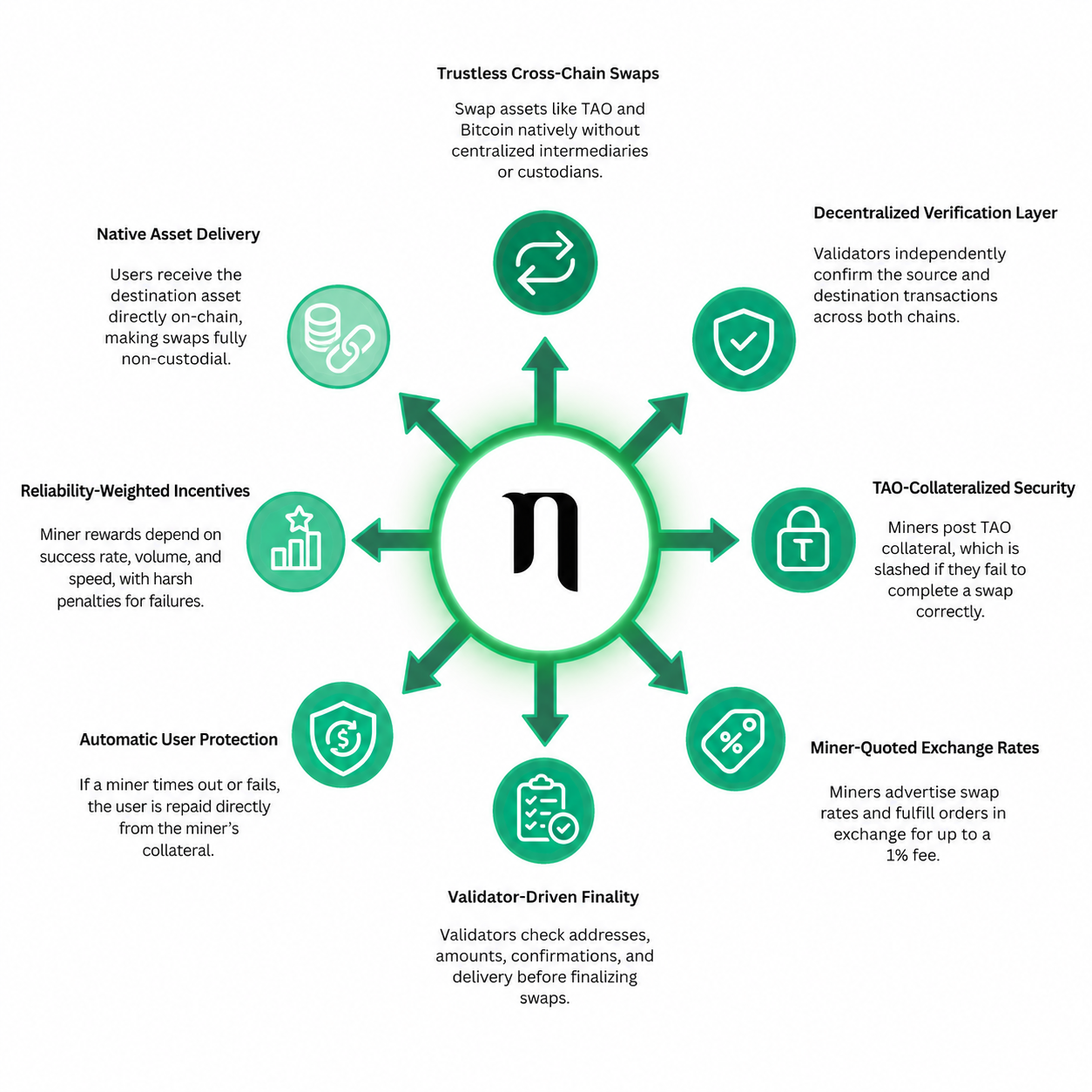
Core Mission and Purpose: Allways is a Bittensor Subnet (SN7) designed to enable trustless native transactions across independent blockchain assets. It provides a decentralized “verification layer” above multiple blockchains so that assets can move natively between them without requiring centralized intermediaries. In practical terms, Allways lets users swap one cryptocurrency for another (for example TAO for Bitcoin or vice versa) completely trustlessly. It solves the cross-chain exchange problem by enforcing swaps on-chain with collateral: miners perform the actual transfers between chains, validators independently verify the transactions on each chain, and a smart contract on Bittensor enforces the outcome through slashing or fee payments.

Miner-Validator Incentive Loop: The system is driven by two roles. Miners post exchange rates and deposit TAO collateral in the Allways contract, promising to fulfill swap orders in exchange for fees. In return they can earn up to a 1% fee on each completed swap (paid in TAO). Validators reserve the chosen miner and then independently verify both the source and destination transactions on their respective chains. Validators vote to confirm swap requests if everything checks out (caller address, amount, sufficient confirmations, etc.), and they also vote to slash a miner’s collateral if the swap times out or fails. This on-chain scoring ensures miners behave correctly. Miners are ranked by success rate, volume and speed, with a harsh exponent on reliability: even a few failures will drastically lower a miner’s score. High-scoring miners earn proportionally more of the subnet’s alpha (mite) emissions, while poor performers lose collateral and rewards.

Swap Execution and Final Output: When a user wishes to swap, they select a miner (who has advertised a rate) and initiate the swap via the Allways CLI, providing a destination address. The user then sends the source funds (TAO or BTC) to the miner’s prompt address. The miner, having observed the incoming funds, sends 99% of the calculated destination amount to the user (retaining 1% to cover the protocol fee). Validators independently verify that the miner actually delivered the funds on the destination chain and then vote to finalize the swap. At that point the Allways smart contract deducts the 1% fee from the miner’s TAO collateral and credits it to the fee pool. If a miner fails to deliver by the timeout, the user is automatically paid from the miner’s collateral (slashed and transferred to the user). In either case the user receives the intended output asset without ever trusting the counterparty. The final service provided by the network is thus secure asset transfers (i.e. completed swaps) between independent cryptocurrencies. The intended beneficiaries are cryptocurrency holders and traders who want to exchange assets in a decentralized, non-custodial way – for example, exchanging on-chain TAO for Bitcoin without a centralized exchange. Allways is unique in the Bittensor ecosystem because it is the first subnet focused purely on enabling atomic value transfers; instead of producing AI outputs, it functions as a decentralized cross-chain transaction platform. By using TAO collateral and Bittensor’s validator scoring as security, it performs asset swaps trustlessly in a way no other subnet does (effectively acting as a built-in, on-chain DEX between TAO and other chains).

Core Mission and Purpose: Allways is a Bittensor Subnet (SN7) designed to enable trustless native transactions across independent blockchain assets. It provides a decentralized “verification layer” above multiple blockchains so that assets can move natively between them without requiring centralized intermediaries. In practical terms, Allways lets users swap one cryptocurrency for another (for example TAO for Bitcoin or vice versa) completely trustlessly. It solves the cross-chain exchange problem by enforcing swaps on-chain with collateral: miners perform the actual transfers between chains, validators independently verify the transactions on each chain, and a smart contract on Bittensor enforces the outcome through slashing or fee payments.

Miner-Validator Incentive Loop: The system is driven by two roles. Miners post exchange rates and deposit TAO collateral in the Allways contract, promising to fulfill swap orders in exchange for fees. In return they can earn up to a 1% fee on each completed swap (paid in TAO). Validators reserve the chosen miner and then independently verify both the source and destination transactions on their respective chains. Validators vote to confirm swap requests if everything checks out (caller address, amount, sufficient confirmations, etc.), and they also vote to slash a miner’s collateral if the swap times out or fails. This on-chain scoring ensures miners behave correctly. Miners are ranked by success rate, volume and speed, with a harsh exponent on reliability: even a few failures will drastically lower a miner’s score. High-scoring miners earn proportionally more of the subnet’s alpha (mite) emissions, while poor performers lose collateral and rewards.

Swap Execution and Final Output: When a user wishes to swap, they select a miner (who has advertised a rate) and initiate the swap via the Allways CLI, providing a destination address. The user then sends the source funds (TAO or BTC) to the miner’s prompt address. The miner, having observed the incoming funds, sends 99% of the calculated destination amount to the user (retaining 1% to cover the protocol fee). Validators independently verify that the miner actually delivered the funds on the destination chain and then vote to finalize the swap. At that point the Allways smart contract deducts the 1% fee from the miner’s TAO collateral and credits it to the fee pool. If a miner fails to deliver by the timeout, the user is automatically paid from the miner’s collateral (slashed and transferred to the user). In either case the user receives the intended output asset without ever trusting the counterparty. The final service provided by the network is thus secure asset transfers (i.e. completed swaps) between independent cryptocurrencies. The intended beneficiaries are cryptocurrency holders and traders who want to exchange assets in a decentralized, non-custodial way – for example, exchanging on-chain TAO for Bitcoin without a centralized exchange. Allways is unique in the Bittensor ecosystem because it is the first subnet focused purely on enabling atomic value transfers; instead of producing AI outputs, it functions as a decentralized cross-chain transaction platform. By using TAO collateral and Bittensor’s validator scoring as security, it performs asset swaps trustlessly in a way no other subnet does (effectively acting as a built-in, on-chain DEX between TAO and other chains).

PURPOSE

What exactly is the 'product/build'?

Current Status: Allways is live on the Bittensor mainnet. The network reports 14 active validators (out of a maximum 64) and 256 total UIDs allocated. There is currently 1 active miner (out of a 256-miner limit), reflecting the project’s early stage. The Allways subnet has its own alpha token; as of this writing each alpha trades around ~0.0044 TAO. Network metrics (from TaoStats and other explorers) show that only a handful of swaps have occurred so far – for example, 7 transactions totaling about 4.08 TAO volume according to one tracker – indicating usage is just beginning. Daily TAO emissions to subsidiary validators follow the standard Bittensor emission schedule (3,600 TAO per day divided across active subnets).

Technical Architecture: Allways operates as a Bittensor subnet implemented mostly in Python. It consists of on-chain and off-chain components. On-chain, a smart contract manages swap state, holds each miner’s collateral deposit, enforces timeouts and slashing, and collects protocol fees. Off-chain, miners and validators run node software. The Allways GitHub repository (github.com/entrius/allways) contains modules for the CLI (`alw` commands), a swap miner application, and a validator process. For example, a miner node will register itself on-chain with an address and rate, listen for swap orders, and execute outgoing transactions. Validators run Bittensor full nodes with the Allways logic: they monitor the blockchain for swap requests, verify both sides of the swap, and cast consensus votes. The implementation includes integrations with external blockchains; notably, a “BitcoinProvider” is used to track and validate Bitcoin transactions (as indicated by recent commits). In practice, when a swap is initiated, the user’s input tx (TAO or BTC) and the miner’s output tx are both checked against their respective chains by the validator logic.

Codebase and GitHub: The Allways code is open-source. The repository’s recent commit history shows active development as of April 2026 – for instance, a developer named “Landyn” made multiple updates to the CLI and validator code on 27 April 2026, fixing swap and recovery behavior. Key files include the smart contract definitions, the CLI tools (e.g. `alw swap`, `alw claim`), and node logic for miner and validator. The infrastructure likely uses a standard Bittensor node environment for consensus, plus whatever APIs or libraries needed to broadcast Bitcoin transactions. No user interface beyond the CLI is documented, so operators must interact via command line and wallet addresses. (The CLI includes commands like `alw claim ` to manually recover swaps if needed.)

Measured Metrics: Public explorer data show that Allways has low usage to date. For example, one stats site reports only 7 total network transactions (with 5 buys and 2 sells) and about 4.08 TAO in total trade volume. Validator count (14) suggests staking participation is established but small. The circulating supply of Allways’ alpha token is on the order of a few million. The 24-hour/7-day price change on TAO markets has been minimal (flat to slightly positive). In summary, basic metrics (miners=1, validators=14, alpha price ~0.0044 TAO) can be observed on Bittensor explorers.

Integrations and External Services: Currently, Allways explicitly supports swaps between TAO and Bitcoin; extensions to other chains have been discussed in community research, but no official integrations (e.g. Ethereum, other tokens) are yet live. The smart contract handles only TAO collateral and relies on validators to check external transactions. The system uses the Bittensor network for on-chain state and either direct Bitcoin node connections or third-party APIs for external chain data. There are no known dependencies on centralized services. All analysis and swap logging happens on-chain, and no external oracle or price feed is used – exchange rates come directly from miners. If any APIs are used (e.g. for new chains), they would be added at the validator level. Allways does not appear to rely on other crypto projects’ APIs yet (the codebase and docs make no mention of external oracle services). All too-date integrations are native on-chain, which distinguishes Allways from many DeFi protocols: it only trusts cryptographic commitments and proof, not external data providers.

Development Roadmap (ongoing): The publicly available documentation and community channels have not released a detailed product roadmap. No upcoming release dates or phases have been announced. However, the commit history (April 2026) suggests that version 1.0 and basic swap functionality are in place, and future work likely involves refining reliability and adding asset support. For now, end users of Allways are expected to be cryptocurrency holders and applications in the Bittensor ecosystem who need to move value across chains, and mining operators who wish to provide that service. (Typically, a miner is someone running a full Bitcoin node and willing to swap BTC with TAO, while validators are standard Bittensor full-node operators scoring miner performance.)

Current Status: Allways is live on the Bittensor mainnet. The network reports 14 active validators (out of a maximum 64) and 256 total UIDs allocated. There is currently 1 active miner (out of a 256-miner limit), reflecting the project’s early stage. The Allways subnet has its own alpha token; as of this writing each alpha trades around ~0.0044 TAO. Network metrics (from TaoStats and other explorers) show that only a handful of swaps have occurred so far – for example, 7 transactions totaling about 4.08 TAO volume according to one tracker – indicating usage is just beginning. Daily TAO emissions to subsidiary validators follow the standard Bittensor emission schedule (3,600 TAO per day divided across active subnets).

Technical Architecture: Allways operates as a Bittensor subnet implemented mostly in Python. It consists of on-chain and off-chain components. On-chain, a smart contract manages swap state, holds each miner’s collateral deposit, enforces timeouts and slashing, and collects protocol fees. Off-chain, miners and validators run node software. The Allways GitHub repository (github.com/entrius/allways) contains modules for the CLI (`alw` commands), a swap miner application, and a validator process. For example, a miner node will register itself on-chain with an address and rate, listen for swap orders, and execute outgoing transactions. Validators run Bittensor full nodes with the Allways logic: they monitor the blockchain for swap requests, verify both sides of the swap, and cast consensus votes. The implementation includes integrations with external blockchains; notably, a “BitcoinProvider” is used to track and validate Bitcoin transactions (as indicated by recent commits). In practice, when a swap is initiated, the user’s input tx (TAO or BTC) and the miner’s output tx are both checked against their respective chains by the validator logic.

Codebase and GitHub: The Allways code is open-source. The repository’s recent commit history shows active development as of April 2026 – for instance, a developer named “Landyn” made multiple updates to the CLI and validator code on 27 April 2026, fixing swap and recovery behavior. Key files include the smart contract definitions, the CLI tools (e.g. `alw swap`, `alw claim`), and node logic for miner and validator. The infrastructure likely uses a standard Bittensor node environment for consensus, plus whatever APIs or libraries needed to broadcast Bitcoin transactions. No user interface beyond the CLI is documented, so operators must interact via command line and wallet addresses. (The CLI includes commands like `alw claim ` to manually recover swaps if needed.)

Measured Metrics: Public explorer data show that Allways has low usage to date. For example, one stats site reports only 7 total network transactions (with 5 buys and 2 sells) and about 4.08 TAO in total trade volume. Validator count (14) suggests staking participation is established but small. The circulating supply of Allways’ alpha token is on the order of a few million. The 24-hour/7-day price change on TAO markets has been minimal (flat to slightly positive). In summary, basic metrics (miners=1, validators=14, alpha price ~0.0044 TAO) can be observed on Bittensor explorers.

Integrations and External Services: Currently, Allways explicitly supports swaps between TAO and Bitcoin; extensions to other chains have been discussed in community research, but no official integrations (e.g. Ethereum, other tokens) are yet live. The smart contract handles only TAO collateral and relies on validators to check external transactions. The system uses the Bittensor network for on-chain state and either direct Bitcoin node connections or third-party APIs for external chain data. There are no known dependencies on centralized services. All analysis and swap logging happens on-chain, and no external oracle or price feed is used – exchange rates come directly from miners. If any APIs are used (e.g. for new chains), they would be added at the validator level. Allways does not appear to rely on other crypto projects’ APIs yet (the codebase and docs make no mention of external oracle services). All too-date integrations are native on-chain, which distinguishes Allways from many DeFi protocols: it only trusts cryptographic commitments and proof, not external data providers.

Development Roadmap (ongoing): The publicly available documentation and community channels have not released a detailed product roadmap. No upcoming release dates or phases have been announced. However, the commit history (April 2026) suggests that version 1.0 and basic swap functionality are in place, and future work likely involves refining reliability and adding asset support. For now, end users of Allways are expected to be cryptocurrency holders and applications in the Bittensor ecosystem who need to move value across chains, and mining operators who wish to provide that service. (Typically, a miner is someone running a full Bitcoin node and willing to swap BTC with TAO, while validators are standard Bittensor full-node operators scoring miner performance.)

WHO

Team Info

Public Team Members and Handles: Almost no personal or organizational names are publicly disclosed for Allways. The project’s identity on GitHub is “entrius” (as seen in the repository name), but real names are not given. The only clue on-chain is the subnet owner’s coldkey, which begins with 5CAc19… and has the label “finzcx”. No media or whitepaper lists individual team members. However, open-source contributions identify at least one developer: a user “Landyn” made multiple commits to the Allways GitHub in April 2026. No high-profile figures or advisors are associated. No public company or institution logos are shown in documentation. In short, the team appears to operate somewhat anonymously, beyond their GitHub presence and blockchain addresses.

GitHub Contributors and Activity: The GitHub organization entrius/allways has a small number of contributors. The recent commit history (visible through block explorers) shows changes to the CLI and validator logic by Landyn. The repository at the time of writing has dozens of commits and includes code for the swap CLI, smart contract, and node applications. There are no indications of forks or contributions from other public teams on GitHub. (Development is ongoing as of late April 2026, but no new code has appeared in May 2026.)

Social Media and Communication: There is no official Twitter/X account specifically for Always/Allways that has been identified. The Bittensor announcements channels (Telegram, Discord) have not highlighted this subnet with named personnel. A linktree for “entrivis” exists, but it does not specifically tie to the project. No Medium or blog posts have been published under Allways’ name. The lack of a public website (attempts to open all-ways.io documentation require login) makes it hard to find official social links. As far as tweeted or written communication, the team does not appear to promote the project through personal handles. In summary, there is no known marketing or social identity; only Bittensor ecosystem explorers list the technical details.

Professional Backgrounds and Partnerships: Because the team members are anonymous, we do not have verified information on their professional backgrounds. There are no public partnerships or investors announced. The project is not a registered company (no “Inc.” appears on any materials). No VC backers or grants have been mentioned. Thus, all we know about team experience is gleaned from on-chain evidence: developer commits and addresses. It is possible (but unconfirmed) that the team has blockchain or software engineering experience given the solidity of the product, but no LinkedIn or resume data is provided.

Launch Date and Community: Allways launched on the mainnet around April 2026 (commit activity is concentrated in late April), although a precise block height or date announcement has not been found in any public channel. At launch, the project’s GitHub had its initial code and the Allways token was minted and tradable. Since then, community engagement appears minimal: only a few dozen individuals have staked or traded Allways tokens and a single miner is active. There is no dedicated Discord channel known for this subnet. In the broader Bittensor community (e.g. Discord, Reddit), mentions of “Always” or “Allways” are virtually non-existent. Overall, team presence and community engagement are very low-profile, consisting only of on-chain activity.

Public Team Members and Handles: Almost no personal or organizational names are publicly disclosed for Allways. The project’s identity on GitHub is “entrius” (as seen in the repository name), but real names are not given. The only clue on-chain is the subnet owner’s coldkey, which begins with 5CAc19… and has the label “finzcx”. No media or whitepaper lists individual team members. However, open-source contributions identify at least one developer: a user “Landyn” made multiple commits to the Allways GitHub in April 2026. No high-profile figures or advisors are associated. No public company or institution logos are shown in documentation. In short, the team appears to operate somewhat anonymously, beyond their GitHub presence and blockchain addresses.

GitHub Contributors and Activity: The GitHub organization entrius/allways has a small number of contributors. The recent commit history (visible through block explorers) shows changes to the CLI and validator logic by Landyn. The repository at the time of writing has dozens of commits and includes code for the swap CLI, smart contract, and node applications. There are no indications of forks or contributions from other public teams on GitHub. (Development is ongoing as of late April 2026, but no new code has appeared in May 2026.)

Social Media and Communication: There is no official Twitter/X account specifically for Always/Allways that has been identified. The Bittensor announcements channels (Telegram, Discord) have not highlighted this subnet with named personnel. A linktree for “entrivis” exists, but it does not specifically tie to the project. No Medium or blog posts have been published under Allways’ name. The lack of a public website (attempts to open all-ways.io documentation require login) makes it hard to find official social links. As far as tweeted or written communication, the team does not appear to promote the project through personal handles. In summary, there is no known marketing or social identity; only Bittensor ecosystem explorers list the technical details.

Professional Backgrounds and Partnerships: Because the team members are anonymous, we do not have verified information on their professional backgrounds. There are no public partnerships or investors announced. The project is not a registered company (no “Inc.” appears on any materials). No VC backers or grants have been mentioned. Thus, all we know about team experience is gleaned from on-chain evidence: developer commits and addresses. It is possible (but unconfirmed) that the team has blockchain or software engineering experience given the solidity of the product, but no LinkedIn or resume data is provided.

Launch Date and Community: Allways launched on the mainnet around April 2026 (commit activity is concentrated in late April), although a precise block height or date announcement has not been found in any public channel. At launch, the project’s GitHub had its initial code and the Allways token was minted and tradable. Since then, community engagement appears minimal: only a few dozen individuals have staked or traded Allways tokens and a single miner is active. There is no dedicated Discord channel known for this subnet. In the broader Bittensor community (e.g. Discord, Reddit), mentions of “Always” or “Allways” are virtually non-existent. Overall, team presence and community engagement are very low-profile, consisting only of on-chain activity.

FUTURE

Roadmap

Milestones and Phases: No formal roadmap or milestones have been publicly announced. The Allways documentation and official sources focus on functional details and contain no timeline. As of mid-2026, the subnet is simply in operation, without a stated schedule of versions or features. The only inferred milestone is the initial mainnet launch (which happened by April 2026, per on-chain commits). There is no publicly available plan for phased expansion.

Vision and Targets: The long-term vision implied by the Allways design is to support trustless swaps for any verifiable asset. While the initial launch supports TAO↔BTC swaps, the project’s broad goal is to scale this mechanism to cover additional chains. However, no concrete step-by-step plan or target dates are documented. All indications of future development come from analyzing the code (e.g. references to adding new currency providers) rather than an official statement. In other words, while the conceptual goal is to become a universal cross-chain settlement layer, the team has not published a specific roadmap to get there.

Recent Updates: The most recent visible updates have been code commits and parameter adjustments. Notably, April 2026 saw a flurry of technical commits addressing swap timeout handling and CLI messaging. No new end-user features or partnerships have been announced since launch. If any maintenance or improvements are planned, they have not been publicized. In sum, the subnet is currently in an active-but-early stage with no publicly stated future deliverables beyond what is already live.

Milestones and Phases: No formal roadmap or milestones have been publicly announced. The Allways documentation and official sources focus on functional details and contain no timeline. As of mid-2026, the subnet is simply in operation, without a stated schedule of versions or features. The only inferred milestone is the initial mainnet launch (which happened by April 2026, per on-chain commits). There is no publicly available plan for phased expansion.

Vision and Targets: The long-term vision implied by the Allways design is to support trustless swaps for any verifiable asset. While the initial launch supports TAO↔BTC swaps, the project’s broad goal is to scale this mechanism to cover additional chains. However, no concrete step-by-step plan or target dates are documented. All indications of future development come from analyzing the code (e.g. references to adding new currency providers) rather than an official statement. In other words, while the conceptual goal is to become a universal cross-chain settlement layer, the team has not published a specific roadmap to get there.

Recent Updates: The most recent visible updates have been code commits and parameter adjustments. Notably, April 2026 saw a flurry of technical commits addressing swap timeout handling and CLI messaging. No new end-user features or partnerships have been announced since launch. If any maintenance or improvements are planned, they have not been publicized. In sum, the subnet is currently in an active-but-early stage with no publicly stated future deliverables beyond what is already live.