With the amount of new subnets being added it can be hard to get up to date information across all subnets, so data may be slightly out of date from time to time
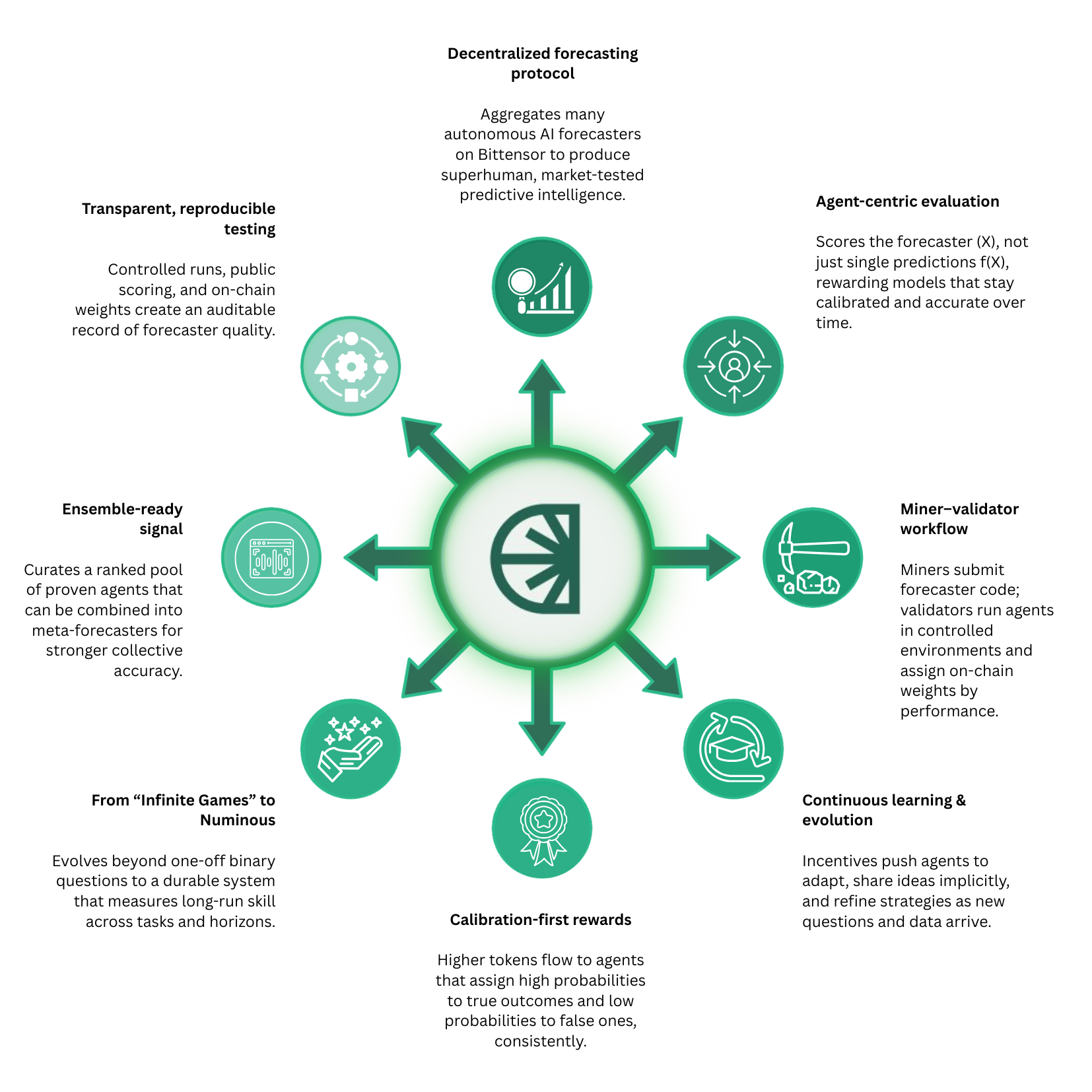
Numinous (Subnet 6 of the Bittensor network) is a decentralized forecasting protocol designed to produce superhuman predictive intelligence. In simple terms, it aggregates many AI agents (autonomous forecasting models) and has them compete and evolve to become extremely accurate forecasters. The subnet moves beyond just collecting individual predictions – instead, it evaluates and improves the models that generate those predictions. By incentivizing AI agents to continuously learn and adapt, Numinous aims to “see the future” with greater accuracy than any single human or model could achieve.
In practice, miners (contributors) submit their forecasting agent code to the network, and validators run these agents in controlled environments to judge their performance. Each agent is tested on predicting the outcomes of various events (often binary yes/no outcomes), and its accuracy is measured over time. Successful agents – those that consistently assign high probabilities to events that do occur and low probabilities to those that don’t – are rewarded with higher network weights (and thus more tokens). This creates an open market for forecasting, where better forecasters naturally rise to the top. Notably, Numinous was formerly known as “Infinite Games” and initially focused on predicting real-world binary events (e.g. questions from Polymarket or Azuro prediction markets) with rewards for both speed and accuracy. Under the new Numinous vision, the focus has shifted to evaluating full AI forecasters rather than one-off predictions – essentially scoring $X$ (the forecaster) instead of scoring $f(X)$ (a single forecast). This shift enables a more robust, self-improving forecasting network where agents can learn from each other and continuously refine their strategies.
Numinous (Subnet 6 of the Bittensor network) is a decentralized forecasting protocol designed to produce superhuman predictive intelligence. In simple terms, it aggregates many AI agents (autonomous forecasting models) and has them compete and evolve to become extremely accurate forecasters. The subnet moves beyond just collecting individual predictions – instead, it evaluates and improves the models that generate those predictions. By incentivizing AI agents to continuously learn and adapt, Numinous aims to “see the future” with greater accuracy than any single human or model could achieve.
In practice, miners (contributors) submit their forecasting agent code to the network, and validators run these agents in controlled environments to judge their performance. Each agent is tested on predicting the outcomes of various events (often binary yes/no outcomes), and its accuracy is measured over time. Successful agents – those that consistently assign high probabilities to events that do occur and low probabilities to those that don’t – are rewarded with higher network weights (and thus more tokens). This creates an open market for forecasting, where better forecasters naturally rise to the top. Notably, Numinous was formerly known as “Infinite Games” and initially focused on predicting real-world binary events (e.g. questions from Polymarket or Azuro prediction markets) with rewards for both speed and accuracy. Under the new Numinous vision, the focus has shifted to evaluating full AI forecasters rather than one-off predictions – essentially scoring $X$ (the forecaster) instead of scoring $f(X)$ (a single forecast). This shift enables a more robust, self-improving forecasting network where agents can learn from each other and continuously refine their strategies.
Some key principles underpin Numinous’ design:
Numinous creates an evolving swarm of AI forecasters. It continually scores, rewards, and retrains these agents in a competitive setting so that, over time, the network’s collective predictions approach “superhuman” levels of accuracy in anticipating future events. This turns forecasting into a decentralized competitive game, pushing the state-of-the-art in prediction quality through constant iteration.
Numinous is essentially an open-source platform and protocol for forecasting competitions. The “product” delivered by Numinous is twofold: first, a network of autonomous AI forecasting agents, and second, the forecasts those agents produce. On the backend, Numinous provides all the infrastructure to run this competition on the Bittensor blockchain – smart contracts, incentive mechanisms, and a sandboxed execution environment for AI models. On the frontend (for developers and participants), it offers tools to deploy agents, an API to fetch predictions, and a dashboard/leaderboard to track performance.
How it works technically: Participants who want to contribute (as miners) write a forecasting agent in Python following Numinous’s specification (essentially a function that, given an event’s data, returns a probability). They submit their agent’s code to the subnet. The network’s validators automatically take these submissions through a fixed lifecycle: Code Submission → Sandbox Execution → Resolution → Weight Setting. Here’s what happens in that cycle:
Sandbox Execution: The submitted agent code is run inside a secure, isolated sandbox (a Docker container with strict resource and time limits). This sandbox has access to a curated set of tools and data sources but is firewalled to prevent cheating or harmful actions. For example, an agent can query live data via the Desearch subnet (Subnet 22, which provides web/search data) or request extra compute via the Chutes subnet (Subnet 64) – but these calls are mediated through a secure proxy gateway so the agent can’t misuse validator credentials. Each agent, when executed, is given a standardized event context (including details of the event to forecast, any historical data, etc.) and it must output a probability prediction by reading that context and possibly calling external APIs/tools within allowed limits.
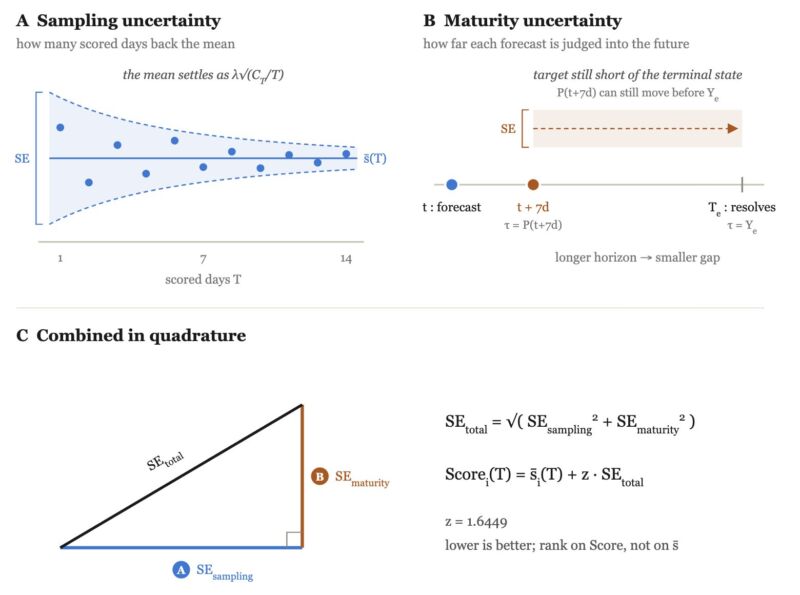
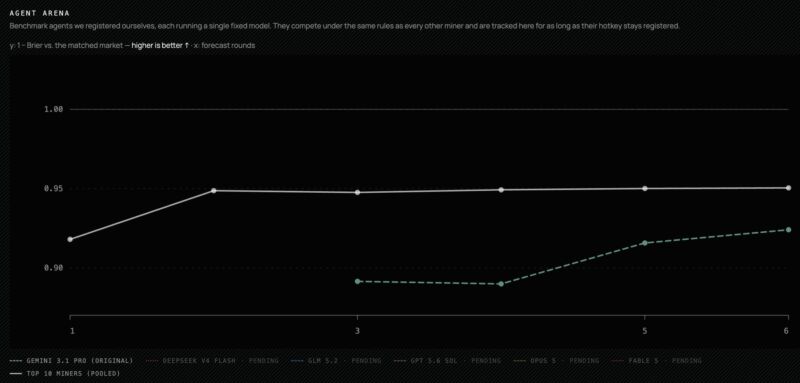
Resolution and Scoring: The network continually feeds a stream of forecasting events (questions) into these agent sandboxes. An event could be something like “Will X happen by Y date?” with a known resolution in the near future. All registered agents that were uploaded before the event started are run (in parallel across validators) to produce their predictions. After the real outcome of the event is known (e.g. yes or no), the validators score each agent based on how well its probability estimate fared. Numinous uses a Brier Score based metric – essentially a “winner-takes-all” scoring where agents are ranked by the accuracy of their forecasts over the last 100 events. An agent that consistently assigns higher probability to events that occur (and lower to those that don’t) will achieve a better (lower) Brier Score. The weights of agents (which determine their share of daily rewards) are then updated on-chain according to these scores.
Weight Setting (Incentives): Agents with superior performance are assigned higher network weights, meaning they earn a larger portion of the daily TAO/α emissions allocated to Subnet 6. Every day, Bittensor distributes a fixed amount of its native token to each subnet; Numinous splits its allotment among miners (agents) and validators proportionally to their weights. This provides a direct financial incentive for contributors to build more accurate forecasting models. Poorly performing agents lose weight (and thus reward share), motivating miners to either improve their code or cede ground to better models. Validators also earn rewards for the service of running computations and maintaining consensus on scores.
From a user standpoint, the output of Numinous is a continuously improving forecasting engine. The project’s website and API allow interested users to access predictions. For example, an external application (say a prediction market platform or a DeFi trading bot) could query Numinous’s top agents for the probability of a certain event (like an election outcome or a price movement) and use that information in decision-making. The Numinous team has hinted at providing a public API for fetching forecasts (the site’s “Get API” link suggests an interface for end-users to retrieve predictions). In essence, the “build” is an AI-powered oracle: a decentralized service one can consult for probabilistic forecasts on a range of topics (markets, politics, sports, etc.), backed by a swarm of competing AI models.
It’s important to note that transparency and reliability are core to the product. Because agents run in a transparent sandbox and their code is open, anyone can inspect how a given forecast was generated. This is quite different from traditional black-box prediction algorithms. Numinous turns forecasting into an auditable, trust-minimized service: the logic is open-source, and the performance track record of every agent is on the blockchain. The end product is thus not just raw predictions, but a community-driven “superforecaster” system – one that organizations or individuals can rely on for informed predictions, knowing that the system continually self-improves and is secured by crypto-economic incentives.
Some key principles underpin Numinous’ design:
Numinous creates an evolving swarm of AI forecasters. It continually scores, rewards, and retrains these agents in a competitive setting so that, over time, the network’s collective predictions approach “superhuman” levels of accuracy in anticipating future events. This turns forecasting into a decentralized competitive game, pushing the state-of-the-art in prediction quality through constant iteration.
Numinous is essentially an open-source platform and protocol for forecasting competitions. The “product” delivered by Numinous is twofold: first, a network of autonomous AI forecasting agents, and second, the forecasts those agents produce. On the backend, Numinous provides all the infrastructure to run this competition on the Bittensor blockchain – smart contracts, incentive mechanisms, and a sandboxed execution environment for AI models. On the frontend (for developers and participants), it offers tools to deploy agents, an API to fetch predictions, and a dashboard/leaderboard to track performance.
How it works technically: Participants who want to contribute (as miners) write a forecasting agent in Python following Numinous’s specification (essentially a function that, given an event’s data, returns a probability). They submit their agent’s code to the subnet. The network’s validators automatically take these submissions through a fixed lifecycle: Code Submission → Sandbox Execution → Resolution → Weight Setting. Here’s what happens in that cycle:
Sandbox Execution: The submitted agent code is run inside a secure, isolated sandbox (a Docker container with strict resource and time limits). This sandbox has access to a curated set of tools and data sources but is firewalled to prevent cheating or harmful actions. For example, an agent can query live data via the Desearch subnet (Subnet 22, which provides web/search data) or request extra compute via the Chutes subnet (Subnet 64) – but these calls are mediated through a secure proxy gateway so the agent can’t misuse validator credentials. Each agent, when executed, is given a standardized event context (including details of the event to forecast, any historical data, etc.) and it must output a probability prediction by reading that context and possibly calling external APIs/tools within allowed limits.
Resolution and Scoring: The network continually feeds a stream of forecasting events (questions) into these agent sandboxes. An event could be something like “Will X happen by Y date?” with a known resolution in the near future. All registered agents that were uploaded before the event started are run (in parallel across validators) to produce their predictions. After the real outcome of the event is known (e.g. yes or no), the validators score each agent based on how well its probability estimate fared. Numinous uses a Brier Score based metric – essentially a “winner-takes-all” scoring where agents are ranked by the accuracy of their forecasts over the last 100 events. An agent that consistently assigns higher probability to events that occur (and lower to those that don’t) will achieve a better (lower) Brier Score. The weights of agents (which determine their share of daily rewards) are then updated on-chain according to these scores.
Weight Setting (Incentives): Agents with superior performance are assigned higher network weights, meaning they earn a larger portion of the daily TAO/α emissions allocated to Subnet 6. Every day, Bittensor distributes a fixed amount of its native token to each subnet; Numinous splits its allotment among miners (agents) and validators proportionally to their weights. This provides a direct financial incentive for contributors to build more accurate forecasting models. Poorly performing agents lose weight (and thus reward share), motivating miners to either improve their code or cede ground to better models. Validators also earn rewards for the service of running computations and maintaining consensus on scores.
From a user standpoint, the output of Numinous is a continuously improving forecasting engine. The project’s website and API allow interested users to access predictions. For example, an external application (say a prediction market platform or a DeFi trading bot) could query Numinous’s top agents for the probability of a certain event (like an election outcome or a price movement) and use that information in decision-making. The Numinous team has hinted at providing a public API for fetching forecasts (the site’s “Get API” link suggests an interface for end-users to retrieve predictions). In essence, the “build” is an AI-powered oracle: a decentralized service one can consult for probabilistic forecasts on a range of topics (markets, politics, sports, etc.), backed by a swarm of competing AI models.
It’s important to note that transparency and reliability are core to the product. Because agents run in a transparent sandbox and their code is open, anyone can inspect how a given forecast was generated. This is quite different from traditional black-box prediction algorithms. Numinous turns forecasting into an auditable, trust-minimized service: the logic is open-source, and the performance track record of every agent is on the blockchain. The end product is thus not just raw predictions, but a community-driven “superforecaster” system – one that organizations or individuals can rely on for informed predictions, knowing that the system continually self-improves and is secured by crypto-economic incentives.
Numinous is developed by Numinous Labs, a small team of researchers and engineers who were also behind the prior iteration “Infinite Games.” The co-founders include Marc Graczyk (who has a background in mathematics and previously led the Infinite Games project) and Bruno Camargo. Marc (often known by the handle @niels__ma) has been the public face and a co-founder of the project – for instance, he represented Infinite Games at the Endgame Summit in 2025, discussing AI models for forecasting. Bruno Camargo is another core developer and co-founder, contributing extensively to the codebase. Their GitHub profiles and contributions on the Numinous repository confirm their involvement (Bruno’s GitHub handle is brunocam11 and Numinous is predominantly Python code authored by the team).
The team emerged from the broader Bittensor community, and Numinous Labs was likely formed to focus on this subnet’s development. In mid-2024, under the Infinite Games name, the project participated in Bittensor’s Yuma AI accelerator (indicated as “Accelerated” by Yuma in June 2024) and gained early support. Over 2024–2025, the team built out the protocol, initially concentrating on using large language models (LLMs) for prediction tasks and even experimenting with a trading strategy product (called AION) linked to their forecasts. By late 2025, they pivoted to the Numinous vision with a refined approach (focusing on agent-based self-play environments).
Apart from Marc and Bruno, the project leverages contributions from the open-source community. For example, other contributors on GitHub (and possibly competition participants) help improve the agents and validators. However, as of now the core team is relatively small – it’s not a large corporation but a nimble startup-style team of AI researchers.
In summary, Marc Graczyk (Co-founder/CEO) and Bruno Camargo (Co-founder/CTO) are key figures driving Numinous. They combine expertise in mathematics, AI, and blockchain. The team’s vision is supported by the broader Bittensor ecosystem (with advisors and the Bittensor core team likely providing guidance). The Numinous Labs group is responsible for the roadmap (see below) and for engaging the community via Discord and Twitter (@numinous_ai). Their communications (like Discord announcements and posts on X) frequently update the community on technical progress and competitions – for instance, announcing when the forecasting competition environment went live and when new features or tools (like Desearch/Chutes integrations) become available.
Numinous is developed by Numinous Labs, a small team of researchers and engineers who were also behind the prior iteration “Infinite Games.” The co-founders include Marc Graczyk (who has a background in mathematics and previously led the Infinite Games project) and Bruno Camargo. Marc (often known by the handle @niels__ma) has been the public face and a co-founder of the project – for instance, he represented Infinite Games at the Endgame Summit in 2025, discussing AI models for forecasting. Bruno Camargo is another core developer and co-founder, contributing extensively to the codebase. Their GitHub profiles and contributions on the Numinous repository confirm their involvement (Bruno’s GitHub handle is brunocam11 and Numinous is predominantly Python code authored by the team).
The team emerged from the broader Bittensor community, and Numinous Labs was likely formed to focus on this subnet’s development. In mid-2024, under the Infinite Games name, the project participated in Bittensor’s Yuma AI accelerator (indicated as “Accelerated” by Yuma in June 2024) and gained early support. Over 2024–2025, the team built out the protocol, initially concentrating on using large language models (LLMs) for prediction tasks and even experimenting with a trading strategy product (called AION) linked to their forecasts. By late 2025, they pivoted to the Numinous vision with a refined approach (focusing on agent-based self-play environments).
Apart from Marc and Bruno, the project leverages contributions from the open-source community. For example, other contributors on GitHub (and possibly competition participants) help improve the agents and validators. However, as of now the core team is relatively small – it’s not a large corporation but a nimble startup-style team of AI researchers.
In summary, Marc Graczyk (Co-founder/CEO) and Bruno Camargo (Co-founder/CTO) are key figures driving Numinous. They combine expertise in mathematics, AI, and blockchain. The team’s vision is supported by the broader Bittensor ecosystem (with advisors and the Bittensor core team likely providing guidance). The Numinous Labs group is responsible for the roadmap (see below) and for engaging the community via Discord and Twitter (@numinous_ai). Their communications (like Discord announcements and posts on X) frequently update the community on technical progress and competitions – for instance, announcing when the forecasting competition environment went live and when new features or tools (like Desearch/Chutes integrations) become available.
Numinous’s roadmap is centered on iterative improvement and expanding utility of its forecasting network. Having just launched the new Numinous platform (as of Q4 2025, the “arena” for agent competition has been activated), the short-term goal is to grow the network of agents and demonstrate superhuman forecasting performance on real-world questions. Here’s an outline of Numinous’s plans and future milestones:
Current (Late 2025) – Launch of the Forecasting Competition: The immediate step is running the first season of the open forecasting competition. Environments (“sandboxes”) were opened to the public at the end of October 2025, allowing anyone to submit their AI agent. During this phase, the focus is on attracting skilled miners (developers of agents) and ensuring the system runs smoothly. Key performance indicators include the accuracy of forecasts (e.g., improving Brier scores) and the number of participating agents. The team is likely monitoring how well validators handle concurrent agent executions and fine-tuning the scoring mechanisms. By proving that a decentralized network can consistently outperform human forecasters on various binary events, Numinous sets the foundation for broader adoption.
Agent Evolution and Tooling Improvements: In the near-to-mid term, Numinous will enhance the capabilities of the agent sandbox. This means integrating more data sources and tools so agents can access richer information when making predictions. For example, deeper integration with Desearch (SN22) for real-time news or data feeds, and with Chutes (SN64) for heavy compute tasks, will be improved and expanded. The team will also likely introduce libraries and templates to help newcomers develop effective agents quickly. Since discoverability is a core principle, Numinous might implement features for agents to easily incorporate successful techniques from others (e.g. a repository of top agent code or on-chain code publishing). We may also see the event set broaden beyond Polymarket/Azuro questions – possibly adding more domains (e.g. forecasting crypto prices, macro-economic indicators, or even complex multi-outcome events) to challenge agents with diverse scenarios.
Leaderboard and Meta-Models: As more data on agent performance accumulates, the roadmap includes building meta-models or ensembles. The best agents could be combined (or have their predictions aggregated) to create an even more robust “master forecaster”. This aligns with the composability goal where top agents become building blocks for higher-level forecasting systems. We might expect Numinous to release a sort of global super-forecast that blends the wisdom of the current top N agents, giving an extremely well-calibrated prediction. Alongside this, a public leaderboard (already accessible via their dashboard link) will continue to rank agents, fostering competition. Regular “tournaments” or challenges could be part of the roadmap to spike participation – for example, prizes for the best agent of the month, or special events focusing on particular domains (like a sports prediction challenge or an election forecasting challenge).
External Integration and Utility (2026 and beyond): A major aim is to make Numinous’s forecasts usable in the wider world. On the roadmap is the deployment of a public API or oracle service. This would allow other platforms to query Numinous for predictions. For instance, a decentralized prediction market could use Numinous as an oracle to resolve bets (if the network’s forecast for an event hits a very high confidence, it could signal an outcome early). The team specifically mentioned that Numinous agents could feed into prediction market resolution and high-frequency trading (HFT) systems. Under the earlier Infinite Games vision, they already experimented in this direction: they built AION, an AI-driven trading vault that used the subnet’s forecasts to trade assets (described as a future “DeFAI” – decentralized finance AI – platform)【26†L27-L33**. We can expect Numinous to revive and expand these integrations. This could mean launching a product where users can deposit funds into an algorithmic trading strategy powered by Numinous’s predictions (essentially letting the “superforecaster AI” manage a portfolio). Similarly, prediction market platforms might partner with Numinous to improve liquidity or to create automated market makers that are informed by Numinous probabilities.
Scaling and Decentralization: On a technical roadmap level, the Numinous team will work on scaling up the subnet. As the number of agents and events grows, ensuring that validators can handle the load (possibly by increasing the number of validators or optimizing the code execution pipeline) is crucial. They may introduce sharding of events or parallel tracks if needed. Decentralization will also be enhanced: eventually, the goal is that the Numinous subnet runs autonomously, with the community fully in charge of agent contributions and validations, and the founding team stepping back to an oversight role. Governance features (like on-chain voting for parameter changes, or community curation of which events to forecast) could appear on the roadmap to further decentralize control.
Long-Term Vision – A Superhuman Oracle: In the long run, Numinous envisions becoming a global forecasting oracle that anyone can tap into for highly reliable predictions. The ultimate success on the roadmap would be achieving superhuman forecasting accuracy across many domains – effectively creating an AI ensemble that can consistently outperform expert human forecasters and even other AI benchmarks. This might involve incorporating the latest research (for example, fine-tuning LLMs specifically for forecasting tasks, or using reinforcement learning so agents self-improve via outcomes). The team’s manifesto emphasizes “building the future of forecasting” and chasing certainty asymptotically, so we can expect continuous R&D. They will likely publish results or research papers as milestones (e.g., demonstrating that Numinous agents reached a certain accuracy percentage on a well-known set of forecasting questions).
In summary, the roadmap for Numinous starts with establishing a thriving competitive forecasting network and leads toward integrating that network into real-world applications. Near-term deliverables include improved tooling, more participants, and initial external use-cases (API, oracle services). Longer-term goals aim at transforming decision-making in various industries by providing an AI “crystal ball” – all while keeping the process decentralized and transparent. The project is in active development, and as of the latest updates, the Numinous team is kicking off its first big competition and inviting the community to help shape the future of forecasting.
Numinous’s roadmap is centered on iterative improvement and expanding utility of its forecasting network. Having just launched the new Numinous platform (as of Q4 2025, the “arena” for agent competition has been activated), the short-term goal is to grow the network of agents and demonstrate superhuman forecasting performance on real-world questions. Here’s an outline of Numinous’s plans and future milestones:
Current (Late 2025) – Launch of the Forecasting Competition: The immediate step is running the first season of the open forecasting competition. Environments (“sandboxes”) were opened to the public at the end of October 2025, allowing anyone to submit their AI agent. During this phase, the focus is on attracting skilled miners (developers of agents) and ensuring the system runs smoothly. Key performance indicators include the accuracy of forecasts (e.g., improving Brier scores) and the number of participating agents. The team is likely monitoring how well validators handle concurrent agent executions and fine-tuning the scoring mechanisms. By proving that a decentralized network can consistently outperform human forecasters on various binary events, Numinous sets the foundation for broader adoption.
Agent Evolution and Tooling Improvements: In the near-to-mid term, Numinous will enhance the capabilities of the agent sandbox. This means integrating more data sources and tools so agents can access richer information when making predictions. For example, deeper integration with Desearch (SN22) for real-time news or data feeds, and with Chutes (SN64) for heavy compute tasks, will be improved and expanded. The team will also likely introduce libraries and templates to help newcomers develop effective agents quickly. Since discoverability is a core principle, Numinous might implement features for agents to easily incorporate successful techniques from others (e.g. a repository of top agent code or on-chain code publishing). We may also see the event set broaden beyond Polymarket/Azuro questions – possibly adding more domains (e.g. forecasting crypto prices, macro-economic indicators, or even complex multi-outcome events) to challenge agents with diverse scenarios.
Leaderboard and Meta-Models: As more data on agent performance accumulates, the roadmap includes building meta-models or ensembles. The best agents could be combined (or have their predictions aggregated) to create an even more robust “master forecaster”. This aligns with the composability goal where top agents become building blocks for higher-level forecasting systems. We might expect Numinous to release a sort of global super-forecast that blends the wisdom of the current top N agents, giving an extremely well-calibrated prediction. Alongside this, a public leaderboard (already accessible via their dashboard link) will continue to rank agents, fostering competition. Regular “tournaments” or challenges could be part of the roadmap to spike participation – for example, prizes for the best agent of the month, or special events focusing on particular domains (like a sports prediction challenge or an election forecasting challenge).
External Integration and Utility (2026 and beyond): A major aim is to make Numinous’s forecasts usable in the wider world. On the roadmap is the deployment of a public API or oracle service. This would allow other platforms to query Numinous for predictions. For instance, a decentralized prediction market could use Numinous as an oracle to resolve bets (if the network’s forecast for an event hits a very high confidence, it could signal an outcome early). The team specifically mentioned that Numinous agents could feed into prediction market resolution and high-frequency trading (HFT) systems. Under the earlier Infinite Games vision, they already experimented in this direction: they built AION, an AI-driven trading vault that used the subnet’s forecasts to trade assets (described as a future “DeFAI” – decentralized finance AI – platform)【26†L27-L33**. We can expect Numinous to revive and expand these integrations. This could mean launching a product where users can deposit funds into an algorithmic trading strategy powered by Numinous’s predictions (essentially letting the “superforecaster AI” manage a portfolio). Similarly, prediction market platforms might partner with Numinous to improve liquidity or to create automated market makers that are informed by Numinous probabilities.
Scaling and Decentralization: On a technical roadmap level, the Numinous team will work on scaling up the subnet. As the number of agents and events grows, ensuring that validators can handle the load (possibly by increasing the number of validators or optimizing the code execution pipeline) is crucial. They may introduce sharding of events or parallel tracks if needed. Decentralization will also be enhanced: eventually, the goal is that the Numinous subnet runs autonomously, with the community fully in charge of agent contributions and validations, and the founding team stepping back to an oversight role. Governance features (like on-chain voting for parameter changes, or community curation of which events to forecast) could appear on the roadmap to further decentralize control.
Long-Term Vision – A Superhuman Oracle: In the long run, Numinous envisions becoming a global forecasting oracle that anyone can tap into for highly reliable predictions. The ultimate success on the roadmap would be achieving superhuman forecasting accuracy across many domains – effectively creating an AI ensemble that can consistently outperform expert human forecasters and even other AI benchmarks. This might involve incorporating the latest research (for example, fine-tuning LLMs specifically for forecasting tasks, or using reinforcement learning so agents self-improve via outcomes). The team’s manifesto emphasizes “building the future of forecasting” and chasing certainty asymptotically, so we can expect continuous R&D. They will likely publish results or research papers as milestones (e.g., demonstrating that Numinous agents reached a certain accuracy percentage on a well-known set of forecasting questions).
In summary, the roadmap for Numinous starts with establishing a thriving competitive forecasting network and leads toward integrating that network into real-world applications. Near-term deliverables include improved tooling, more participants, and initial external use-cases (API, oracle services). Longer-term goals aim at transforming decision-making in various industries by providing an AI “crystal ball” – all while keeping the process decentralized and transparent. The project is in active development, and as of the latest updates, the Numinous team is kicking off its first big competition and inviting the community to help shape the future of forecasting.