
With the amount of new subnets being added it can be hard to get up to date information across all subnets, so data may be slightly out of date from time to time
Sparket.ai is a decentralized prediction market infrastructure focused on sports and live events. In simple terms, it creates a transparent, peer-to-peer marketplace for betting and predictions, where the community collectively generates odds and verifies outcomes, rather than relying on a single centralized provider. Sparket operates as Subnet 57 within the Bittensor network – meaning it leverages Bittensor’s decentralized AI protocol to incentivize a global network of nodes (miners and validators) to produce fast and accurate sports/event data. By crowdsourcing data contributions (like user-generated odds and event results) and applying advanced AI/ML models, Sparket democratizes access to high-fidelity sports data and predictive analytics, challenging the traditional centralized sports data models. Participants in Sparket’s network are rewarded for providing valuable, low-latency data on games and events, which in turn feeds into a real-time odds market for betting.
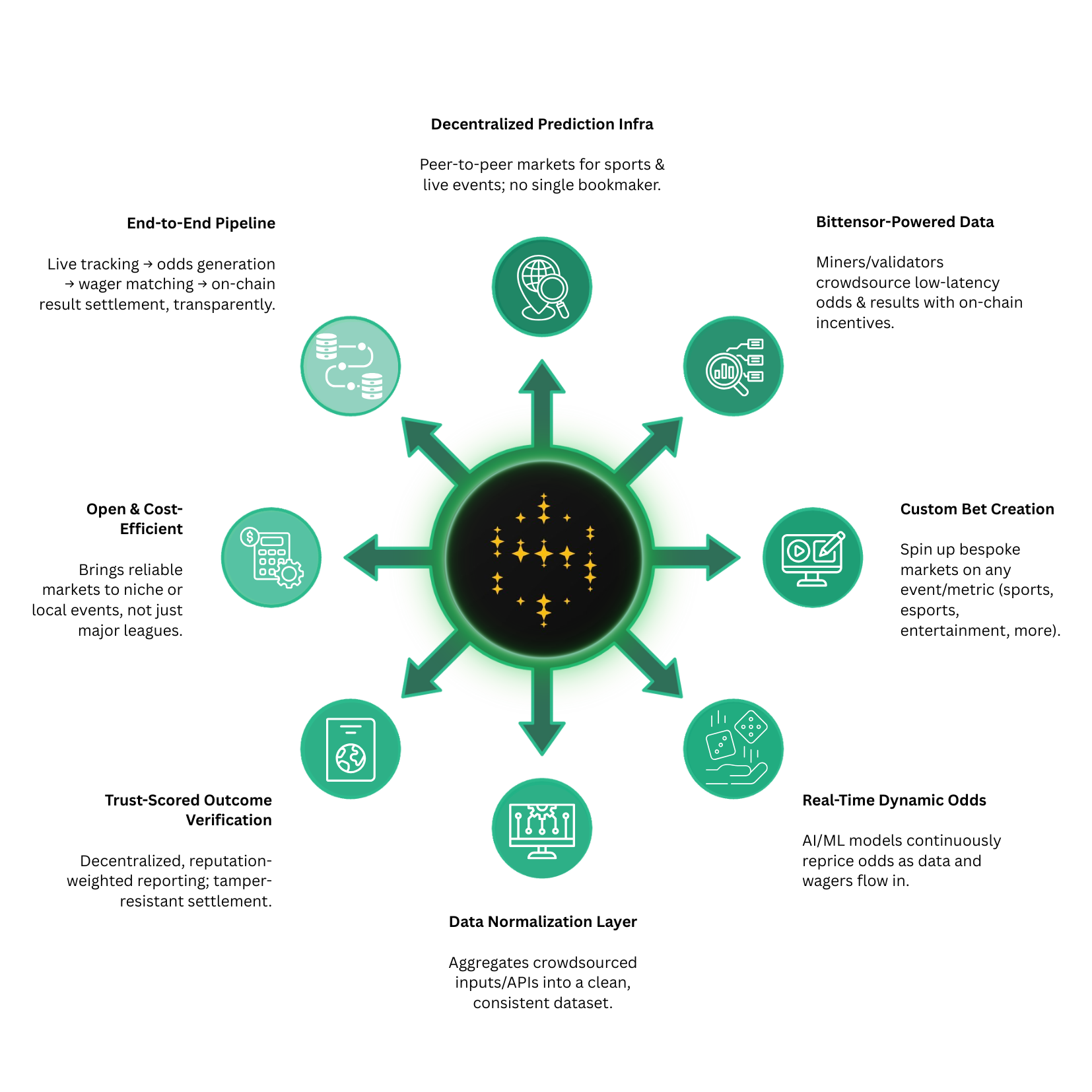
Sparket’s patented system introduces several innovative features to power this decentralized betting marketplace:
Custom Bet Creation: Users can create bespoke betting markets or contests on virtually any event or metric (sports games, esports, entertainment outcomes, etc.), enabling a true “bet on anything” experience. This flexibility means even niche sports or live-streamed events can have prediction markets.
Dynamic Odds: Odds are not fixed by a bookmaker; instead, they adjust automatically based on incoming data and wagers. The platform continuously recalculates odds in real time (using AI-driven models) as new information or bets flow in, ensuring the odds remain fair and reflective of the latest insights.
Data Normalization: Sparket aggregates and standardizes data from many sources (crowdsourced inputs, APIs, etc.) to ensure consistency and comparability. This means data from different users or feeds is normalized into a common format, forming a high-quality dataset for odds calculation and analytics.
Trust-Scored Outcome Verification: Event outcomes (the results of matches or contests) are confirmed through a decentralized process with a reputation system. Multiple independent validators report or confirm the outcome, and Sparket assigns trust scores to these reports (based on past accuracy and other factors). This trust-weighted voting on outcomes guarantees that the final result used for settling bets is accurate and tamper-proof, without relying on any single authority.
Using the above mechanisms, Sparket provides a transparent and tamper-resistant betting environment. The backbone is a network of miners and validators competing and collaborating to deliver the fastest, most accurate live-event data in the industry. For example, if someone creates a market for an upcoming football match, miners on the Sparket subnet might submit their odds or predictions for each team winning. As the match progresses and data (like scores or plays) comes in, the odds update dynamically. Once the match ends, validators within the subnet verify the final score (perhaps by comparing multiple data sources or user reports), and the outcome is settled automatically on-chain. This process drastically reduces reliance on centralized odds-makers and data providers.
Crucially, Sparket’s model lowers the cost of unique data sets and betting operations. Traditional sports data and odds services can be expensive and focused only on popular events; Sparket opens it up so that even small or emerging sports and events can have a market with reliable data at low cost. It delivers accurate, low-latency data and wagering systems for any event – whether it’s a major league game or a local community match – thereby empowering new sports leagues, esports tournaments, and other organizers to unlock revenue streams from betting and fan engagement. In summary, Sparket’s subnet creates a self-sustaining ecosystem of live event tracking, odds generation, wager matching, and result settlement, producing valuable real-time datasets and predictive intelligence for both businesses and everyday users. All of this is done in a decentralized manner, with open participation, which ensures transparency and resilience (no single point of failure) and aligns the incentives of participants (bettors, data contributors, and platform providers) through crypto-economic rewards.
Sparket.ai is a decentralized prediction market infrastructure focused on sports and live events. In simple terms, it creates a transparent, peer-to-peer marketplace for betting and predictions, where the community collectively generates odds and verifies outcomes, rather than relying on a single centralized provider. Sparket operates as Subnet 57 within the Bittensor network – meaning it leverages Bittensor’s decentralized AI protocol to incentivize a global network of nodes (miners and validators) to produce fast and accurate sports/event data. By crowdsourcing data contributions (like user-generated odds and event results) and applying advanced AI/ML models, Sparket democratizes access to high-fidelity sports data and predictive analytics, challenging the traditional centralized sports data models. Participants in Sparket’s network are rewarded for providing valuable, low-latency data on games and events, which in turn feeds into a real-time odds market for betting.
Sparket’s patented system introduces several innovative features to power this decentralized betting marketplace:
Custom Bet Creation: Users can create bespoke betting markets or contests on virtually any event or metric (sports games, esports, entertainment outcomes, etc.), enabling a true “bet on anything” experience. This flexibility means even niche sports or live-streamed events can have prediction markets.
Dynamic Odds: Odds are not fixed by a bookmaker; instead, they adjust automatically based on incoming data and wagers. The platform continuously recalculates odds in real time (using AI-driven models) as new information or bets flow in, ensuring the odds remain fair and reflective of the latest insights.
Data Normalization: Sparket aggregates and standardizes data from many sources (crowdsourced inputs, APIs, etc.) to ensure consistency and comparability. This means data from different users or feeds is normalized into a common format, forming a high-quality dataset for odds calculation and analytics.
Trust-Scored Outcome Verification: Event outcomes (the results of matches or contests) are confirmed through a decentralized process with a reputation system. Multiple independent validators report or confirm the outcome, and Sparket assigns trust scores to these reports (based on past accuracy and other factors). This trust-weighted voting on outcomes guarantees that the final result used for settling bets is accurate and tamper-proof, without relying on any single authority.
Using the above mechanisms, Sparket provides a transparent and tamper-resistant betting environment. The backbone is a network of miners and validators competing and collaborating to deliver the fastest, most accurate live-event data in the industry. For example, if someone creates a market for an upcoming football match, miners on the Sparket subnet might submit their odds or predictions for each team winning. As the match progresses and data (like scores or plays) comes in, the odds update dynamically. Once the match ends, validators within the subnet verify the final score (perhaps by comparing multiple data sources or user reports), and the outcome is settled automatically on-chain. This process drastically reduces reliance on centralized odds-makers and data providers.
Crucially, Sparket’s model lowers the cost of unique data sets and betting operations. Traditional sports data and odds services can be expensive and focused only on popular events; Sparket opens it up so that even small or emerging sports and events can have a market with reliable data at low cost. It delivers accurate, low-latency data and wagering systems for any event – whether it’s a major league game or a local community match – thereby empowering new sports leagues, esports tournaments, and other organizers to unlock revenue streams from betting and fan engagement. In summary, Sparket’s subnet creates a self-sustaining ecosystem of live event tracking, odds generation, wager matching, and result settlement, producing valuable real-time datasets and predictive intelligence for both businesses and everyday users. All of this is done in a decentralized manner, with open participation, which ensures transparency and resilience (no single point of failure) and aligns the incentives of participants (bettors, data contributors, and platform providers) through crypto-economic rewards.
Sparket’s core product is a B2B betting platform that allows partner organizations to offer a “bet on anything” system to their users. In practice, Sparket provides the back-end technology (the “Sparket engine”) that can be integrated into casinos, sportsbooks, or even online communities to enable custom prediction markets in a fun, social, and engaging way. For instance, a casino or gaming company can use Sparket’s platform to let their customers create and join pools predicting anything from sports scores to reality TV outcomes, rather than being limited to pre-set bets. This platform has already been deployed with major industry partners – Sparket powers the wagering technology behind Station Casinos (NASDAQ: RRR) and Penn Entertainment (NASDAQ: PENN) in the US, as well as international partners like Sega Sammy (a large entertainment company) and multiple tribal gaming groups (e.g. Wondr Nation/Foxwoods). Sparket has also formed partnerships with emerging sports leagues such as Major League Rugby and the World Jai Alai League, demonstrating the product’s ability to cover non-traditional sports and events. These real-world integrations show that Sparket’s build is not just theoretical – it’s an operational platform bringing new betting experiences to market.
From a technical perspective, Sparket’s Bittensor subnet (SN–57) is the engine that enhances and expands this product. The subnet acts as a decentralized infrastructure layer, a testing arena, and an AI-driven intelligence engine for Sparket’s platform. Sparket has open-sourced the code for this subnet on GitHub, allowing anyone to run a node (miner or validator) and contribute to the network. The current Subnet 57 beta supports two primary task types that mirror the platform’s core functions:
Odds Origination: Nodes in the network (miners) generate odds or predictive models for upcoming events. This can involve AI algorithms that analyze historical data, current team statistics, weather, or other factors to produce a probability (odds) for each possible outcome of an event. In Sparket’s system, many miners might submit odds, and the best or most accurate predictions (as determined by the network’s validation mechanism) are used to set the market odds.
Outcome Verification: After an event concludes, the network’s nodes confirm the actual outcome (e.g. the final score or result) in a decentralized manner. Validators cross-verify outcomes using external data feeds or user submissions, and because each validator has a trust score or reputation, the network can filter out false reports. The consensus on the true result is then used to settle bets in a transparent way.
These subnet outputs – the crowdsourced odds and the verified results – feed directly into Sparket’s B2B platform. In other words, the data produced by the subnet supports product development and expansion of Sparket’s offerings. As Sparket adds new features or enters new markets, the subnet can be used to quickly generate the necessary data and intelligence. It also serves as a proving ground for Sparket’s algorithms: the decentralized node network allows testing and refining of models (for odds-making, risk management, etc.) under real-world conditions, which can then be rolled into the commercial platform.
It’s important to note that real-money wagering is planned for future phases of Sparket’s rollout. During the current beta, users can participate by contributing data (and perhaps making play-money or test bets) to help train the system. This phased approach ensures that the platform’s mechanics are robust and secure before enabling actual financial stakes. When real-money betting goes live, Sparket will likely integrate with payment rails or digital wallets, allowing users to wager cryptocurrency (or even fiat, through partners) in the decentralized markets, all while the underlying odds and settlements are handled by the Sparket subnet. The patented architecture (custom bets, dynamic odds, etc.) will then be fully realized in a production environment, offering a novel betting experience to end-users.
In summary, Sparket’s “product” is twofold: (1) an enterprise-ready betting platform that clients in the gaming industry can adopt (including white-label solutions where a partner can brand their own prediction markets powered by Sparket), and (2) the Sparket Subnet 57 on Bittensor, which is the decentralized network of AI/ML-powered nodes that generates the odds and verifies outcomes that drive those markets. This combination of a front-end product with a decentralized back-end is what makes Sparket unique. The technology stack ranges from web interfaces and mobile apps for user engagement (on the partner side) to blockchain-based incentive mechanisms and machine learning models on the Bittensor side. By bridging these, Sparket can deliver a seamless betting experience to users (through its partners) while continually improving the data and models via community contributions on the subnet.
Sparket’s core product is a B2B betting platform that allows partner organizations to offer a “bet on anything” system to their users. In practice, Sparket provides the back-end technology (the “Sparket engine”) that can be integrated into casinos, sportsbooks, or even online communities to enable custom prediction markets in a fun, social, and engaging way. For instance, a casino or gaming company can use Sparket’s platform to let their customers create and join pools predicting anything from sports scores to reality TV outcomes, rather than being limited to pre-set bets. This platform has already been deployed with major industry partners – Sparket powers the wagering technology behind Station Casinos (NASDAQ: RRR) and Penn Entertainment (NASDAQ: PENN) in the US, as well as international partners like Sega Sammy (a large entertainment company) and multiple tribal gaming groups (e.g. Wondr Nation/Foxwoods). Sparket has also formed partnerships with emerging sports leagues such as Major League Rugby and the World Jai Alai League, demonstrating the product’s ability to cover non-traditional sports and events. These real-world integrations show that Sparket’s build is not just theoretical – it’s an operational platform bringing new betting experiences to market.
From a technical perspective, Sparket’s Bittensor subnet (SN–57) is the engine that enhances and expands this product. The subnet acts as a decentralized infrastructure layer, a testing arena, and an AI-driven intelligence engine for Sparket’s platform. Sparket has open-sourced the code for this subnet on GitHub, allowing anyone to run a node (miner or validator) and contribute to the network. The current Subnet 57 beta supports two primary task types that mirror the platform’s core functions:
Odds Origination: Nodes in the network (miners) generate odds or predictive models for upcoming events. This can involve AI algorithms that analyze historical data, current team statistics, weather, or other factors to produce a probability (odds) for each possible outcome of an event. In Sparket’s system, many miners might submit odds, and the best or most accurate predictions (as determined by the network’s validation mechanism) are used to set the market odds.
Outcome Verification: After an event concludes, the network’s nodes confirm the actual outcome (e.g. the final score or result) in a decentralized manner. Validators cross-verify outcomes using external data feeds or user submissions, and because each validator has a trust score or reputation, the network can filter out false reports. The consensus on the true result is then used to settle bets in a transparent way.
These subnet outputs – the crowdsourced odds and the verified results – feed directly into Sparket’s B2B platform. In other words, the data produced by the subnet supports product development and expansion of Sparket’s offerings. As Sparket adds new features or enters new markets, the subnet can be used to quickly generate the necessary data and intelligence. It also serves as a proving ground for Sparket’s algorithms: the decentralized node network allows testing and refining of models (for odds-making, risk management, etc.) under real-world conditions, which can then be rolled into the commercial platform.
It’s important to note that real-money wagering is planned for future phases of Sparket’s rollout. During the current beta, users can participate by contributing data (and perhaps making play-money or test bets) to help train the system. This phased approach ensures that the platform’s mechanics are robust and secure before enabling actual financial stakes. When real-money betting goes live, Sparket will likely integrate with payment rails or digital wallets, allowing users to wager cryptocurrency (or even fiat, through partners) in the decentralized markets, all while the underlying odds and settlements are handled by the Sparket subnet. The patented architecture (custom bets, dynamic odds, etc.) will then be fully realized in a production environment, offering a novel betting experience to end-users.
In summary, Sparket’s “product” is twofold: (1) an enterprise-ready betting platform that clients in the gaming industry can adopt (including white-label solutions where a partner can brand their own prediction markets powered by Sparket), and (2) the Sparket Subnet 57 on Bittensor, which is the decentralized network of AI/ML-powered nodes that generates the odds and verifies outcomes that drive those markets. This combination of a front-end product with a decentralized back-end is what makes Sparket unique. The technology stack ranges from web interfaces and mobile apps for user engagement (on the partner side) to blockchain-based incentive mechanisms and machine learning models on the Bittensor side. By bridging these, Sparket can deliver a seamless betting experience to users (through its partners) while continually improving the data and models via community contributions on the subnet.
Sparket is backed by a team of industry-recognized entrepreneurs and experts in tech, finance, and sports analytics. In fact, Sparket was honored as the 2025 Startup of the Year in the iGaming industry, underscoring the team’s innovative work in gambling technology. Key team members include:
Aaron Basch – CEO & Co-Founder: Aaron has a strong background in mathematics and finance. He earned degrees in mathematics/computer science and education from UC San Diego, then a Master’s in Financial Engineering from UCLA. Before founding Sparket, he served as Executive Director of Risk and Finance at an alternative vehicle financing company, where he honed skills in data-driven process improvements and complex financial modeling. Aaron is an avid sports and esports fan (he played college sports and ranked highly in esports), and even has hands-on crypto experience from building and operating Ethereum mining rigs. His blend of quantitative finance expertise and passion for sports betting analytics helped lay the foundation for Sparket’s vision.
Evan Fisher – COO & Co-Founder: Evan spent 8 years at Google, including time at “Google X” (the experimental projects lab), focusing on product user experience and leading teams of finance professionals. He holds an MBA from Columbia University with a focus on Entrepreneurship and Finance. Evan’s strengths lie in product and program management — he has a track record of driving complex initiatives to completion and leading large teams, skills crucial for scaling the Sparket platform. He’s also a huge sports fan (enthusiastic about tennis, chess, basketball), which aligns with Sparket’s domain. Together with Aaron, Evan provides strategic and operational leadership at Sparket, combining technical product development know-how with business acumen.
Joe Margolis – AI Software Engineer: Joe is a data scientist who also played collegiate baseball, reflecting the intersection of sports and analytics at Sparket. He earned a Master’s in Data Science from Fordham University and previously worked as a software consultant providing analytics for auto insurance providers. At Sparket, Joe leads machine learning and AI development efforts, focusing on the odds projection algorithms for Sparket.ai. His goal is to continuously improve the accuracy of odds, expand coverage to niche sports, and aggregate data from various prediction sources to enhance Sparket’s AI models.
Kira Sobolev – Senior Full Stack Engineer: Kira brings 10+ years of experience in building and scaling SaaS platforms. He holds a Master’s in Control Systems and Computer Science from BMSTU, with an early career focus on aerospace control systems – a background that gave him strong engineering fundamentals. Notably, Kira built Sport24, a sports news and statistics portal serving millions of users, from the ground up early in his career. He later worked at Deutsche Bank and on an AI-driven test automation startup. At Sparket, Kira applies his full-stack development expertise and passion for AI to build out the Sparket platform’s infrastructure and user-facing components. His experience in high-scale sports data systems is particularly valuable for Sparket’s needs.
Jake Malek – Manager of Markets & Analytics: Jake has a lifelong background in sports and a career spent managing complex programs and operations, including in nonprofit sectors. He has led teams and large-scale initiatives both in the US and internationally, developing a strong skill set in execution and leadership. At Sparket, Jake oversees the creation and management of betting pools and custom contests on the platform. Essentially, he makes sure that Sparket’s markets are engaging, well-balanced, and intuitive for users. Jake’s detail-oriented approach and problem-solving at the intersection of sports, data, and user experience help ensure that the betting contests run smoothly and appeal to a broad audience.
This multidisciplinary team (along with other contributors not listed here) drives Sparket’s development. Their combined expertise in finance (risk management, financial engineering), technology (AI, software engineering at scale), and gaming/sports (industry connections and domain knowledge) gives Sparket a strong foundation. The recognition as a top startup in iGaming in 2025 attests to their progress so far. Under Aaron and Evan’s leadership, the team is not only building innovative tech (like the patented betting architecture and the Bittensor subnet integration) but is also navigating partnerships and regulatory landscapes to bring decentralized betting to mainstream use.
Sparket is backed by a team of industry-recognized entrepreneurs and experts in tech, finance, and sports analytics. In fact, Sparket was honored as the 2025 Startup of the Year in the iGaming industry, underscoring the team’s innovative work in gambling technology. Key team members include:
Aaron Basch – CEO & Co-Founder: Aaron has a strong background in mathematics and finance. He earned degrees in mathematics/computer science and education from UC San Diego, then a Master’s in Financial Engineering from UCLA. Before founding Sparket, he served as Executive Director of Risk and Finance at an alternative vehicle financing company, where he honed skills in data-driven process improvements and complex financial modeling. Aaron is an avid sports and esports fan (he played college sports and ranked highly in esports), and even has hands-on crypto experience from building and operating Ethereum mining rigs. His blend of quantitative finance expertise and passion for sports betting analytics helped lay the foundation for Sparket’s vision.
Evan Fisher – COO & Co-Founder: Evan spent 8 years at Google, including time at “Google X” (the experimental projects lab), focusing on product user experience and leading teams of finance professionals. He holds an MBA from Columbia University with a focus on Entrepreneurship and Finance. Evan’s strengths lie in product and program management — he has a track record of driving complex initiatives to completion and leading large teams, skills crucial for scaling the Sparket platform. He’s also a huge sports fan (enthusiastic about tennis, chess, basketball), which aligns with Sparket’s domain. Together with Aaron, Evan provides strategic and operational leadership at Sparket, combining technical product development know-how with business acumen.
Joe Margolis – AI Software Engineer: Joe is a data scientist who also played collegiate baseball, reflecting the intersection of sports and analytics at Sparket. He earned a Master’s in Data Science from Fordham University and previously worked as a software consultant providing analytics for auto insurance providers. At Sparket, Joe leads machine learning and AI development efforts, focusing on the odds projection algorithms for Sparket.ai. His goal is to continuously improve the accuracy of odds, expand coverage to niche sports, and aggregate data from various prediction sources to enhance Sparket’s AI models.
Kira Sobolev – Senior Full Stack Engineer: Kira brings 10+ years of experience in building and scaling SaaS platforms. He holds a Master’s in Control Systems and Computer Science from BMSTU, with an early career focus on aerospace control systems – a background that gave him strong engineering fundamentals. Notably, Kira built Sport24, a sports news and statistics portal serving millions of users, from the ground up early in his career. He later worked at Deutsche Bank and on an AI-driven test automation startup. At Sparket, Kira applies his full-stack development expertise and passion for AI to build out the Sparket platform’s infrastructure and user-facing components. His experience in high-scale sports data systems is particularly valuable for Sparket’s needs.
Jake Malek – Manager of Markets & Analytics: Jake has a lifelong background in sports and a career spent managing complex programs and operations, including in nonprofit sectors. He has led teams and large-scale initiatives both in the US and internationally, developing a strong skill set in execution and leadership. At Sparket, Jake oversees the creation and management of betting pools and custom contests on the platform. Essentially, he makes sure that Sparket’s markets are engaging, well-balanced, and intuitive for users. Jake’s detail-oriented approach and problem-solving at the intersection of sports, data, and user experience help ensure that the betting contests run smoothly and appeal to a broad audience.
This multidisciplinary team (along with other contributors not listed here) drives Sparket’s development. Their combined expertise in finance (risk management, financial engineering), technology (AI, software engineering at scale), and gaming/sports (industry connections and domain knowledge) gives Sparket a strong foundation. The recognition as a top startup in iGaming in 2025 attests to their progress so far. Under Aaron and Evan’s leadership, the team is not only building innovative tech (like the patented betting architecture and the Bittensor subnet integration) but is also navigating partnerships and regulatory landscapes to bring decentralized betting to mainstream use.
The Sparket.ai subnet is envisioned to be the core infrastructure layer, testing ground, and intelligence engine for Sparket’s platform as it evolves. To reach its full vision, Sparket has laid out a clear development roadmap divided into several phases:
Phase 00: Launch & Refinement – This initial phase is about getting the basics right. It focuses on launching the subnet and rigorously testing the node applications (the miner and validator software) in a controlled environment. The goals are to ensure network stability, fix any bugs, and harden the system against potential exploits or attacks. During Phase 00, Sparket establishes the baseline performance for its two main tasks (odds origination and outcome verification) on traditional major sports markets. Essentially, it’s a calibration phase where the core mechanisms are validated with real data – for example, testing that the miners can successfully generate odds for popular sports games and that validators can correctly reach consensus on those game outcomes.
Phase 01: Live Betting Intelligence – In this phase, Sparket will introduce live (in-play) betting scenarios to the subnet. The idea is to prove that the network can handle dynamic, rapidly-changing odds during live events – a much harder challenge than pre-game odds. Phase 01 will capture execution data and intelligence from actual betting activity (likely in a test or limited environment) to evaluate how well Sparket’s AI models perform when people are placing bets in real time. A key aspect here is the evaluation of “betting agents” or strategies. Instead of just analyzing individual bets, Sparket will analyze entire strategies (perhaps bots or algorithms that place a series of bets) to see which strategies are effective. By doing so, Sparket can gather deeper insights into betting behaviors and odds accuracy. This phase basically acts as a proof-of-concept that the subnet’s crowdsourced odds can beat or match traditional odds-makers in a live setting, and it helps fine-tune the system before scaling up.
Phase 02: Product Development – Once the core is stable and proven in major sports, Sparket will expand its coverage to a much broader range of events and markets. Phase 02 involves scaling the system to support alternative sports and non-sports events: think niche sports leagues, pop culture events (like award show outcomes), reality TV contests, esports, and more. During this phase, Sparket also plans to release initial versions of new products for beta testing. This could include new front-end applications, user interfaces, or integration tools for partners. For example, Sparket might roll out a beta of a consumer-facing app or a toolkit for partners to create custom markets. The goal of Phase 02 is to ensure the platform isn’t limited to just big sports – it should handle anything people want to bet on, aligning with the “bet on anything” motto. By beta testing new products in this phase, Sparket can gather user feedback and make improvements before full-scale launch.
Phase 03: Global Scaling – With the platform functionality broad and tested, the final planned phase is about scaling up the user base and data volume massively. Sparket’s patented ecosystem works best with huge participation – thousands or even millions of users contributing odds, creating markets, and verifying outcomes, which creates richer data and more liquid markets. In Phase 03, Sparket aims to drive adoption through strategies like affiliate programs (incentivizing third parties to bring in users or data contributors), partnerships with other platforms or even other Bittensor subnets, and continual product refinement to improve user experience. Essentially, they will market the platform and grow the community so that Sparket becomes a widely used global network. As more users join and contribute, the value of the network’s data and predictions increases, creating a positive feedback loop. By the end of this phase, Sparket envisions a fully decentralized, global betting ecosystem in line with its original patent vision – one where the crowd is collectively generating odds and markets on anything imaginable, and the system naturally attracts more users because it offers variety, fairness, and transparency that traditional betting systems cannot match.
Each phase of the roadmap builds on the previous one, gradually de-risking the project and adding capabilities. Sparket’s approach is careful: start with core functionality and known markets, then progressively push into live scenarios, more content, and finally growth. This roadmap also highlights how the Bittensor subnet (SN57) plays a pivotal role at every step – from Phase 00 where it’s mainly an R&D tool to Phase 03 where it scales as a global network of potentially millions of nodes and users. By following this multi-phase plan, Sparket aims to create a robust, self-sustaining prediction market ecosystem that can transform the sports and event betting industry.
Throughout these phases, Sparket will likely remain adaptive to technological and regulatory developments. For example, enabling real-money wagering (as mentioned, planned after the beta) will require compliance with gambling regulations in various jurisdictions – something the team will integrate into the roadmap execution. Additionally, the success of early phases (like proving the quality of crowdsourced odds) will feed into partnerships and user acquisition strategies in later phases. By 2030, with the global sports betting market projected to exceed $180 billion and the rise of data-driven prediction markets, Sparket’s roadmap positions it to be at the forefront of this “predictive economy” – offering a decentralized, AI-powered alternative that could reshape how betting and prediction data are generated and consumed.
Overall, the roadmap underscores Sparket’s ambition: to go from a cutting-edge subnet project to a mainstream, global betting platform powered by decentralization. Each milestone achieved will bring Sparket closer to that end goal, while delivering value to both the Sparket community (subnet participants) and the betting industry partners that utilize its technology. The journey through Phase 00 to Phase 03 will be critical to watch as Sparket (Bittensor Subnet 57) matures from beta to a full-fledged, world-scale ecosystem.
The Sparket.ai subnet is envisioned to be the core infrastructure layer, testing ground, and intelligence engine for Sparket’s platform as it evolves. To reach its full vision, Sparket has laid out a clear development roadmap divided into several phases:
Phase 00: Launch & Refinement – This initial phase is about getting the basics right. It focuses on launching the subnet and rigorously testing the node applications (the miner and validator software) in a controlled environment. The goals are to ensure network stability, fix any bugs, and harden the system against potential exploits or attacks. During Phase 00, Sparket establishes the baseline performance for its two main tasks (odds origination and outcome verification) on traditional major sports markets. Essentially, it’s a calibration phase where the core mechanisms are validated with real data – for example, testing that the miners can successfully generate odds for popular sports games and that validators can correctly reach consensus on those game outcomes.
Phase 01: Live Betting Intelligence – In this phase, Sparket will introduce live (in-play) betting scenarios to the subnet. The idea is to prove that the network can handle dynamic, rapidly-changing odds during live events – a much harder challenge than pre-game odds. Phase 01 will capture execution data and intelligence from actual betting activity (likely in a test or limited environment) to evaluate how well Sparket’s AI models perform when people are placing bets in real time. A key aspect here is the evaluation of “betting agents” or strategies. Instead of just analyzing individual bets, Sparket will analyze entire strategies (perhaps bots or algorithms that place a series of bets) to see which strategies are effective. By doing so, Sparket can gather deeper insights into betting behaviors and odds accuracy. This phase basically acts as a proof-of-concept that the subnet’s crowdsourced odds can beat or match traditional odds-makers in a live setting, and it helps fine-tune the system before scaling up.
Phase 02: Product Development – Once the core is stable and proven in major sports, Sparket will expand its coverage to a much broader range of events and markets. Phase 02 involves scaling the system to support alternative sports and non-sports events: think niche sports leagues, pop culture events (like award show outcomes), reality TV contests, esports, and more. During this phase, Sparket also plans to release initial versions of new products for beta testing. This could include new front-end applications, user interfaces, or integration tools for partners. For example, Sparket might roll out a beta of a consumer-facing app or a toolkit for partners to create custom markets. The goal of Phase 02 is to ensure the platform isn’t limited to just big sports – it should handle anything people want to bet on, aligning with the “bet on anything” motto. By beta testing new products in this phase, Sparket can gather user feedback and make improvements before full-scale launch.
Phase 03: Global Scaling – With the platform functionality broad and tested, the final planned phase is about scaling up the user base and data volume massively. Sparket’s patented ecosystem works best with huge participation – thousands or even millions of users contributing odds, creating markets, and verifying outcomes, which creates richer data and more liquid markets. In Phase 03, Sparket aims to drive adoption through strategies like affiliate programs (incentivizing third parties to bring in users or data contributors), partnerships with other platforms or even other Bittensor subnets, and continual product refinement to improve user experience. Essentially, they will market the platform and grow the community so that Sparket becomes a widely used global network. As more users join and contribute, the value of the network’s data and predictions increases, creating a positive feedback loop. By the end of this phase, Sparket envisions a fully decentralized, global betting ecosystem in line with its original patent vision – one where the crowd is collectively generating odds and markets on anything imaginable, and the system naturally attracts more users because it offers variety, fairness, and transparency that traditional betting systems cannot match.
Each phase of the roadmap builds on the previous one, gradually de-risking the project and adding capabilities. Sparket’s approach is careful: start with core functionality and known markets, then progressively push into live scenarios, more content, and finally growth. This roadmap also highlights how the Bittensor subnet (SN57) plays a pivotal role at every step – from Phase 00 where it’s mainly an R&D tool to Phase 03 where it scales as a global network of potentially millions of nodes and users. By following this multi-phase plan, Sparket aims to create a robust, self-sustaining prediction market ecosystem that can transform the sports and event betting industry.
Throughout these phases, Sparket will likely remain adaptive to technological and regulatory developments. For example, enabling real-money wagering (as mentioned, planned after the beta) will require compliance with gambling regulations in various jurisdictions – something the team will integrate into the roadmap execution. Additionally, the success of early phases (like proving the quality of crowdsourced odds) will feed into partnerships and user acquisition strategies in later phases. By 2030, with the global sports betting market projected to exceed $180 billion and the rise of data-driven prediction markets, Sparket’s roadmap positions it to be at the forefront of this “predictive economy” – offering a decentralized, AI-powered alternative that could reshape how betting and prediction data are generated and consumed.
Overall, the roadmap underscores Sparket’s ambition: to go from a cutting-edge subnet project to a mainstream, global betting platform powered by decentralization. Each milestone achieved will bring Sparket closer to that end goal, while delivering value to both the Sparket community (subnet participants) and the betting industry partners that utilize its technology. The journey through Phase 00 to Phase 03 will be critical to watch as Sparket (Bittensor Subnet 57) matures from beta to a full-fledged, world-scale ecosystem.