
With the amount of new subnets being added it can be hard to get up to date information across all subnets, so data may be slightly out of date from time to time
Rec4ll is Bittensor’s dedicated subnet for decentralised retrieval-augmented generation (RAG) — the technique that lets AI models pull in relevant knowledge before generating a response. Rather than relying on a single centralised service to manage embeddings, vector search, and LLM inference, Rec4ll distributes these responsibilities across a competitive network of miners operating on the Bittensor blockchain.
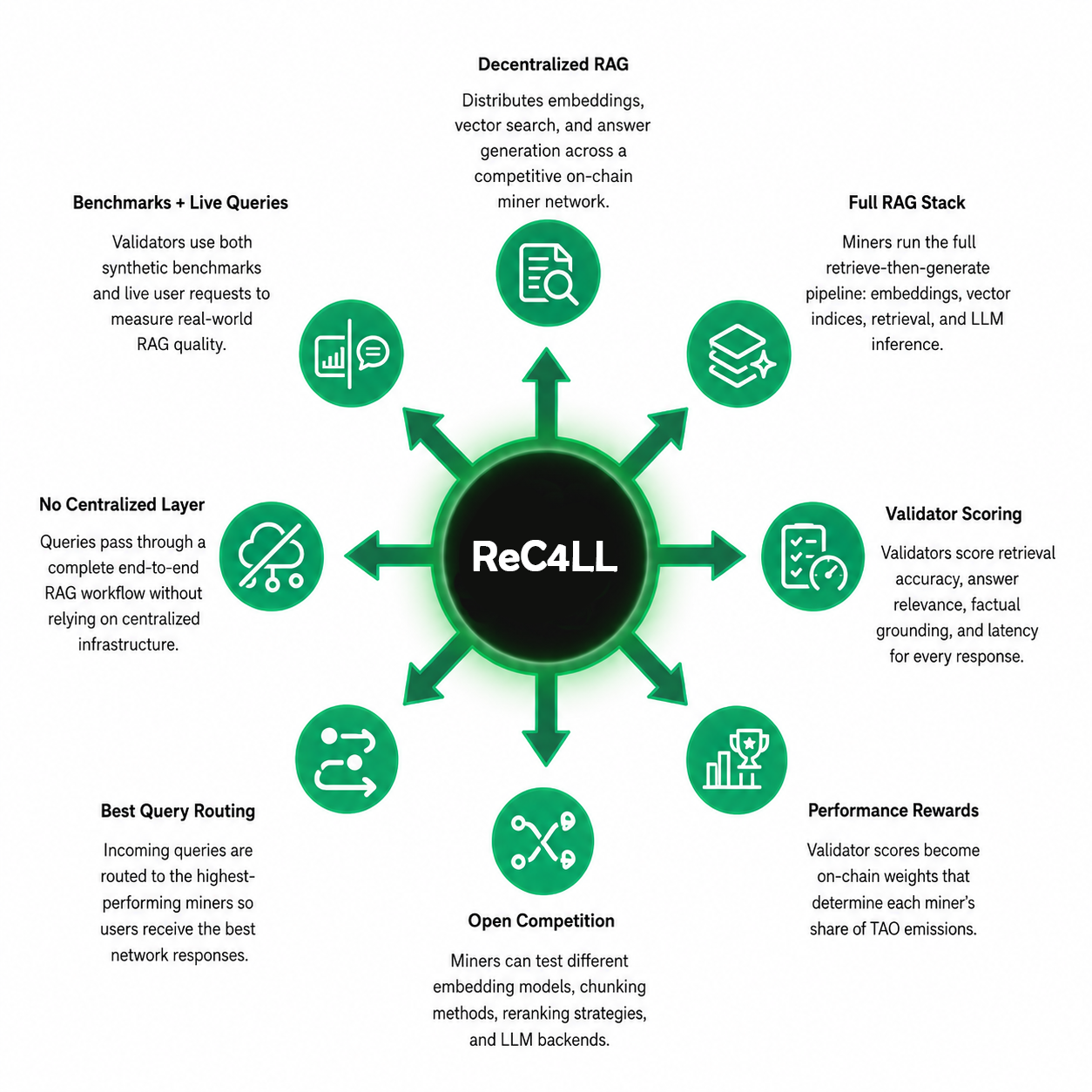
Miners on SN31 are responsible for the full RAG stack: they run embedding models to convert text into high-dimensional vectors, maintain and serve vector search indices to find the most contextually relevant documents, and perform LLM inference to synthesise a final answer grounded in retrieved content. This means any query sent to the subnet passes through a complete retrieve-then-generate pipeline, end to end, without touching any centralised infrastructure.
Validators sit above the miners and independently evaluate the quality of each miner’s responses. They issue queries — both synthetic benchmarks and live user requests — and assess miners on retrieval accuracy, answer relevance, factual grounding, and latency. These scores are converted into weights that determine each miner’s share of TAO emissions, creating a direct financial incentive to continuously improve RAG performance.
The core innovation of Rec4ll’s design is how it surfaces quality through open competition. Rather than hard-coding a single retrieval strategy, the subnet allows miners to experiment with different embedding models, chunking strategies, re-ranking techniques, and LLM backends. Validators are the neutral arbiter: whichever pipeline produces the most accurate, relevant, and timely responses earns the most TAO. The subnet then routes incoming queries to the highest-performing miners, so end users always receive the best the network has to offer.
Rec4ll is Bittensor’s dedicated subnet for decentralised retrieval-augmented generation (RAG) — the technique that lets AI models pull in relevant knowledge before generating a response. Rather than relying on a single centralised service to manage embeddings, vector search, and LLM inference, Rec4ll distributes these responsibilities across a competitive network of miners operating on the Bittensor blockchain.
Miners on SN31 are responsible for the full RAG stack: they run embedding models to convert text into high-dimensional vectors, maintain and serve vector search indices to find the most contextually relevant documents, and perform LLM inference to synthesise a final answer grounded in retrieved content. This means any query sent to the subnet passes through a complete retrieve-then-generate pipeline, end to end, without touching any centralised infrastructure.
Validators sit above the miners and independently evaluate the quality of each miner’s responses. They issue queries — both synthetic benchmarks and live user requests — and assess miners on retrieval accuracy, answer relevance, factual grounding, and latency. These scores are converted into weights that determine each miner’s share of TAO emissions, creating a direct financial incentive to continuously improve RAG performance.
The core innovation of Rec4ll’s design is how it surfaces quality through open competition. Rather than hard-coding a single retrieval strategy, the subnet allows miners to experiment with different embedding models, chunking strategies, re-ranking techniques, and LLM backends. Validators are the neutral arbiter: whichever pipeline produces the most accurate, relevant, and timely responses earns the most TAO. The subnet then routes incoming queries to the highest-performing miners, so end users always receive the best the network has to offer.
The product Rec4ll is building is a decentralised RAG API — an infrastructure layer that any application, AI agent, or Bittensor subnet can call to retrieve context-enriched answers. In practical terms, it is a drop-in alternative to centralised RAG stacks built on services like Pinecone, Weaviate, or LangChain: developers send a query and receive a grounded, document-backed answer, but the compute and data storage is provided by a competitive, trustless network rather than a single vendor.
The target customers span the Bittensor ecosystem and beyond. AI application developers who want retrieval capabilities without managing vector databases and LLM inference infrastructure are a natural fit. Bittensor-native projects can integrate SN31 as a composable knowledge layer, having their agents call Rec4ll to enrich prompts before routing to inference subnets. Enterprise teams seeking to reduce dependency on centralised AI providers — and benefit from the economic efficiency of an open marketplace — are the longer-horizon audience.
Technically, the product rests on a layered architecture. The first layer is the embedding pipeline, where miners convert documents and queries into vector representations. The second layer is vector retrieval, where miners maintain search indices and return the most semantically relevant document chunks for a given query. The third layer is LLM inference, where miners generate a final answer conditioned on the retrieved context. Each layer is provided independently by competitive miners, and validators evaluate the aggregate output quality of each miner’s full pipeline.
Incentive alignment is central to the architecture. Miners earn TAO in proportion to how well their RAG pipelines score against the validator’s ground-truth evaluations. This means the network self-optimises: poorly performing miners are outcompeted and lose emissions, while high-quality RAG pipelines attract more routing and greater rewards. The result is a market-driven quality floor that improves over time without requiring central coordination.
The product Rec4ll is building is a decentralised RAG API — an infrastructure layer that any application, AI agent, or Bittensor subnet can call to retrieve context-enriched answers. In practical terms, it is a drop-in alternative to centralised RAG stacks built on services like Pinecone, Weaviate, or LangChain: developers send a query and receive a grounded, document-backed answer, but the compute and data storage is provided by a competitive, trustless network rather than a single vendor.
The target customers span the Bittensor ecosystem and beyond. AI application developers who want retrieval capabilities without managing vector databases and LLM inference infrastructure are a natural fit. Bittensor-native projects can integrate SN31 as a composable knowledge layer, having their agents call Rec4ll to enrich prompts before routing to inference subnets. Enterprise teams seeking to reduce dependency on centralised AI providers — and benefit from the economic efficiency of an open marketplace — are the longer-horizon audience.
Technically, the product rests on a layered architecture. The first layer is the embedding pipeline, where miners convert documents and queries into vector representations. The second layer is vector retrieval, where miners maintain search indices and return the most semantically relevant document chunks for a given query. The third layer is LLM inference, where miners generate a final answer conditioned on the retrieved context. Each layer is provided independently by competitive miners, and validators evaluate the aggregate output quality of each miner’s full pipeline.
Incentive alignment is central to the architecture. Miners earn TAO in proportion to how well their RAG pipelines score against the validator’s ground-truth evaluations. This means the network self-optimises: poorly performing miners are outcompeted and lose emissions, while high-quality RAG pipelines attract more routing and greater rewards. The result is a market-driven quality floor that improves over time without requiring central coordination.
The Rec4ll team has not yet made public announcements identifying named founders or team members. The project maintains a GitHub account at github.com/rec4ll, though no repositories have been made public at the time of writing, suggesting the codebase is still in private development ahead of the subnet’s official launch.
What is observable is that the project has attracted substantial early interest: over 1,700 token holders had accumulated ALPHA before the subnet’s active mining phase began — a level of attention typically seen only when a credible, organised team is quietly building behind the scenes. The team’s choice to work quietly before launch is not uncommon in Bittensor, where subnets often prefer to let technical delivery speak before public promotion.
As development progresses and Rec4ll moves toward full miner onboarding, further information about the team, their backgrounds, and their approach to governance is expected to emerge. This page will be updated as the team makes public disclosures.
The Rec4ll team has not yet made public announcements identifying named founders or team members. The project maintains a GitHub account at github.com/rec4ll, though no repositories have been made public at the time of writing, suggesting the codebase is still in private development ahead of the subnet’s official launch.
What is observable is that the project has attracted substantial early interest: over 1,700 token holders had accumulated ALPHA before the subnet’s active mining phase began — a level of attention typically seen only when a credible, organised team is quietly building behind the scenes. The team’s choice to work quietly before launch is not uncommon in Bittensor, where subnets often prefer to let technical delivery speak before public promotion.
As development progresses and Rec4ll moves toward full miner onboarding, further information about the team, their backgrounds, and their approach to governance is expected to emerge. This page will be updated as the team makes public disclosures.
Rec4ll is currently in its pre-launch phase: the subnet’s slot (SN31) is registered on the Bittensor mainnet and has attracted over 1,700 token holders, but active miners are still being onboarded. The immediate priority is completing the open-source release of the miner and validator codebases, which will allow the broader Bittensor community to participate in the network and begin earning TAO emissions.
Once active mining begins, the network’s self-improving incentive mechanism will take over: validator-driven scoring will naturally surface the best-performing RAG strategies, and the subnet will route queries to top miners accordingly. Medium-term milestones are expected to include integration with Bittensor-native AI agents, the release of a developer-facing API for external applications, and possible partnerships with other subnets seeking to add a retrieval layer to their existing inference pipelines.
Longer term, Rec4ll is positioned to become a foundational infrastructure layer for knowledge-grounded AI within the Bittensor ecosystem — the go-to subnet whenever an AI application needs to retrieve, contextualise, and generate with real-world information rather than relying on a model’s frozen training data alone.
Rec4ll is currently in its pre-launch phase: the subnet’s slot (SN31) is registered on the Bittensor mainnet and has attracted over 1,700 token holders, but active miners are still being onboarded. The immediate priority is completing the open-source release of the miner and validator codebases, which will allow the broader Bittensor community to participate in the network and begin earning TAO emissions.
Once active mining begins, the network’s self-improving incentive mechanism will take over: validator-driven scoring will naturally surface the best-performing RAG strategies, and the subnet will route queries to top miners accordingly. Medium-term milestones are expected to include integration with Bittensor-native AI agents, the release of a developer-facing API for external applications, and possible partnerships with other subnets seeking to add a retrieval layer to their existing inference pipelines.
Longer term, Rec4ll is positioned to become a foundational infrastructure layer for knowledge-grounded AI within the Bittensor ecosystem — the go-to subnet whenever an AI application needs to retrieve, contextualise, and generate with real-world information rather than relying on a model’s frozen training data alone.