With the amount of new subnets being added it can be hard to get up to date information across all subnets, so data may be slightly out of date from time to time
Decentralized Risk Intelligence
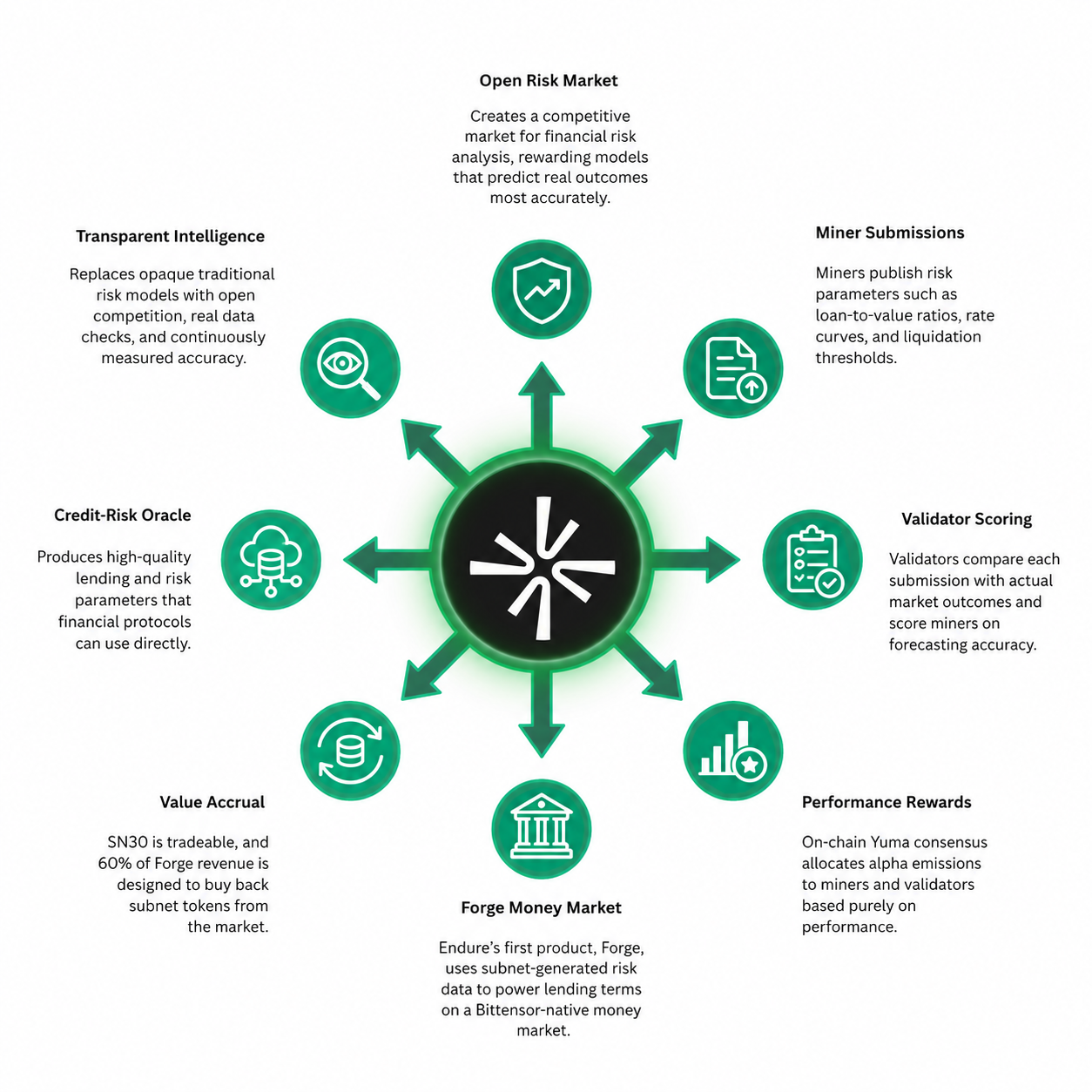
Endure Network (SN30 on Bittensor, formerly “Wahoot”) creates an open market for risk analysis. It tackles the problem that traditional financial risk models are opaque and rarely checked against real data. Instead, Endure makes risk intelligence competitive: independent miners (AI models or analysts) submit risk parameters (loan-to-value ratios, interest rate curves, liquidation thresholds, etc.) and validators score every submission against actual market outcomes. High-performing predictions earn proportionally higher rewards, while inaccurate models quickly lose standing. In effect the network continuously measures and rewards forecasting accuracy.
Miner/Validator Mechanism
Endure follows Bittensor’s standard subnet loop. Each epoch, miners produce the commodity of the subnet – in this case risk metrics – and post commitments of their predictions. Validators then independently evaluate these model submissions according to criteria defined by the subnet’s incentive mechanism. Validators compare each miner’s parameters to what actually happened in the market and assign scores. Those scores feed into the on-chain consensus (Yuma), which allocates the subnet’s α-token emissions to each miner and validator by performance. Thus, miners earn SN30 tokens mainly for correct predictions: accuracy immediately increases one’s share of rewards and tenure or branding carries no weight.
Outcomes and Products
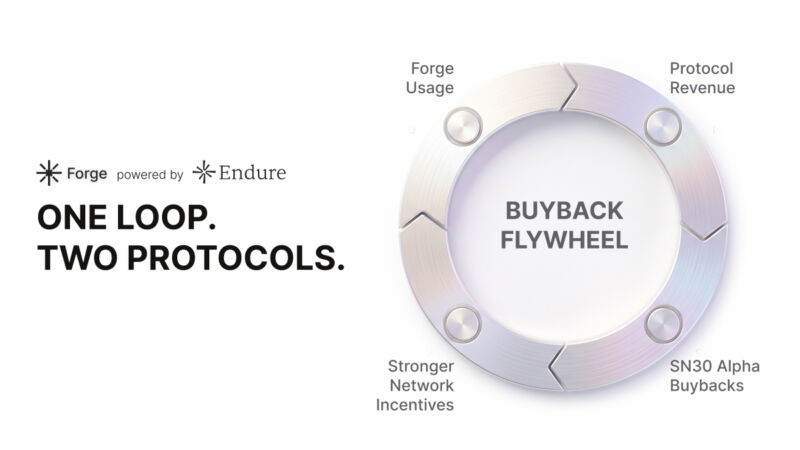
The tangible output of Endure is high-quality risk parameters that financial protocols can use. The first concrete product is Forge, a Bittensor-native money market. In Forge, the network’s own secured risk outputs automatically set lending terms. For example, users borrow TAO by staking SN30 α as collateral, or they lend TAO to earn higher yields, with all loan-to-value limits and interest rates coming from miners’ submissions. SN30 itself is tradeable (circulating supply ~2.11M α) and is designed to accrue value: e.g. 60% of Forge revenue is earmarked to buy back SN30 from the market. In contrast to many Bittensor subnets focused on generic AI tasks or data, Endure specifically produces financial risk data. In other words, it is building a decentralized credit-risk oracle rather than a content-generation model. (Previously “Wahoot” was described simply as a Bittensor-based prediction market platform (backprop.finance), but under the new Endure framing the emphasis is solely on financial risk metrics.) This unique focus sets it apart from other subnets and aligns incentives directly with real-world financial outcomes (backprop.finance).
Decentralized Risk Intelligence
Endure Network (SN30 on Bittensor, formerly “Wahoot”) creates an open market for risk analysis. It tackles the problem that traditional financial risk models are opaque and rarely checked against real data. Instead, Endure makes risk intelligence competitive: independent miners (AI models or analysts) submit risk parameters (loan-to-value ratios, interest rate curves, liquidation thresholds, etc.) and validators score every submission against actual market outcomes. High-performing predictions earn proportionally higher rewards, while inaccurate models quickly lose standing. In effect the network continuously measures and rewards forecasting accuracy.
Miner/Validator Mechanism
Endure follows Bittensor’s standard subnet loop. Each epoch, miners produce the commodity of the subnet – in this case risk metrics – and post commitments of their predictions. Validators then independently evaluate these model submissions according to criteria defined by the subnet’s incentive mechanism. Validators compare each miner’s parameters to what actually happened in the market and assign scores. Those scores feed into the on-chain consensus (Yuma), which allocates the subnet’s α-token emissions to each miner and validator by performance. Thus, miners earn SN30 tokens mainly for correct predictions: accuracy immediately increases one’s share of rewards and tenure or branding carries no weight.
Outcomes and Products
The tangible output of Endure is high-quality risk parameters that financial protocols can use. The first concrete product is Forge, a Bittensor-native money market. In Forge, the network’s own secured risk outputs automatically set lending terms. For example, users borrow TAO by staking SN30 α as collateral, or they lend TAO to earn higher yields, with all loan-to-value limits and interest rates coming from miners’ submissions. SN30 itself is tradeable (circulating supply ~2.11M α) and is designed to accrue value: e.g. 60% of Forge revenue is earmarked to buy back SN30 from the market. In contrast to many Bittensor subnets focused on generic AI tasks or data, Endure specifically produces financial risk data. In other words, it is building a decentralized credit-risk oracle rather than a content-generation model. (Previously “Wahoot” was described simply as a Bittensor-based prediction market platform (backprop.finance), but under the new Endure framing the emphasis is solely on financial risk metrics.) This unique focus sets it apart from other subnets and aligns incentives directly with real-world financial outcomes (backprop.finance).
Implementation Status
The Endure subnet itself is live on the Bittensor network (SN30), but its primary application (the Forge money market) is still being finalized. According to the project’s roadmap, Forge is the first phase and is already under development. The SN30 α token trades around ~0.00478 TAO, with a fully-diluted valuation on the order of 100,000 TAO. About 2.11M α are in circulation (roughly 10% of total issuance). Daily trading volume is modest (on the order of 1,000–1,200 TAO per day). The Forge protocol has been audited/tested internally and an official security audit is expected before a full mainnet launch. In short, the network and token are active, but the public-facing DeFi product will roll out later once audited.
Technical Architecture
Endure’s code is built atop the Bittensor framework. Miners run the subnet’s incentive logic (likely in Python using the Bittensor client) to generate predictions. A key feature is a commit-reveal scheme: miners first submit cryptographic commits of their risk parameters, which are later revealed to prevent copying. Validators then score each revealed submission across multiple dimensions (realized accuracy, confidence calibration, etc.), using an EMA-weighted median to aggregate and ignore outliers. After each epoch, validators publish signed aggregate parameter sets (with full provenance metadata) that any downstream protocol can use. In summary, Endure’s off-chain mechanism consists of four layers: collection (miners’ signed predictions), validation (multi-factor scoring), delivery (on-chain signed results), and consumption by DeFi products.
Codebase and Repository
As of this writing, no public GitHub repository for Endure/Wahoot has been released. By analogy, most Bittensor subnet repos include folders for miner and validator code, model definitions, configuration and docs. For example, the Bettensor subnet (another sports prediction project) had Python scripts for submitting predictions and scoring, along with installation docs. If Endure were published, it would similarly contain an “incentive mechanism” defining the miner/validator interface. However, without an official repo link we cannot report commit activity or code structure for Endure specifically.
Metrics and Tokenomics
Key metrics show this subnet is still small. The TAO reserve for SN30 stands around 10,080 TAO). Circulating α is ~2.11M, with ~1.97M α in liquidity reserves. Emissions to miners and validators follow Bittensor’s halving schedule (initially 1 α per block, halving over time), subject to the flow-based weighting rules (subnets with net TAO inflow get full emissions). No external APIs are live yet; currently risk outputs feed first into Forge internally. Longer-term plans include exposing the data via APIs and oracles. The end-users today are essentially DeFi lenders and borrowers on Forge: users borrow TAO with SN30 as collateral or lend TAO for yield, according to parameters set by the network. In the future, any protocol or institution in need of decentralized risk signals (loans, insurance, dashboards) would be a consumer of Endure’s output.
Implementation Status
The Endure subnet itself is live on the Bittensor network (SN30), but its primary application (the Forge money market) is still being finalized. According to the project’s roadmap, Forge is the first phase and is already under development. The SN30 α token trades around ~0.00478 TAO, with a fully-diluted valuation on the order of 100,000 TAO. About 2.11M α are in circulation (roughly 10% of total issuance). Daily trading volume is modest (on the order of 1,000–1,200 TAO per day). The Forge protocol has been audited/tested internally and an official security audit is expected before a full mainnet launch. In short, the network and token are active, but the public-facing DeFi product will roll out later once audited.
Technical Architecture
Endure’s code is built atop the Bittensor framework. Miners run the subnet’s incentive logic (likely in Python using the Bittensor client) to generate predictions. A key feature is a commit-reveal scheme: miners first submit cryptographic commits of their risk parameters, which are later revealed to prevent copying. Validators then score each revealed submission across multiple dimensions (realized accuracy, confidence calibration, etc.), using an EMA-weighted median to aggregate and ignore outliers. After each epoch, validators publish signed aggregate parameter sets (with full provenance metadata) that any downstream protocol can use. In summary, Endure’s off-chain mechanism consists of four layers: collection (miners’ signed predictions), validation (multi-factor scoring), delivery (on-chain signed results), and consumption by DeFi products.
Codebase and Repository
As of this writing, no public GitHub repository for Endure/Wahoot has been released. By analogy, most Bittensor subnet repos include folders for miner and validator code, model definitions, configuration and docs. For example, the Bettensor subnet (another sports prediction project) had Python scripts for submitting predictions and scoring, along with installation docs. If Endure were published, it would similarly contain an “incentive mechanism” defining the miner/validator interface. However, without an official repo link we cannot report commit activity or code structure for Endure specifically.
Metrics and Tokenomics
Key metrics show this subnet is still small. The TAO reserve for SN30 stands around 10,080 TAO). Circulating α is ~2.11M, with ~1.97M α in liquidity reserves. Emissions to miners and validators follow Bittensor’s halving schedule (initially 1 α per block, halving over time), subject to the flow-based weighting rules (subnets with net TAO inflow get full emissions). No external APIs are live yet; currently risk outputs feed first into Forge internally. Longer-term plans include exposing the data via APIs and oracles. The end-users today are essentially DeFi lenders and borrowers on Forge: users borrow TAO with SN30 as collateral or lend TAO for yield, according to parameters set by the network. In the future, any protocol or institution in need of decentralized risk signals (loans, insurance, dashboards) would be a consumer of Endure’s output.
Team Identity
Publicly, the SN30 subnet is attributed to the team called “WahooPredict” (backprop.finance). This group originally launched under the “Wahoot Predict” branding, with social links (e.g. X/Twitter @wahootsubnet and @Wahoopredict) beginning in 2023. The project has an official website and also a WahooPredict site for its prediction-market roots. Beyond the brand name, no individual founders or team bios have been disclosed. Their known community channels include a Telegram support group (t.me/wahoopredict_support), but an official Discord invite or detailed organization chart is not publicly available.
Background
The team’s prior work was in decentralized prediction markets. For example, “Wahooτ” was described as a platform for trading yes/no bets on events, built atop Bittensor (backprop.finance). While exact roles are unclear, the team markets itself as experienced in leveraging blockchain incentives for accurate forecasting. With the rebrand to Endure, they have refocused from general event betting to specialized DeFi risk modeling. Their litepaper and site emphasize “world-class analysts” and competitive risk parameters, implying expertise in financial data, but no resumes or past affiliations have been published. No institutional partners or major backers are listed on their materials to date.
Community/Contributors
There is limited independent coverage: the subnet is small and has few listed validators/miners. On-chain explorers (like TaoStats) show only a handful of active keys under SN30. The team maintains a presence in Bittensor community channels (e.g. occasional TAO Daily posts and updates on X), but formal community events or grant partnerships are not documented. In summary, all publicly verifiable information points to a single anonymous team (“WahooPredict”) steering the project, with no further entities identifiable.
Team Identity
Publicly, the SN30 subnet is attributed to the team called “WahooPredict” (backprop.finance). This group originally launched under the “Wahoot Predict” branding, with social links (e.g. X/Twitter @wahootsubnet and @Wahoopredict) beginning in 2023. The project has an official website and also a WahooPredict site for its prediction-market roots. Beyond the brand name, no individual founders or team bios have been disclosed. Their known community channels include a Telegram support group (t.me/wahoopredict_support), but an official Discord invite or detailed organization chart is not publicly available.
Background
The team’s prior work was in decentralized prediction markets. For example, “Wahooτ” was described as a platform for trading yes/no bets on events, built atop Bittensor (backprop.finance). While exact roles are unclear, the team markets itself as experienced in leveraging blockchain incentives for accurate forecasting. With the rebrand to Endure, they have refocused from general event betting to specialized DeFi risk modeling. Their litepaper and site emphasize “world-class analysts” and competitive risk parameters, implying expertise in financial data, but no resumes or past affiliations have been published. No institutional partners or major backers are listed on their materials to date.
Community/Contributors
There is limited independent coverage: the subnet is small and has few listed validators/miners. On-chain explorers (like TaoStats) show only a handful of active keys under SN30. The team maintains a presence in Bittensor community channels (e.g. occasional TAO Daily posts and updates on X), but formal community events or grant partnerships are not documented. In summary, all publicly verifiable information points to a single anonymous team (“WahooPredict”) steering the project, with no further entities identifiable.
Roadmap
The official roadmap lays out a phased build. Phase 1 – Forge (Completed/In Progress): Launch of the Forge money market on mainnet. This gives the network its first live users and market feedback (it supplies real trading behavior and lending demands for scoring risk). According to the team, Forge is the initial milestone (“the first product built on Endure”). A security audit for Forge was planned prior to full release.
Phase 2 – Decentralized Markets: Expand beyond a single lending market into multiple crypto-native risk markets. This means adding new asset types and collateral to be covered, so that more lending/derivative markets generate outcome data. The goal is to increase the variety of real-world results flowing back into the subnet for richer scoring (for example, lending pools on different chains or structured products).
Phase 3 – Risk Distribution: Make the subnet’s risk outputs broadly accessible. The plan is to deploy APIs, dashboards, SDKs and other integrations so that any protocol, wallet or analytics tool can consume Endure’s scored indicators. In practice, this could mean an on-chain oracle contract or off-chain feed (like The Graph) that publishes Endure’s suggested LTVs and rates to other blockchains and DeFi projects.
Phase 4 – Institutional Layer: Extend continuous risk scoring into traditional finance users. Over time, Endure aims to provide its risk intelligence to hedge funds, market makers, banks and lenders outside crypto. Institutions which need transparent, competitive risk signals (instead of proprietary models) are targeted in this phase. This might involve licensing APIs or data feeds to large financial organizations.
Phase 5 – Global Risk Layer: The long-term vision is a universal credit/risk intelligence backbone. This phase envisions covering credit risk, collateral risk, liquidity risk and portfolio risk across all asset classes. The subnet aspires to become a core socio-economic intelligence layer (akin to an open, algorithmic replacement for credit rating agencies). No explicit quarter-by-quarter timeline is given, but Forge’s rollout in 2026 suggests these steps will extend through 2027 and beyond. No additional milestone dates or updates have been announced publicly since the rebrand.
Roadmap
The official roadmap lays out a phased build. Phase 1 – Forge (Completed/In Progress): Launch of the Forge money market on mainnet. This gives the network its first live users and market feedback (it supplies real trading behavior and lending demands for scoring risk). According to the team, Forge is the initial milestone (“the first product built on Endure”). A security audit for Forge was planned prior to full release.
Phase 2 – Decentralized Markets: Expand beyond a single lending market into multiple crypto-native risk markets. This means adding new asset types and collateral to be covered, so that more lending/derivative markets generate outcome data. The goal is to increase the variety of real-world results flowing back into the subnet for richer scoring (for example, lending pools on different chains or structured products).
Phase 3 – Risk Distribution: Make the subnet’s risk outputs broadly accessible. The plan is to deploy APIs, dashboards, SDKs and other integrations so that any protocol, wallet or analytics tool can consume Endure’s scored indicators. In practice, this could mean an on-chain oracle contract or off-chain feed (like The Graph) that publishes Endure’s suggested LTVs and rates to other blockchains and DeFi projects.
Phase 4 – Institutional Layer: Extend continuous risk scoring into traditional finance users. Over time, Endure aims to provide its risk intelligence to hedge funds, market makers, banks and lenders outside crypto. Institutions which need transparent, competitive risk signals (instead of proprietary models) are targeted in this phase. This might involve licensing APIs or data feeds to large financial organizations.
Phase 5 – Global Risk Layer: The long-term vision is a universal credit/risk intelligence backbone. This phase envisions covering credit risk, collateral risk, liquidity risk and portfolio risk across all asset classes. The subnet aspires to become a core socio-economic intelligence layer (akin to an open, algorithmic replacement for credit rating agencies). No explicit quarter-by-quarter timeline is given, but Forge’s rollout in 2026 suggests these steps will extend through 2027 and beyond. No additional milestone dates or updates have been announced publicly since the rebrand.