
With the amount of new subnets being added it can be hard to get up to date information across all subnets, so data may be slightly out of date from time to time
Ralph is Bittensor Subnet 40 (netuid 40), operated by RalphLabs AI. Its core mission is to run a standing, decentralised market for compressing open-source AI models — making powerful language models small enough to run on laptops, phones, and edge devices, without sacrificing what makes them useful. The key principle is captured in the project’s tagline: smaller, not dumber. A compressed Ralph model is not a new model trained to imitate a larger one — it is the exact same model, stored in fewer bits, with the architecture completely unchanged.
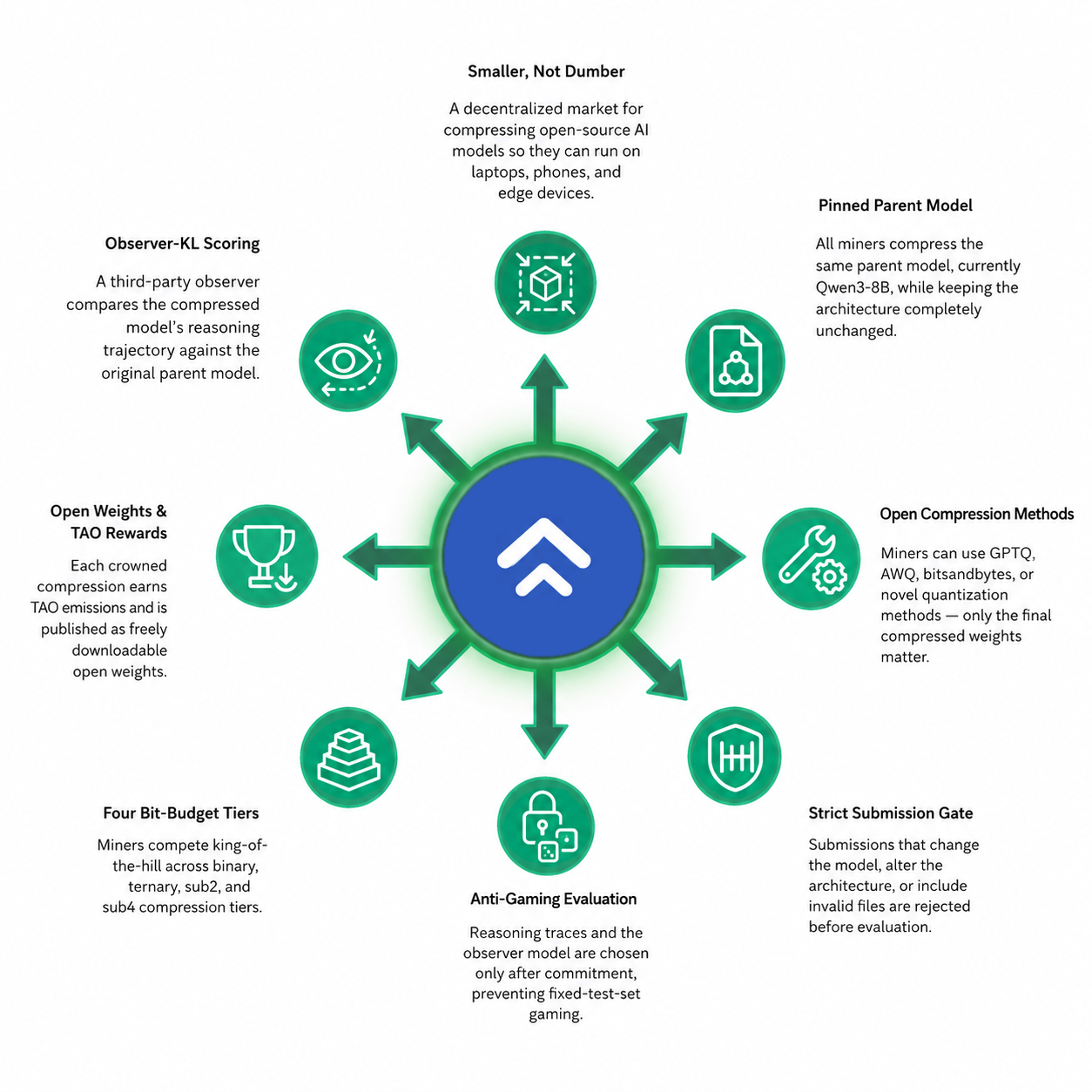
The subnet maintains a single pinned parent model — currently Qwen/Qwen3-8B at 16.38 GB in full precision — and opens it as a continuous compression bounty. Miners use any quantisation or compression technique they choose (GPTQ, AWQ, bitsandbytes, or novel methods of their own invention) to produce a compressed version of that model. The subnet never inspects how the compression was achieved, only what was produced. Submissions that change the architecture, swap the model, or ship non-weight files are rejected at the gate before any weights ever load.
Scoring is handled by a mechanism called Observer-KL. Both the miner’s compressed model and the original parent independently continue the same reasoning trajectory. A third, independent observer model reads both continuations and scores how closely the compressed model moved it to the same predictive state as the parent did. Which reasoning traces are scored, and which observer model acts as grader, are determined by a chain value that does not exist until after the miner has already committed their submission — meaning there is no fixed test set to game and no grader that can be known or optimised for in advance. The results aggregate the worst slice across languages and contexts, so a strong performance in one area cannot compensate for a weak one elsewhere.
The competition is organised as king-of-the-hill across four bit-budget tiers: binary (≤1.15 bits per weight, ~1.18 GB), ternary (≤1.75 bits per weight, ~1.79 GB), sub2 (≤2.0 bits per weight, ~2.05 GB), and sub4 (≤4.0 bits per weight, ~4.10 GB). The current crown-holder in each tier earns TAO emissions. A new miner must beat the reigning king by a margin that clears the statistically measured noise floor — preventing fraudulent or noisy claims from displacing a genuine best. Every crowned compression is published as freely downloadable open weights, not merely a leaderboard position.
Before v2, Ralph operated as a training recipe improvement subnet (v1), where miners proposed patches to a shared canonical training recipe and the network evaluated whether a change — a new learning-rate schedule, data mix, or initialisation scheme — improved the resulting model. That version produced Ralph-1, a 254M-parameter reference model trained on FineWeb-Edu. The v1 protocol was archived in August 2026 when RalphLabs pivoted the subnet toward compression, recognising that the more immediate gap in open AI development is not between the best model and the second-best, but between the best model and the one people can actually run.
Ralph is Bittensor Subnet 40 (netuid 40), operated by RalphLabs AI. Its core mission is to run a standing, decentralised market for compressing open-source AI models — making powerful language models small enough to run on laptops, phones, and edge devices, without sacrificing what makes them useful. The key principle is captured in the project’s tagline: smaller, not dumber. A compressed Ralph model is not a new model trained to imitate a larger one — it is the exact same model, stored in fewer bits, with the architecture completely unchanged.
The subnet maintains a single pinned parent model — currently Qwen/Qwen3-8B at 16.38 GB in full precision — and opens it as a continuous compression bounty. Miners use any quantisation or compression technique they choose (GPTQ, AWQ, bitsandbytes, or novel methods of their own invention) to produce a compressed version of that model. The subnet never inspects how the compression was achieved, only what was produced. Submissions that change the architecture, swap the model, or ship non-weight files are rejected at the gate before any weights ever load.
Scoring is handled by a mechanism called Observer-KL. Both the miner’s compressed model and the original parent independently continue the same reasoning trajectory. A third, independent observer model reads both continuations and scores how closely the compressed model moved it to the same predictive state as the parent did. Which reasoning traces are scored, and which observer model acts as grader, are determined by a chain value that does not exist until after the miner has already committed their submission — meaning there is no fixed test set to game and no grader that can be known or optimised for in advance. The results aggregate the worst slice across languages and contexts, so a strong performance in one area cannot compensate for a weak one elsewhere.
The competition is organised as king-of-the-hill across four bit-budget tiers: binary (≤1.15 bits per weight, ~1.18 GB), ternary (≤1.75 bits per weight, ~1.79 GB), sub2 (≤2.0 bits per weight, ~2.05 GB), and sub4 (≤4.0 bits per weight, ~4.10 GB). The current crown-holder in each tier earns TAO emissions. A new miner must beat the reigning king by a margin that clears the statistically measured noise floor — preventing fraudulent or noisy claims from displacing a genuine best. Every crowned compression is published as freely downloadable open weights, not merely a leaderboard position.
Before v2, Ralph operated as a training recipe improvement subnet (v1), where miners proposed patches to a shared canonical training recipe and the network evaluated whether a change — a new learning-rate schedule, data mix, or initialisation scheme — improved the resulting model. That version produced Ralph-1, a 254M-parameter reference model trained on FineWeb-Edu. The v1 protocol was archived in August 2026 when RalphLabs pivoted the subnet toward compression, recognising that the more immediate gap in open AI development is not between the best model and the second-best, but between the best model and the one people can actually run.
The product Ralph ships is simple and concrete: the best publicly available compressed version of each pinned open-source model, at each bit tier, freely downloadable by anyone. Where traditional research labs compress a model once and publish a paper, Ralph does it continuously — a standing market that always reflects the current frontier of compression research, with the results immediately available as usable weights rather than academic descriptions of a method.
The target audience is anyone who wants to run a capable large language model on hardware they already own. A Qwen3-8B model at full precision requires 16.38 GB of memory, putting it out of reach for most consumer devices. The same model at ternary precision fits in under 1.8 GB. The architecture is unchanged, so the model behaves as expected — it is not a distilled surrogate trained to approximate the original; it is the original, stored more efficiently. This distinction matters practically: users get the reasoning capabilities and instruction-following behaviour of the parent model, not a smaller model that happens to produce similar-looking output.
On the technical side, the subnet is built around a commit-reveal submission protocol. Before a round exists, a miner commits a cryptographic hash of their exact compressed weights to the Bittensor chain. When the round opens and the scoring nonce is drawn, the miner reveals their weights. Six sequential gates verify the submission: economics (registration and bonding), safety (no executable code or pickle files), tier fit (parameter count and dtype consistency), bit budget (bits-per-weight measured from tensor data, not from file headers), pinned parent (architecture and weight-count must match Qwen3-8B exactly), and commit-reveal integrity. Only submissions that pass all six gates reach the scoring stage. This sealed-bid architecture means there is no advantage to waiting and copying a competitor’s approach at the last moment.
Validators run GPU-backed scoring, but the audit trail is designed so that anyone — including participants without a GPU — can independently verify any published crown. The audit system runs at four levels of cost: arithmetic-only verification (no models required), re-deriving the exam items from the round nonce, re-deriving the observer’s grades, and fully binding a published result to the model checkpoints. An auditor that skips expensive verification steps reports the result as incomplete rather than verified, so there is no way to claim a round is confirmed by running only the cheap half. This makes the compression marketplace not just open, but independently auditable — a property most AI benchmarks and leaderboards cannot claim.
The economic design discourages gaming at scale. Each registered coldkey receives one free evaluation per round; additional submissions require a bond that is only refunded if the miner improves on their own previous best. This makes best-of-N crown-farming unprofitable, while keeping honest iteration affordable. Miners who discover genuinely better compression methods benefit immediately from TAO emissions proportional to their performance margin over the incumbent — creating a direct financial incentive to advance the state of the art in open model compression.
The product Ralph ships is simple and concrete: the best publicly available compressed version of each pinned open-source model, at each bit tier, freely downloadable by anyone. Where traditional research labs compress a model once and publish a paper, Ralph does it continuously — a standing market that always reflects the current frontier of compression research, with the results immediately available as usable weights rather than academic descriptions of a method.
The target audience is anyone who wants to run a capable large language model on hardware they already own. A Qwen3-8B model at full precision requires 16.38 GB of memory, putting it out of reach for most consumer devices. The same model at ternary precision fits in under 1.8 GB. The architecture is unchanged, so the model behaves as expected — it is not a distilled surrogate trained to approximate the original; it is the original, stored more efficiently. This distinction matters practically: users get the reasoning capabilities and instruction-following behaviour of the parent model, not a smaller model that happens to produce similar-looking output.
On the technical side, the subnet is built around a commit-reveal submission protocol. Before a round exists, a miner commits a cryptographic hash of their exact compressed weights to the Bittensor chain. When the round opens and the scoring nonce is drawn, the miner reveals their weights. Six sequential gates verify the submission: economics (registration and bonding), safety (no executable code or pickle files), tier fit (parameter count and dtype consistency), bit budget (bits-per-weight measured from tensor data, not from file headers), pinned parent (architecture and weight-count must match Qwen3-8B exactly), and commit-reveal integrity. Only submissions that pass all six gates reach the scoring stage. This sealed-bid architecture means there is no advantage to waiting and copying a competitor’s approach at the last moment.
Validators run GPU-backed scoring, but the audit trail is designed so that anyone — including participants without a GPU — can independently verify any published crown. The audit system runs at four levels of cost: arithmetic-only verification (no models required), re-deriving the exam items from the round nonce, re-deriving the observer’s grades, and fully binding a published result to the model checkpoints. An auditor that skips expensive verification steps reports the result as incomplete rather than verified, so there is no way to claim a round is confirmed by running only the cheap half. This makes the compression marketplace not just open, but independently auditable — a property most AI benchmarks and leaderboards cannot claim.
The economic design discourages gaming at scale. Each registered coldkey receives one free evaluation per round; additional submissions require a bond that is only refunded if the miner improves on their own previous best. This makes best-of-N crown-farming unprofitable, while keeping honest iteration affordable. Miners who discover genuinely better compression methods benefit immediately from TAO emissions proportional to their performance margin over the incumbent — creating a direct financial incentive to advance the state of the art in open model compression.
Ralph is built and operated by RalphLabs AI, a team that has not publicly disclosed the names of its founders or individual members. What is evident from the project’s public output is that the team has deep expertise across machine learning research, distributed systems, and cryptographic protocol design. They have authored a formal technical whitepaper (v1.3), implemented NVIDIA Confidential Computing attestation using TDX and nvtrust for hardware-level execution proofs, and built a multi-tier auditing framework capable of independently verifying scoring results without access to a GPU. The team also caught and reverted two fraudulent crowns on the public record during v1 operation — demonstrating both active maintenance and a willingness to be transparent about failures.
RalphLabs AI operates under the GitHub organisation RalphLabsAI and communicates publicly through their Twitter/X account at @RalphLabsAI. The project has been active on Bittensor mainnet since at least 2025, progressing through a staged development roadmap before pivoting the subnet’s core mission in August 2026. The team’s writing — across the whitepaper, GitHub documentation, and social media announcements — reflects careful thinking about mechanism design, economic incentives, and the specific failure modes of decentralised AI benchmarks. No external investors or advisors have been publicly disclosed at this time.
Ralph is built and operated by RalphLabs AI, a team that has not publicly disclosed the names of its founders or individual members. What is evident from the project’s public output is that the team has deep expertise across machine learning research, distributed systems, and cryptographic protocol design. They have authored a formal technical whitepaper (v1.3), implemented NVIDIA Confidential Computing attestation using TDX and nvtrust for hardware-level execution proofs, and built a multi-tier auditing framework capable of independently verifying scoring results without access to a GPU. The team also caught and reverted two fraudulent crowns on the public record during v1 operation — demonstrating both active maintenance and a willingness to be transparent about failures.
RalphLabs AI operates under the GitHub organisation RalphLabsAI and communicates publicly through their Twitter/X account at @RalphLabsAI. The project has been active on Bittensor mainnet since at least 2025, progressing through a staged development roadmap before pivoting the subnet’s core mission in August 2026. The team’s writing — across the whitepaper, GitHub documentation, and social media announcements — reflects careful thinking about mechanism design, economic incentives, and the specific failure modes of decentralised AI benchmarks. No external investors or advisors have been publicly disclosed at this time.
As of August 2026, Ralph v2 has completed its mechanism build and initial real-GPU validation. The protocol spec is fully implemented, 57 tests pass on CPU with no GPU required, and a real round record has been published from experiments on H100 PCIe, A100 SXM4, and L40S hardware. The immediate next milestones are the first live round with real third-party miners submitting compressed weights, and the first miner participation beyond the team’s own testing environment. These represent the transition from a validated protocol to an active competitive network.
Beyond the initial live rounds, the roadmap includes expanding the pinned parent model beyond Qwen3-8B — a change described as a configuration update rather than a fundamental protocol change, though it has not yet been run in production. Larger parent models would enable more meaningful compression targets and attract miners with access to higher-end GPU resources. The team has also pre-registered a transfer-credibility test — frozen analysis with pinned reference models — to publicly answer whether performance improvements at smaller scale reliably predict improvements at larger scale. Results will be published either way.
Ralph is an early-stage subnet in active development. The compression market mechanism is novel within the Bittensor ecosystem, and the roadmap will likely evolve as the first miners engage and real competition begins. The underlying design — a continuously-running compression bounty with open published weights — positions Ralph to become the canonical source for optimised community versions of major open-source models as the subnet scales.
As of August 2026, Ralph v2 has completed its mechanism build and initial real-GPU validation. The protocol spec is fully implemented, 57 tests pass on CPU with no GPU required, and a real round record has been published from experiments on H100 PCIe, A100 SXM4, and L40S hardware. The immediate next milestones are the first live round with real third-party miners submitting compressed weights, and the first miner participation beyond the team’s own testing environment. These represent the transition from a validated protocol to an active competitive network.
Beyond the initial live rounds, the roadmap includes expanding the pinned parent model beyond Qwen3-8B — a change described as a configuration update rather than a fundamental protocol change, though it has not yet been run in production. Larger parent models would enable more meaningful compression targets and attract miners with access to higher-end GPU resources. The team has also pre-registered a transfer-credibility test — frozen analysis with pinned reference models — to publicly answer whether performance improvements at smaller scale reliably predict improvements at larger scale. Results will be published either way.
Ralph is an early-stage subnet in active development. The compression market mechanism is novel within the Bittensor ecosystem, and the roadmap will likely evolve as the first miners engage and real competition begins. The underlying design — a continuously-running compression bounty with open published weights — positions Ralph to become the canonical source for optimised community versions of major open-source models as the subnet scales.