With the amount of new subnets being added it can be hard to get up to date information across all subnets, so data may be slightly out of date from time to time

Subnet 41

Almanac

Alpha Price
Value
Market Cap
Value
Neurons
Value
Registration Cost
Value
TAO Liquidity
Value
Alpha in Pool
Value
Total Alpha Supply
Value
% Alpha Staked
Value

ABOUT

What exactly does it do?

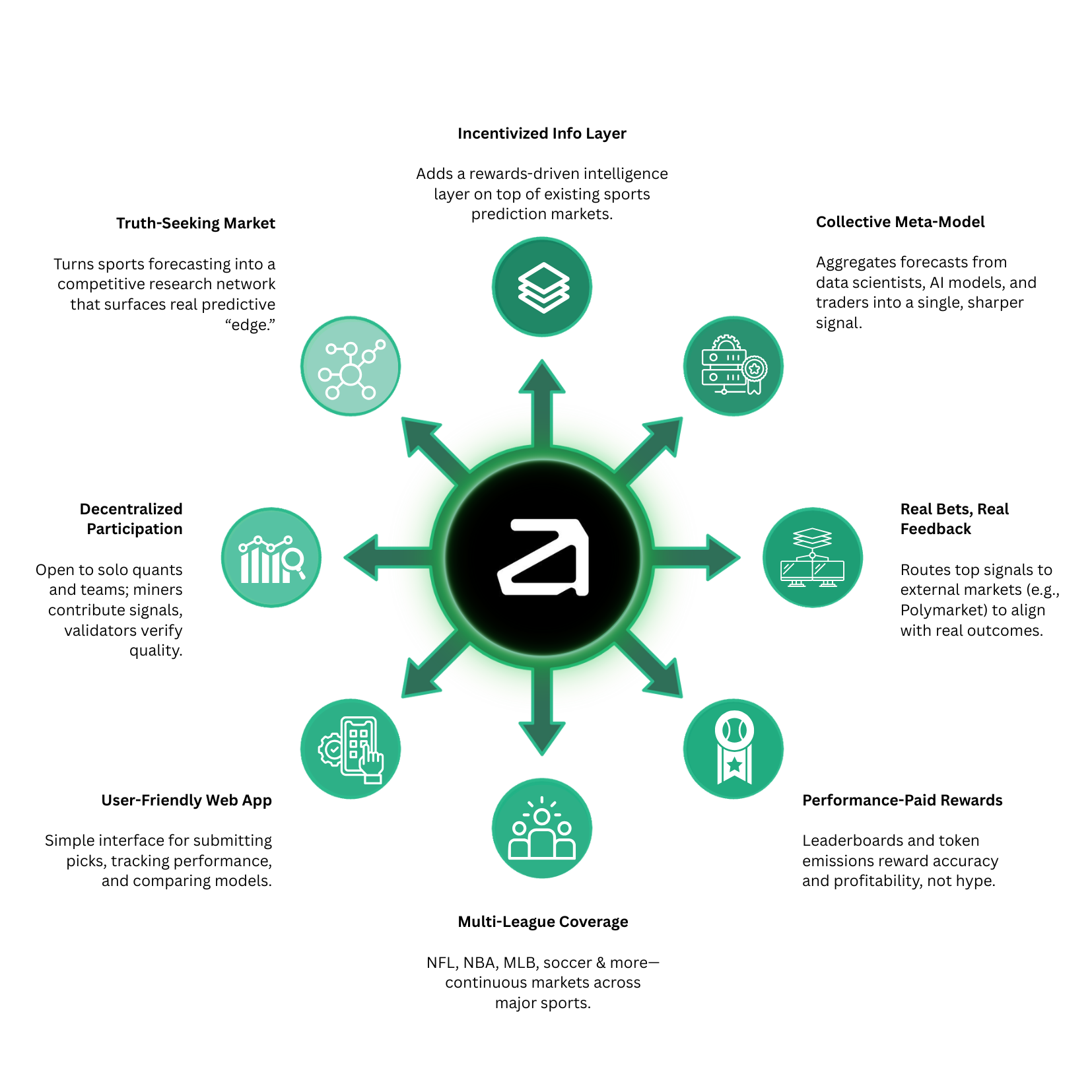
Almanac (Subnet-41) is a decentralized AI-driven platform for sports prediction markets. It acts as an “incentivized information layer” on top of existing prediction markets, starting with sports betting outcomes. In practice, Almanac enables data scientists, AI models, and skilled traders to trade on their insights about sports events, and rewards them for accuracy and profitability. By aggregating many independent forecasts into a single meta-model, the system harnesses collective intelligence to produce more accurate predictions than any single model alone. These high-quality prediction signals are then used to place real bets in external markets (via Polymarket), aligning the Bittensor network’s intelligence with real-world outcomes. Overall, Almanac’s mission is to improve market accuracy and uncover predictive “edge” by aligning incentives with superior research and modeling.

In simpler terms, Almanac turns sports forecasting into a competitive, reward-driven network. It provides a user-friendly web interface where participants (“miners” in Bittensor terms) compete to make the best predictions on games (NFL, NBA, MLB, soccer, etc.). Those who consistently beat the odds climb a leaderboard and earn token rewards, on top of any profits from the bets themselves. This approach democratizes advanced sports analytics – instead of predictions being dominated by a few firms, Almanac opens it up to a decentralized community of AI enthusiasts and traders. In doing so, it bridges Bittensor’s decentralized AI network with the real-world sports betting markets (through its Polymarket integration) to create a truth-seeking market for information.

Almanac (Subnet-41) is a decentralized AI-driven platform for sports prediction markets. It acts as an “incentivized information layer” on top of existing prediction markets, starting with sports betting outcomes. In practice, Almanac enables data scientists, AI models, and skilled traders to trade on their insights about sports events, and rewards them for accuracy and profitability. By aggregating many independent forecasts into a single meta-model, the system harnesses collective intelligence to produce more accurate predictions than any single model alone. These high-quality prediction signals are then used to place real bets in external markets (via Polymarket), aligning the Bittensor network’s intelligence with real-world outcomes. Overall, Almanac’s mission is to improve market accuracy and uncover predictive “edge” by aligning incentives with superior research and modeling.

In simpler terms, Almanac turns sports forecasting into a competitive, reward-driven network. It provides a user-friendly web interface where participants (“miners” in Bittensor terms) compete to make the best predictions on games (NFL, NBA, MLB, soccer, etc.). Those who consistently beat the odds climb a leaderboard and earn token rewards, on top of any profits from the bets themselves. This approach democratizes advanced sports analytics – instead of predictions being dominated by a few firms, Almanac opens it up to a decentralized community of AI enthusiasts and traders. In doing so, it bridges Bittensor’s decentralized AI network with the real-world sports betting markets (through its Polymarket integration) to create a truth-seeking market for information.

PURPOSE

What exactly is the 'product/build'?

Almanac is the front-end application built by the Sportstensor team to realize this vision. The product is essentially a prediction market terminal where users can trade on sports outcomes via a clean interface, without needing to understand the underlying Bittensor mechanics. On the back-end, Almanac is tightly integrated with Polymarket (a popular blockchain prediction market) as its trading engine – every bet placed through Almanac is actually routed to Polymarket’s order books in the background. This gives Almanac users access to real liquidity and markets, while the Almanac system can track and evaluate each trade as a prediction signal.

Here’s how it works: Participants (who may be independent developers running AI models or manual traders) sign up on the Almanac web app and link it to their Bittensor subnet account. These participants act as “miners” on Subnet-41. When a miner has a prediction about, say, an upcoming game, they place a trade through Almanac (e.g. buying shares on Polymarket for a team winning). Almanac uses a smart proxy wallet to execute that trade on Polymarket’s platform, so the bet is live in the real market. At the same time, the details of that trade (the odds, outcome, profit/loss, timing, etc.) are recorded by the Subnet-41 validators. Once the game is over and the outcome known, the system treats the trade as a scored prediction:

Scoring & Rewards: Almanac implements a sophisticated two-phase optimization algorithm to score all miners’ predictions over rolling 24-hour epochs. It computes each trader’s ROI (return on investment) and qualified volume (amount wagered on winning trades) over the past month. Only traders who meet certain performance gates – e.g. a minimum ROI and activity level – are deemed eligible for rewards. The system then optimizes reward distribution in two steps: first maximizing the total profitable volume funded within a fixed token budget, then adjusting to favor higher-ROI traders. Finally, it converts these scores into weights and allocates the subnet’s native token (“Alpha” SN41) to the top-performing miners proportionally. This process repeats each epoch, continually learning who the best signal providers are.

Miner and Validator Roles: A miner in this context is anyone generating prediction signals by trading via the Almanac app. The performance is model-agnostic – miners can use AI models, statistical methods, or expert knowledge; only results matter. Validators run the off-chain scoring process: at each epoch they pull the latest trading data from Almanac’s backend, run the scoring algorithm, and then write the updated weightings (i.e. each miner’s share of upcoming token emissions) onto the Bittensor blockchain. In effect, validators ensure the reward mechanism is executed fairly and transparently according to the rules in code.

This product architecture marries a web2-like user experience (a slick betting interface) with a web3 backend (Bittensor’s decentralized incentive network and Polymarket’s decentralized market liquidity). Key technical features of Almanac’s build include:

Dual-Pool Scoring: The system maintains separate consideration for registered Bittensor miners versus general traders using the platform, ensuring fairness and that outsiders can participate without bias.

Performance Gating: Only profitable and active predictors qualify for token rewards – unprofitable “noise” contributions simply don’t get rewarded, preventing dilution of the reward pool. (Earlier iterations of Sportstensor rewarded all miners somewhat, but Almanac’s new “anti-dilutive flywheel” rewards only proven winning signals, burning or recycling the rest of emissions.)

Recent Performance Emphasis: A volume decay factor weights recent trades more heavily than older ones, so the scoring is responsive to current performance.

Smooth Transitions: Constraints are in place to prevent sudden swings in rewards (no single trader can dominate overnight), maintaining stability as models improve or new entrants join.

Budget Management: The token emission is capped to a budget, and the algorithm optimally spreads that budget among the qualified signals each epoch so that total payouts never exceed the allocated budget.

Transparency and Auditability: All prediction outcomes are logged on-chain (or via validators) and a leaderboard in the app lets everyone see which strategies are performing best, promoting competition and accountability.

Monetization and Tokenomics: The native token of Subnet-41 is often called the “Alpha” token (SN41). Miners earn these tokens as described above, effectively converting their prediction skill into cryptocurrency. The project has also introduced a clever revenue model to support token value: Almanac takes a 1% fee on all winning trades placed through the platform. Instead of pocketing this fee as profit, Almanac uses that revenue to buy back its SN41 tokens on the open market (and potentially burn them), creating buy pressure and value support for the token. In other words, as Almanac’s user base grows and more winning bets flow through it, the subnet’s token holders benefit directly from that success (making it one of the first Bittensor subnets where a product’s revenue feeds back into miner incentives and token value). This aligns the economic interests of traders, token holders, and the platform itself towards producing genuinely accurate predictions.

 

Almanac is the front-end application built by the Sportstensor team to realize this vision. The product is essentially a prediction market terminal where users can trade on sports outcomes via a clean interface, without needing to understand the underlying Bittensor mechanics. On the back-end, Almanac is tightly integrated with Polymarket (a popular blockchain prediction market) as its trading engine – every bet placed through Almanac is actually routed to Polymarket’s order books in the background. This gives Almanac users access to real liquidity and markets, while the Almanac system can track and evaluate each trade as a prediction signal.

Here’s how it works: Participants (who may be independent developers running AI models or manual traders) sign up on the Almanac web app and link it to their Bittensor subnet account. These participants act as “miners” on Subnet-41. When a miner has a prediction about, say, an upcoming game, they place a trade through Almanac (e.g. buying shares on Polymarket for a team winning). Almanac uses a smart proxy wallet to execute that trade on Polymarket’s platform, so the bet is live in the real market. At the same time, the details of that trade (the odds, outcome, profit/loss, timing, etc.) are recorded by the Subnet-41 validators. Once the game is over and the outcome known, the system treats the trade as a scored prediction:

Scoring & Rewards: Almanac implements a sophisticated two-phase optimization algorithm to score all miners’ predictions over rolling 24-hour epochs. It computes each trader’s ROI (return on investment) and qualified volume (amount wagered on winning trades) over the past month. Only traders who meet certain performance gates – e.g. a minimum ROI and activity level – are deemed eligible for rewards. The system then optimizes reward distribution in two steps: first maximizing the total profitable volume funded within a fixed token budget, then adjusting to favor higher-ROI traders. Finally, it converts these scores into weights and allocates the subnet’s native token (“Alpha” SN41) to the top-performing miners proportionally. This process repeats each epoch, continually learning who the best signal providers are.

Miner and Validator Roles: A miner in this context is anyone generating prediction signals by trading via the Almanac app. The performance is model-agnostic – miners can use AI models, statistical methods, or expert knowledge; only results matter. Validators run the off-chain scoring process: at each epoch they pull the latest trading data from Almanac’s backend, run the scoring algorithm, and then write the updated weightings (i.e. each miner’s share of upcoming token emissions) onto the Bittensor blockchain. In effect, validators ensure the reward mechanism is executed fairly and transparently according to the rules in code.

This product architecture marries a web2-like user experience (a slick betting interface) with a web3 backend (Bittensor’s decentralized incentive network and Polymarket’s decentralized market liquidity). Key technical features of Almanac’s build include:

Dual-Pool Scoring: The system maintains separate consideration for registered Bittensor miners versus general traders using the platform, ensuring fairness and that outsiders can participate without bias.

Performance Gating: Only profitable and active predictors qualify for token rewards – unprofitable “noise” contributions simply don’t get rewarded, preventing dilution of the reward pool. (Earlier iterations of Sportstensor rewarded all miners somewhat, but Almanac’s new “anti-dilutive flywheel” rewards only proven winning signals, burning or recycling the rest of emissions.)

Recent Performance Emphasis: A volume decay factor weights recent trades more heavily than older ones, so the scoring is responsive to current performance.

Smooth Transitions: Constraints are in place to prevent sudden swings in rewards (no single trader can dominate overnight), maintaining stability as models improve or new entrants join.

Budget Management: The token emission is capped to a budget, and the algorithm optimally spreads that budget among the qualified signals each epoch so that total payouts never exceed the allocated budget.

Transparency and Auditability: All prediction outcomes are logged on-chain (or via validators) and a leaderboard in the app lets everyone see which strategies are performing best, promoting competition and accountability.

Monetization and Tokenomics: The native token of Subnet-41 is often called the “Alpha” token (SN41). Miners earn these tokens as described above, effectively converting their prediction skill into cryptocurrency. The project has also introduced a clever revenue model to support token value: Almanac takes a 1% fee on all winning trades placed through the platform. Instead of pocketing this fee as profit, Almanac uses that revenue to buy back its SN41 tokens on the open market (and potentially burn them), creating buy pressure and value support for the token. In other words, as Almanac’s user base grows and more winning bets flow through it, the subnet’s token holders benefit directly from that success (making it one of the first Bittensor subnets where a product’s revenue feeds back into miner incentives and token value). This aligns the economic interests of traders, token holders, and the platform itself towards producing genuinely accurate predictions.


WHO

Team Info

Almanac was founded by Leo Lucian, who leads the project’s development and vision. Working alongside him is Stephen (known by the handle “Neuromancer”), another core team member instrumental in designing the network’s architecture and incentive mechanisms. As of late 2025 the core team is small (around 5 people), reflecting a lean startup-style operation.

The project also benefits from a broader community of contributors and partners. Notably, Sportstensor partnered with the Polymarket team early on to integrate Almanac with a leading prediction market platform. Community developers have contributed to specialized aspects like the computer vision pipelines for sports data and code improvements in the open-source repository (contributors with handles like xzistance, conidig, Cardoso-topdev have been acknowledged for their code commits). This blend of a focused core team with community support has enabled Almanac to progress rapidly in a short time. While individual profiles of the team are not extensively public, the vision and execution (from research reports to partnership announcements) suggest a capable team combining expertise in AI modeling (for sports) and blockchain development. Their work earned a spotlight in an April 2025 Grayscale/FS Insight report on Bittensor, which highlighted Sportstensor as a promising project in the decentralized AI ecosystem.

Almanac was founded by Leo Lucian, who leads the project’s development and vision. Working alongside him is Stephen (known by the handle “Neuromancer”), another core team member instrumental in designing the network’s architecture and incentive mechanisms. As of late 2025 the core team is small (around 5 people), reflecting a lean startup-style operation.

The project also benefits from a broader community of contributors and partners. Notably, Sportstensor partnered with the Polymarket team early on to integrate Almanac with a leading prediction market platform. Community developers have contributed to specialized aspects like the computer vision pipelines for sports data and code improvements in the open-source repository (contributors with handles like xzistance, conidig, Cardoso-topdev have been acknowledged for their code commits). This blend of a focused core team with community support has enabled Almanac to progress rapidly in a short time. While individual profiles of the team are not extensively public, the vision and execution (from research reports to partnership announcements) suggest a capable team combining expertise in AI modeling (for sports) and blockchain development. Their work earned a spotlight in an April 2025 Grayscale/FS Insight report on Bittensor, which highlighted Sportstensor as a promising project in the decentralized AI ecosystem.

FUTURE

Roadmap

Almanac’s journey from a concept to a live product can be traced through several phases, and its future plans aim to extend its capabilities beyond sports. Below is an overview of key milestones and roadmap items for Subnet-41 (Almanac):

Q3 2024 – Foundation: Sportstensor (Subnet-41) launched on Bittensor’s testnet (#172) and then the main subnet, focusing initially on building baseline predictive models for Major League Soccer (MLS) and Major League Baseball (MLB). This phase established the core machine learning models and data pipelines for the network and saw the launch of the project’s website and community presence.

Q4 2024 – Incentive Upgrade: The team overhauled the incentive mechanism (rollout of “Incentive v2” in October 2024) to introduce key features like league-specific commitments and a new scoring system based on “closing line” value. These upgrades improved how miner predictions were evaluated against market odds. During this expansion phase, development also began on the Almanac front-end interface (internally) and the project started forming partnerships. By the end of 2024, Sportstensor was preparing to expand beyond the initial sports – with eyes on basketball and American football seasons – and refining its models for higher accuracy.

Q1 2025 – Expansion and Early Success: Sportstensor added coverage for additional major leagues such as the NBA (basketball) and NFL (American football), providing year-round sports prediction opportunities. The project also explored niche areas like e-sports and UFC to test its approach on new domains. In February 2025, the subnet demonstrated real trading success – its treasury models earned ~$17,842 in profit that month, a 178% monthly return on capital, which was reinvested into the SN41 token to bolster the network’s value. This period proved the concept that the collective intelligence could beat the market by a significant margin. The user-facing Almanac app was being readied for launch (to monetize these predictions via a friendly UI) and plans were made to offer API access to the predictive insights for outside developers or partners.

April 2025 – Recognition: The project gained institutional recognition by being featured in “Bittensor: The Internet of AI,” a research report published by Grayscale and FS Insight. This highlighted Sportstensor/Almanac as a pioneering example of real-world utility in the Bittensor ecosystem, validating its approach to investors and the broader AI community.

September 2025 – Refinement & Partnership: Continuing its rapid development, Sportstensor introduced “Incentive Mechanism v2.5 – Sortino” on September 11, 2025. This update integrated advanced metrics like the Sortino Ratio and PnL-based calculations to better reward consistent, risk-adjusted performance (penalizing risky swings and rewarding stable gains). Just days later, on September 14, 2025, the team announced a major strategic partnership with Polymarket, one of the largest decentralized prediction market platforms. Through this partnership, Almanac became a layer on top of Polymarket – bringing deeper liquidity and real-money market infrastructure to Subnet-41, and in return providing Polymarket with enhanced predictive signals and volume. This was a pivotal step that set the stage for Almanac’s product launch.

Late 2025 – Almanac Beta Launch: By the end of 2025, Subnet-41 rebranded itself around its core product, Almanac, reflecting the shift from a research project (Sportstensor) to a user-facing platform. The Almanac open beta went live in early December 2025, inviting traders (including those outside the Bittensor community) to test the platform. The user experience was emphasized – the interface abstracts away the complexity of the Bittensor network, offering a familiar trading dashboard where users can place bets and see leaderboards. This marked the transition from “promises to products”. Additionally, the $ALPHA (SN41) token economics were fully tied in: product revenues (from the 1% winning trade fee) now loop back to token buybacks, creating one of the first direct links between a Bittensor subnet’s real-world revenue and its incentive model.

Future (2026 and Beyond) – Beyond Sports: Almanac’s broader vision is to evolve into a general information discovery engine, not limited to sports. The team hints at expanding into e-sports (with a partnership with data provider Grid for games like Counter-Strike and League of Legends), finance (e.g. commodity price forecasts for hedge funds), and geopolitics (risk prediction for investment and policy use). Essentially, any domain where superior predictive insight is valued could be integrated into Almanac’s platform. To facilitate this, planned developments include a proprietary LLM-powered chatbot that can provide conversational analytics based on miner predictions (making the insights more accessible to end users). The team is also exploring more traditional avenues, such as possibly launching a hedge fund or managed fund that trades on Almanac’s aggregated signals (allowing large capital to systematically profit from the collective intelligence). These future initiatives, combined with continuous improvements to the core models and data pipelines (e.g. advanced computer vision for sports data, as noted in late 2025 updates), form the roadmap ahead. The overarching goal is for Almanac to become a blueprint for real-world AI integration in Bittensor – proving that a decentralized network can consistently beat market odds and deliver value in various industries.

Each step of this roadmap builds on the previous, steadily transforming Almanac from a niche sports AI experiment into a scalable platform for monetizing collective intelligence at scale. The progress to date and the planned trajectory suggest that Subnet-41 (Almanac) could pioneer a new class of prediction markets where truth-seeking is financially rewarded, benefiting both participants and the industries leveraging those insights.


Almanac’s journey from a concept to a live product can be traced through several phases, and its future plans aim to extend its capabilities beyond sports. Below is an overview of key milestones and roadmap items for Subnet-41 (Almanac):

Q3 2024 – Foundation: Sportstensor (Subnet-41) launched on Bittensor’s testnet (#172) and then the main subnet, focusing initially on building baseline predictive models for Major League Soccer (MLS) and Major League Baseball (MLB). This phase established the core machine learning models and data pipelines for the network and saw the launch of the project’s website and community presence.

Q4 2024 – Incentive Upgrade: The team overhauled the incentive mechanism (rollout of “Incentive v2” in October 2024) to introduce key features like league-specific commitments and a new scoring system based on “closing line” value. These upgrades improved how miner predictions were evaluated against market odds. During this expansion phase, development also began on the Almanac front-end interface (internally) and the project started forming partnerships. By the end of 2024, Sportstensor was preparing to expand beyond the initial sports – with eyes on basketball and American football seasons – and refining its models for higher accuracy.

Q1 2025 – Expansion and Early Success: Sportstensor added coverage for additional major leagues such as the NBA (basketball) and NFL (American football), providing year-round sports prediction opportunities. The project also explored niche areas like e-sports and UFC to test its approach on new domains. In February 2025, the subnet demonstrated real trading success – its treasury models earned ~$17,842 in profit that month, a 178% monthly return on capital, which was reinvested into the SN41 token to bolster the network’s value. This period proved the concept that the collective intelligence could beat the market by a significant margin. The user-facing Almanac app was being readied for launch (to monetize these predictions via a friendly UI) and plans were made to offer API access to the predictive insights for outside developers or partners.

April 2025 – Recognition: The project gained institutional recognition by being featured in “Bittensor: The Internet of AI,” a research report published by Grayscale and FS Insight. This highlighted Sportstensor/Almanac as a pioneering example of real-world utility in the Bittensor ecosystem, validating its approach to investors and the broader AI community.

September 2025 – Refinement & Partnership: Continuing its rapid development, Sportstensor introduced “Incentive Mechanism v2.5 – Sortino” on September 11, 2025. This update integrated advanced metrics like the Sortino Ratio and PnL-based calculations to better reward consistent, risk-adjusted performance (penalizing risky swings and rewarding stable gains). Just days later, on September 14, 2025, the team announced a major strategic partnership with Polymarket, one of the largest decentralized prediction market platforms. Through this partnership, Almanac became a layer on top of Polymarket – bringing deeper liquidity and real-money market infrastructure to Subnet-41, and in return providing Polymarket with enhanced predictive signals and volume. This was a pivotal step that set the stage for Almanac’s product launch.

Late 2025 – Almanac Beta Launch: By the end of 2025, Subnet-41 rebranded itself around its core product, Almanac, reflecting the shift from a research project (Sportstensor) to a user-facing platform. The Almanac open beta went live in early December 2025, inviting traders (including those outside the Bittensor community) to test the platform. The user experience was emphasized – the interface abstracts away the complexity of the Bittensor network, offering a familiar trading dashboard where users can place bets and see leaderboards. This marked the transition from “promises to products”. Additionally, the $ALPHA (SN41) token economics were fully tied in: product revenues (from the 1% winning trade fee) now loop back to token buybacks, creating one of the first direct links between a Bittensor subnet’s real-world revenue and its incentive model.

Future (2026 and Beyond) – Beyond Sports: Almanac’s broader vision is to evolve into a general information discovery engine, not limited to sports. The team hints at expanding into e-sports (with a partnership with data provider Grid for games like Counter-Strike and League of Legends), finance (e.g. commodity price forecasts for hedge funds), and geopolitics (risk prediction for investment and policy use). Essentially, any domain where superior predictive insight is valued could be integrated into Almanac’s platform. To facilitate this, planned developments include a proprietary LLM-powered chatbot that can provide conversational analytics based on miner predictions (making the insights more accessible to end users). The team is also exploring more traditional avenues, such as possibly launching a hedge fund or managed fund that trades on Almanac’s aggregated signals (allowing large capital to systematically profit from the collective intelligence). These future initiatives, combined with continuous improvements to the core models and data pipelines (e.g. advanced computer vision for sports data, as noted in late 2025 updates), form the roadmap ahead. The overarching goal is for Almanac to become a blueprint for real-world AI integration in Bittensor – proving that a decentralized network can consistently beat market odds and deliver value in various industries.

Each step of this roadmap builds on the previous, steadily transforming Almanac from a niche sports AI experiment into a scalable platform for monetizing collective intelligence at scale. The progress to date and the planned trajectory suggest that Subnet-41 (Almanac) could pioneer a new class of prediction markets where truth-seeking is financially rewarded, benefiting both participants and the industries leveraging those insights.


NEWS

Announcements

Load More