With the amount of new subnets being added it can be hard to get up to date information across all subnets, so data may be slightly out of date from time to time

Subnet 108

Prometheon

Alpha Price
Value
Market Cap
Value
Neurons
Value
Registration Cost
Value
TAO Liquidity
Value
Alpha in Pool
Value
Total Alpha Supply
Value
% Alpha Staked
Value

ABOUT

What exactly does it do?

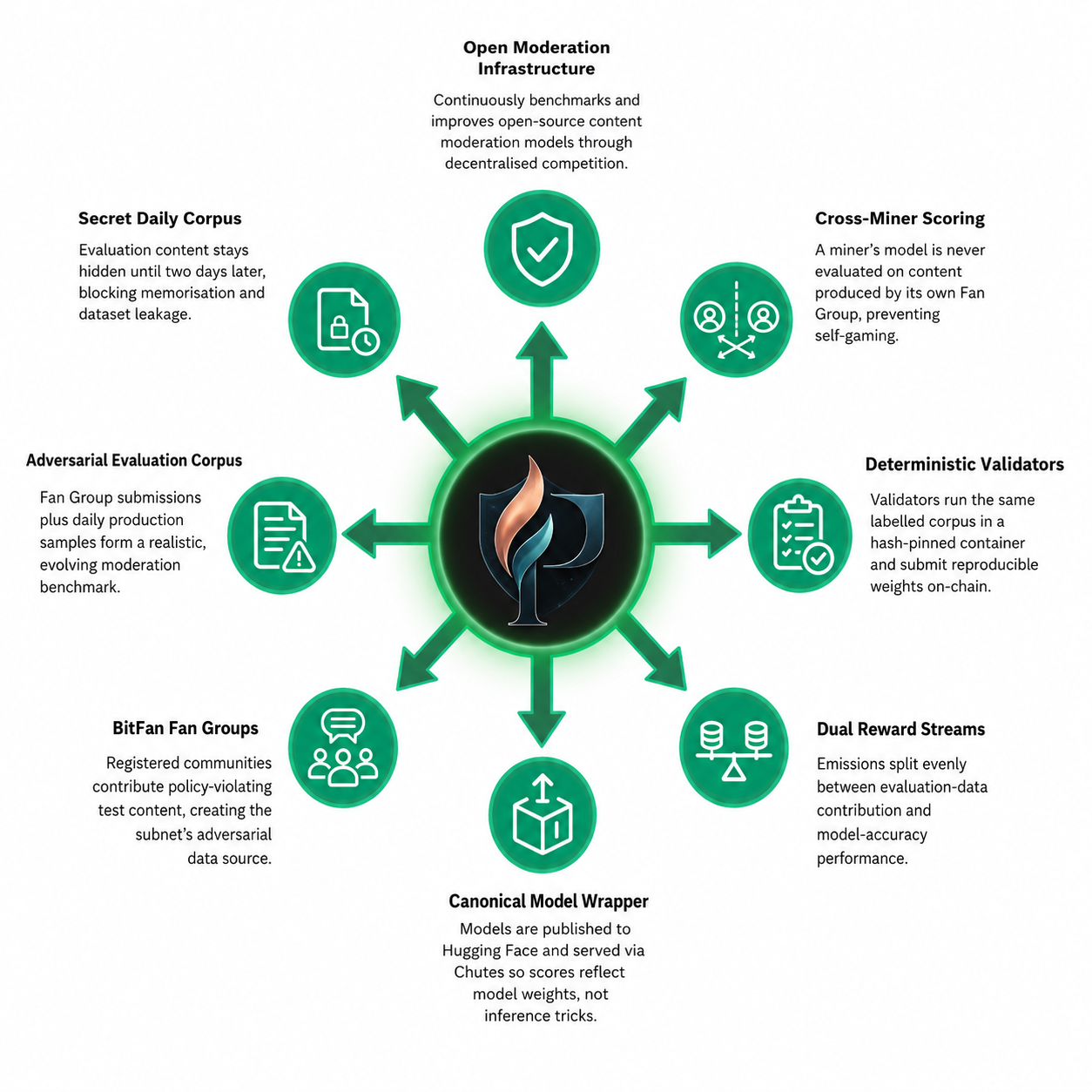
Prometheon is Bittensor Subnet 108 (SN108), a decentralised infrastructure layer for continuously developing, benchmarking, and improving open-source content moderation models. The subnet transforms Bittensor’s economic incentive system into a competitive research pipeline: miners are rewarded not for raw compute or data throughput, but for producing moderation models that genuinely outperform their peers on real, adversarial evaluation data. The result is a self-improving system where the economic pressure to earn TAO emissions drives measurable advances in AI safety technology.

Prometheon operates across two phases that work in concert. The first phase establishes the data supply chain. Miners register BitFan Fan Groups — communities of verified users on the BitFan platform — whose members write test content they believe violates the subnet’s content policy. This material, together with a daily sample of real production content, forms the evaluation corpus for that cycle. Because users are motivated participants in a real platform rather than paid annotators, the content reflects the evolving, adversarial nature of genuine policy violations, from coordinated inauthentic behaviour to context-dependent abuse.

The second phase is the model competition. Miners train or fine-tune content moderation models offline, publish their weights to Hugging Face, and deploy the models via Chutes — a secure, off-chain inference platform. Each miner commits a cryptographic reference to their model (Hugging Face repository, revision SHA, and Chutes endpoint) directly on the Bittensor chain. Validators then run every committed model against the labelled corpus inside a subnet-authored, hash-pinned container, recording forced-choice YES or NO verdicts for each item. The use of a canonical inference wrapper eliminates output ambiguity: scores reflect only the quality of the model weights, nothing else.

A critical design feature of Prometheon is its anti-gaming architecture. A miner’s model is never evaluated on content that its own Fan Group users generated — cross-miner scoring is enforced at the protocol level. Additionally, the daily corpus is kept secret from miners until two days after the cycle that used it, preventing memorisation strategies. Every model runs the same code in the same container environment, so validators cannot be manipulated through inference-side tricks. These guarantees mean a meaningful performance difference between two miners can only arise from a meaningful difference in their models.

Emissions are split equally between two reward streams: one for the quality and volume of evaluation data contributed, and one for model accuracy. Validators compute a single deterministic weight vector and submit it to Bittensor via set_weights. Because the scoring formula is open and reproducible, any compliant validator given the same corpus and metagraph state produces the same output — decentralising trust across the entire validator set rather than concentrating it in any single party.

Prometheon is Bittensor Subnet 108 (SN108), a decentralised infrastructure layer for continuously developing, benchmarking, and improving open-source content moderation models. The subnet transforms Bittensor’s economic incentive system into a competitive research pipeline: miners are rewarded not for raw compute or data throughput, but for producing moderation models that genuinely outperform their peers on real, adversarial evaluation data. The result is a self-improving system where the economic pressure to earn TAO emissions drives measurable advances in AI safety technology.

Prometheon operates across two phases that work in concert. The first phase establishes the data supply chain. Miners register BitFan Fan Groups — communities of verified users on the BitFan platform — whose members write test content they believe violates the subnet’s content policy. This material, together with a daily sample of real production content, forms the evaluation corpus for that cycle. Because users are motivated participants in a real platform rather than paid annotators, the content reflects the evolving, adversarial nature of genuine policy violations, from coordinated inauthentic behaviour to context-dependent abuse.

The second phase is the model competition. Miners train or fine-tune content moderation models offline, publish their weights to Hugging Face, and deploy the models via Chutes — a secure, off-chain inference platform. Each miner commits a cryptographic reference to their model (Hugging Face repository, revision SHA, and Chutes endpoint) directly on the Bittensor chain. Validators then run every committed model against the labelled corpus inside a subnet-authored, hash-pinned container, recording forced-choice YES or NO verdicts for each item. The use of a canonical inference wrapper eliminates output ambiguity: scores reflect only the quality of the model weights, nothing else.

A critical design feature of Prometheon is its anti-gaming architecture. A miner’s model is never evaluated on content that its own Fan Group users generated — cross-miner scoring is enforced at the protocol level. Additionally, the daily corpus is kept secret from miners until two days after the cycle that used it, preventing memorisation strategies. Every model runs the same code in the same container environment, so validators cannot be manipulated through inference-side tricks. These guarantees mean a meaningful performance difference between two miners can only arise from a meaningful difference in their models.

Emissions are split equally between two reward streams: one for the quality and volume of evaluation data contributed, and one for model accuracy. Validators compute a single deterministic weight vector and submit it to Bittensor via set_weights. Because the scoring formula is open and reproducible, any compliant validator given the same corpus and metagraph state produces the same output — decentralising trust across the entire validator set rather than concentrating it in any single party.

PURPOSE

What exactly is the 'product/build'?

The product Prometheon delivers is a continuously updated, decentralised benchmark and model improvement pipeline for content moderation AI. Where traditional moderation benchmarks are static snapshots assembled by a central team, Prometheon generates fresh evaluation data every day through real user behaviour on the BitFan platform. The benchmark evolves as adversarial tactics evolve, and the models competing against it are forced to evolve in response. For any organisation that needs reliable content moderation — a social platform, a gaming company, an AI lab — Prometheon provides a transparent, auditable evidence base for comparing model quality.

Target users and customers span several categories. Social platforms and digital communities can consume the open-source models emerging from the subnet or use the benchmark corpus to test their own moderation systems against adversarial data they did not curate themselves. AI research labs gain access to a real-world adversarial dataset generated under economic incentives, making it harder to game than synthetically constructed test sets. Enterprises building trust and safety products can anchor their model selection or procurement decisions to Prometheon’s leaderboard, which is grounded in on-chain cryptographic commitments rather than self-reported benchmarks.

The technical architecture in Phase 2 is implemented as a modular Python package. The canonical module defines the exact inference engine and container wrapper every miner must deploy; validators verify the deployed bytes against the on-chain hash before accepting any results. The chain module handles all Bittensor interactions: reading the metagraph, publishing model commits, and submitting weight vectors. The registry module enforces model eligibility, checking for duplicates and verifying Hugging Face provenance before a submission can enter scoring. The evaluation module assembles the daily corpus from the subnet’s database layer, orchestrates inference across all committed models via Chutes, and pipes results into the scoring engine. The scoring module allocates emissions using a deterministic integer method — the largest-remainder algorithm — across data contributors and top-performing model submitters.

The subnet’s incentive structure is carefully aligned with product quality. Miners cannot earn rewards by submitting the same model twice under different hashes, by generating their own evaluation data, or by gaming the inference environment. The only reliable path to higher emissions is building a moderation model that labels content more accurately than competing miners’ models, on data those miners did not control. This alignment means the economic energy flowing through Bittensor’s TAO emissions is directly channelled into model quality improvement — a key differentiator from subnets where rewarded work is only loosely connected to the outputs consumers actually care about.

The product Prometheon delivers is a continuously updated, decentralised benchmark and model improvement pipeline for content moderation AI. Where traditional moderation benchmarks are static snapshots assembled by a central team, Prometheon generates fresh evaluation data every day through real user behaviour on the BitFan platform. The benchmark evolves as adversarial tactics evolve, and the models competing against it are forced to evolve in response. For any organisation that needs reliable content moderation — a social platform, a gaming company, an AI lab — Prometheon provides a transparent, auditable evidence base for comparing model quality.

Target users and customers span several categories. Social platforms and digital communities can consume the open-source models emerging from the subnet or use the benchmark corpus to test their own moderation systems against adversarial data they did not curate themselves. AI research labs gain access to a real-world adversarial dataset generated under economic incentives, making it harder to game than synthetically constructed test sets. Enterprises building trust and safety products can anchor their model selection or procurement decisions to Prometheon’s leaderboard, which is grounded in on-chain cryptographic commitments rather than self-reported benchmarks.

The technical architecture in Phase 2 is implemented as a modular Python package. The canonical module defines the exact inference engine and container wrapper every miner must deploy; validators verify the deployed bytes against the on-chain hash before accepting any results. The chain module handles all Bittensor interactions: reading the metagraph, publishing model commits, and submitting weight vectors. The registry module enforces model eligibility, checking for duplicates and verifying Hugging Face provenance before a submission can enter scoring. The evaluation module assembles the daily corpus from the subnet’s database layer, orchestrates inference across all committed models via Chutes, and pipes results into the scoring engine. The scoring module allocates emissions using a deterministic integer method — the largest-remainder algorithm — across data contributors and top-performing model submitters.

The subnet’s incentive structure is carefully aligned with product quality. Miners cannot earn rewards by submitting the same model twice under different hashes, by generating their own evaluation data, or by gaming the inference environment. The only reliable path to higher emissions is building a moderation model that labels content more accurately than competing miners’ models, on data those miners did not control. This alignment means the economic energy flowing through Bittensor’s TAO emissions is directly channelled into model quality improvement — a key differentiator from subnets where rewarded work is only loosely connected to the outputs consumers actually care about.

WHO

Team Info

Prometheon is built and maintained by BitSpace, a software development organisation operating under the GitHub handle BitSpaceorganization. BitSpace’s public identity is closely associated with the BitFan ecosystem — a Bittensor-native platform for fan communities and social engagement — which serves as the primary data source for Prometheon’s evaluation pipeline. The broader BitSpace entity, identified on LinkedIn as bitspaceorg, is a technology collective based in Chennai, India, with between 11 and 50 employees. Named individuals associated with BitSpace include K P Prasanna and Albert Richard, though detailed biographical information has not been made public through official channels. The organisation can be contacted via [email protected] and maintains a presence on X as @BITFANSPACE.

Subnet 108 was not originally Prometheon’s. It was previously operated as TalkHead, a subnet focused on decentralised talking-head video generation, where miners deployed Dockerised generative models and validators scored them on CelebAHQ face and LibriSpeech audio benchmarks. Emissions for TalkHead miners ceased in mid-2026, and BitSpace subsequently acquired the subnet and pivoted its mission entirely. The rebrand to Prometheon was accompanied by the release of two new codebases — prometheon_v1 and prometheon_v2 — implementing the Fan Group growth and content moderation model competition mechanisms respectively. This transition represents one of the more substantive subnet pivots in Bittensor’s history, replacing a generative media task with a safety and evaluation-focused one.

Both Prometheon repositories are published under the MIT licence and copyright 2026 BitSpace. The project’s documentation is thorough and publicly accessible through GitHub, covering miner setup, validator operation, the scoring formula, burn policy, decentralised validation architecture, and security practices. While the team has not published a formal blog or whitepaper, the codebase and its accompanying docs serve as a detailed technical specification for anyone seeking to understand or participate in the subnet.

Prometheon is built and maintained by BitSpace, a software development organisation operating under the GitHub handle BitSpaceorganization. BitSpace’s public identity is closely associated with the BitFan ecosystem — a Bittensor-native platform for fan communities and social engagement — which serves as the primary data source for Prometheon’s evaluation pipeline. The broader BitSpace entity, identified on LinkedIn as bitspaceorg, is a technology collective based in Chennai, India, with between 11 and 50 employees. Named individuals associated with BitSpace include K P Prasanna and Albert Richard, though detailed biographical information has not been made public through official channels. The organisation can be contacted via [email protected] and maintains a presence on X as @BITFANSPACE.

Subnet 108 was not originally Prometheon’s. It was previously operated as TalkHead, a subnet focused on decentralised talking-head video generation, where miners deployed Dockerised generative models and validators scored them on CelebAHQ face and LibriSpeech audio benchmarks. Emissions for TalkHead miners ceased in mid-2026, and BitSpace subsequently acquired the subnet and pivoted its mission entirely. The rebrand to Prometheon was accompanied by the release of two new codebases — prometheon_v1 and prometheon_v2 — implementing the Fan Group growth and content moderation model competition mechanisms respectively. This transition represents one of the more substantive subnet pivots in Bittensor’s history, replacing a generative media task with a safety and evaluation-focused one.

Both Prometheon repositories are published under the MIT licence and copyright 2026 BitSpace. The project’s documentation is thorough and publicly accessible through GitHub, covering miner setup, validator operation, the scoring formula, burn policy, decentralised validation architecture, and security practices. While the team has not published a formal blog or whitepaper, the codebase and its accompanying docs serve as a detailed technical specification for anyone seeking to understand or participate in the subnet.

FUTURE

Roadmap

Prometheon’s roadmap is structured around a phased expansion model. Phase 1 (prometheon_v1) established the Fan Group growth and data-generation incentive layer; Phase 2 (prometheon_v2) introduced the model competition and evaluation pipeline. The v1 repository explicitly reserves prometheon_v3 and prometheon_v4 as future repositories, to be activated when the corresponding phase boundaries are reached. This phased approach signals that Prometheon is designed for long-term incremental expansion rather than a single monolithic deployment.

Identified technical priorities for future phases include extending the evaluation pipeline to handle richer content types beyond text — such as image and multimodal inputs — as adversarial tactics evolve. The team has also noted the potential to integrate Bittensor’s commit-reveal weight submission scheme, which would add an additional layer of privacy and tamper-resistance to the scoring process. Expanding the validator network to support larger daily corpora and more complex policy ontologies is another area under active consideration, reflecting the expectation that content policy complexity will grow as Prometheon’s participant base scales.

Prometheon’s roadmap is structured around a phased expansion model. Phase 1 (prometheon_v1) established the Fan Group growth and data-generation incentive layer; Phase 2 (prometheon_v2) introduced the model competition and evaluation pipeline. The v1 repository explicitly reserves prometheon_v3 and prometheon_v4 as future repositories, to be activated when the corresponding phase boundaries are reached. This phased approach signals that Prometheon is designed for long-term incremental expansion rather than a single monolithic deployment.

Identified technical priorities for future phases include extending the evaluation pipeline to handle richer content types beyond text — such as image and multimodal inputs — as adversarial tactics evolve. The team has also noted the potential to integrate Bittensor’s commit-reveal weight submission scheme, which would add an additional layer of privacy and tamper-resistance to the scoring process. Expanding the validator network to support larger daily corpora and more complex policy ontologies is another area under active consideration, reflecting the expectation that content policy complexity will grow as Prometheon’s participant base scales.