With the amount of new subnets being added it can be hard to get up to date information across all subnets, so data may be slightly out of date from time to time
Minos is a Bittensor subnet dedicated to genomic variant calling. It transforms the process of identifying DNA mutations from sequencing data into a decentralized competition where accuracy is continuously measured and rewarded. The platform directly addresses a core problem in genomics: labs currently self-report their variant-calling accuracy and keep pipelines static over time, often excluding difficult genomic regions. Minos replaces this with transparent, incentive-aligned benchmarking for single-nucleotide polymorphisms (SNPs) and indel (INDEL) detection. By running continuous challenges with hidden ground truth, Minos ensures that any improvement in accuracy is objectively verified and economically rewarded.
Mining and Validation Loop:
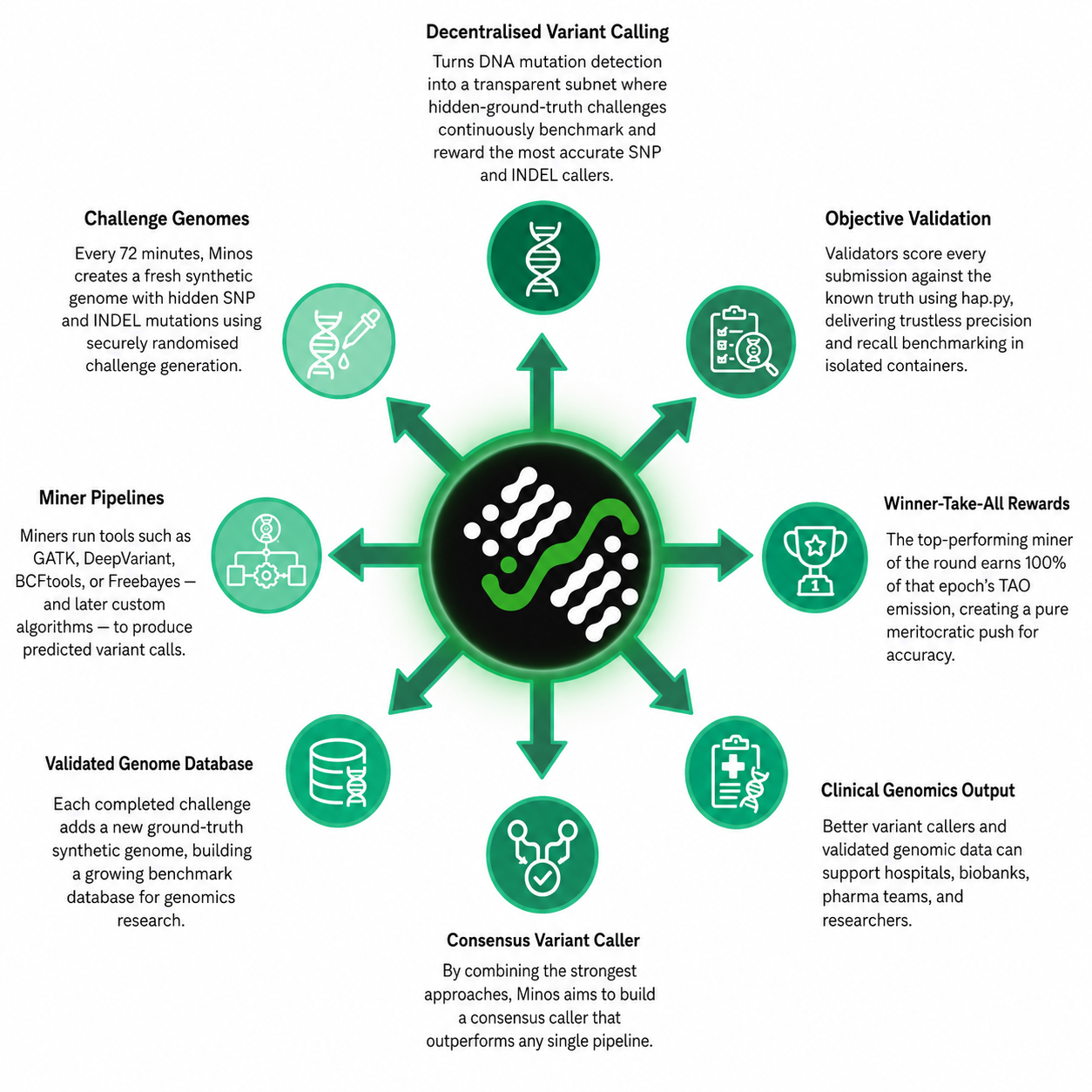
Minos operates on a recurring 72-minute epoch. At each epoch, the subnet’s infrastructure generates a new “challenge genome” by injecting synthetic mutations into genomic data. These challenge genomes are fresh, unique, and cryptographically unpredictable. Miners in the network then participate by choosing a variant-calling strategy and submitting predictions for the hidden mutations. Initially (currently), miners pick among established variant caller tools (such as GATK HaplotypeCaller, DeepVariant, BCFtools, or Freebayes), optimizing hyperparameters for each new dataset. In later phases, miners will be able to submit entirely custom variant-calling algorithms as code.
Miner Contributions:
Miners contribute in two main ways. In the current phase, each miner supplies a set of hyperparameters for one of the supported variant-calling tools. As the network matures, miners will supply entire algorithms or models for variant detection. In every case, their contribution is a proposed solution for analyzing the challenge genome. Practically, the miner returns a .VCF (variant call) file for the injected dataset. Optionally, miners may include multiple pipelines or ensemble strategies as different submissions in parallel. Each submission is measured solely by its accuracy against ground truth.
Validator Role and Scoring:
Validators are special nodes that take each miner’s submission and score it. They host the reference data (ground truth) and use the hap.py framework to compare the miner’s variant calls with the true mutations. Validators run each solution in a secure, sandboxed container to avoid interference. They report detailed scoring metrics to the network. The subnet then ranks miners by these accuracy scores. Consistency matters: Minos uses an exponential moving average of each miner’s recent scores to smooth out variance. Validators effectively ensure trustless, objective evaluation: miners cannot falsify results, as validators strictly control scoring against known truth.
Final Outputs and Services:
Beyond raw on-chain rewards, Minos produces three key outputs. First, it generates a massive *validated synthetic genome database*. Each completed challenge adds an entirely new genome with known true variants, creating thousands of verified genome datasets (with millions of variants) in the first year. Second, by aggregating the best solutions, Minos trains a consensus variant caller. This ensemble model combines the strengths of many top pipelines and is expected to exceed the accuracy of any single tool. Third, the final vision is to deploy that consensus model as a clinical-grade service: organizations (e.g. hospitals, biobanks, pharmaceutical companies) can submit real sequencing samples and receive ultra-accurate variant calls, effectively benchmarking genomic analysis on-chain. This lowers the rate of false negatives/positives in medical genomics and creates economic incentives aligning labs with accuracy rather than proprietary claims.
Intended Users and Beneficiaries:
Minos primarily targets the genomics and biotech community, including research labs and clinical institutions that perform DNA sequencing. These users benefit from continually-improved variant detection tools and an open benchmark to trust results. In addition, Bittensor network participants (miners and delegators) are users of the subnet’s token market; delegators stake on miners they believe will yield high accuracy. The broader beneficiaries include any entity needing high-quality genomic analysis: hospitals diagnosing mutations, pharma companies screening drug targets, and bioinformatics researchers. The decentralized model also democratizes access: smaller labs can leverage community-sourced variant callers instead of buying expensive closed-source software.
Unique Aspects:
Minos stands out among Bittensor subnets by its focus on scientific computing in genomics. No other subnet is dedicated specifically to DNA variant calling. It is fully open-source and transparent: the data generation, scoring, and code are public. Unlike traditional pipelines, Minos continuously expands its benchmark coverage (eventually into difficult genomic regions) and rewards improvements with real economic incentive. Its use of hap.py and industry-standard genomic tools (GATK, DeepVariant, etc.) means it directly complements existing best practices. The real-time competition framework (with 72-minute rounds) and Winner-Take-All design is also unique: it creates a meritocratic, push-for-performance environment, rather than fixed rewards. All of these factors together – genomics focus, open evaluation, and dynamic incentives – make Minos a novel infrastructure within the Bittensor ecosystem.
Minos is a Bittensor subnet dedicated to genomic variant calling. It transforms the process of identifying DNA mutations from sequencing data into a decentralized competition where accuracy is continuously measured and rewarded. The platform directly addresses a core problem in genomics: labs currently self-report their variant-calling accuracy and keep pipelines static over time, often excluding difficult genomic regions. Minos replaces this with transparent, incentive-aligned benchmarking for single-nucleotide polymorphisms (SNPs) and indel (INDEL) detection. By running continuous challenges with hidden ground truth, Minos ensures that any improvement in accuracy is objectively verified and economically rewarded.
Mining and Validation Loop:
Minos operates on a recurring 72-minute epoch. At each epoch, the subnet’s infrastructure generates a new “challenge genome” by injecting synthetic mutations into genomic data. These challenge genomes are fresh, unique, and cryptographically unpredictable. Miners in the network then participate by choosing a variant-calling strategy and submitting predictions for the hidden mutations. Initially (currently), miners pick among established variant caller tools (such as GATK HaplotypeCaller, DeepVariant, BCFtools, or Freebayes), optimizing hyperparameters for each new dataset. In later phases, miners will be able to submit entirely custom variant-calling algorithms as code.
Miner Contributions:
Miners contribute in two main ways. In the current phase, each miner supplies a set of hyperparameters for one of the supported variant-calling tools. As the network matures, miners will supply entire algorithms or models for variant detection. In every case, their contribution is a proposed solution for analyzing the challenge genome. Practically, the miner returns a .VCF (variant call) file for the injected dataset. Optionally, miners may include multiple pipelines or ensemble strategies as different submissions in parallel. Each submission is measured solely by its accuracy against ground truth.
Validator Role and Scoring:
Validators are special nodes that take each miner’s submission and score it. They host the reference data (ground truth) and use the hap.py framework to compare the miner’s variant calls with the true mutations. Validators run each solution in a secure, sandboxed container to avoid interference. They report detailed scoring metrics to the network. The subnet then ranks miners by these accuracy scores. Consistency matters: Minos uses an exponential moving average of each miner’s recent scores to smooth out variance. Validators effectively ensure trustless, objective evaluation: miners cannot falsify results, as validators strictly control scoring against known truth.
Final Outputs and Services:
Beyond raw on-chain rewards, Minos produces three key outputs. First, it generates a massive *validated synthetic genome database*. Each completed challenge adds an entirely new genome with known true variants, creating thousands of verified genome datasets (with millions of variants) in the first year. Second, by aggregating the best solutions, Minos trains a consensus variant caller. This ensemble model combines the strengths of many top pipelines and is expected to exceed the accuracy of any single tool. Third, the final vision is to deploy that consensus model as a clinical-grade service: organizations (e.g. hospitals, biobanks, pharmaceutical companies) can submit real sequencing samples and receive ultra-accurate variant calls, effectively benchmarking genomic analysis on-chain. This lowers the rate of false negatives/positives in medical genomics and creates economic incentives aligning labs with accuracy rather than proprietary claims.
Intended Users and Beneficiaries:
Minos primarily targets the genomics and biotech community, including research labs and clinical institutions that perform DNA sequencing. These users benefit from continually-improved variant detection tools and an open benchmark to trust results. In addition, Bittensor network participants (miners and delegators) are users of the subnet’s token market; delegators stake on miners they believe will yield high accuracy. The broader beneficiaries include any entity needing high-quality genomic analysis: hospitals diagnosing mutations, pharma companies screening drug targets, and bioinformatics researchers. The decentralized model also democratizes access: smaller labs can leverage community-sourced variant callers instead of buying expensive closed-source software.
Unique Aspects:
Minos stands out among Bittensor subnets by its focus on scientific computing in genomics. No other subnet is dedicated specifically to DNA variant calling. It is fully open-source and transparent: the data generation, scoring, and code are public. Unlike traditional pipelines, Minos continuously expands its benchmark coverage (eventually into difficult genomic regions) and rewards improvements with real economic incentive. Its use of hap.py and industry-standard genomic tools (GATK, DeepVariant, etc.) means it directly complements existing best practices. The real-time competition framework (with 72-minute rounds) and Winner-Take-All design is also unique: it creates a meritocratic, push-for-performance environment, rather than fixed rewards. All of these factors together – genomics focus, open evaluation, and dynamic incentives – make Minos a novel infrastructure within the Bittensor ecosystem.
Live Operations:
Minos is currently live on the Bittensor mainnet (Phase 1 active). Every 72 minutes the network emits a genome challenge to miners. Validators and miners are running on-chain consensus, and the Minos alpha token (SN107) is traded on Bittensor exchanges. As of mid-2026, Minos has ~11 active validators and a single active miner securing the subnet. The total TAO stake on Minos is roughly 918,912 TAO. The alpha token currently trades around $3–8 (depending on time; see market data). The protocol’s “mechanism” is fully implemented: challenge generation, submission intake, containerized validation, scoring, and the winner-take-all reward distribution are all operational. The GitHub repository (minos-protocol/minos_subnet) has active development: for example, a commit on April 11, 2026 added multi-chromosome and multi-sample support with synthetic-only scoring. (Version 0.1.0 of the code was released in early 2026, with the initial commit in March 2026.)
Architecture and Data Flow:
The technical architecture centers on three components: the challenge engine, the miners/validators, and the on-chain ledger. The challenge engine (off-chain) uses HelixForge or similar to inject synthetic mutations into reference genomes. This challenge data is broadcast to miners. Miners (nodes running Minos client) then process the genome using their chosen tool. Validators (other nodes) run each miner’s code inside isolated Docker containers; they fetch known truth sets and run hap.py to score each output. All node interactions are mediated by the Bittensor protocol: miners must have staked TAO, and after each round the subnet distributes a fixed emission to the winner, recorded on-chain. Era transitions and random seeds for genome generation likely rely on Bittensor’s entropy and scheduling. In summary, the data flow is: Bittensor events/time triggers -> synthetic genome generation -> miner execution -> validator scoring -> on-chain result recording.
Tooling and Integrations:
Minos leverages existing bioinformatics tools as building blocks. Current miners use open-source variant callers (e.g. GATK, DeepVariant, FreeBayes, BCFtools). For evaluation, validators use the hap.py toolkit (used by Illumina) to objectively score precision and recall. The project code likely includes interfaces for running these tools on the challenge data. Minos also integrates with Bittensor’s staking and API layers. Notably, Minos has announced a partnership with the Hippius subnet: Hippius provides decentralized data storage services, which Minos will use for archiving the large genomic challenge datasets. This off-chain integration (Hippius storage) helps Minos scale its data securely. Other than bioinformatics tools and storage, Minos mainly uses on-chain mechanics; there are no external oracles yet. All code is open source on its GitHub: it contains the infrastructure (APIs, Docker images, scoring scripts), configuration files for the variant callers, and the validator logic. Commit messages show active development of key features (multi-chromosome support, UI improvements, etc.)
Metrics and Activity:
Some current metrics: total TAO staked ~918,900, which implies ~0.07% of all TAO. The utilization (miners per allowed slot) is very low (1/64 slots). The alpha token supply is small (circa 258k circulating out of 21M max). There has been modest trading volume (e.g. ~$1.05M 24h as of April 2026). Emissions are set at the standard rate determined by Bittensor (Minos’s share ~1.34% of global emission), but all of a round’s emission currently goes to the single winning miner. Network health is flagged as “Weak” by some analytics due to low utilization, but that also means ample capacity for growth. On development activity, the GitHub repo has recent pushes (last week as of April 2026), and several commits by the core team.
In Development:
Planned work includes Phase 2 and beyond. Phase 2 (incoming) will allow miners to submit custom variant-calling algorithms (neural nets, hybrid methods, etc. in code form). This will require a secure code sandbox and likely a rewrite of parts of the subnet to accept arbitrary containers. Phase 3 (planned) will expand variant types: structural variants (SVs), copy-number variants (CNVs), HLA gene typing, and more “difficult” regions. This means generating new challenge genomes and evolving scoring to handle these variants. Phase 4 (planned) is developing a consensus/cascaded model: the subnet will train an ensemble “meta-caller” from top submissions. Phase 5 (vision) is full production: versioned container deployments, automatic updates from Minos learnings, and a polished clinical-reporting interface. Each phase has specific technical targets and the roadmap is public on the Minos website.
End Users / Customers:
The current “customers” of Minos are essentially the Bittensor community and researchers. In practice: beta users, genomic R&D teams, and token delegators are engaging by staking on Minos. In the long term, intended end users include healthcare and biotech organizations who would use Minos’s variant-calling service or consensus model. Community engagement primarily happens via the Minos Discord (invite linked on their site) and Twitter (@theminos_ai). Some announcements (e.g. launch, partnerships) have appeared on X (Twitter) and aggregator sites. As of now, the userbase is small but growing as the subnet stabilizes.
Live Operations:
Minos is currently live on the Bittensor mainnet (Phase 1 active). Every 72 minutes the network emits a genome challenge to miners. Validators and miners are running on-chain consensus, and the Minos alpha token (SN107) is traded on Bittensor exchanges. As of mid-2026, Minos has ~11 active validators and a single active miner securing the subnet. The total TAO stake on Minos is roughly 918,912 TAO. The alpha token currently trades around $3–8 (depending on time; see market data). The protocol’s “mechanism” is fully implemented: challenge generation, submission intake, containerized validation, scoring, and the winner-take-all reward distribution are all operational. The GitHub repository (minos-protocol/minos_subnet) has active development: for example, a commit on April 11, 2026 added multi-chromosome and multi-sample support with synthetic-only scoring. (Version 0.1.0 of the code was released in early 2026, with the initial commit in March 2026.)
Architecture and Data Flow:
The technical architecture centers on three components: the challenge engine, the miners/validators, and the on-chain ledger. The challenge engine (off-chain) uses HelixForge or similar to inject synthetic mutations into reference genomes. This challenge data is broadcast to miners. Miners (nodes running Minos client) then process the genome using their chosen tool. Validators (other nodes) run each miner’s code inside isolated Docker containers; they fetch known truth sets and run hap.py to score each output. All node interactions are mediated by the Bittensor protocol: miners must have staked TAO, and after each round the subnet distributes a fixed emission to the winner, recorded on-chain. Era transitions and random seeds for genome generation likely rely on Bittensor’s entropy and scheduling. In summary, the data flow is: Bittensor events/time triggers -> synthetic genome generation -> miner execution -> validator scoring -> on-chain result recording.
Tooling and Integrations:
Minos leverages existing bioinformatics tools as building blocks. Current miners use open-source variant callers (e.g. GATK, DeepVariant, FreeBayes, BCFtools). For evaluation, validators use the hap.py toolkit (used by Illumina) to objectively score precision and recall. The project code likely includes interfaces for running these tools on the challenge data. Minos also integrates with Bittensor’s staking and API layers. Notably, Minos has announced a partnership with the Hippius subnet: Hippius provides decentralized data storage services, which Minos will use for archiving the large genomic challenge datasets. This off-chain integration (Hippius storage) helps Minos scale its data securely. Other than bioinformatics tools and storage, Minos mainly uses on-chain mechanics; there are no external oracles yet. All code is open source on its GitHub: it contains the infrastructure (APIs, Docker images, scoring scripts), configuration files for the variant callers, and the validator logic. Commit messages show active development of key features (multi-chromosome support, UI improvements, etc.)
Metrics and Activity:
Some current metrics: total TAO staked ~918,900, which implies ~0.07% of all TAO. The utilization (miners per allowed slot) is very low (1/64 slots). The alpha token supply is small (circa 258k circulating out of 21M max). There has been modest trading volume (e.g. ~$1.05M 24h as of April 2026). Emissions are set at the standard rate determined by Bittensor (Minos’s share ~1.34% of global emission), but all of a round’s emission currently goes to the single winning miner. Network health is flagged as “Weak” by some analytics due to low utilization, but that also means ample capacity for growth. On development activity, the GitHub repo has recent pushes (last week as of April 2026), and several commits by the core team.
In Development:
Planned work includes Phase 2 and beyond. Phase 2 (incoming) will allow miners to submit custom variant-calling algorithms (neural nets, hybrid methods, etc. in code form). This will require a secure code sandbox and likely a rewrite of parts of the subnet to accept arbitrary containers. Phase 3 (planned) will expand variant types: structural variants (SVs), copy-number variants (CNVs), HLA gene typing, and more “difficult” regions. This means generating new challenge genomes and evolving scoring to handle these variants. Phase 4 (planned) is developing a consensus/cascaded model: the subnet will train an ensemble “meta-caller” from top submissions. Phase 5 (vision) is full production: versioned container deployments, automatic updates from Minos learnings, and a polished clinical-reporting interface. Each phase has specific technical targets and the roadmap is public on the Minos website.
End Users / Customers:
The current “customers” of Minos are essentially the Bittensor community and researchers. In practice: beta users, genomic R&D teams, and token delegators are engaging by staking on Minos. In the long term, intended end users include healthcare and biotech organizations who would use Minos’s variant-calling service or consensus model. Community engagement primarily happens via the Minos Discord (invite linked on their site) and Twitter (@theminos_ai). Some announcements (e.g. launch, partnerships) have appeared on X (Twitter) and aggregator sites. As of now, the userbase is small but growing as the subnet stabilizes.
Team and Individuals:
The Minos subnet project refers to its team collectively as “Minos,” but individual names or backgrounds have not been publicly disclosed. The subnet’s on-chain owner (ColdKey) is 5DA2vL…7UZZBM, associated with the project. GitHub commits and social posts credit “Minos” or “minos-protocol” as the author. According to SubnetAIQ, team details are not posted, so the core developers remain pseudonymous. The project’s Twitter account (@theminos_ai) and website theminos.ai present it as a collaborative group.
Online Presence:
Minos maintains an official website (theminos.ai) and a Twitter/X account (@theminos_ai) for announcements. The Twitter handle was active around launch (e.g. congratulating the team on subnet activation). The team also announced a partnership with the Hippius subnet for genomic data storage. The official Discord community link is listed but not publicized (likely invite-only for holders). The founders and engineers have not listed LinkedIn or blogs, so their professional backgrounds (in AI, genomics or blockchain) are not on record. No specific investors or venture partners are publicly named; the project appears to be privately funded by its developers.
Contributors and Commits:
GitHub activity shows development by user “Minos” and by an organization “minos-protocol.” For example, a commit on April 11, 2026 (by minos-protocol) added multi-chromosome and multi-sample support. Another commit by “Minos” user (48bd6eb) marked the v0.1.0 release in March 2026. Overall, code contributions have come from these two accounts; no other GitHub usernames appear in the history from early development. There are few external contributors or pull requests, as most work is done by the core developers.
Launch and Timeline:
Minos’s whitepaper (v1.1) was published in February 2026. The subnet was registered on the Bittensor network around March 2026 (GitHub first commit: 2026-03-15). Initial token emission and mining began soon after. Public announcement of the subnet activation was made in Q1 2026 (e.g. a celebratory tweet by the project). No specific press releases are noted, but Minos is listed on Bittensor explorers (TaoStats, SubnetRadar) with its details.
Community Engagement:
Minos has a presence on major Bittensor platforms. It is listed on TaoStats and TaoPulse. Discussion appears on Bittensor forums and Telegram among subnet researchers. The Minos team has engaged the community by sharing its roadmap and inviting participants to test the subnet. With close to 100 community members on Discord (as typical for new subnets), the team answers technical questions there. They have not posted Medium or long-form articles yet, but the rich documentation on their site (whitepaper, FAQ) serves that role. The project’s roadmap and output metrics are publicly visible, encouraging transparency. Overall, the Minos team maintains an open communication channel for early adopters and remains available to collaborate with genomics researchers.
Team and Individuals:
The Minos subnet project refers to its team collectively as “Minos,” but individual names or backgrounds have not been publicly disclosed. The subnet’s on-chain owner (ColdKey) is 5DA2vL…7UZZBM, associated with the project. GitHub commits and social posts credit “Minos” or “minos-protocol” as the author. According to SubnetAIQ, team details are not posted, so the core developers remain pseudonymous. The project’s Twitter account (@theminos_ai) and website theminos.ai present it as a collaborative group.
Online Presence:
Minos maintains an official website (theminos.ai) and a Twitter/X account (@theminos_ai) for announcements. The Twitter handle was active around launch (e.g. congratulating the team on subnet activation). The team also announced a partnership with the Hippius subnet for genomic data storage. The official Discord community link is listed but not publicized (likely invite-only for holders). The founders and engineers have not listed LinkedIn or blogs, so their professional backgrounds (in AI, genomics or blockchain) are not on record. No specific investors or venture partners are publicly named; the project appears to be privately funded by its developers.
Contributors and Commits:
GitHub activity shows development by user “Minos” and by an organization “minos-protocol.” For example, a commit on April 11, 2026 (by minos-protocol) added multi-chromosome and multi-sample support. Another commit by “Minos” user (48bd6eb) marked the v0.1.0 release in March 2026. Overall, code contributions have come from these two accounts; no other GitHub usernames appear in the history from early development. There are few external contributors or pull requests, as most work is done by the core developers.
Launch and Timeline:
Minos’s whitepaper (v1.1) was published in February 2026. The subnet was registered on the Bittensor network around March 2026 (GitHub first commit: 2026-03-15). Initial token emission and mining began soon after. Public announcement of the subnet activation was made in Q1 2026 (e.g. a celebratory tweet by the project). No specific press releases are noted, but Minos is listed on Bittensor explorers (TaoStats, SubnetRadar) with its details.
Community Engagement:
Minos has a presence on major Bittensor platforms. It is listed on TaoStats and TaoPulse. Discussion appears on Bittensor forums and Telegram among subnet researchers. The Minos team has engaged the community by sharing its roadmap and inviting participants to test the subnet. With close to 100 community members on Discord (as typical for new subnets), the team answers technical questions there. They have not posted Medium or long-form articles yet, but the rich documentation on their site (whitepaper, FAQ) serves that role. The project’s roadmap and output metrics are publicly visible, encouraging transparency. Overall, the Minos team maintains an open communication channel for early adopters and remains available to collaborate with genomics researchers.
Phase 1 – Hyperparameter Optimization (Active):
Minos launched with Phase 1 active. In this phase, miners optimize hyperparameter configurations for four established variant-calling tools: GATK HaplotypeCaller, DeepVariant, bcftools, and FreeBayes. Each 72-minute round generates a new challenge genome and all currently submitted solutions are scored for accuracy. This phase validates the core infrastructure (challenge generation, scoring with hap.py, EMA tracking, and emissions) and produces a continuously updated leaderboard of the best configurations. The network is currently operating these 72-min rounds in real-time.
Phase 2 – Custom Genotyping Algorithms (Next):
In Phase 2 (coming soon), miners will be able to submit their own variant-calling algorithms as executable code. This unlocks algorithmic innovation beyond hyperparameters: neural-network callers, hybrid methods, or specialized heuristics can be deployed. Each submission will run in a sandboxed Docker container on validators. The subnet will thus reward new algorithm designs directly. The repository and infrastructure are being prepared for this shift to custom code.
Phase 3 – Broader Variant Spectrum (Planned):
Phase 3 will extend Minos to additional variant types and genomic regions. In particular, structural variants (SVs), copy-number variants (CNVs), HLA gene segments, and other difficult regions will be included. The scoring system (currently focused on SNPs/indels) will be adapted to handle these complex variants. New challenge data generation (injecting bigger or multi-locus mutations) is required. This phase broadens the subnet’s scope to full-spectrum genomic variant calling.
Phase 4 – Consensus AI (Planned):
Once diverse solutions have been recorded, Phase 4 aims to build a consensus (meta-)caller from the top-performing models. By ensembling the best pipelines, Minos will train a new AI model expected to exceed any single pipeline’s accuracy. This “meta-caller” will automatically combine insights from multiple approaches. Continuously updating this ensemble from the latest winners forms a feedback loop. This phase effectively creates a higher-level output from the competition results.
Phase 5 – Production Deployment (Vision):
The final phase targets production readiness. This includes creating versioned container images of the leading pipelines, integrating clinical reporting formats, and automating the deployment of Minos services. The vision is a turnkey platform: users submit sequencing samples via an API or interface, and the network runs the consensus caller to return variant calls. Passive features like automatic updates from new subnet results, end-to-end encrypted data handling, and compliance with clinical standards are part of this goal. Essentially, Minos will mature into an on-demand genomic analysis service, with stable REST/Docker APIs and human-friendly reports.
Roadmap Timeline:
The public roadmap (available on theminos.ai) lists these five phases. As of now, Minos is in Phase 1 (active, early 2026) and preparing for Phase 2. No fixed dates have been announced for later phases. The whitepaper (v1.1, Feb 2026) and site indicate planned milestones but emphasize that development will proceed with network activity. In summary: Phase 1 (2026) ‒ active, Phase 2 (expected later 2026), Phases 3–5 (late 2026/2027), subject to further announcements. All milestones and progress updates are documented on the Minos site and communicated via social channels when ready.
Phase 1 – Hyperparameter Optimization (Active):
Minos launched with Phase 1 active. In this phase, miners optimize hyperparameter configurations for four established variant-calling tools: GATK HaplotypeCaller, DeepVariant, bcftools, and FreeBayes. Each 72-minute round generates a new challenge genome and all currently submitted solutions are scored for accuracy. This phase validates the core infrastructure (challenge generation, scoring with hap.py, EMA tracking, and emissions) and produces a continuously updated leaderboard of the best configurations. The network is currently operating these 72-min rounds in real-time.
Phase 2 – Custom Genotyping Algorithms (Next):
In Phase 2 (coming soon), miners will be able to submit their own variant-calling algorithms as executable code. This unlocks algorithmic innovation beyond hyperparameters: neural-network callers, hybrid methods, or specialized heuristics can be deployed. Each submission will run in a sandboxed Docker container on validators. The subnet will thus reward new algorithm designs directly. The repository and infrastructure are being prepared for this shift to custom code.
Phase 3 – Broader Variant Spectrum (Planned):
Phase 3 will extend Minos to additional variant types and genomic regions. In particular, structural variants (SVs), copy-number variants (CNVs), HLA gene segments, and other difficult regions will be included. The scoring system (currently focused on SNPs/indels) will be adapted to handle these complex variants. New challenge data generation (injecting bigger or multi-locus mutations) is required. This phase broadens the subnet’s scope to full-spectrum genomic variant calling.
Phase 4 – Consensus AI (Planned):
Once diverse solutions have been recorded, Phase 4 aims to build a consensus (meta-)caller from the top-performing models. By ensembling the best pipelines, Minos will train a new AI model expected to exceed any single pipeline’s accuracy. This “meta-caller” will automatically combine insights from multiple approaches. Continuously updating this ensemble from the latest winners forms a feedback loop. This phase effectively creates a higher-level output from the competition results.
Phase 5 – Production Deployment (Vision):
The final phase targets production readiness. This includes creating versioned container images of the leading pipelines, integrating clinical reporting formats, and automating the deployment of Minos services. The vision is a turnkey platform: users submit sequencing samples via an API or interface, and the network runs the consensus caller to return variant calls. Passive features like automatic updates from new subnet results, end-to-end encrypted data handling, and compliance with clinical standards are part of this goal. Essentially, Minos will mature into an on-demand genomic analysis service, with stable REST/Docker APIs and human-friendly reports.
Roadmap Timeline:
The public roadmap (available on theminos.ai) lists these five phases. As of now, Minos is in Phase 1 (active, early 2026) and preparing for Phase 2. No fixed dates have been announced for later phases. The whitepaper (v1.1, Feb 2026) and site indicate planned milestones but emphasize that development will proceed with network activity. In summary: Phase 1 (2026) ‒ active, Phase 2 (expected later 2026), Phases 3–5 (late 2026/2027), subject to further announcements. All milestones and progress updates are documented on the Minos site and communicated via social channels when ready.