With the amount of new subnets being added it can be hard to get up to date information across all subnets, so data may be slightly out of date from time to time

Subnet 80

OpenRoboto

Alpha Price
Value
Market Cap
Value
Neurons
Value
Registration Cost
Value
TAO Liquidity
Value
Alpha in Pool
Value
Total Alpha Supply
Value
% Alpha Staked
Value

ABOUT

What exactly does it do?

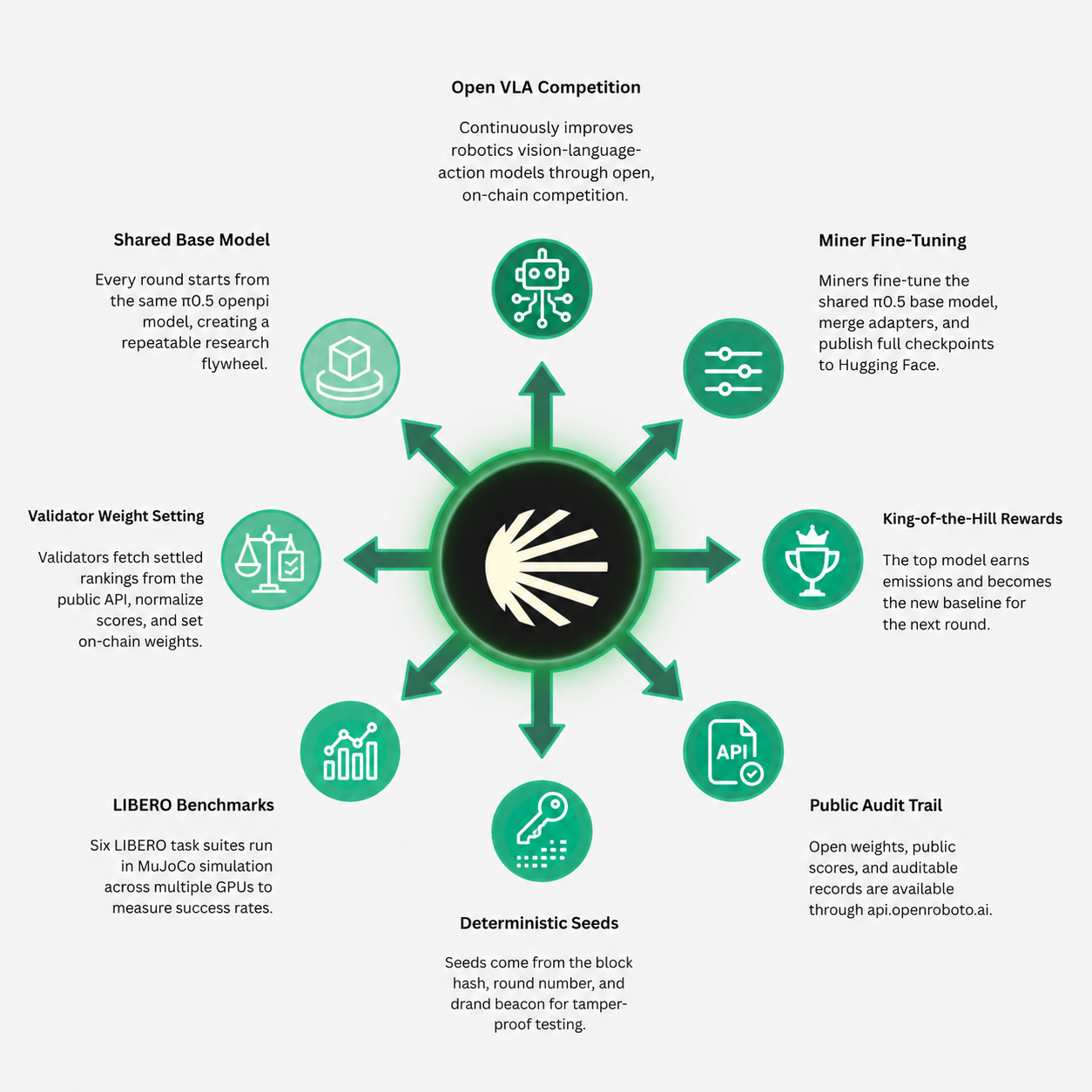
OpenRoboto is Bittensor Subnet 80 — an open, on-chain competition designed to continuously improve vision-language-action (VLA) models for robotics. The subnet orchestrates a repeatable research flywheel: a shared base model (π0.5, approximately 3 billion parameters, built on Physical Intelligence’s openpi framework) serves as the starting point for every round. Miners fine-tune that model using any training recipe they choose — including LoRA — then merge their adapter into a complete checkpoint and publish it to Hugging Face. They pay a small evaluation fee in TAO (currently 0.1 TAO, burned rather than transferred), announce their model commitment on-chain, and enter the evaluation queue. The winning model does not just earn emissions — it becomes the new baseline for the next round, compounding improvements over time.

Evaluation is handled by a decentralised backend and benchmark worker system. Once a miner’s burn is verified and a tamper-proof seed has been derived — using a SHA-256 hash of the commitment block hash, the subnet round number, and an independent drand beacon value — the submission enters a standardised testing pipeline. Six LIBERO task suites (libero_spatial, libero_goal, libero_object, libero_10, and two perturbation variants) are executed in MuJoCo simulation across multiple GPUs, producing reproducible success-rate scores. Every score, seed, and evaluation record is publicly auditable via the open API at api.openroboto.ai, and any miner can locally verify their results before submitting.

Validators on SN80 do not run evaluations themselves. Instead, validator.py fetches the settled ranking from the public API, normalises scores to unsigned 16-bit weights, and calls set_weights on the Bittensor chain — ensuring on-chain emissions are always aligned with independently verified benchmark performance. The ranking follows a king-of-the-hill model: a challenger must beat the reigning champion’s average by at least a defined margin to dethrone it, discouraging trivial copies and queue flooding.

What makes OpenRoboto distinctive within the Bittensor ecosystem is its commitment to full transparency. Every submitted model is a public open-weight artifact on Hugging Face. Every evaluation seed is deterministically derivable from public on-chain data and the drand randomness beacon. There is no private task data or hidden scoring — just open benchmarks, open weights, and on-chain economic accountability. The output of the subnet is a continuously improving, publicly accessible robotics model that anyone can download and use.

OpenRoboto is Bittensor Subnet 80 — an open, on-chain competition designed to continuously improve vision-language-action (VLA) models for robotics. The subnet orchestrates a repeatable research flywheel: a shared base model (π0.5, approximately 3 billion parameters, built on Physical Intelligence’s openpi framework) serves as the starting point for every round. Miners fine-tune that model using any training recipe they choose — including LoRA — then merge their adapter into a complete checkpoint and publish it to Hugging Face. They pay a small evaluation fee in TAO (currently 0.1 TAO, burned rather than transferred), announce their model commitment on-chain, and enter the evaluation queue. The winning model does not just earn emissions — it becomes the new baseline for the next round, compounding improvements over time.

Evaluation is handled by a decentralised backend and benchmark worker system. Once a miner’s burn is verified and a tamper-proof seed has been derived — using a SHA-256 hash of the commitment block hash, the subnet round number, and an independent drand beacon value — the submission enters a standardised testing pipeline. Six LIBERO task suites (libero_spatial, libero_goal, libero_object, libero_10, and two perturbation variants) are executed in MuJoCo simulation across multiple GPUs, producing reproducible success-rate scores. Every score, seed, and evaluation record is publicly auditable via the open API at api.openroboto.ai, and any miner can locally verify their results before submitting.

Validators on SN80 do not run evaluations themselves. Instead, validator.py fetches the settled ranking from the public API, normalises scores to unsigned 16-bit weights, and calls set_weights on the Bittensor chain — ensuring on-chain emissions are always aligned with independently verified benchmark performance. The ranking follows a king-of-the-hill model: a challenger must beat the reigning champion’s average by at least a defined margin to dethrone it, discouraging trivial copies and queue flooding.

What makes OpenRoboto distinctive within the Bittensor ecosystem is its commitment to full transparency. Every submitted model is a public open-weight artifact on Hugging Face. Every evaluation seed is deterministically derivable from public on-chain data and the drand randomness beacon. There is no private task data or hidden scoring — just open benchmarks, open weights, and on-chain economic accountability. The output of the subnet is a continuously improving, publicly accessible robotics model that anyone can download and use.

PURPOSE

What exactly is the 'product/build'?

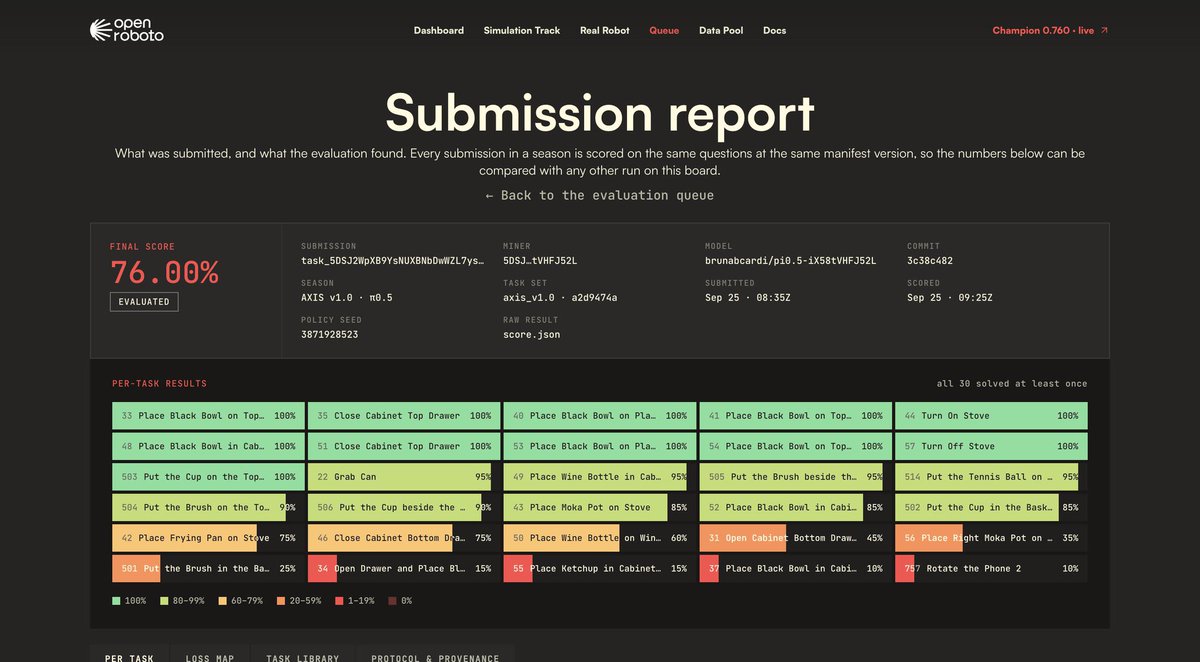
The product OpenRoboto delivers is an open, incentive-aligned research infrastructure for robotics model development. Rather than a single application, it is a decentralised R&D flywheel: each competition round produces a better open-weight VLA model that any researcher, robotics engineer, or organisation can download and build upon. The live leaderboard at openroboto.ai/#/benchmark shows every submission’s performance in real time, with deltas against the current baseline, giving the field an honest, reproducible reference point that closed-lab benchmarks cannot offer.

The primary target users are robotics machine-learning engineers, academic research labs, and decentralised AI teams who want to contribute to — or benefit from — state-of-the-art robot control models without needing access to expensive proprietary training infrastructure. Miners participate by running training jobs on their own GPU hardware, paying only the small per-submission burn fee. Validators earn Bittensor emissions in exchange for honest weight-setting. End users — robotics developers and researchers — benefit from a continuously improving, freely available model checkpoint.

Technically, the system is built around the π0.5 base model (a ~3B-parameter vision-language-action transformer from Physical Intelligence’s openpi project) and the LIBERO simulation benchmark suite running in MuJoCo. The evaluation harness fans tasks across multiple GPUs, runs 40 tasks × 10 trials per suite, and applies two anti-gaming perturbation benchmarks — LIBERO-Pro (16 suites across semantic, object, position-swap, and task-goal perturbations) and LIBERO-plus (10,030 variants across 7 robustness dimensions) — to ensure models that score well are genuinely robust, not memorising fixed demonstrations. The openroboto-evaluation repository is fully open-source under the MIT licence.

The subnet’s incentive structure directly reinforces the product goal. The burn mechanism (TAO burned, not paid to the operator) makes flooding the evaluation queue economically irrational. The one-commitment-per-hotkey-per-round rule prevents split-submission strategies. The king-of-the-hill ranking with a required champion margin punishes marginal weight copies. Together, these mechanisms mean the only reliable way to earn emissions on SN80 is to genuinely improve the shared robotics model — which is precisely what the subnet exists to do. The long-term vision, as stated in the project’s public communications, is for champion models to graduate from the simulation leaderboard into real-world factory deployment, bridging the sim-to-real gap through decentralised, open competition.

The product OpenRoboto delivers is an open, incentive-aligned research infrastructure for robotics model development. Rather than a single application, it is a decentralised R&D flywheel: each competition round produces a better open-weight VLA model that any researcher, robotics engineer, or organisation can download and build upon. The live leaderboard at openroboto.ai/#/benchmark shows every submission’s performance in real time, with deltas against the current baseline, giving the field an honest, reproducible reference point that closed-lab benchmarks cannot offer.

The primary target users are robotics machine-learning engineers, academic research labs, and decentralised AI teams who want to contribute to — or benefit from — state-of-the-art robot control models without needing access to expensive proprietary training infrastructure. Miners participate by running training jobs on their own GPU hardware, paying only the small per-submission burn fee. Validators earn Bittensor emissions in exchange for honest weight-setting. End users — robotics developers and researchers — benefit from a continuously improving, freely available model checkpoint.

Technically, the system is built around the π0.5 base model (a ~3B-parameter vision-language-action transformer from Physical Intelligence’s openpi project) and the LIBERO simulation benchmark suite running in MuJoCo. The evaluation harness fans tasks across multiple GPUs, runs 40 tasks × 10 trials per suite, and applies two anti-gaming perturbation benchmarks — LIBERO-Pro (16 suites across semantic, object, position-swap, and task-goal perturbations) and LIBERO-plus (10,030 variants across 7 robustness dimensions) — to ensure models that score well are genuinely robust, not memorising fixed demonstrations. The openroboto-evaluation repository is fully open-source under the MIT licence.

The subnet’s incentive structure directly reinforces the product goal. The burn mechanism (TAO burned, not paid to the operator) makes flooding the evaluation queue economically irrational. The one-commitment-per-hotkey-per-round rule prevents split-submission strategies. The king-of-the-hill ranking with a required champion margin punishes marginal weight copies. Together, these mechanisms mean the only reliable way to earn emissions on SN80 is to genuinely improve the shared robotics model — which is precisely what the subnet exists to do. The long-term vision, as stated in the project’s public communications, is for champion models to graduate from the simulation leaderboard into real-world factory deployment, bridging the sim-to-real gap through decentralised, open competition.

WHO

Team Info

OpenRoboto is operated by the openroboto-ai GitHub organisation, which acquired Bittensor netuid 80 and launched the subnet on mainnet in August 2026. The organisation’s GitHub profile lists its location as China and links to the official X account at @openroboto, but individual team members have not been publicly named in any available documentation, social posts, or press coverage as of the subnet’s launch. All GitHub organisation membership is set to private.

The technical output of the team is substantial and well-documented: two production-quality Python repositories (openroboto-subnet and openroboto-evaluation, both MIT-licensed), detailed protocol documentation covering the submission lifecycle, seed derivation, ranking logic, and API contract, and a live public leaderboard and queue dashboard. The subnet received an official retweet from the Opentensor Foundation at launch, signalling recognition within the core Bittensor ecosystem. Community engagement currently takes place via GitHub Issues and the Bittensor forums, with the team reachable at the contact address listed on tao.app.

While the absence of named founders is notable for a subnet at this stage, the depth and rigour of the public technical documentation — including transparent anti-gaming design, verifiable seed generation using drand, and a fully open evaluation harness — reflects a team with serious experience in machine learning systems engineering and decentralised protocol design. The project’s philosophy of radical openness (open weights, open data, open benchmarks) is embedded in every architectural decision, suggesting a research-first team rather than a commercially-driven one.

OpenRoboto is operated by the openroboto-ai GitHub organisation, which acquired Bittensor netuid 80 and launched the subnet on mainnet in August 2026. The organisation’s GitHub profile lists its location as China and links to the official X account at @openroboto, but individual team members have not been publicly named in any available documentation, social posts, or press coverage as of the subnet’s launch. All GitHub organisation membership is set to private.

The technical output of the team is substantial and well-documented: two production-quality Python repositories (openroboto-subnet and openroboto-evaluation, both MIT-licensed), detailed protocol documentation covering the submission lifecycle, seed derivation, ranking logic, and API contract, and a live public leaderboard and queue dashboard. The subnet received an official retweet from the Opentensor Foundation at launch, signalling recognition within the core Bittensor ecosystem. Community engagement currently takes place via GitHub Issues and the Bittensor forums, with the team reachable at the contact address listed on tao.app.

While the absence of named founders is notable for a subnet at this stage, the depth and rigour of the public technical documentation — including transparent anti-gaming design, verifiable seed generation using drand, and a fully open evaluation harness — reflects a team with serious experience in machine learning systems engineering and decentralised protocol design. The project’s philosophy of radical openness (open weights, open data, open benchmarks) is embedded in every architectural decision, suggesting a research-first team rather than a commercially-driven one.

FUTURE

Roadmap

OpenRoboto has outlined a staged roadmap that moves from pure simulation competition toward real-world robotics deployment. The current phase — active as of the August 2026 mainnet launch — focuses on the simulation leaderboard in MuJoCo: miners compete to improve the π0.5 base model across six LIBERO task suites under standardised, reproducible conditions. The subnet infrastructure, evaluation harness, and public API are all live, and the first champion model has been established as the baseline for ongoing rounds.

The second phase centres on continuously improving model quality through accumulated competition rounds. As more miners participate and the field of challengers broadens, the king-of-the-hill mechanism is designed to compound improvements — each new champion raises the floor for all future submissions. Planned protocol enhancements include expanding the suite of benchmark tasks, refining the perturbation benchmarks to capture broader generalisation, and potentially introducing an Open Data Pool where training datasets contributed by miners are shared across the network.

The long-term goal, described in the project’s public communications as moving “from a sim leaderboard to robots that earn their keep,” is factory deployment: champion models graduating from the simulation environment into real-world robotic workcells. This sim-to-real transfer ambition positions OpenRoboto not just as a research benchmark, but as a production pipeline for open robotics intelligence — with Bittensor’s economic incentives driving the journey from virtual evaluation to physical deployment.

OpenRoboto has outlined a staged roadmap that moves from pure simulation competition toward real-world robotics deployment. The current phase — active as of the August 2026 mainnet launch — focuses on the simulation leaderboard in MuJoCo: miners compete to improve the π0.5 base model across six LIBERO task suites under standardised, reproducible conditions. The subnet infrastructure, evaluation harness, and public API are all live, and the first champion model has been established as the baseline for ongoing rounds.

The second phase centres on continuously improving model quality through accumulated competition rounds. As more miners participate and the field of challengers broadens, the king-of-the-hill mechanism is designed to compound improvements — each new champion raises the floor for all future submissions. Planned protocol enhancements include expanding the suite of benchmark tasks, refining the perturbation benchmarks to capture broader generalisation, and potentially introducing an Open Data Pool where training datasets contributed by miners are shared across the network.

The long-term goal, described in the project’s public communications as moving “from a sim leaderboard to robots that earn their keep,” is factory deployment: champion models graduating from the simulation environment into real-world robotic workcells. This sim-to-real transfer ambition positions OpenRoboto not just as a research benchmark, but as a production pipeline for open robotics intelligence — with Bittensor’s economic incentives driving the journey from virtual evaluation to physical deployment.