With the amount of new subnets being added it can be hard to get up to date information across all subnets, so data may be slightly out of date from time to time
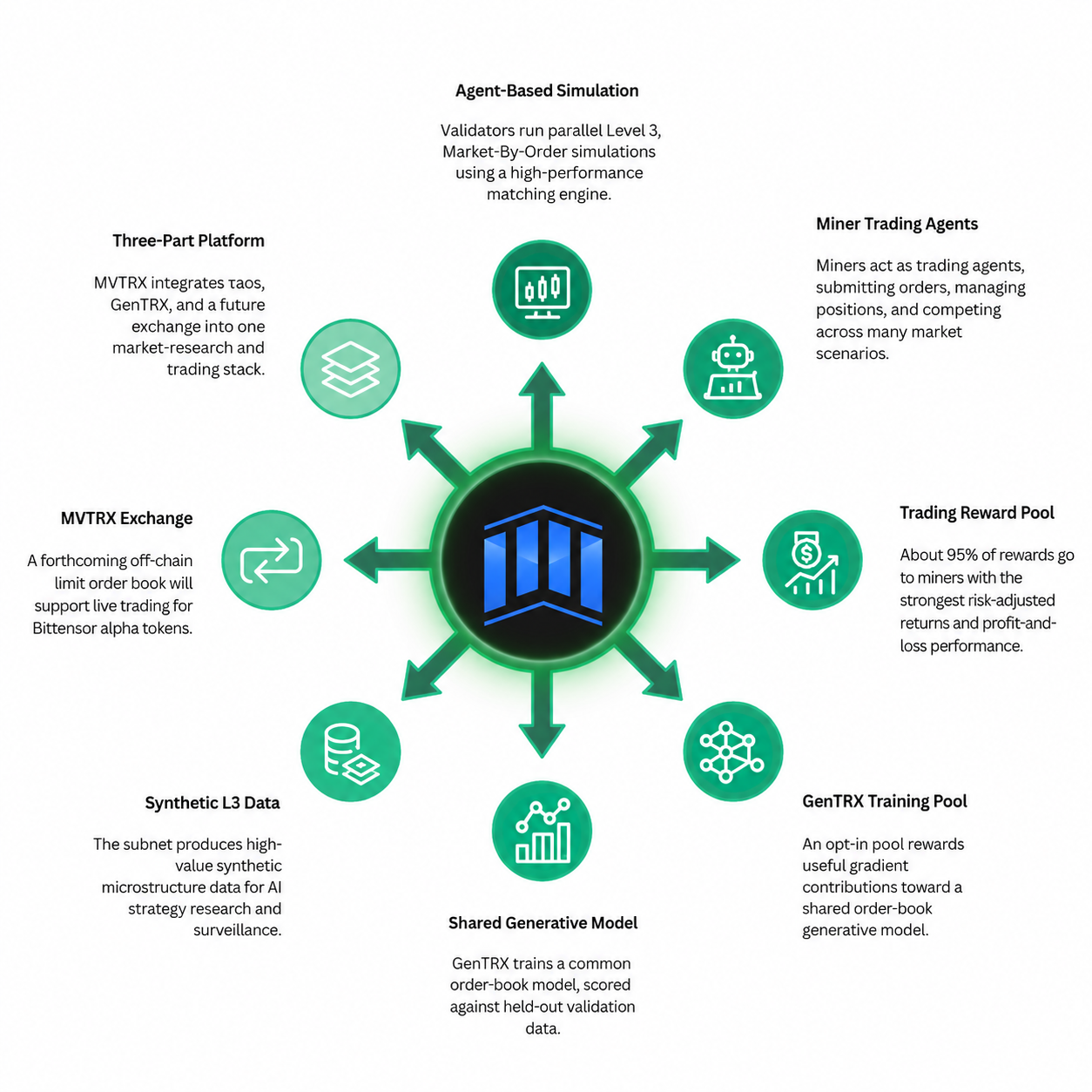
MVTRX is Bittensor Subnet 79 (SN79), a decentralised platform for market research, algorithmic trading strategy development, and AI model training. Launched on Bittensor MainNet on 7 May 2025, MVTRX operates across three tightly integrated components: τaos — an agent-based simulation of automated trading in intelligent markets; GenTRX — distributed training of a shared order-book generative model; and the MVTRX Exchange (forthcoming) — a live off-chain limit order book for Bittensor alpha tokens.
The τaos component sits at the heart of the subnet. Validators run a high-performance C++ simulation engine (built on MAXE) that constructs full Level 3, Market-By-Order (MBO) limit order books across many parallel market realisations simultaneously. Miners act as trading agents within these simulations — submitting orders, managing positions, and competing to maximise risk-adjusted returns. The simulation mirrors real exchange microstructure with remarkable fidelity: every background agent, order event, and price movement is processed through a central matching engine, producing high-resolution data that captures the full depth of market dynamics.
Miner rewards are split between two incentive pools. The trading pool (approximately 95% of rewards) scores miners on an intraday Kappa-3 ratio and profit-and-loss across all simulated orderbooks — rewarding strategies that are both high-performing and risk-managed. The GenTRX training pool (approximately 5%, opt-in) scores miners on the quality of gradients they contribute toward a shared order-book generative model, assessed against held-out validation data. The two pools operate independently and are merged at weight-setting time, so opting into GenTRX carries no penalty on trading rewards.
What makes MVTRX unique on Bittensor is its use of agent-based modelling to generate genuinely synthetic yet statistically rigorous market data at the L3/MBO level — a data type that is extremely valuable for AI strategy development, market surveillance, and regulatory analysis, but historically difficult and expensive to obtain. By incentivising miners to produce ever more intelligent and risk-managed trading behaviour, the subnet continuously improves both the realism of its simulation output and the quality of AI models trained on it.
MVTRX is Bittensor Subnet 79 (SN79), a decentralised platform for market research, algorithmic trading strategy development, and AI model training. Launched on Bittensor MainNet on 7 May 2025, MVTRX operates across three tightly integrated components: τaos — an agent-based simulation of automated trading in intelligent markets; GenTRX — distributed training of a shared order-book generative model; and the MVTRX Exchange (forthcoming) — a live off-chain limit order book for Bittensor alpha tokens.
The τaos component sits at the heart of the subnet. Validators run a high-performance C++ simulation engine (built on MAXE) that constructs full Level 3, Market-By-Order (MBO) limit order books across many parallel market realisations simultaneously. Miners act as trading agents within these simulations — submitting orders, managing positions, and competing to maximise risk-adjusted returns. The simulation mirrors real exchange microstructure with remarkable fidelity: every background agent, order event, and price movement is processed through a central matching engine, producing high-resolution data that captures the full depth of market dynamics.
Miner rewards are split between two incentive pools. The trading pool (approximately 95% of rewards) scores miners on an intraday Kappa-3 ratio and profit-and-loss across all simulated orderbooks — rewarding strategies that are both high-performing and risk-managed. The GenTRX training pool (approximately 5%, opt-in) scores miners on the quality of gradients they contribute toward a shared order-book generative model, assessed against held-out validation data. The two pools operate independently and are merged at weight-setting time, so opting into GenTRX carries no penalty on trading rewards.
What makes MVTRX unique on Bittensor is its use of agent-based modelling to generate genuinely synthetic yet statistically rigorous market data at the L3/MBO level — a data type that is extremely valuable for AI strategy development, market surveillance, and regulatory analysis, but historically difficult and expensive to obtain. By incentivising miners to produce ever more intelligent and risk-managed trading behaviour, the subnet continuously improves both the realism of its simulation output and the quality of AI models trained on it.
MVTRX is building a three-layer product stack that bridges simulation, AI training, and live trading. The first layer — the τaos sandbox — gives algorithmic traders a professional-grade simulation environment to stress-test strategies against realistic L3 order-book data. Up to 21% of mining rewards flow through an open algorithm race in this sandbox, creating direct economic incentives for strategy development and improvement. The simulation currently manages 40 parallel orderbooks, each with approximately 1,000 background agents, with a near-term goal of scaling to 1,000+ orderbooks to achieve meaningful statistical significance in performance evaluation.
The second layer — GenTRX distributed training — leverages the simulation data to collaboratively train a shared order-book generative model. Miners that opt in extend their trading agents to also perform federated gradient contributions: downloading assigned data slices from a validator-managed S3 bucket, running a training pass, and uploading compressed gradients. A gradient server sidecar evaluates submissions, applies overfitting penalties, and aggregates the best-scoring delta into a shared model checkpoint. This creates a continuously improving generative model of market microstructure — a research asset with direct value for quant research firms and AI-native trading desks.
The third layer — the MVTRX Exchange — is the culmination of the stack. It will operate as a live, off-chain limit order book exchange for Bittensor alpha tokens, running the same C++ matching engine used in the simulation. Up to 79% of mining rewards will flow through a closed algorithm race on the live exchange, where miners deploy real capital and compete for liquidity incentives. This architecture means strategies proven in simulation can move directly to live trading without any change in infrastructure. The exchange is expected to offer advanced features for transparency, market quality, and active risk management.
Target users span quantitative finance and crypto: algorithmic traders looking for low-risk strategy incubation, HFT developers needing realistic L3 microstructure data, AI and ML researchers building generative market models, and institutional participants in the Bittensor ecosystem seeking better tools for alpha token liquidity and price discovery. The subnet’s incentive design aligns all participants — miners, validators, and token holders — around the goal of producing the highest-quality market simulation and trading intelligence data possible.
MVTRX is building a three-layer product stack that bridges simulation, AI training, and live trading. The first layer — the τaos sandbox — gives algorithmic traders a professional-grade simulation environment to stress-test strategies against realistic L3 order-book data. Up to 21% of mining rewards flow through an open algorithm race in this sandbox, creating direct economic incentives for strategy development and improvement. The simulation currently manages 40 parallel orderbooks, each with approximately 1,000 background agents, with a near-term goal of scaling to 1,000+ orderbooks to achieve meaningful statistical significance in performance evaluation.
The second layer — GenTRX distributed training — leverages the simulation data to collaboratively train a shared order-book generative model. Miners that opt in extend their trading agents to also perform federated gradient contributions: downloading assigned data slices from a validator-managed S3 bucket, running a training pass, and uploading compressed gradients. A gradient server sidecar evaluates submissions, applies overfitting penalties, and aggregates the best-scoring delta into a shared model checkpoint. This creates a continuously improving generative model of market microstructure — a research asset with direct value for quant research firms and AI-native trading desks.
The third layer — the MVTRX Exchange — is the culmination of the stack. It will operate as a live, off-chain limit order book exchange for Bittensor alpha tokens, running the same C++ matching engine used in the simulation. Up to 79% of mining rewards will flow through a closed algorithm race on the live exchange, where miners deploy real capital and compete for liquidity incentives. This architecture means strategies proven in simulation can move directly to live trading without any change in infrastructure. The exchange is expected to offer advanced features for transparency, market quality, and active risk management.
Target users span quantitative finance and crypto: algorithmic traders looking for low-risk strategy incubation, HFT developers needing realistic L3 microstructure data, AI and ML researchers building generative market models, and institutional participants in the Bittensor ecosystem seeking better tools for alpha token liquidity and price discovery. The subnet’s incentive design aligns all participants — miners, validators, and token holders — around the goal of producing the highest-quality market simulation and trading intelligence data possible.
MVTRX is developed by the team behind taos.im, a pseudonymous research and engineering group operating within the Bittensor ecosystem. The GitHub organisation — previously named taos-im, now rebranded as MVTRX — has no public members listed, which is consistent with a privacy-first approach common to technically-focused Bittensor teams. The project’s whitepaper and technical documentation are published via simulate.trading.
While no individuals are named publicly, the team’s technical output speaks clearly to a high level of expertise. They have authored a custom C++ agent-based matching engine (extending the open-source MAXE project), a Python-based Bittensor validator framework, a federated gradient training system (GenTRX), and a detailed academic-style whitepaper that cites peer-reviewed market microstructure research, including Chiarella et al. (2007) and Vuorenmaa & Wang (2014). The combination of exchange engineering, quantitative finance domain knowledge, and distributed systems design represents a rare and specialised skill set within the broader AI subnet landscape.
The project launched on Bittensor MainNet on 7 May 2025 after what the team described as a challenging but ultimately successful journey. Since launch, the codebase has been actively maintained — receiving over 112 commits as of mid-2026 — and has attracted a community of 1,052+ alpha token holders and significant conviction staking. A detailed public code review was published by the independent research platform IntoTAO (vaNlabs) in June 2026, further validating the technical quality of the implementation.
MVTRX is developed by the team behind taos.im, a pseudonymous research and engineering group operating within the Bittensor ecosystem. The GitHub organisation — previously named taos-im, now rebranded as MVTRX — has no public members listed, which is consistent with a privacy-first approach common to technically-focused Bittensor teams. The project’s whitepaper and technical documentation are published via simulate.trading.
While no individuals are named publicly, the team’s technical output speaks clearly to a high level of expertise. They have authored a custom C++ agent-based matching engine (extending the open-source MAXE project), a Python-based Bittensor validator framework, a federated gradient training system (GenTRX), and a detailed academic-style whitepaper that cites peer-reviewed market microstructure research, including Chiarella et al. (2007) and Vuorenmaa & Wang (2014). The combination of exchange engineering, quantitative finance domain knowledge, and distributed systems design represents a rare and specialised skill set within the broader AI subnet landscape.
The project launched on Bittensor MainNet on 7 May 2025 after what the team described as a challenging but ultimately successful journey. Since launch, the codebase has been actively maintained — receiving over 112 commits as of mid-2026 — and has attracted a community of 1,052+ alpha token holders and significant conviction staking. A detailed public code review was published by the independent research platform IntoTAO (vaNlabs) in June 2026, further validating the technical quality of the implementation.
MVTRX has a clearly sequenced roadmap with two major phases already underway and a third on the horizon. The τaos simulation and GenTRX distributed training components are both live on Bittensor MainNet as of 2025. The immediate near-term development focus is scaling the simulation from its current 40 parallel orderbooks to 1,000+ orderbooks — a milestone the team identifies as necessary to achieve statistically meaningful evaluations of miner performance, and to produce datasets large enough to train production-quality generative models.
The most anticipated milestone is the launch of the MVTRX Exchange — a live, off-chain limit order book for Bittensor alpha tokens. The exchange will use the same battle-tested C++ matching engine currently powering the simulation, enabling a seamless transition from paper trading to live markets. When the exchange enters testnet, the team plans to publish full mechanism details for the additional reward dimensions it will introduce for both miners and validators. Mechanism details for the live exchange component have been deliberately held back until testnet, reflecting a measured, research-first approach to product rollout.
Beyond the exchange, the roadmap includes transitioning miner-validator communication from a request-response model to continuous bidirectional streaming — more closely matching how real exchanges operate — and expanding the diversity of simulated asset classes and market conditions. The scoring model will continue to evolve as new performance metrics are added to drive the most useful possible real-world outputs from the subnet.
MVTRX has a clearly sequenced roadmap with two major phases already underway and a third on the horizon. The τaos simulation and GenTRX distributed training components are both live on Bittensor MainNet as of 2025. The immediate near-term development focus is scaling the simulation from its current 40 parallel orderbooks to 1,000+ orderbooks — a milestone the team identifies as necessary to achieve statistically meaningful evaluations of miner performance, and to produce datasets large enough to train production-quality generative models.
The most anticipated milestone is the launch of the MVTRX Exchange — a live, off-chain limit order book for Bittensor alpha tokens. The exchange will use the same battle-tested C++ matching engine currently powering the simulation, enabling a seamless transition from paper trading to live markets. When the exchange enters testnet, the team plans to publish full mechanism details for the additional reward dimensions it will introduce for both miners and validators. Mechanism details for the live exchange component have been deliberately held back until testnet, reflecting a measured, research-first approach to product rollout.
Beyond the exchange, the roadmap includes transitioning miner-validator communication from a request-response model to continuous bidirectional streaming — more closely matching how real exchanges operate — and expanding the diversity of simulated asset classes and market conditions. The scoring model will continue to evolve as new performance metrics are added to drive the most useful possible real-world outputs from the subnet.
Novelty Search is great, but for most investors trying to understand Bittensor, the technical depth is a wall, not a bridge. If we’re going to attract investment into this ecosystem then we need more people to understand it! That’s why Siam Kidd and Mark Creaser from DSV Fund have launched Revenue Search, where they ask the simple questions that investors want to know the answers to.
This session begins with Mark and Siam chatting about a proposed new Bittensor “shorting mechanism” aimed at punishing malicious or gaming subnets by letting markets drive their alpha toward zero and trigger deregistration—while flagging obvious risks like self-shorting by subnet owners and the broader concern that changing market rules can make the ecosystem feel less investable. They then bring on Tommi from Subnet 79 (rebranded from “Taos” to “MVTRX”), who explains they’re building a state-of-the-art exchange for Bittensor dTAO/alpha tokens, paired with a sophisticated sandbox simulation framework (C++/Rust) where miners can test trading algorithms under many parallel, realistic limit-order-book simulations before deploying to live trading.
MVTRX Follow 420 981
Building the future of intelligent markets. SOTA dTAO exchange powered by SN79.
The strategy is yours.
The proof is public.
That's the whole idea.
How many strategies died in your drafts because testing them properly cost too much?
Nobody buys a pitch twice.
Proof sells itself.
Your strategy idea isn't worth much.
Ideas are everywhere.
And the record becomes an asset - mint the strategy as an NFT, let others license it.
Ideas are cheap. Proof is the product. Which would you pay for - a pitch or a record?
Fall plans - Montreal in September, Chicago in October, and the Bachelier conversations keep going. The research isn't decoration. It's the plan.
A track record nobody can verify is just a story.
Put it on-chain and it's a fact.