With the amount of new subnets being added it can be hard to get up to date information across all subnets, so data may be slightly out of date from time to time
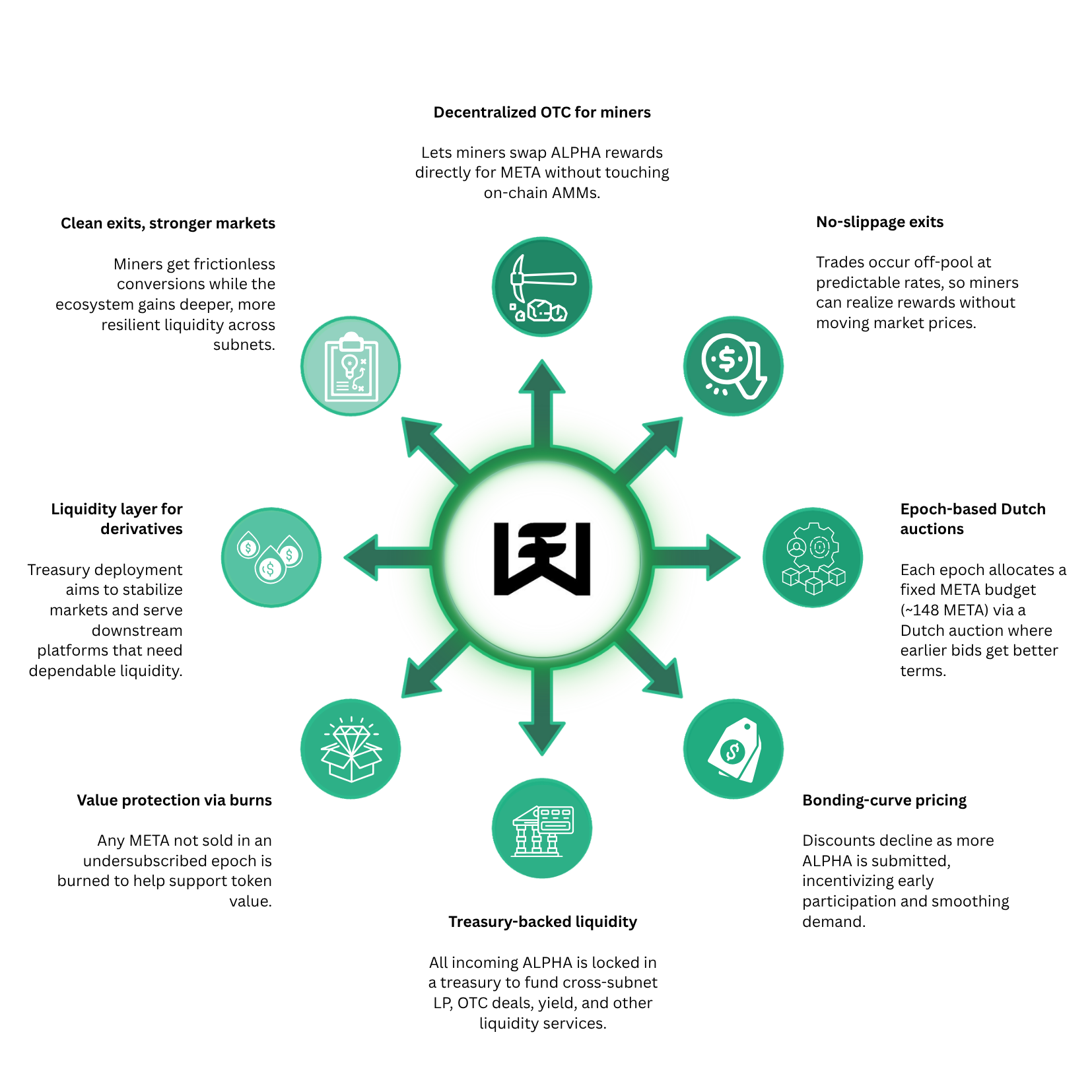
MetaHash (Bittensor Subnet 73) is essentially a decentralized OTC (over-the-counter) marketplace for Bittensor miners. In practice, it lets network participants swap their earned subnet tokens (“ALPHA” rewards) directly for the SN73 native token (“META”) without going through on-chain liquidity pools. This means miners can exit their subnet positions without slippage or price impact on the original subnet. MetaHash is explicitly described as “the first meta-mining subnet on Bittensor — a decentralized OTC marketplace for Bittensor miners”. All ALPHA submitted in an epoch is routed into a treasury, which is then used for purposes like providing cross-subnet liquidity (e.g. Uniswap V3 pools), executing other OTC trades, earning yield, etc.. The system operates in discrete epochs: each epoch has a three-phase cycle – (1) finalize rewards for the previous auction, (2) a short preparation window, then (3) a Dutch auction where miners bid by sending ALPHA in exchange for META. Early bids get larger discounts (higher META per ALPHA) as determined by a bonding curve.
No-slippage swaps: Miners can transfer ALPHA to acquire META at a predictable rate, avoiding on-pool price impact.
Epoch auctions: Each epoch distributes a fixed budget of META (≈148 META per epoch) to miners via a Dutch auction. The auction starts at a high “discount” (cheap META) that gradually decreases as more ALPHA enters the treasury. This incentivizes early participation and smooths demand.
Treasury-backed liquidity: All ALPHA received is locked in a subnet treasury. The dev team indicates this treasury funds various ecosystem supports (liquidity pools, yield strategies, OTC trades, consumption of digital goods, etc.) to “serve as a liquidity layer for derivative platforms”. Unused META (if the auction is undersubscribed) is burned to protect token value.
MetaHash (Bittensor Subnet 73) is essentially a decentralized OTC (over-the-counter) marketplace for Bittensor miners. In practice, it lets network participants swap their earned subnet tokens (“ALPHA” rewards) directly for the SN73 native token (“META”) without going through on-chain liquidity pools. This means miners can exit their subnet positions without slippage or price impact on the original subnet. MetaHash is explicitly described as “the first meta-mining subnet on Bittensor — a decentralized OTC marketplace for Bittensor miners”. All ALPHA submitted in an epoch is routed into a treasury, which is then used for purposes like providing cross-subnet liquidity (e.g. Uniswap V3 pools), executing other OTC trades, earning yield, etc.. The system operates in discrete epochs: each epoch has a three-phase cycle – (1) finalize rewards for the previous auction, (2) a short preparation window, then (3) a Dutch auction where miners bid by sending ALPHA in exchange for META. Early bids get larger discounts (higher META per ALPHA) as determined by a bonding curve.
No-slippage swaps: Miners can transfer ALPHA to acquire META at a predictable rate, avoiding on-pool price impact.
Epoch auctions: Each epoch distributes a fixed budget of META (≈148 META per epoch) to miners via a Dutch auction. The auction starts at a high “discount” (cheap META) that gradually decreases as more ALPHA enters the treasury. This incentivizes early participation and smooths demand.
Treasury-backed liquidity: All ALPHA received is locked in a subnet treasury. The dev team indicates this treasury funds various ecosystem supports (liquidity pools, yield strategies, OTC trades, consumption of digital goods, etc.) to “serve as a liquidity layer for derivative platforms”. Unused META (if the auction is undersubscribed) is burned to protect token value.
There is no front-end product – MetaHash is a software protocol/subnet built on the Bittensor platform. The entire implementation is open-source (in the fx-integral/metahash GitHub repo) and written in Python, following standard Bittensor subnet patterns. Nodes run as Python processes (“miners” and “validators”) that interact with the Bittensor network.
Validators run a similar run_validator script. Internally, each epoch’s logic (auction mechanics, reward calculations, bonding curve) is encoded in on-chain consensus code and off-chain Python scripts. The code defines how ALPHA inputs are tracked and how weights are computed using the Dutch auction/bonding-curve formula. In short, the “product” is the subnet code itself – a specialized Bittensor consensus module – rather than a user application. Key architectural points:
Epoch-based auction logic: Custom on-chain routines handle a 3-phase auction per epoch. Validators calculate each miner’s share of META based on incoming ALPHA using a decaying bonding curve.
Python node scripts: Miners/validators join the network via Python scripts (run_miner / run_validator) that submit on-chain transactions and fetch state. This is the standard Bittensor subnet setup.
Bonding curve pricing: The protocol uses a mathematical formula (rate = max(r_min, C₀/(1+β·m))) to price ALPHA contributions. This ensures early ALPHA buys more META, and caps excess payouts.
Treasury and smart contracts: While not detailed in open docs, the mention of a “treasury” implies on-chain accounts or contracts that accumulate ALPHA and manage META issuance. In other words, incoming ALPHA is locked on-chain and only released as META via the epoch logic.
There is no front-end product – MetaHash is a software protocol/subnet built on the Bittensor platform. The entire implementation is open-source (in the fx-integral/metahash GitHub repo) and written in Python, following standard Bittensor subnet patterns. Nodes run as Python processes (“miners” and “validators”) that interact with the Bittensor network.
Validators run a similar run_validator script. Internally, each epoch’s logic (auction mechanics, reward calculations, bonding curve) is encoded in on-chain consensus code and off-chain Python scripts. The code defines how ALPHA inputs are tracked and how weights are computed using the Dutch auction/bonding-curve formula. In short, the “product” is the subnet code itself – a specialized Bittensor consensus module – rather than a user application. Key architectural points:
Epoch-based auction logic: Custom on-chain routines handle a 3-phase auction per epoch. Validators calculate each miner’s share of META based on incoming ALPHA using a decaying bonding curve.
Python node scripts: Miners/validators join the network via Python scripts (run_miner / run_validator) that submit on-chain transactions and fetch state. This is the standard Bittensor subnet setup.
Bonding curve pricing: The protocol uses a mathematical formula (rate = max(r_min, C₀/(1+β·m))) to price ALPHA contributions. This ensures early ALPHA buys more META, and caps excess payouts.
Treasury and smart contracts: While not detailed in open docs, the mention of a “treasury” implies on-chain accounts or contracts that accumulate ALPHA and manage META issuance. In other words, incoming ALPHA is locked on-chain and only released as META via the epoch logic.
The known lead developer and creator goes by the handle “Fxintegral” and corresponds to a GitHub account (fx-integral) which hosts the project’s code, as well as a Twitter/X profile (@fxintegral_T). The Twitter profile tagline for Fxintegral confirms their role by describing Metahash’s mission, and early announcements explicitly credit “Metahash by @fxintegral_T” as the subnet’s introduction to the community. In the repository’s commit history, the author name “tegridy” appears, suggesting that the primary developer’s pseudonym might be Tegridy (potentially the same person behind Fxintegral). At this stage, the team appears to be small – likely one primary developer (Fxintegral/Tegridy) with possible support from a few community testers.
The project is open source, so community members can contribute via the GitHub repository. So far, no additional core contributors have been publicly named. Community presence: The Metahash team and community interact through public channels.
The known lead developer and creator goes by the handle “Fxintegral” and corresponds to a GitHub account (fx-integral) which hosts the project’s code, as well as a Twitter/X profile (@fxintegral_T). The Twitter profile tagline for Fxintegral confirms their role by describing Metahash’s mission, and early announcements explicitly credit “Metahash by @fxintegral_T” as the subnet’s introduction to the community. In the repository’s commit history, the author name “tegridy” appears, suggesting that the primary developer’s pseudonym might be Tegridy (potentially the same person behind Fxintegral). At this stage, the team appears to be small – likely one primary developer (Fxintegral/Tegridy) with possible support from a few community testers.
The project is open source, so community members can contribute via the GitHub repository. So far, no additional core contributors have been publicly named. Community presence: The Metahash team and community interact through public channels.
Metahash was launched in April 2025 (known then as Merit). Given its recent launch, it is in an early phase of deployment, sometimes referred to as an “alpha” stage. At launch, the code and whitepaper were made available and the basic functionality (cross-subnet scoring with ping checks) was up and running.
Key launch milestones achieved:
Current status (Mid-2025): Metahash is operational with a small but growing set of miners and validators. Being new, it likely hasn’t reached its maximum capacity (Bittensor subnets can have up to 256 miners, but Metahash currently has far fewer). The emission rate for Merit is still low relative to larger subnets – the root subnet’s allocation for SN-73 might be minimal until Metahash proves its utility. This period is essentially a trial by fire: the community can observe how Metahash’s incentive model performs. Key things being monitored now include:
The short-term roadmap for Metahash is likely about refinement and stabilization. Ee can infer some near-term plans:
Looking further ahead, the medium to long-term strategic goals for Metahash tie back to its mission of fostering cross-network collaboration:
In terms of concrete upcoming milestones, the community can watch for:
It’s important to note that Metahash’s formal roadmap is not yet public, and the above are logical projections. The founder has stated that at its core Metahash aims to “foster a collaborative space” for the community of miners. This suggests the philosophy guiding future plans is one of openness and collaboration. As the project grows, we can expect the Metahash team to remain communicative via Discord/Twitter about upcoming features or adjustments. The long-term vision is to ensure Metahash continues to fairly and effectively reward cross-network contributors, thereby strengthening Bittensor’s decentralized AI marketplace as a whole.
In conclusion, Bittensor Subnet 73 – Meethash – is in its infancy but has a well-defined purpose and mechanism. Going forward, its success will be measured by how well it incentivizes positive behavior network-wide and how it adapts to Bittensor’s evolution. The community-driven roadmap will evolve with input from miners and validators, steering Metahash toward its goal of making “meritocracy” a reality in decentralized AI.
Metahash was launched in April 2025 (known then as Merit). Given its recent launch, it is in an early phase of deployment, sometimes referred to as an “alpha” stage. At launch, the code and whitepaper were made available and the basic functionality (cross-subnet scoring with ping checks) was up and running.
Key launch milestones achieved:
Current status (Mid-2025): Metahash is operational with a small but growing set of miners and validators. Being new, it likely hasn’t reached its maximum capacity (Bittensor subnets can have up to 256 miners, but Metahash currently has far fewer). The emission rate for Merit is still low relative to larger subnets – the root subnet’s allocation for SN-73 might be minimal until Metahash proves its utility. This period is essentially a trial by fire: the community can observe how Metahash’s incentive model performs. Key things being monitored now include:
The short-term roadmap for Metahash is likely about refinement and stabilization. Ee can infer some near-term plans:
Looking further ahead, the medium to long-term strategic goals for Metahash tie back to its mission of fostering cross-network collaboration:
In terms of concrete upcoming milestones, the community can watch for:
It’s important to note that Metahash’s formal roadmap is not yet public, and the above are logical projections. The founder has stated that at its core Metahash aims to “foster a collaborative space” for the community of miners. This suggests the philosophy guiding future plans is one of openness and collaboration. As the project grows, we can expect the Metahash team to remain communicative via Discord/Twitter about upcoming features or adjustments. The long-term vision is to ensure Metahash continues to fairly and effectively reward cross-network contributors, thereby strengthening Bittensor’s decentralized AI marketplace as a whole.
In conclusion, Bittensor Subnet 73 – Meethash – is in its infancy but has a well-defined purpose and mechanism. Going forward, its success will be measured by how well it incentivizes positive behavior network-wide and how it adapts to Bittensor’s evolution. The community-driven roadmap will evolve with input from miners and validators, steering Metahash toward its goal of making “meritocracy” a reality in decentralized AI.
Happy to announce AceGuard ♠️
We’re building a Bittensor subnet to detect bots in competitive environments, starting with online poker.
Born in gaming. Built for trust.
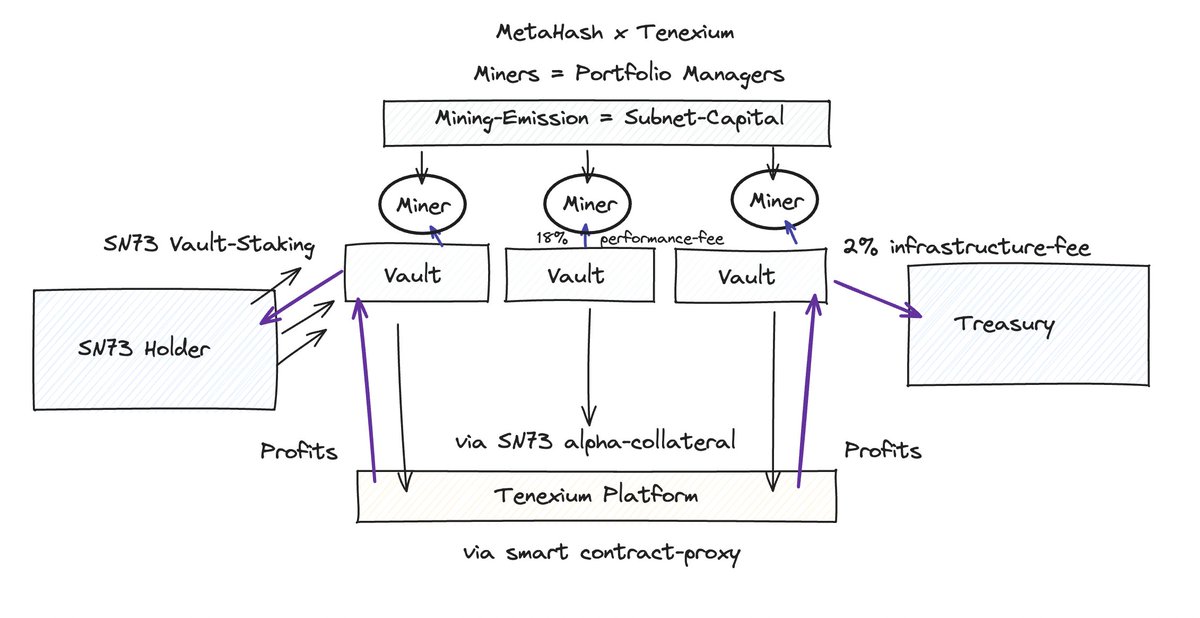
MetaHash × Tenexium - The Vault Engine Is Now Live
MetaHash v4 turns miners into Portfolio Managers. Each miner operates a performance-driven vault funded directly by miner emissions.
With the @Tenex_SN67 integration, these vaults become active trading engines. They can deploy
@mentatminds is now optimizing the MetaHash treasury through dynamic delegation to top-performing validators.
As part of our ongoing capital deployment strategy, we have delegated treasury alpha to the Mentat Minds validator.
What this unlocks:
🔥 Stronger exposure to
Mentat Minds is now optimizing @MetaHashSn73 treasury through dynamic allocation to top-performing validators.
🚀 SN73 × SN67 (Tenexium) is live.
MetaHash v4 turns miners into dTAO hedge-fund managers : each miner receives a performance-driven vault funded with mining emission.
Now these vaults level up:
MetaHash vaults can now trade perpetuals on Tenexium using SN73 as collateral.
→
TaoFlow update is here and MetaHash is perfectly positioned! Lets see why 👇
Without realizing it, we have positioned ourselves perfectly for this unexpected emission mechanism update in $TAO.
We have been building up the treasury for the last couple of months and this gives us