With the amount of new subnets being added it can be hard to get up to date information across all subnets, so data may be slightly out of date from time to time
StreetVision is a specialized Bittensor subnet for analyzing crowdsourced street-level imagery to improve mapping and autonomous driving (Physical AI). It ingests 360° video and images from NATIX’s global camera network and outputs refined AI models and map insights. In NATIX’s words, StreetVision “combines NATIX’s curated real-world data with Bittensor’s crowdsourced intelligence” to create a “trustless, ever-evolving ecosystem” for autonomous vehicles and smart maps.
The initial focus is real-time roadwork detection (for navigation safety and map updates), but it will quickly expand to other infrastructure use cases (potholes, road signs, litter, etc.) and scenario classification (edge-case driving scenarios). As NATIX explains, StreetVision ingests live street imagery, continuously trains better models via miner competition, and feeds those models back to edge devices (smartphones/dashcams) for real-time analysis. In short, it uses decentralized AI to turn NATIX’s massive crowdsourced map data into actionable models for safer, more up-to-date maps and autonomous driving.
StreetVision is a specialized Bittensor subnet for analyzing crowdsourced street-level imagery to improve mapping and autonomous driving (Physical AI). It ingests 360° video and images from NATIX’s global camera network and outputs refined AI models and map insights. In NATIX’s words, StreetVision “combines NATIX’s curated real-world data with Bittensor’s crowdsourced intelligence” to create a “trustless, ever-evolving ecosystem” for autonomous vehicles and smart maps.
The initial focus is real-time roadwork detection (for navigation safety and map updates), but it will quickly expand to other infrastructure use cases (potholes, road signs, litter, etc.) and scenario classification (edge-case driving scenarios). As NATIX explains, StreetVision ingests live street imagery, continuously trains better models via miner competition, and feeds those models back to edge devices (smartphones/dashcams) for real-time analysis. In short, it uses decentralized AI to turn NATIX’s massive crowdsourced map data into actionable models for safer, more up-to-date maps and autonomous driving.
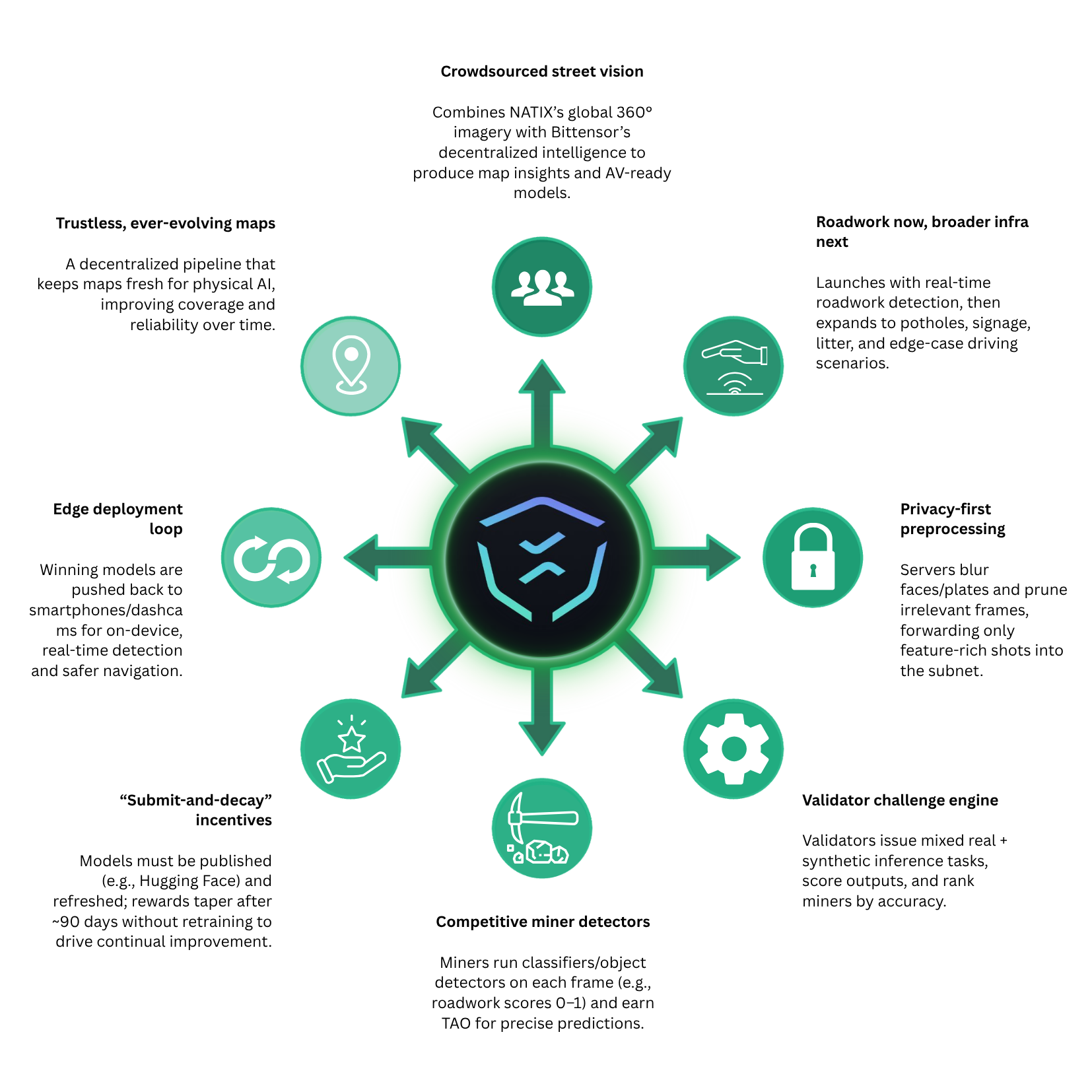
StreetVision follows a decentralized data pipeline on Bittensor with distinct roles for data ingestion, filtering, validators, and miners. In practice, NATIX’s system works as follows:
The subnet runs under Bittensor’s incentive model: it issues dTAO tokens each block (around 2 per block) shared by miners, validators, and NATIX as owner. Validators must stake NATIX tokens (and hold Alpha tokens) to participate; miners currently have no staking requirement to encourage wide participation. Together, this framework encourages a global community of miners and validators to build and refine the vision models while NATIX supplies the raw data.
Products and Applications
StreetVision sits atop NATIX’s DePIN platform of crowdsourced mapping. Key NATIX offerings feed into it:
StreetVision Platform: The subnet provides a backend AI service for smart mobility. Its applications include:
In essence, StreetVision is not a consumer app, but an AI platform: it processes NATIX’s live data to produce intelligent insights and models that feed back into NATIX’s ecosystem of apps and devices.
Architecture and Technical Details
Technically, StreetVision spans from edge hardware through Bittensor nodes:
Taken together, StreetVision is a physical-to-digital AI stack: real-world video → cloud preprocessing → Bittensor validators/miners → refined models → edge inference.
StreetVision follows a decentralized data pipeline on Bittensor with distinct roles for data ingestion, filtering, validators, and miners. In practice, NATIX’s system works as follows:
The subnet runs under Bittensor’s incentive model: it issues dTAO tokens each block (around 2 per block) shared by miners, validators, and NATIX as owner. Validators must stake NATIX tokens (and hold Alpha tokens) to participate; miners currently have no staking requirement to encourage wide participation. Together, this framework encourages a global community of miners and validators to build and refine the vision models while NATIX supplies the raw data.
Products and Applications
StreetVision sits atop NATIX’s DePIN platform of crowdsourced mapping. Key NATIX offerings feed into it:
StreetVision Platform: The subnet provides a backend AI service for smart mobility. Its applications include:
In essence, StreetVision is not a consumer app, but an AI platform: it processes NATIX’s live data to produce intelligent insights and models that feed back into NATIX’s ecosystem of apps and devices.
Architecture and Technical Details
Technically, StreetVision spans from edge hardware through Bittensor nodes:
Taken together, StreetVision is a physical-to-digital AI stack: real-world video → cloud preprocessing → Bittensor validators/miners → refined models → edge inference.
NATIX is led by its founding team, supported by strategic partners in AI and mobility:
Alireza Ghods, Ph.D. – Co-founder & CEO of NATIX. (10+ years in IoT, mapping, autonomous driving).
Lorenz Muck – Co-founder & CPO. (VR/Computer Vision product expert).
Omid Mogharian – Co-founder & CTO. (15+ years in software and blockchain).
Dr. Ulrich Lages – Core contributor (Automotive Lead). (LiDAR pioneer with 30+ years in AI/AV).
Partnering organizations:
Yuma (DCG) – An AI infrastructure company incubated by Digital Currency Group. Yuma guided StreetVision’s launch, contributing AI modeling and go-to-market support. (Yuma is explicitly credited for incubating Subnet 72.)
BitMind – Open-source AI architecture (cited as inspiration for the subnet).
Grab – Southeast Asian tech “super-app”; collaborated on the VX360 hardware. Grab is also an early customer (using NATIX data for maps).
Solana Labs – Underlying blockchain (NATIX runs on Solana).
Bittensor Foundation – The core decentralized AI network. (Subnet is part of Bittensor’s ecosystem; validators are part of Bittensor community).
These affiliations and personnel are publicly verifiable from NATIX’s site and press. For instance, NATIX’s “About” page lists the founders and core contributors, and the StreetVision announcement explicitly names Yuma/DCG involvement and Grab’s role.
NATIX is led by its founding team, supported by strategic partners in AI and mobility:
Alireza Ghods, Ph.D. – Co-founder & CEO of NATIX. (10+ years in IoT, mapping, autonomous driving).
Lorenz Muck – Co-founder & CPO. (VR/Computer Vision product expert).
Omid Mogharian – Co-founder & CTO. (15+ years in software and blockchain).
Dr. Ulrich Lages – Core contributor (Automotive Lead). (LiDAR pioneer with 30+ years in AI/AV).
Partnering organizations:
Yuma (DCG) – An AI infrastructure company incubated by Digital Currency Group. Yuma guided StreetVision’s launch, contributing AI modeling and go-to-market support. (Yuma is explicitly credited for incubating Subnet 72.)
BitMind – Open-source AI architecture (cited as inspiration for the subnet).
Grab – Southeast Asian tech “super-app”; collaborated on the VX360 hardware. Grab is also an early customer (using NATIX data for maps).
Solana Labs – Underlying blockchain (NATIX runs on Solana).
Bittensor Foundation – The core decentralized AI network. (Subnet is part of Bittensor’s ecosystem; validators are part of Bittensor community).
These affiliations and personnel are publicly verifiable from NATIX’s site and press. For instance, NATIX’s “About” page lists the founders and core contributors, and the StreetVision announcement explicitly names Yuma/DCG involvement and Grab’s role.
2020: NATIX Network founded (Hamburg); launched Drive& app to crowdsource mapping data.
2023–2024: 250K+ drivers joined; the network mapped 170M+ km of roads. Platform matured to include wearable/automotive devices.
Nov 2024: Launched the VX360 Tesla camera device and companion app. Secured first enterprise data client (large geospatial firm). Burned 33M+ $NATIX tokens as part of tokenomics. Achieved a “Network Laps” milestone of 100M km, rewarding users.
Q1 2025: Network grew to ~244K users and ~153M km mapped. NATIX relaunched its Network Laps V2 reward program and burned another 38M+ $NATIX. New partnerships announced (e.g. with E-Money, RepairPal).
May 2025: StreetVision Subnet (Subnet 72) launched on Bittensor. This marked the beginning of on-chain training of the roadwork-detection model. Initial tasks (roadwork classification) went live to test the system.
Current (mid-2025): StreetVision is processing NATIX’s live data feeds. Grab is a paying customer already integrating NATIX data. The team is adding validators and encouraging miners (now open without staking requirements). Several autonomous-driving companies are in talks to use the data/models. NATIX holds regular updates (monthly “Progress” blogs and AMAs) hinting at big announcements ahead.
Upcoming: The subnet will broaden its scope. As NATIX and its press note, next targets include pothole detection, sign recognition, litter identification, and infrastructure monitoring. They will also enable scenario classification of driving videos for AV simulation. In parallel, NATIX plans to monetize these models and insights (via protocol revenue) to support token value. Technical enhancements like model updates on Hugging Face and further decentralization (more validators) are ongoing. Finally, NATIX is working with top AV research labs to deliver “simulation-to-reality” products in the coming months.
Milestones to watch: deployment of production-grade roadwork models, rollout of additional use-cases (potholes, etc.), and any official partnerships with autonomous vehicle or mapping firms. NATIX’s public communications (blog and social media) regularly outline these plans, which align with their vision of a continuously improving, decentralized street-vision AI network.
2020: NATIX Network founded (Hamburg); launched Drive& app to crowdsource mapping data.
2023–2024: 250K+ drivers joined; the network mapped 170M+ km of roads. Platform matured to include wearable/automotive devices.
Nov 2024: Launched the VX360 Tesla camera device and companion app. Secured first enterprise data client (large geospatial firm). Burned 33M+ $NATIX tokens as part of tokenomics. Achieved a “Network Laps” milestone of 100M km, rewarding users.
Q1 2025: Network grew to ~244K users and ~153M km mapped. NATIX relaunched its Network Laps V2 reward program and burned another 38M+ $NATIX. New partnerships announced (e.g. with E-Money, RepairPal).
May 2025: StreetVision Subnet (Subnet 72) launched on Bittensor. This marked the beginning of on-chain training of the roadwork-detection model. Initial tasks (roadwork classification) went live to test the system.
Current (mid-2025): StreetVision is processing NATIX’s live data feeds. Grab is a paying customer already integrating NATIX data. The team is adding validators and encouraging miners (now open without staking requirements). Several autonomous-driving companies are in talks to use the data/models. NATIX holds regular updates (monthly “Progress” blogs and AMAs) hinting at big announcements ahead.
Upcoming: The subnet will broaden its scope. As NATIX and its press note, next targets include pothole detection, sign recognition, litter identification, and infrastructure monitoring. They will also enable scenario classification of driving videos for AV simulation. In parallel, NATIX plans to monetize these models and insights (via protocol revenue) to support token value. Technical enhancements like model updates on Hugging Face and further decentralization (more validators) are ongoing. Finally, NATIX is working with top AV research labs to deliver “simulation-to-reality” products in the coming months.
Milestones to watch: deployment of production-grade roadwork models, rollout of additional use-cases (potholes, etc.), and any official partnerships with autonomous vehicle or mapping firms. NATIX’s public communications (blog and social media) regularly outline these plans, which align with their vision of a continuously improving, decentralized street-vision AI network.
Our Japanese community is live via @kudasai_japan, driving around with NATIX 🇯🇵
NATIXは日本でも大きな存在で、日本のコミュニティを心から愛しています!
Check it out 👇
Three weeks ago, one of our leads (a large OEM) asked if we could deliver the amount of data that is worth millions.
Today, another conversation turned into “how much data do you have total? we want it all.” 😄
Demand for real-world data is accelerating fast.
2026 is the year
Here is our December Progress Update, and the last for 2025:
🚗>267K Drivers
🛣️>235M KMs
🤖>1.3B Data Points
💹>5.8B $NATIX Staked
🔥>516M Tokens Burned
📹>100K Multi-Camera Driving Hours
🥇WorldSeek VLM Release
Full recap👇
https://www.natix.network/blog/progress-update-natix-network-december-2025
2/
We want to thank everyone who made 2025 possible: all the drivers, contributors, DePIN enthusiasts, and supporters. 🚗
2026 is the year of Physical AI. We're ready for it.💪
Elon’s right.
This decade is going to be defined by who owns the long tail.
The hard part is not getting autonomous vehicles to “sort of work.”
It’s grinding through the long tails and edge cases until the system is meaningfully safer than humans. That takes years.
Reasoning
Ever tried finding heavy traffic without getting stuck in it? 😅
With WorldSeek, you can. 🌎
Just type what you’re looking for, and the Visual Language Model pulls it straight from real-world footage — fast, accurate, and effortless. 🔍
We want to wish a happy New Year to the entire NATIX community. 🎉
Before we kick off 2026, we want to recap what this year meant to us with a few words from CEO @AlirezaGhods2.
This year was crazy, so let's take a look at some of the highlights. 👇
6/
🤖 The Rise of DePAI and Robotics
2025 made it clear. Physical AI is no longer theoretical.
Robotics and autonomy are accelerating, and data is the bottleneck. DePAI is how the world scales it.
NATIX is positioned at the center of this shift. 💪
7/
⚡️2026 is set up to be even bigger
More data. More regions. More products. More partners.
More ways for the community to contribute, earn, and push Physical AI forward. 🌎
We're not going to take our foot off the gas for DePIN, robotics, & autonomous driving. Bring it on.