
With the amount of new subnets being added it can be hard to get up to date information across all subnets, so data may be slightly out of date from time to time
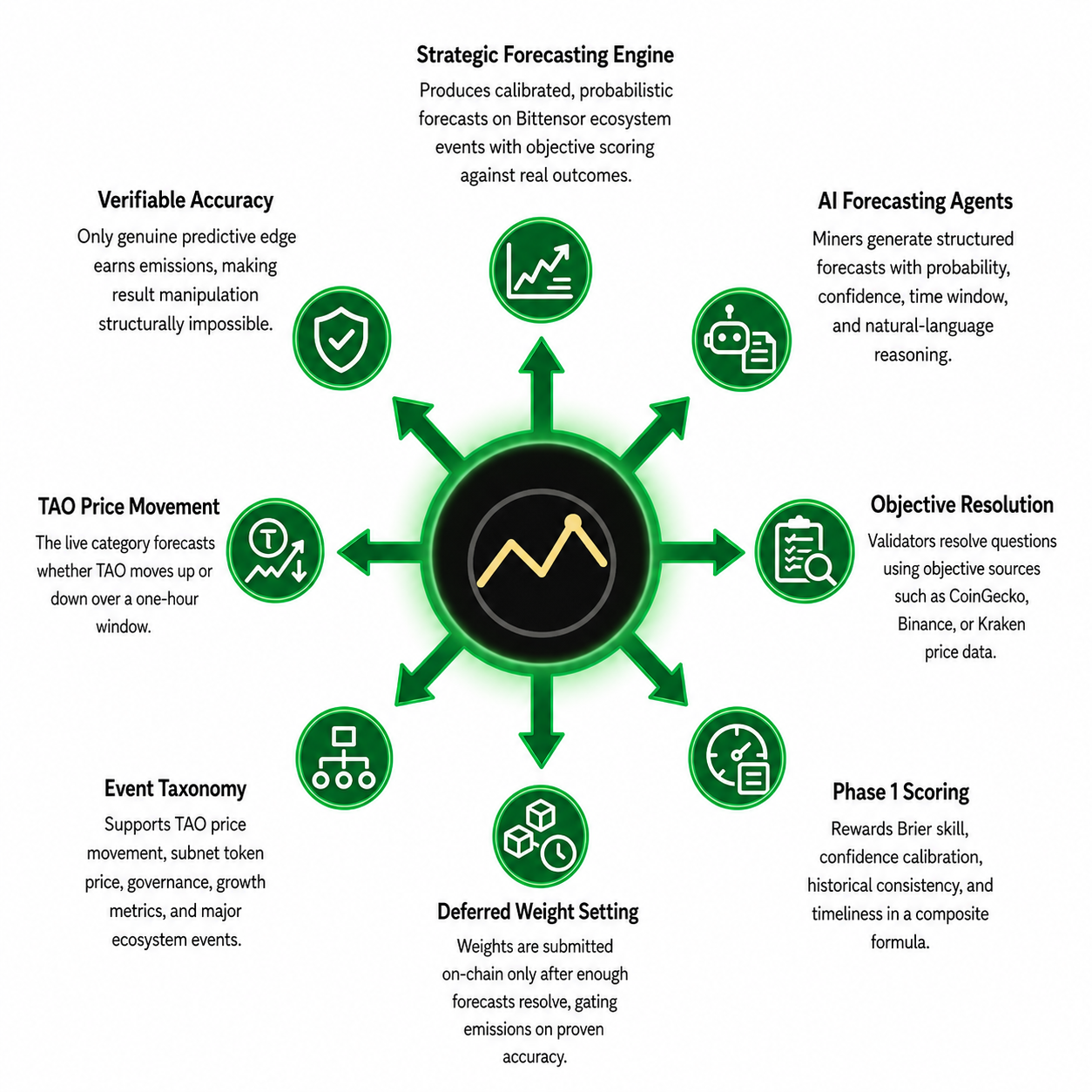
MASX (MasXAI) is Bittensor Subnet 104 — an Autonomous Strategic Forecasting Engine built to produce calibrated, probabilistic predictions on Bittensor ecosystem events. Where most Bittensor subnets focus on generative AI, compute, or data retrieval, MASX carves out a distinct niche: structured forecasting with verifiable accuracy, scored rigorously against objective ground truth. Miners on the subnet function as AI forecasting agents, and validators act as impartial resolution engines, ensuring that only genuine predictive accuracy earns emissions.
Each forecasting round begins when the validator issues a task drawn from MASX’s event taxonomy. Currently active is the tao_price_movement category — whether TAO’s price will move in a given direction over a one-hour window — resolved automatically via a price oracle pulling from CoinGecko, Binance, or Kraken. The taxonomy also includes subnet_token_price, new_subnet_registration, governance_outcome, ecosystem_growth_metric, and significant_bittensor_event; each additional type is unlocked once a corresponding objective resolver is implemented.
Miners receive a forecast task and context from the validator, then use a Gemini 2.5 Pro-backed agent to generate a structured forecast — including a probability estimate, confidence score, forecast window, and natural-language reasoning. The validator collects responses, queues them until the question’s cutoff date, then fetches actual outcomes from a central resolution service. Critically, miners are scored against real-world outcomes, never against MASX’s own engine predictions, making result manipulation structurally impossible.
Scoring follows a Phase 1 composite formula: 50% Brier skill versus a neutral baseline, 20% confidence calibration, 20% historical consistency, and 10% timeliness. A flat 0.5 probability forecast earns zero reward — the system is explicitly designed to reward genuine predictive edge. Validator weights are only submitted to chain once a minimum number of forecasts have resolved, gating emissions on demonstrated accuracy rather than mere participation. This deferred-resolution loop is the core mechanism that enforces forecast quality across the subnet.
MASX (MasXAI) is Bittensor Subnet 104 — an Autonomous Strategic Forecasting Engine built to produce calibrated, probabilistic predictions on Bittensor ecosystem events. Where most Bittensor subnets focus on generative AI, compute, or data retrieval, MASX carves out a distinct niche: structured forecasting with verifiable accuracy, scored rigorously against objective ground truth. Miners on the subnet function as AI forecasting agents, and validators act as impartial resolution engines, ensuring that only genuine predictive accuracy earns emissions.
Each forecasting round begins when the validator issues a task drawn from MASX’s event taxonomy. Currently active is the tao_price_movement category — whether TAO’s price will move in a given direction over a one-hour window — resolved automatically via a price oracle pulling from CoinGecko, Binance, or Kraken. The taxonomy also includes subnet_token_price, new_subnet_registration, governance_outcome, ecosystem_growth_metric, and significant_bittensor_event; each additional type is unlocked once a corresponding objective resolver is implemented.
Miners receive a forecast task and context from the validator, then use a Gemini 2.5 Pro-backed agent to generate a structured forecast — including a probability estimate, confidence score, forecast window, and natural-language reasoning. The validator collects responses, queues them until the question’s cutoff date, then fetches actual outcomes from a central resolution service. Critically, miners are scored against real-world outcomes, never against MASX’s own engine predictions, making result manipulation structurally impossible.
Scoring follows a Phase 1 composite formula: 50% Brier skill versus a neutral baseline, 20% confidence calibration, 20% historical consistency, and 10% timeliness. A flat 0.5 probability forecast earns zero reward — the system is explicitly designed to reward genuine predictive edge. Validator weights are only submitted to chain once a minimum number of forecasts have resolved, gating emissions on demonstrated accuracy rather than mere participation. This deferred-resolution loop is the core mechanism that enforces forecast quality across the subnet.
MASX’s commercial product operates at two levels. The first is the public intelligence platform at bt.masxai.com — a Bittensor-focused dashboard delivering live forecasts, anomaly signals, calibration views, advisories, and network health analysis. Consumers of this service get a continuously-updated read on Bittensor ecosystem dynamics without needing to run any infrastructure themselves. The site includes a methodology section, documentation, whitepapers, and a track record view — the hallmarks of a forecasting operation built around transparency and reproducibility.
The second product layer is fully autonomous content generation. From the subnet’s resolved forecast data, MASX auto-generates podcasts, email newsletters, LinkedIn draft posts, and Discord pipeline summaries. These outputs are entirely machine-produced: no human editorial step between the forecast engine and the finished intelligence briefing. The target audience is Bittensor participants — subnet operators, TAO holders, validators, and developers — who need timely, calibrated insight on network conditions without the overhead of manual research.
On the technical side, MASX operates in a Phase 1 centralised mode powered by a FastAPI backend service (BT-Forecast). Each day, the service generates a deterministic run ID, publishes a set of forecast questions, and later records objective resolutions. Validators poll this service, distribute questions to miners via ForecastSynapse v3, collect responses, wait for resolution, then score and feed results back. Miner accuracy data is looped back into the central service, enabling the platform’s calibration metrics and track record views to reflect real subnet performance.
The subnet’s incentive economics are unusually aggressive: the target is to burn 96% of miner emissions and distribute only 4% by validator weights. This design prioritises quality signal over broad participation, creating a highly competitive environment where forecasting accuracy determines reward. The result is a subnet where economic incentives are tightly coupled to the product’s core value proposition — producing the most accurate probabilistic intelligence possible about the Bittensor network.
MASX’s commercial product operates at two levels. The first is the public intelligence platform at bt.masxai.com — a Bittensor-focused dashboard delivering live forecasts, anomaly signals, calibration views, advisories, and network health analysis. Consumers of this service get a continuously-updated read on Bittensor ecosystem dynamics without needing to run any infrastructure themselves. The site includes a methodology section, documentation, whitepapers, and a track record view — the hallmarks of a forecasting operation built around transparency and reproducibility.
The second product layer is fully autonomous content generation. From the subnet’s resolved forecast data, MASX auto-generates podcasts, email newsletters, LinkedIn draft posts, and Discord pipeline summaries. These outputs are entirely machine-produced: no human editorial step between the forecast engine and the finished intelligence briefing. The target audience is Bittensor participants — subnet operators, TAO holders, validators, and developers — who need timely, calibrated insight on network conditions without the overhead of manual research.
On the technical side, MASX operates in a Phase 1 centralised mode powered by a FastAPI backend service (BT-Forecast). Each day, the service generates a deterministic run ID, publishes a set of forecast questions, and later records objective resolutions. Validators poll this service, distribute questions to miners via ForecastSynapse v3, collect responses, wait for resolution, then score and feed results back. Miner accuracy data is looped back into the central service, enabling the platform’s calibration metrics and track record views to reflect real subnet performance.
The subnet’s incentive economics are unusually aggressive: the target is to burn 96% of miner emissions and distribute only 4% by validator weights. This design prioritises quality signal over broad participation, creating a highly competitive environment where forecasting accuracy determines reward. The result is a subnet where economic incentives are tightly coupled to the product’s core value proposition — producing the most accurate probabilistic intelligence possible about the Bittensor network.
MASX / MasXAI operates as a pseudonymous team with no publicly named founders or team members at the time of writing. The GitHub organisation (github.com/masxai) lists no public members, and the project’s website and documentation do not identify individual contributors. This is consistent with the broader culture of early-stage Bittensor subnet development, where teams often launch under project identities rather than personal brands.
What can be inferred from the technical output: the team has meaningful experience in forecasting methodology, Bittensor subnet architecture, and production AI systems. The codebase demonstrates familiarity with Brier score decomposition, isotonic recalibration, FastAPI service design, and LLM integration (Gemini 2.5 Pro). The existence of a separate Next.js documentation site, a live product dashboard at bt.masxai.com, and a structured validator/miner architecture points to a team capable of shipping full-stack, production-grade systems — not a solo hobbyist effort.
MASX / MasXAI operates as a pseudonymous team with no publicly named founders or team members at the time of writing. The GitHub organisation (github.com/masxai) lists no public members, and the project’s website and documentation do not identify individual contributors. This is consistent with the broader culture of early-stage Bittensor subnet development, where teams often launch under project identities rather than personal brands.
What can be inferred from the technical output: the team has meaningful experience in forecasting methodology, Bittensor subnet architecture, and production AI systems. The codebase demonstrates familiarity with Brier score decomposition, isotonic recalibration, FastAPI service design, and LLM integration (Gemini 2.5 Pro). The existence of a separate Next.js documentation site, a live product dashboard at bt.masxai.com, and a structured validator/miner architecture points to a team capable of shipping full-stack, production-grade systems — not a solo hobbyist effort.
MASX’s near-term roadmap centres on expanding the active event taxonomy. Phase 1 is live with tao_price_movement as the only enabled forecast type — chosen for its fully automatic, oracle-based resolution. The path forward involves building objective resolvers for the remaining event types: subnet_token_price, new_subnet_registration, governance_outcome, ecosystem_growth_metric, and significant_bittensor_event. Each activation expands the subnet’s coverage of Bittensor dynamics and the depth of intelligence available through the product.
A second roadmap thread is the subnet’s emission mechanics. The stated target — burning 96% of miner emissions and distributing 4% by validator weights — requires enforcement at the subnet economics and runtime configuration layer, separate from the current codebase. Implementing this burn model is a critical milestone that will distinguish MASX’s incentive structure from standard Bittensor subnets and reinforce the quality-over-quantity design philosophy. Alongside this, the masxai-docs TypeScript project suggests a more polished public documentation site is in active development, indicating the team is building toward a broader user-facing launch.
MASX’s near-term roadmap centres on expanding the active event taxonomy. Phase 1 is live with tao_price_movement as the only enabled forecast type — chosen for its fully automatic, oracle-based resolution. The path forward involves building objective resolvers for the remaining event types: subnet_token_price, new_subnet_registration, governance_outcome, ecosystem_growth_metric, and significant_bittensor_event. Each activation expands the subnet’s coverage of Bittensor dynamics and the depth of intelligence available through the product.
A second roadmap thread is the subnet’s emission mechanics. The stated target — burning 96% of miner emissions and distributing 4% by validator weights — requires enforcement at the subnet economics and runtime configuration layer, separate from the current codebase. Implementing this burn model is a critical milestone that will distinguish MASX’s incentive structure from standard Bittensor subnets and reinforce the quality-over-quantity design philosophy. Alongside this, the masxai-docs TypeScript project suggests a more polished public documentation site is in active development, indicating the team is building toward a broader user-facing launch.