With the amount of new subnets being added it can be hard to get up to date information across all subnets, so data may be slightly out of date from time to time

Subnet 105

Beam

Alpha Price
Value
Market Cap
Value
Neurons
Value
Registration Cost
Value
TAO Liquidity
Value
Alpha in Pool
Value
Total Alpha Supply
Value
% Alpha Staked
Value

ABOUT

What exactly does it do?

Core Bandwidth Coordination Problem

Beam is designed to solve the lack of a decentralized, verifiable data transfer layer within Bittensor. According to the project, it is a “decentralized data transfer network” which provides high-performance bandwidth and routing infrastructure across the Bittensor ecosystem. By using a Proof-of-Bandwidth approach, every data transfer on Beam generates measurable performance data, ensuring transfers are reliable and efficient. In practice, Beam acts as a kind of open “highway” or CDN layer for data: it allows an on-chain network of nodes to move large volumes of data quickly, with cryptographic verification of delivery. This approach is intended to support demanding workloads such as large cloud transfers or AI-agent communications. In short, Beam’s core mission is to coordinate and optimize bandwidth – a resource the project calls “the internet’s most under-coordinated resource” – by aligning node rewards with actual data throughput.

Subnet Function and Incentive Loop

Beam operates as Subnet 105 on the Bittensor blockchain, so it follows Bittensor’s general model of miners and validators. In this model, Beam miners run specialized node software and compete to provide data transfer services, while Beam validators (typically the top-staked nodes) verify those services and score performance. Following the usual Bittensor mechanism, each block’s emission is distributed in proportion to miners’ weighted performance as reported by validators. In practice, a Beam mining node may behave as both an “orchestrator” and several “workers.” The orchestrator’s job is to coordinate transfers – for example, finding low-latency routes, splitting a data file into chunks, balancing load across workers, and monitoring each worker’s status. Each worker process then physically streams chunks of data to the destination, updating the orchestrator with progress and validating integrity (e.g. via Merkle proofs) of each chunk. This separation of roles lets Beam optimize routing (by comparing metrics like latency and throughput) and ensures reliability even if individual workers fail or retry. After a transfer is complete, the system produces a Proof-of-Bandwidth record for that job, which encompasses the measured throughput, latency, and success of the delivery. Beam validators pull these proofs, verify their correctness, and then adjust each miner’s score (weight) based on performance. For example, the Beam website notes that its validators “verify proofs and adjust rewards,” reflecting this loop. In summary, Beam nodes earn rewards by actually moving data: miners run the transfer workload, generate proofs, and validators endorse the results, thereby triggering the usual on-chain reward distribution by Yuma consensus.

Miners’ Contribution

Beam miners contribute bandwidth and routing capacity. Each miner stakes tokens and registers on SN105 to obtain a UID slot. In each transfer, they commit network resources: their orchestrator decrypts a manifest, splits files into chunks, and assigns chunks to their own worker processes. The worker processes then pull (or push) data from Edge sources (cloud storage, APIs, webhooks, etc.) to the destination, consuming network bandwidth. Throughout this process, miners continuously report performance metrics (bytes transferred per second, chunk completion, errors) and generate cryptographic proofs that the data was sent correctly (for instance, Merkle tree hashes of transferred chunks). By doing this work reliably and quickly, a miner gains weight. Conversely, failing to deliver or experiencing poor bandwidth will lower a miner’s score. In this way, Beam miners effectively offer a decentralized bandwidth market: they bid network capacity into a global transfer, and are paid for verifiably delivering data. This is fundamentally different from other subnets that reward purely AI compute or data labeling; here the “compute” is data movement itself.

Validators and Scoring

Beam validators fulfill the critical governance and consensus role. Being top-staked miners, they have permission to submit weight updates on-chain. His work is standard for any Bittensor subnet: they evaluate miners by the Subnet’s defined incentive mechanism and commit weights for each miner to the chain. For Beam, this means inspecting the Proof-of-Bandwidth records submitted by miners. If a proof is valid, the validator endorses the transfer by assigning a positive weight proportional to its performance; if invalid or incomplete, a miner gets a lower score. The on-chain result is that faster, higher-throughput miners accumulate more weight and thus earn a larger share of the alpha emission. The Beam website explicitly notes this process: “Validators verify proofs and adjust rewards,” indicating that verifying each transfer’s proof directly feeds into the per-block reward distribution. In essence, Beam validators ensure only genuine data transfers earn token rewards, making the marketplace trustless.

End Product for Users

To end users or developers, the Beam network appears as a decentralized data transfer service with payment. A user might request that certain data (from AWS S3, Google Cloud, etc.) be delivered to a destination node or service. Beam nodes compete to fulfill that request, rendering it quickly. Users pay for access (for example via on-chain tokens or micropayments) and in return receive fast, verified data delivery without relying on any single cloud provider. The Beam team describes it as the “bandwidth coordination layer for the open internet,” enabling secure, verifiable transfers for cloud infrastructure or AI agents. Essentially, the outcome is an ultra-efficient, multi-path data highway open to anyone. Unlike existing centralized CDNs or cloud transfer services, Beam’s output is decentralized and permissionless – if the underlying system works, users benefit from potentially cheaper, censorship-resistant data transport.

Comparison to Other Subnets

Beam is distinct from most Bittensor subnets, which generally focus on AI models, data labeling, or other compute tasks. Instead, Beam is purely an infrastructural subnet. To our knowledge, no other SN network on Bittensor provides a bandwidth market or CDN-like service. In that respect, Beam fills a new niche (much as subnets like Hippius provide storage). This means its dynamics differ from typical AI subnets: for example, performance is measured in gigabits/second rather than model accuracy. The design also contrasts with generic blockchain data transfer solutions because it tightly integrates with Bittensor’s economic model. In summary, Beam’s innovation is to turn raw network bandwidth into a quantifiable, scalable on-chain commodity, a role unique among Bittensor networks.

Core Bandwidth Coordination Problem

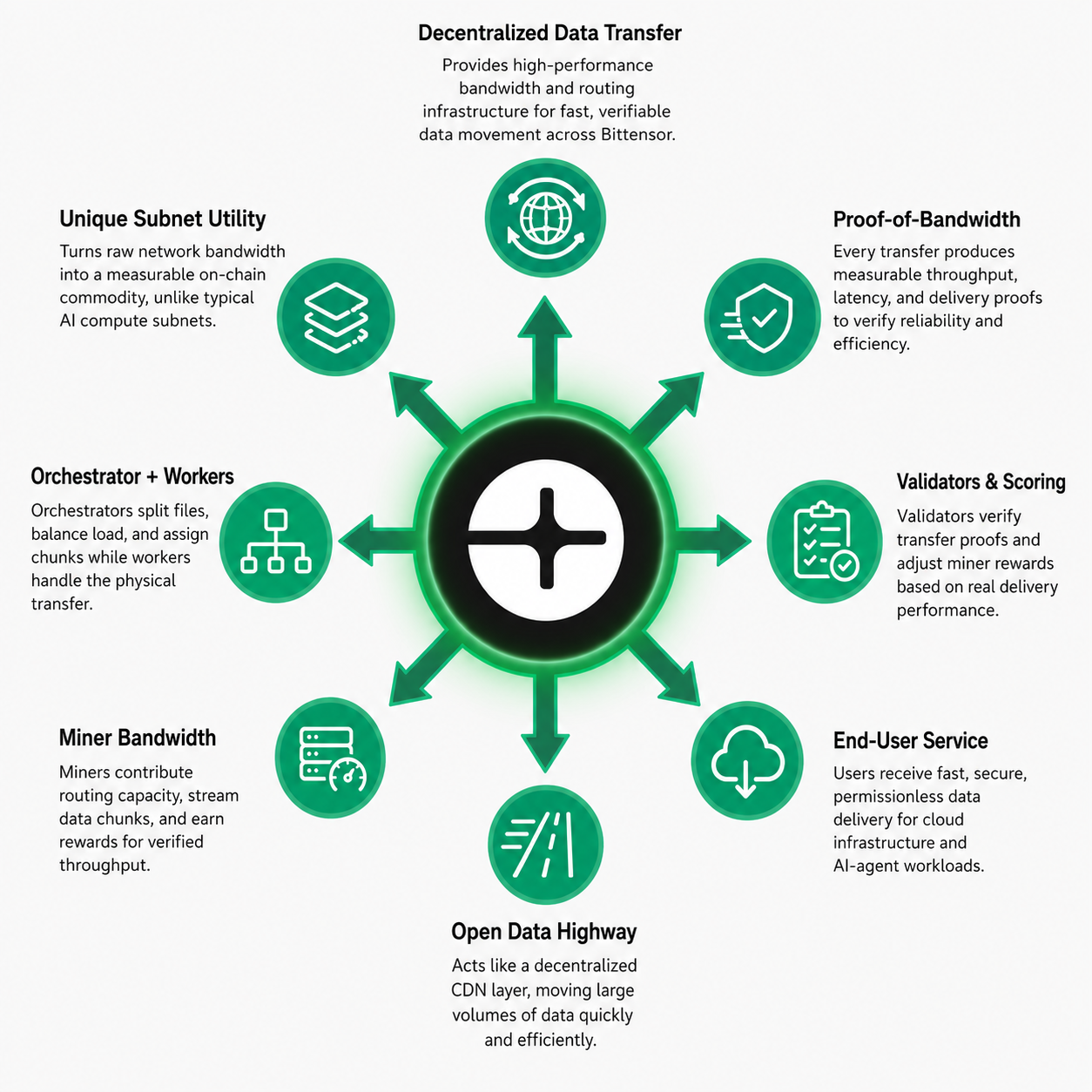
Beam is designed to solve the lack of a decentralized, verifiable data transfer layer within Bittensor. According to the project, it is a “decentralized data transfer network” which provides high-performance bandwidth and routing infrastructure across the Bittensor ecosystem. By using a Proof-of-Bandwidth approach, every data transfer on Beam generates measurable performance data, ensuring transfers are reliable and efficient. In practice, Beam acts as a kind of open “highway” or CDN layer for data: it allows an on-chain network of nodes to move large volumes of data quickly, with cryptographic verification of delivery. This approach is intended to support demanding workloads such as large cloud transfers or AI-agent communications. In short, Beam’s core mission is to coordinate and optimize bandwidth – a resource the project calls “the internet’s most under-coordinated resource” – by aligning node rewards with actual data throughput.

Subnet Function and Incentive Loop

Beam operates as Subnet 105 on the Bittensor blockchain, so it follows Bittensor’s general model of miners and validators. In this model, Beam miners run specialized node software and compete to provide data transfer services, while Beam validators (typically the top-staked nodes) verify those services and score performance. Following the usual Bittensor mechanism, each block’s emission is distributed in proportion to miners’ weighted performance as reported by validators. In practice, a Beam mining node may behave as both an “orchestrator” and several “workers.” The orchestrator’s job is to coordinate transfers – for example, finding low-latency routes, splitting a data file into chunks, balancing load across workers, and monitoring each worker’s status. Each worker process then physically streams chunks of data to the destination, updating the orchestrator with progress and validating integrity (e.g. via Merkle proofs) of each chunk. This separation of roles lets Beam optimize routing (by comparing metrics like latency and throughput) and ensures reliability even if individual workers fail or retry. After a transfer is complete, the system produces a Proof-of-Bandwidth record for that job, which encompasses the measured throughput, latency, and success of the delivery. Beam validators pull these proofs, verify their correctness, and then adjust each miner’s score (weight) based on performance. For example, the Beam website notes that its validators “verify proofs and adjust rewards,” reflecting this loop. In summary, Beam nodes earn rewards by actually moving data: miners run the transfer workload, generate proofs, and validators endorse the results, thereby triggering the usual on-chain reward distribution by Yuma consensus.

Miners’ Contribution

Beam miners contribute bandwidth and routing capacity. Each miner stakes tokens and registers on SN105 to obtain a UID slot. In each transfer, they commit network resources: their orchestrator decrypts a manifest, splits files into chunks, and assigns chunks to their own worker processes. The worker processes then pull (or push) data from Edge sources (cloud storage, APIs, webhooks, etc.) to the destination, consuming network bandwidth. Throughout this process, miners continuously report performance metrics (bytes transferred per second, chunk completion, errors) and generate cryptographic proofs that the data was sent correctly (for instance, Merkle tree hashes of transferred chunks). By doing this work reliably and quickly, a miner gains weight. Conversely, failing to deliver or experiencing poor bandwidth will lower a miner’s score. In this way, Beam miners effectively offer a decentralized bandwidth market: they bid network capacity into a global transfer, and are paid for verifiably delivering data. This is fundamentally different from other subnets that reward purely AI compute or data labeling; here the “compute” is data movement itself.

Validators and Scoring

Beam validators fulfill the critical governance and consensus role. Being top-staked miners, they have permission to submit weight updates on-chain. His work is standard for any Bittensor subnet: they evaluate miners by the Subnet’s defined incentive mechanism and commit weights for each miner to the chain. For Beam, this means inspecting the Proof-of-Bandwidth records submitted by miners. If a proof is valid, the validator endorses the transfer by assigning a positive weight proportional to its performance; if invalid or incomplete, a miner gets a lower score. The on-chain result is that faster, higher-throughput miners accumulate more weight and thus earn a larger share of the alpha emission. The Beam website explicitly notes this process: “Validators verify proofs and adjust rewards,” indicating that verifying each transfer’s proof directly feeds into the per-block reward distribution. In essence, Beam validators ensure only genuine data transfers earn token rewards, making the marketplace trustless.

End Product for Users

To end users or developers, the Beam network appears as a decentralized data transfer service with payment. A user might request that certain data (from AWS S3, Google Cloud, etc.) be delivered to a destination node or service. Beam nodes compete to fulfill that request, rendering it quickly. Users pay for access (for example via on-chain tokens or micropayments) and in return receive fast, verified data delivery without relying on any single cloud provider. The Beam team describes it as the “bandwidth coordination layer for the open internet,” enabling secure, verifiable transfers for cloud infrastructure or AI agents. Essentially, the outcome is an ultra-efficient, multi-path data highway open to anyone. Unlike existing centralized CDNs or cloud transfer services, Beam’s output is decentralized and permissionless – if the underlying system works, users benefit from potentially cheaper, censorship-resistant data transport.

Comparison to Other Subnets

Beam is distinct from most Bittensor subnets, which generally focus on AI models, data labeling, or other compute tasks. Instead, Beam is purely an infrastructural subnet. To our knowledge, no other SN network on Bittensor provides a bandwidth market or CDN-like service. In that respect, Beam fills a new niche (much as subnets like Hippius provide storage). This means its dynamics differ from typical AI subnets: for example, performance is measured in gigabits/second rather than model accuracy. The design also contrasts with generic blockchain data transfer solutions because it tightly integrates with Bittensor’s economic model. In summary, Beam’s innovation is to turn raw network bandwidth into a quantifiable, scalable on-chain commodity, a role unique among Bittensor networks.

PURPOSE

What exactly is the 'product/build'?

Live Status vs Development

The Beam subnet (SN105) is currently live on Bittensor, as indicated by the recent subnet identity announcement. The public dashboard and website suggest that initial mainnet operation is underway: over 1,240 miner nodes are active (as noted by the site showing “Miners 1247”), and the network reports an aggregate bandwidth of roughly 847 Gb/s and 2.4 PB of data moved. At the same time, Beam is still in early stages. The website labels the project as a “beta,” and certain features (like complex multi-cloud sync) appear forthcoming. For example, the site teases a future “Cross-Cloud Sync” feature to move data seamlessly between AWS, GCP, Azure, etc.. Thus, core functionality—such as basic transfers and staking—is live now, but advanced integrations and scaling remain under development. In short, Beam is in public beta: the network is running, miners are registering and transmitting real workloads, but newer capabilities are still being rolled out.

Technical Architecture

Beam’s design revolves around a modular node architecture. Each Beam node runs a Bittensor-compatible daemon with additional logic for data routing. At runtime, a node acts as an orchestrator that interfaces with multiple worker processes. The orchestrator’s job is multi-fold: it selects optimal data paths (minimizing latency), splits each file or stream into smaller chunks for parallel transfer, and balances load among workers based on their available bandwidth. Worker processes then carry out the actual data transfer: streaming chunks to destinations, tracking progress, and verifying each chunk via cryptographic checks (e.g. generating Merkle proofs). The orchestrator collects performance metrics from the workers in real-time to compute the final throughput. This “transfer lifecycle” is then summarized into a Proof-of-Bandwidth record. Finally, Beam’s economic layer records this proof on-chain: validators pull the proofs and rank miners accordingly. The architecture is designed to be protocol-agnostic (compatible with any standard data protocol) and to scale horizontally by adding more workers and miners.

GitHub Repositories and Components

Beam’s code and resources are organized into several GitHub repositories. The official Beam organization (which can be found via references on the Beam website) currently hosts repositories for documentation, client SDKs, and infrastructure configs. Key repos include beam-docs (project documentation), beam-api-clients (SDK libraries in C#, TypeScript, etc. for interacting with Beam), and beam-token (token contract logic). There is also a beam-subnet repo that holds network configuration details (chain ID, RPC endpoints, contract addresses) for the Beam subnet. Overall, the codebase is split into documentation, on-chain components, and example clients. (At the time of writing, commit activity in these repos is modest; for instance, beam-subnet shows only a few updates in the past year.) The organization structure makes it clear which pieces of Beam are open-source: it invites developers to explore the docs and use the SDKs.

Metrics and Activity

Several live metrics indicate Beam’s early adoption. As of now, the site reports roughly 1,247 active miners and a sustained throughput of 847 Gb/s. On-chain, the total daily alpha emission to miners is on the order of 2,952 alpha per day. The on-chain registration parameters likewise reveal economics: for example, a new node must burn about 0.166767 TAO as a registration cost (roughly tens of dollars at current TAO prices). The Beam alpha token is also trading publicly: at press time it’s about 0.007053 TAO per alpha (around $2.20), reflecting relatively low market capitalization and high emission rate. GitHub activity is still emerging: as noted, core repos have only a few commits recently. The modest activity suggests that Beam is a young project, though the available code indicates a clear baseline infrastructure.

Integrations and External Connections

Beam is built to integrate with existing cloud and data services. The website explicitly lists connectors for major platforms: AWS S3 storage, Cloudflare R2, Google Cloud Storage, Snowflake (data warehouse), Salesforce, and generic REST APIs and webhooks. It also mentions support for “MCP servers” (message-command proxies) and custom endpoints, implying Beam can interface with a wide range of data sources. In practice, this means a Beam orchestrator can pull data from any of these sources during a transfer. These connectors indicate that Beam’s network nodes can seamlessly pull from or push to popular cloud systems. The “Cross-Cloud Sync” feature teaser further suggests planned integration across cloud providers.

End Users and Customers

The intended users of Beam are organizations or applications that need high-volume data movement. The project points to use cases in cloud and AI: for example, delivering data to AI agents, syncing data between enterprise cloud accounts, or streaming backups across data centers. In the Bittensor context, any participant who needs to move data reliably – whether for training models or handling large datasets – could use Beam. As the Beam site notes, its service can be used by researchers, businesses, or “autonomous agents” to trade bandwidth on demand. Although Beam’s alpha token economy suggests a typical blockchain user can stake and earn, the real “customers” are likely developers integrating the Beam API for data pipeline tasks. In sum, Beam’s user base is envisioned to be broad – essentially anyone who would otherwise pay for cloud transfer or CDN services, but in a decentralized manner.

Live Status vs Development

The Beam subnet (SN105) is currently live on Bittensor, as indicated by the recent subnet identity announcement. The public dashboard and website suggest that initial mainnet operation is underway: over 1,240 miner nodes are active (as noted by the site showing “Miners 1247”), and the network reports an aggregate bandwidth of roughly 847 Gb/s and 2.4 PB of data moved. At the same time, Beam is still in early stages. The website labels the project as a “beta,” and certain features (like complex multi-cloud sync) appear forthcoming. For example, the site teases a future “Cross-Cloud Sync” feature to move data seamlessly between AWS, GCP, Azure, etc.. Thus, core functionality—such as basic transfers and staking—is live now, but advanced integrations and scaling remain under development. In short, Beam is in public beta: the network is running, miners are registering and transmitting real workloads, but newer capabilities are still being rolled out.

Technical Architecture

Beam’s design revolves around a modular node architecture. Each Beam node runs a Bittensor-compatible daemon with additional logic for data routing. At runtime, a node acts as an orchestrator that interfaces with multiple worker processes. The orchestrator’s job is multi-fold: it selects optimal data paths (minimizing latency), splits each file or stream into smaller chunks for parallel transfer, and balances load among workers based on their available bandwidth. Worker processes then carry out the actual data transfer: streaming chunks to destinations, tracking progress, and verifying each chunk via cryptographic checks (e.g. generating Merkle proofs). The orchestrator collects performance metrics from the workers in real-time to compute the final throughput. This “transfer lifecycle” is then summarized into a Proof-of-Bandwidth record. Finally, Beam’s economic layer records this proof on-chain: validators pull the proofs and rank miners accordingly. The architecture is designed to be protocol-agnostic (compatible with any standard data protocol) and to scale horizontally by adding more workers and miners.

GitHub Repositories and Components

Beam’s code and resources are organized into several GitHub repositories. The official Beam organization (which can be found via references on the Beam website) currently hosts repositories for documentation, client SDKs, and infrastructure configs. Key repos include beam-docs (project documentation), beam-api-clients (SDK libraries in C#, TypeScript, etc. for interacting with Beam), and beam-token (token contract logic). There is also a beam-subnet repo that holds network configuration details (chain ID, RPC endpoints, contract addresses) for the Beam subnet. Overall, the codebase is split into documentation, on-chain components, and example clients. (At the time of writing, commit activity in these repos is modest; for instance, beam-subnet shows only a few updates in the past year.) The organization structure makes it clear which pieces of Beam are open-source: it invites developers to explore the docs and use the SDKs.

Metrics and Activity

Several live metrics indicate Beam’s early adoption. As of now, the site reports roughly 1,247 active miners and a sustained throughput of 847 Gb/s. On-chain, the total daily alpha emission to miners is on the order of 2,952 alpha per day. The on-chain registration parameters likewise reveal economics: for example, a new node must burn about 0.166767 TAO as a registration cost (roughly tens of dollars at current TAO prices). The Beam alpha token is also trading publicly: at press time it’s about 0.007053 TAO per alpha (around $2.20), reflecting relatively low market capitalization and high emission rate. GitHub activity is still emerging: as noted, core repos have only a few commits recently. The modest activity suggests that Beam is a young project, though the available code indicates a clear baseline infrastructure.

Integrations and External Connections

Beam is built to integrate with existing cloud and data services. The website explicitly lists connectors for major platforms: AWS S3 storage, Cloudflare R2, Google Cloud Storage, Snowflake (data warehouse), Salesforce, and generic REST APIs and webhooks. It also mentions support for “MCP servers” (message-command proxies) and custom endpoints, implying Beam can interface with a wide range of data sources. In practice, this means a Beam orchestrator can pull data from any of these sources during a transfer. These connectors indicate that Beam’s network nodes can seamlessly pull from or push to popular cloud systems. The “Cross-Cloud Sync” feature teaser further suggests planned integration across cloud providers.

End Users and Customers

The intended users of Beam are organizations or applications that need high-volume data movement. The project points to use cases in cloud and AI: for example, delivering data to AI agents, syncing data between enterprise cloud accounts, or streaming backups across data centers. In the Bittensor context, any participant who needs to move data reliably – whether for training models or handling large datasets – could use Beam. As the Beam site notes, its service can be used by researchers, businesses, or “autonomous agents” to trade bandwidth on demand. Although Beam’s alpha token economy suggests a typical blockchain user can stake and earn, the real “customers” are likely developers integrating the Beam API for data pipeline tasks. In sum, Beam’s user base is envisioned to be broad – essentially anyone who would otherwise pay for cloud transfer or CDN services, but in a decentralized manner.

WHO

Team Info

Public Team Information

As of now, the individuals behind the Beam subnet have not been publicly disclosed. The project appears to be led by a group calling itself “Beam Network,” but no founders or engineers are named on the website. Beam maintains an official website and social presence: for example, a LinkedIn page (“Beam Network”) announced the SN105 launch in 2026. The website declares that Beam is “open-source and community-driven,” inviting anyone (researchers, builders, users) to participate in development. This language suggests a decentralized team structure rather than a corporate entity. There is no evidence of major venture funding or formal partnerships mentioned in public sources. The only official on-chain pointing is the Git repository out of an organization (BuildOnBeam) and the Bittensor subnet itself; off-chain, the community connection seems limited to a Discord (via link on the site) and social media. In short, the Beam team is largely anonymous: interested observers know that the project launched its subnet identity around mid-2026 and promises open collaboration, but no personal profiles or affiliations are available. Community engagement appears to be the primary avenue for contact – the website links to X (formerly Twitter) and Discord – but the official stance remains that of a public, community-run project. No official partnerships, grants, or backers have been announced as of this writing.

Public Team Information

As of now, the individuals behind the Beam subnet have not been publicly disclosed. The project appears to be led by a group calling itself “Beam Network,” but no founders or engineers are named on the website. Beam maintains an official website and social presence: for example, a LinkedIn page (“Beam Network”) announced the SN105 launch in 2026. The website declares that Beam is “open-source and community-driven,” inviting anyone (researchers, builders, users) to participate in development. This language suggests a decentralized team structure rather than a corporate entity. There is no evidence of major venture funding or formal partnerships mentioned in public sources. The only official on-chain pointing is the Git repository out of an organization (BuildOnBeam) and the Bittensor subnet itself; off-chain, the community connection seems limited to a Discord (via link on the site) and social media. In short, the Beam team is largely anonymous: interested observers know that the project launched its subnet identity around mid-2026 and promises open collaboration, but no personal profiles or affiliations are available. Community engagement appears to be the primary avenue for contact – the website links to X (formerly Twitter) and Discord – but the official stance remains that of a public, community-run project. No official partnerships, grants, or backers have been announced as of this writing.

FUTURE

Roadmap

Phases and Milestones

Beam has not published a detailed public roadmap with dated milestones. The one clearly documented milestone is the mainnet launch: the Beam subnet identity was made live on Bittensor SN105 in mid-2026. This corresponds to Phase 1 of deployment (subnet activation and initial node registration). Beyond that, the team has only provided broad vision goals rather than a time-sequenced plan. For example, their website touts “Live competitive benchmarks” and “Future-proof scaling” as goals, but does not attach dates. There was an announcement teasing a “Cross-Cloud Sync” feature to interconnect AWS, GCP, Azure and other clouds, implying a future Phase 2 of integrating data pipelines across providers. However, no official timeframe (e.g. Q2 2026 target) has been stated. In short, the only explicit milestone so far is the network launch; all other developments appear to be rolling out as the team completes the protocol and integrations.

Future Vision

The fully realized vision for Beam is a globally unified bandwidth network. The Beam site describes empowering the network to reach “the full potential of distributed bandwidth, delivering the first truly unified network for massively parallel, ultra-efficient data transfer”. In practice, this looks like a world where any service can tap the Beam subnet for data routing, and autonomous agents can pay per-transfer in a decentralized manner. The team has hinted that future updates will focus on expanding connectors, enhancing performance, and implementing payment gateways (e.g. stablecoin tolls) to make bandwidth a tradable commodity.

Recent Updates

The most recent public update was the subnet identity launch noted above. Aside from that, news comes mainly from on-site content: for example, the introduction of the “Cross-Cloud Sync” concept suggests upcoming features but no concrete dates. The project’s communication so far has been limited to its website and social channels. In summary, no future quarterly targets have been publicly announced. The team appears to be iterating in private, with the next changes likely being further infrastructure integrations (as advertised on the site) and more stable releases of the mining/validation software.

Phases and Milestones

Beam has not published a detailed public roadmap with dated milestones. The one clearly documented milestone is the mainnet launch: the Beam subnet identity was made live on Bittensor SN105 in mid-2026. This corresponds to Phase 1 of deployment (subnet activation and initial node registration). Beyond that, the team has only provided broad vision goals rather than a time-sequenced plan. For example, their website touts “Live competitive benchmarks” and “Future-proof scaling” as goals, but does not attach dates. There was an announcement teasing a “Cross-Cloud Sync” feature to interconnect AWS, GCP, Azure and other clouds, implying a future Phase 2 of integrating data pipelines across providers. However, no official timeframe (e.g. Q2 2026 target) has been stated. In short, the only explicit milestone so far is the network launch; all other developments appear to be rolling out as the team completes the protocol and integrations.

Future Vision

The fully realized vision for Beam is a globally unified bandwidth network. The Beam site describes empowering the network to reach “the full potential of distributed bandwidth, delivering the first truly unified network for massively parallel, ultra-efficient data transfer”. In practice, this looks like a world where any service can tap the Beam subnet for data routing, and autonomous agents can pay per-transfer in a decentralized manner. The team has hinted that future updates will focus on expanding connectors, enhancing performance, and implementing payment gateways (e.g. stablecoin tolls) to make bandwidth a tradable commodity.

Recent Updates

The most recent public update was the subnet identity launch noted above. Aside from that, news comes mainly from on-site content: for example, the introduction of the “Cross-Cloud Sync” concept suggests upcoming features but no concrete dates. The project’s communication so far has been limited to its website and social channels. In summary, no future quarterly targets have been publicly announced. The team appears to be iterating in private, with the next changes likely being further infrastructure integrations (as advertised on the site) and more stable releases of the mining/validation software.