
With the amount of new subnets being added it can be hard to get up to date information across all subnets, so data may be slightly out of date from time to time
Instant is Bittensor Subnet 46 (SN46), a decentralised network purpose-built for fast, reliable, and verifiable AI model inference. At its core, Instant exposes an OpenAI-compatible streaming API, allowing any developer or application using standard LLM client libraries to route requests through a competitive, decentralised network of inference providers rather than a centralised cloud service.
The network separates responsibility across three distinct roles. A platform gateway serves as the public-facing edge: it handles authentication, enforces usage quotas, selects the best available miner for each request, and relays streaming responses back to the client. Miners are the compute backbone — they run model-serving hardware, authenticate incoming machine-to-machine calls, enforce local capacity limits, and publish availability and health metrics so validators can discover and evaluate them. Validators act purely as observers, measuring each miner’s performance — including latency, throughput, uptime, and response correctness — and translating those observations into deterministic scores that are committed on-chain via Bittensor’s weight-setting mechanism.
Critically, Bittensor itself never touches raw prompts or generated responses. The chain manages only node registration, validator authority, weights, and token incentives — preserving both user privacy and network scalability. This clean separation means that customer data stays off-chain while the economic layer remains transparent and verifiable.
What makes Instant distinctive within the Bittensor ecosystem is its explicit focus on production-grade inference quality. Validator scoring is deterministic and publicly documented, meaning miners compete on objective, measurable criteria rather than opaque evaluation. This creates a self-optimising marketplace where inference speed and reliability are directly rewarded.
Instant is Bittensor Subnet 46 (SN46), a decentralised network purpose-built for fast, reliable, and verifiable AI model inference. At its core, Instant exposes an OpenAI-compatible streaming API, allowing any developer or application using standard LLM client libraries to route requests through a competitive, decentralised network of inference providers rather than a centralised cloud service.
The network separates responsibility across three distinct roles. A platform gateway serves as the public-facing edge: it handles authentication, enforces usage quotas, selects the best available miner for each request, and relays streaming responses back to the client. Miners are the compute backbone — they run model-serving hardware, authenticate incoming machine-to-machine calls, enforce local capacity limits, and publish availability and health metrics so validators can discover and evaluate them. Validators act purely as observers, measuring each miner’s performance — including latency, throughput, uptime, and response correctness — and translating those observations into deterministic scores that are committed on-chain via Bittensor’s weight-setting mechanism.
Critically, Bittensor itself never touches raw prompts or generated responses. The chain manages only node registration, validator authority, weights, and token incentives — preserving both user privacy and network scalability. This clean separation means that customer data stays off-chain while the economic layer remains transparent and verifiable.
What makes Instant distinctive within the Bittensor ecosystem is its explicit focus on production-grade inference quality. Validator scoring is deterministic and publicly documented, meaning miners compete on objective, measurable criteria rather than opaque evaluation. This creates a self-optimising marketplace where inference speed and reliability are directly rewarded.
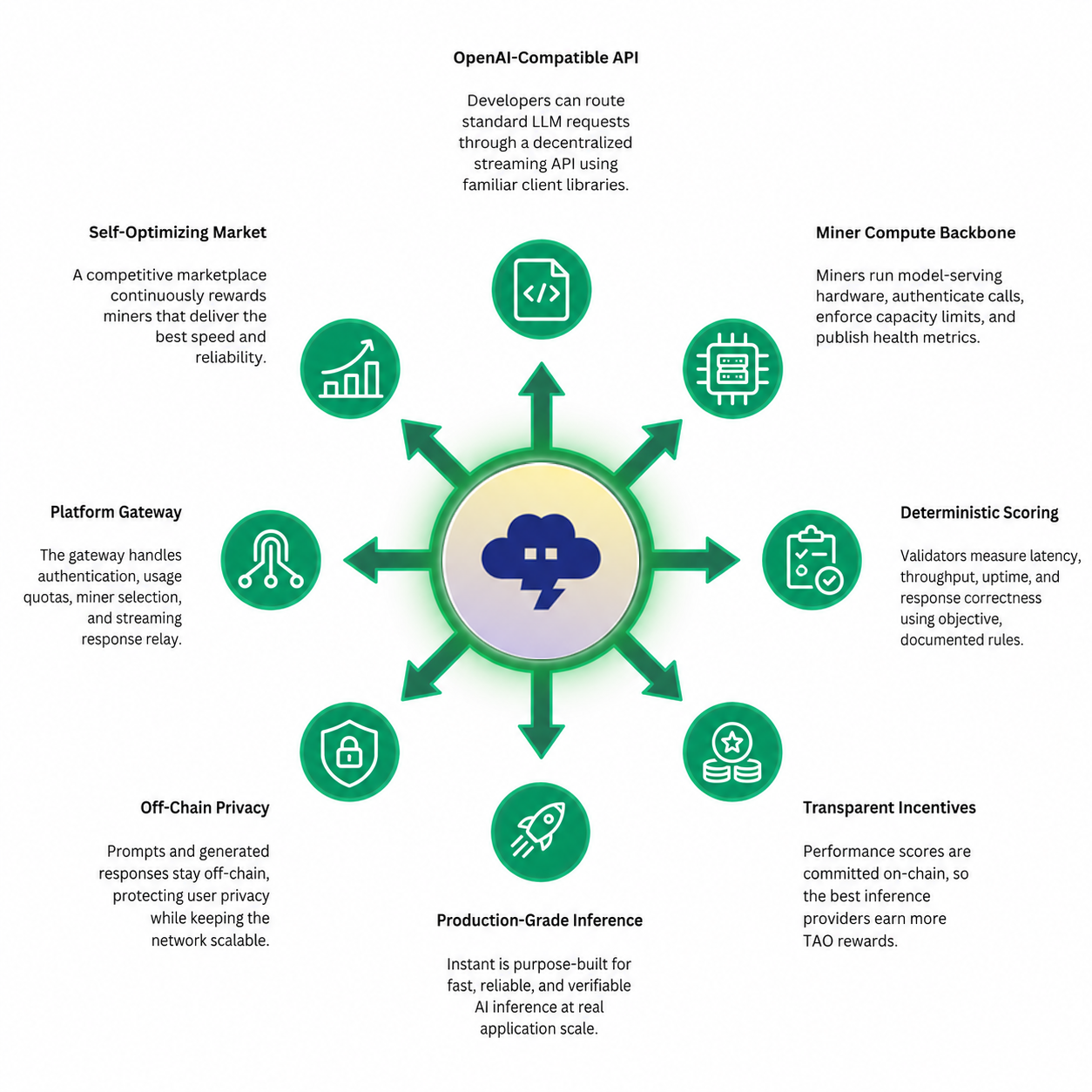
The product Instant is building is a drop-in replacement for centralised inference APIs — specifically designed to be interchangeable with the OpenAI API. Any developer currently calling api.openai.com could, in principle, point their client at Instant’s gateway and receive the same streaming JSON responses from a decentralised miner network. The gateway layer handles all the complexity of miner selection, failover, and usage accounting, making the decentralised backend invisible to the end application.
The target users are AI developers, enterprise engineering teams, and organisations that need low-latency inference with stronger privacy guarantees or audit-grade traceability than traditional cloud providers offer. Pain points addressed include opaque service-level agreements, the risk of prompt data being retained by third-party providers, and vendor lock-in to a single cloud’s pricing and capacity constraints. By routing through a competitive miner marketplace, Instant aims to deliver cost efficiency alongside verifiability — miners must perform or lose rewards, creating a direct economic incentive for quality of service.
Technically, the system comprises the gateway (routing, auth, accounting), the miner software stack (model runtime, capacity management, health reporting), and the validator stack (performance measurement, deterministic scoring, weight submission). The protocol and deployment architecture are under active development on the project’s dev branch, with stable interfaces promoted to the main branch as they mature. The repository structure is deliberately split to allow rapid iteration on the core protocol without exposing unstable interfaces publicly.
Public API access and operator onboarding are not yet open. The official website at instantsubnet.com currently hosts a waitlist for “lightning fast, private inference,” collecting developer and enterprise interest ahead of a public launch. Subnet incentives align directly with product goals: miners are scored on the same dimensions — latency, throughput, reliability — that paying customers care about most, so the network naturally selects for the best inference providers.
The product Instant is building is a drop-in replacement for centralised inference APIs — specifically designed to be interchangeable with the OpenAI API. Any developer currently calling api.openai.com could, in principle, point their client at Instant’s gateway and receive the same streaming JSON responses from a decentralised miner network. The gateway layer handles all the complexity of miner selection, failover, and usage accounting, making the decentralised backend invisible to the end application.
The target users are AI developers, enterprise engineering teams, and organisations that need low-latency inference with stronger privacy guarantees or audit-grade traceability than traditional cloud providers offer. Pain points addressed include opaque service-level agreements, the risk of prompt data being retained by third-party providers, and vendor lock-in to a single cloud’s pricing and capacity constraints. By routing through a competitive miner marketplace, Instant aims to deliver cost efficiency alongside verifiability — miners must perform or lose rewards, creating a direct economic incentive for quality of service.
Technically, the system comprises the gateway (routing, auth, accounting), the miner software stack (model runtime, capacity management, health reporting), and the validator stack (performance measurement, deterministic scoring, weight submission). The protocol and deployment architecture are under active development on the project’s dev branch, with stable interfaces promoted to the main branch as they mature. The repository structure is deliberately split to allow rapid iteration on the core protocol without exposing unstable interfaces publicly.
Public API access and operator onboarding are not yet open. The official website at instantsubnet.com currently hosts a waitlist for “lightning fast, private inference,” collecting developer and enterprise interest ahead of a public launch. Subnet incentives align directly with product goals: miners are scored on the same dimensions — latency, throughput, reliability — that paying customers care about most, so the network naturally selects for the best inference providers.
Instant is operated under the GitHub organisation instant-subnet and is the latest evolution of a subnet that was originally founded by Seby Rubino (known in the community as “sebyverse”), the principal of Resi Labs. Rubino and the Resi Labs team built and launched Subnet 46 in its initial form as a real estate price prediction network, attracting early institutional attention including a reported investment from DSV Fund and a letter of intent from NextGen Digital Platforms to form a joint venture for enterprise deployment.
The subnet has since undergone two significant pivots: first from real estate intelligence (RESI) to on-chain private credit under the name Zipcode in May 2026, and then to its current form as a general-purpose decentralised inference network, Instant, announced in August 2026. These pivots reflect the team’s responsiveness to market demand and the flexibility of the Bittensor subnet model. The core contributor group identified during the RESI and Zipcode phases — including GitHub handles such as konrad096057, panniki10, calebcgates6, and MeepCoding204 alongside Rubino — appears to have continued into the Instant phase. Institutional investor Astrid Intelligence PLC (ticker: ASTR) has publicly disclosed a stake in SN46, underscoring ongoing commercial interest in the team’s direction.
No formal public team page or named leadership disclosures beyond Seby Rubino are currently published for the Instant iteration. The project is pre-launch, with the team focused on protocol development on the private dev branch. The GitHub repository policy and security documentation reflect professional engineering practices, including strict credential handling, private vulnerability disclosure, and a clean separation between stable public interfaces and in-progress development work.
Instant is operated under the GitHub organisation instant-subnet and is the latest evolution of a subnet that was originally founded by Seby Rubino (known in the community as “sebyverse”), the principal of Resi Labs. Rubino and the Resi Labs team built and launched Subnet 46 in its initial form as a real estate price prediction network, attracting early institutional attention including a reported investment from DSV Fund and a letter of intent from NextGen Digital Platforms to form a joint venture for enterprise deployment.
The subnet has since undergone two significant pivots: first from real estate intelligence (RESI) to on-chain private credit under the name Zipcode in May 2026, and then to its current form as a general-purpose decentralised inference network, Instant, announced in August 2026. These pivots reflect the team’s responsiveness to market demand and the flexibility of the Bittensor subnet model. The core contributor group identified during the RESI and Zipcode phases — including GitHub handles such as konrad096057, panniki10, calebcgates6, and MeepCoding204 alongside Rubino — appears to have continued into the Instant phase. Institutional investor Astrid Intelligence PLC (ticker: ASTR) has publicly disclosed a stake in SN46, underscoring ongoing commercial interest in the team’s direction.
No formal public team page or named leadership disclosures beyond Seby Rubino are currently published for the Instant iteration. The project is pre-launch, with the team focused on protocol development on the private dev branch. The GitHub repository policy and security documentation reflect professional engineering practices, including strict credential handling, private vulnerability disclosure, and a clean separation between stable public interfaces and in-progress development work.
Instant is currently in its pre-launch phase. The official repository states clearly that “Public API access and operator onboarding are not open yet. Release and participation details will be published here when they are ready.” The team is actively developing the core protocol on the dev branch, with the architecture documentation — covering the gateway, miner, and validator roles — already published on main as a stable reference point. Five commits have been made to the repository since launch, with the most recent landing in August 2026.
The near-term roadmap centres on stabilising the protocol interfaces sufficiently to open miner and validator onboarding. This includes finalising the scoring algorithm’s deterministic measurement criteria, hardening the gateway’s routing and authentication layer, and establishing the operator documentation needed for third parties to deploy miners safely. A waitlist on the official website is collecting developer and enterprise interest ahead of an access announcement.
Longer-term, Instant’s direction points toward positioning decentralised inference as a credible alternative to centralised cloud providers — competing on latency, cost, and verifiability rather than brand trust alone. The team’s track record of iterating rapidly across three distinct product concepts on the same subnet suggests a pragmatic, market-led approach to finding the best fit for the underlying infrastructure.
Instant is currently in its pre-launch phase. The official repository states clearly that “Public API access and operator onboarding are not open yet. Release and participation details will be published here when they are ready.” The team is actively developing the core protocol on the dev branch, with the architecture documentation — covering the gateway, miner, and validator roles — already published on main as a stable reference point. Five commits have been made to the repository since launch, with the most recent landing in August 2026.
The near-term roadmap centres on stabilising the protocol interfaces sufficiently to open miner and validator onboarding. This includes finalising the scoring algorithm’s deterministic measurement criteria, hardening the gateway’s routing and authentication layer, and establishing the operator documentation needed for third parties to deploy miners safely. A waitlist on the official website is collecting developer and enterprise interest ahead of an access announcement.
Longer-term, Instant’s direction points toward positioning decentralised inference as a credible alternative to centralised cloud providers — competing on latency, cost, and verifiability rather than brand trust alone. The team’s track record of iterating rapidly across three distinct product concepts on the same subnet suggests a pragmatic, market-led approach to finding the best fit for the underlying infrastructure.
A special thanks to Mark Jeffrey for his amazing Hash Rate series! In this series, he provides valuable insights into Bittensor Subnets and the world of decentralized AI. Be sure to check out the full series on his YouTube channel for more expert analysis and deep dives.
Recorded in August 2026, Mark Jeffrey sits down with Dan of Instant, Subnet 46, to discuss his journey from engineering roles at Amazon and Microsoft to working inside the Bittensor ecosystem, including time with the Opentensor Foundation and Subnet 2, where he helped develop zero-knowledge machine-learning infrastructure designed to cryptographically verify AI inference. The conversation then turns to Instant, the newly repurposed Subnet 46, which is being built as a high-speed AI inference network initially focused on supplying Ditto with the throughput it needs for its growing user base and benchmarking workloads. Dan explains how Instant plans to differentiate itself through aggressive software optimization, persistent connections to miners and a narrow focus on a small number of leading open-source models, with early internal testing already outperforming comparable OpenRouter throughput. A major part of the discussion explores Dan’s belief that analog computing could eventually transform AI inference by physically encoding model weights into chips, allowing models to run at extraordinary speeds while using a fraction of the energy consumed by traditional GPU infrastructure, with companies such as Mythic and the recently acquired Taalas offering an early glimpse of what this future could look like. They also discuss how Instant hopes to incentivize miners to experiment with this type of specialist hardware over time, potentially pushing inference speeds from hundreds to thousands of tokens per second. Finally, Dan and Mark discuss the strategic decision to pivot Subnet 46 away from its previous real-estate-focused ZipCode model following major changes to Bittensor’s economics, why ZipCode is continuing separately on Base, and how the rapidly evolving rules of Bittensor are forcing subnet teams to adapt quickly, focus on immediate product-market fit and revenue, and ultimately help the strongest Bittensor companies break through into the wider AI market.