
With the amount of new subnets being added it can be hard to get up to date information across all subnets, so data may be slightly out of date from time to time
Decentralized AI for Software Engineering
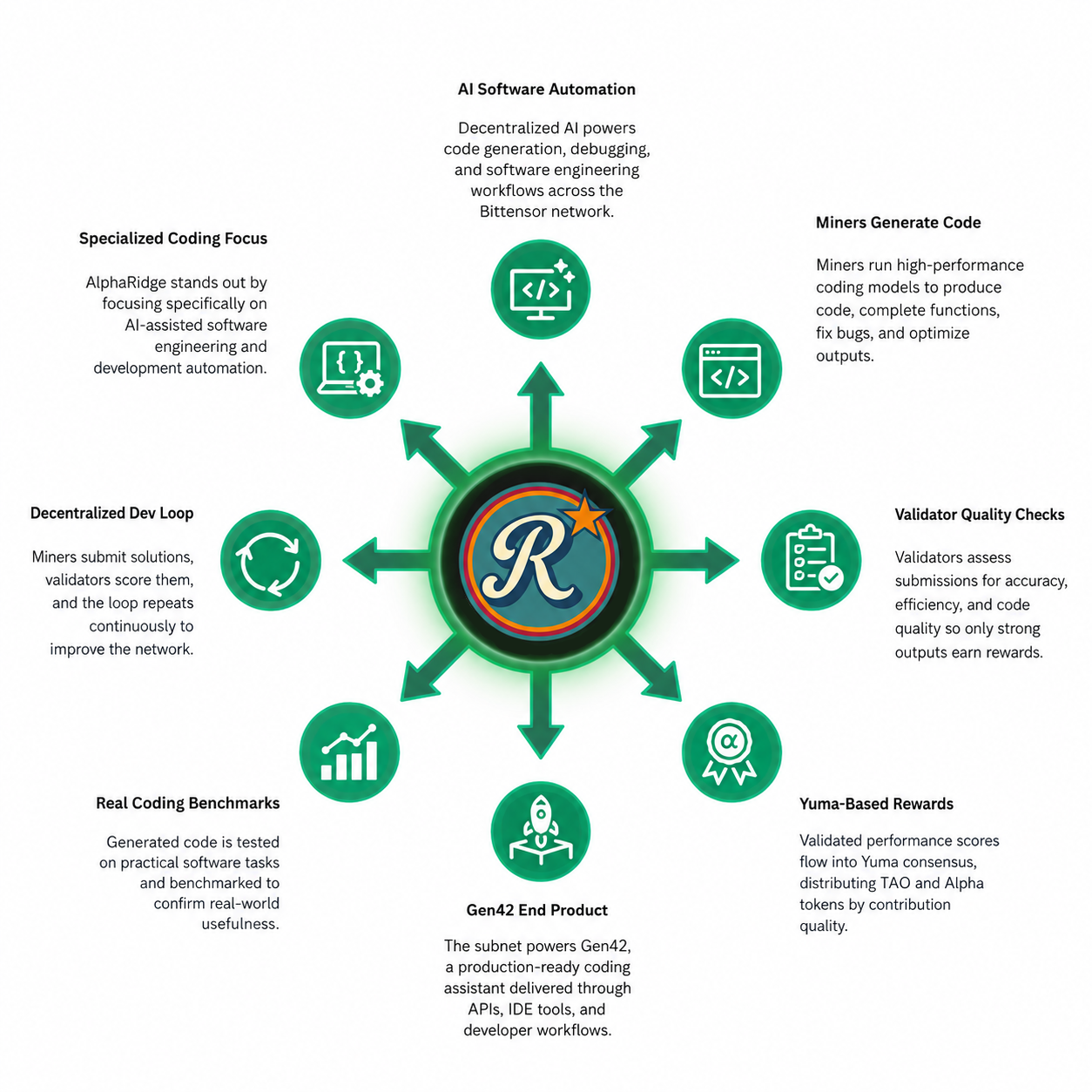
AlphaRidge tackles AI-driven software development and automation of coding tasks on the Bittensor network. According to the Rizzo Network, SN45 is “the leading AI-powered coding subnet” that redefines software engineering with decentralized intelligence. In practice, this means AlphaRidge uses distributed computing to optimize code generation, automated debugging, and prompt engineering. Miners on SN45 train and run high-performance AI models for generating code, completing functions, or identifying bugs, while validators independently score the accuracy and efficiency of those outputs. Bittensor’s consensus mechanism (Yuma) then allocates the subnet’s TAO rewards and Alpha tokens based on those performance scores. In effect, the “software engineering” functionality – branded as Gen42 – emerges as the end product: an AI assistant/tool that developers can use to accelerate their coding tasks (via IDE extensions or APIs).
Mining and Validation Loop
As with all subnets, miners on AlphaRidge run the work defined by the subnet’s incentive mechanism and push their contributions to the chain. The Rizzo documentation describes a decentralized development process: miners “fine-tune AI for code generation and debugging” while validators “assess code quality and efficiency”. In Bittensor terms, this follows the generic model where each subnet’s off-chain code defines its task – here, software generation tasks – and validators check them. For example, AlphaRidge miners may submit generated code or debugged outputs, and validators benchmark these submissions (e.g. on Princeton’s SWE-Bench) to produce a score. Only the miners’ outputs that receive sufficient validation pass through, ensuring that only high-quality AI contributions earn rewards. The aggregated scores over each scoring period then feed into the on-chain Yuma consensus algorithm, which determines how many Alpha tokens are minted and distributed to each miner and validator proportionally. Because AlphaRidge is an ongoing subnet, miners and validators continuously repeat this loop to sustain the network and earn tokens.
Contributions and Output
Miners contribute computational work by actually running the AI models that attempt to solve real coding problems, turning raw compute into useful outputs (code, bug fixes, optimizations). Validators provide the “true test” of those outputs by running offline or real-time evaluations – for example, benchmarking the generated code on standard tests. The result is a matrix of miner scores that directly drives token emission. The output of SN45’s subnet emerges as an AI software assistant: as described by the team, Gen42.ai is a production-ready coding assistant offering smart code completion, debugging, and suggestions. In other words, an end user or investor will see AlphaRidge’s value as an intelligent coding product (available via APIs or IDE plugins) bolstered by the Alpha token economy. Investors see its alpha token price and market data) and emissions) as the financial output of the subnet. Users – primarily software developers and companies – experience Gen42 as the tool enabled by the subnet’s decentralized AI work.
Comparison to Other Subnets
AlphaRidge is distinct in the Bittensor ecosystem because it squarely targets software engineering rather than a general AI task or another domain. As stated on the official site, SN45 “focuses on AI-assisted software automation”, whereas many other subnets handle tasks like natural language processing, image generation, or financial signals. For example, SN5 “Hone” targets AI research text, others like BitAds focus on ad text generation, and some (like SN20 BitAgent) deal with finance. By contrast, AlphaRidge’s unique niche is AI-driven coding assistance and development automation. This specialized focus makes its performance measurable via benchmarks like Princeton’s SWE-Bench (where Team Rizzo competes against models from big AI labs). In summary, AlphaRidge solves the specific problem of decentralizing the growth of AI-enhanced software tools: miners accelerate code creation across a global network, validators ensure quality, and the product (Gen42) delivers an automated coding assistant to developers, all powered by Bittensor’s token economy.
Decentralized AI for Software Engineering
AlphaRidge tackles AI-driven software development and automation of coding tasks on the Bittensor network. According to the Rizzo Network, SN45 is “the leading AI-powered coding subnet” that redefines software engineering with decentralized intelligence. In practice, this means AlphaRidge uses distributed computing to optimize code generation, automated debugging, and prompt engineering. Miners on SN45 train and run high-performance AI models for generating code, completing functions, or identifying bugs, while validators independently score the accuracy and efficiency of those outputs. Bittensor’s consensus mechanism (Yuma) then allocates the subnet’s TAO rewards and Alpha tokens based on those performance scores. In effect, the “software engineering” functionality – branded as Gen42 – emerges as the end product: an AI assistant/tool that developers can use to accelerate their coding tasks (via IDE extensions or APIs).
Mining and Validation Loop
As with all subnets, miners on AlphaRidge run the work defined by the subnet’s incentive mechanism and push their contributions to the chain. The Rizzo documentation describes a decentralized development process: miners “fine-tune AI for code generation and debugging” while validators “assess code quality and efficiency”. In Bittensor terms, this follows the generic model where each subnet’s off-chain code defines its task – here, software generation tasks – and validators check them. For example, AlphaRidge miners may submit generated code or debugged outputs, and validators benchmark these submissions (e.g. on Princeton’s SWE-Bench) to produce a score. Only the miners’ outputs that receive sufficient validation pass through, ensuring that only high-quality AI contributions earn rewards. The aggregated scores over each scoring period then feed into the on-chain Yuma consensus algorithm, which determines how many Alpha tokens are minted and distributed to each miner and validator proportionally. Because AlphaRidge is an ongoing subnet, miners and validators continuously repeat this loop to sustain the network and earn tokens.
Contributions and Output
Miners contribute computational work by actually running the AI models that attempt to solve real coding problems, turning raw compute into useful outputs (code, bug fixes, optimizations). Validators provide the “true test” of those outputs by running offline or real-time evaluations – for example, benchmarking the generated code on standard tests. The result is a matrix of miner scores that directly drives token emission. The output of SN45’s subnet emerges as an AI software assistant: as described by the team, Gen42.ai is a production-ready coding assistant offering smart code completion, debugging, and suggestions. In other words, an end user or investor will see AlphaRidge’s value as an intelligent coding product (available via APIs or IDE plugins) bolstered by the Alpha token economy. Investors see its alpha token price and market data) and emissions) as the financial output of the subnet. Users – primarily software developers and companies – experience Gen42 as the tool enabled by the subnet’s decentralized AI work.
Comparison to Other Subnets
AlphaRidge is distinct in the Bittensor ecosystem because it squarely targets software engineering rather than a general AI task or another domain. As stated on the official site, SN45 “focuses on AI-assisted software automation”, whereas many other subnets handle tasks like natural language processing, image generation, or financial signals. For example, SN5 “Hone” targets AI research text, others like BitAds focus on ad text generation, and some (like SN20 BitAgent) deal with finance. By contrast, AlphaRidge’s unique niche is AI-driven coding assistance and development automation. This specialized focus makes its performance measurable via benchmarks like Princeton’s SWE-Bench (where Team Rizzo competes against models from big AI labs). In summary, AlphaRidge solves the specific problem of decentralizing the growth of AI-enhanced software tools: miners accelerate code creation across a global network, validators ensure quality, and the product (Gen42) delivers an automated coding assistant to developers, all powered by Bittensor’s token economy.
Current Status (Live vs In Development)
The AlphaRidge subnet’s core application is already live and accessible in beta. According to Rizzo’s site, Gen42 has been launched and integrated into developer environments (such as the Interact IDE). The site also notes active community engagement and continuous improvements. Meanwhile, known development goals include improving SN45’s SWE-Bench ranking and expanding enterprise integrations (e.g. linking with GitLab and other tools). In short, the existing build (Gen42) is available to users today for real-time code completion and debugging, while further features are under development to meet longer-term targets. The system is explicitly described as a work-in-progress: DynamicTaoMarketCap labels the network “Pretraining” and notes the product is in “beta” with some features yet under development.
Technical Architecture
AlphaRidge leverages the standard Bittensor infrastructure. At its core, the Subtensor blockchain handles on-chain consensus and token accounting, while AlphaRidge’s custom code (formerly on the Team-Rizzo GitHub) defines the miners’ and validators’ tasks off-chain. The subnet’s off-chain code coordinates how miners obtain data (e.g. source code snippets or error reports), compute AI-model outputs, and submit them to validators. Validators then run separate evaluation routines (such as code benchmarks) to score those outputs. This logic is maintained by the subnet’s incentive mechanism repository – as in all subnets, the code for miner/validator interfaces is off-chain code updated by the developers. Although the exact details of AlphaRidge’s coordination server aren’t public, leaked descriptions suggest a central API that batches miner submissions and coordinates validators, ensuring only unanimously validated results count. In practical terms, miners run GPU-backed AI-model pipelines (fine-tuning language models for code) and validators run test harnesses to measure correctness. The consensus loop then on-chain distributes the subnet’s alpha tokens proportional to those validation scores. The Rizzo team also emphasizes real-world integrations: they connect to Gen42’s API and IDE plugins to pull tasks and push results into developer workflows..
GitHub and Activity
The subnet source code has historically been on Team Rizzo’s GitHub (e.g. the talisman-ai repo). Community metrics indicate modest but ongoing development: ICM Analytics reports roughly 24 code commits in the last 30 days and only 3 contributors, suggesting active maintenance. The latest commit (as of May 2026) was only a few days old, indicating the team is still pushing updates. The social and trading data reflect this stage: ICM lists 13 validators on SN45 (supporting demand for compute) and a relatively small number of miners. The alpha token’s market data, daily volume tens of thousands USD) suggest a small-scale project in terms of token economy. Emission rate is around 0.19% (daily) as reported on TAO bots. In summary, the repository contains AI-model training code and the coordination logic for validators, and the development velocity appears healthy but not large-scale at this point.
Integrations and External Connections
AlphaRidge connects to other tools primarily through its Gen42 product. The Gen42 engine provides an API for intelligent code completion and is integrated into developer platforms. The Rizzo documentation specifically notes support for IDE environments and platforms like GitLab. This means AlphaRidge miners/validators may pull tasks from Git repositories or IDE calls and then push AI-generated code back through those same channels. In addition, SN45 works in tandem with other subnets: for example, it coordinates with SN20 for cross-subnet task orchestration and uses Gen42’s results in the broader ecosystem. However, there are no direct off-chain feeds or oracle integrations beyond these developer tools mentioned. All interactions occur within Bittensor and via conventional web APIs (e.g. Git protocols) rather than specialized data sources.
Users and Customers
AlphaRidge’s end users are primarily software developers, data scientists, and organizations that need AI-assisted coding. The publicly listed Gen42.ai product is marketed as an “AI coding assistant” for developers to accelerate software creation. Rizzo’s own site explicitly says that developers, validators, and miners can participate by training models and using Gen42 in their workflows. In practice, end customers could range from freelance coders to enterprise R&D teams. For investors, the “product” is the alpha token itself; stakers can hold SN45’s alpha as a way to earn yield on Bittensor. As such, institutional users include anyone building on Bittensor or staking on SN45. Overall, the target demographic is technical: developers seeking AI code tools, plus technical crypto users allocating TAO to technical subnets that push AI boundaries. The Rizzo team also engages the community via demos and forums (e.g. links to a live Gen42 demo) to attract this user base.
Current Status (Live vs In Development)
The AlphaRidge subnet’s core application is already live and accessible in beta. According to Rizzo’s site, Gen42 has been launched and integrated into developer environments (such as the Interact IDE). The site also notes active community engagement and continuous improvements. Meanwhile, known development goals include improving SN45’s SWE-Bench ranking and expanding enterprise integrations (e.g. linking with GitLab and other tools). In short, the existing build (Gen42) is available to users today for real-time code completion and debugging, while further features are under development to meet longer-term targets. The system is explicitly described as a work-in-progress: DynamicTaoMarketCap labels the network “Pretraining” and notes the product is in “beta” with some features yet under development.
Technical Architecture
AlphaRidge leverages the standard Bittensor infrastructure. At its core, the Subtensor blockchain handles on-chain consensus and token accounting, while AlphaRidge’s custom code (formerly on the Team-Rizzo GitHub) defines the miners’ and validators’ tasks off-chain. The subnet’s off-chain code coordinates how miners obtain data (e.g. source code snippets or error reports), compute AI-model outputs, and submit them to validators. Validators then run separate evaluation routines (such as code benchmarks) to score those outputs. This logic is maintained by the subnet’s incentive mechanism repository – as in all subnets, the code for miner/validator interfaces is off-chain code updated by the developers. Although the exact details of AlphaRidge’s coordination server aren’t public, leaked descriptions suggest a central API that batches miner submissions and coordinates validators, ensuring only unanimously validated results count. In practical terms, miners run GPU-backed AI-model pipelines (fine-tuning language models for code) and validators run test harnesses to measure correctness. The consensus loop then on-chain distributes the subnet’s alpha tokens proportional to those validation scores. The Rizzo team also emphasizes real-world integrations: they connect to Gen42’s API and IDE plugins to pull tasks and push results into developer workflows..
GitHub and Activity
The subnet source code has historically been on Team Rizzo’s GitHub (e.g. the talisman-ai repo). Community metrics indicate modest but ongoing development: ICM Analytics reports roughly 24 code commits in the last 30 days and only 3 contributors, suggesting active maintenance. The latest commit (as of May 2026) was only a few days old, indicating the team is still pushing updates. The social and trading data reflect this stage: ICM lists 13 validators on SN45 (supporting demand for compute) and a relatively small number of miners. The alpha token’s market data, daily volume tens of thousands USD) suggest a small-scale project in terms of token economy. Emission rate is around 0.19% (daily) as reported on TAO bots. In summary, the repository contains AI-model training code and the coordination logic for validators, and the development velocity appears healthy but not large-scale at this point.
Integrations and External Connections
AlphaRidge connects to other tools primarily through its Gen42 product. The Gen42 engine provides an API for intelligent code completion and is integrated into developer platforms. The Rizzo documentation specifically notes support for IDE environments and platforms like GitLab. This means AlphaRidge miners/validators may pull tasks from Git repositories or IDE calls and then push AI-generated code back through those same channels. In addition, SN45 works in tandem with other subnets: for example, it coordinates with SN20 for cross-subnet task orchestration and uses Gen42’s results in the broader ecosystem. However, there are no direct off-chain feeds or oracle integrations beyond these developer tools mentioned. All interactions occur within Bittensor and via conventional web APIs (e.g. Git protocols) rather than specialized data sources.
Users and Customers
AlphaRidge’s end users are primarily software developers, data scientists, and organizations that need AI-assisted coding. The publicly listed Gen42.ai product is marketed as an “AI coding assistant” for developers to accelerate software creation. Rizzo’s own site explicitly says that developers, validators, and miners can participate by training models and using Gen42 in their workflows. In practice, end customers could range from freelance coders to enterprise R&D teams. For investors, the “product” is the alpha token itself; stakers can hold SN45’s alpha as a way to earn yield on Bittensor. As such, institutional users include anyone building on Bittensor or staking on SN45. Overall, the target demographic is technical: developers seeking AI code tools, plus technical crypto users allocating TAO to technical subnets that push AI boundaries. The Rizzo team also engages the community via demos and forums (e.g. links to a live Gen42 demo) to attract this user base.
Core Team and Leadership
AlphaRidge (Subnet 45) is developed and maintained by Team Rizzo, a Bittensor validator group. The public-facing co-founders of Rizzo are nicknamed “roguetensor” (CTO) and “frankrizz07” (CEO), who together lead the project. RogueTensor brings expertise in AI/ML integration and computer vision, while Frank Rizzo has a background in entrepreneurship, automation, and web3 development. These co-founders direct the subnet’s vision and business strategy. Team Rizzo is also known as the operators of General Tensor, a company in the Bittensor ecosystem (backed by investors like Digital Currency Group and Lvna Capital). In the Bittensor community, Frank and Rogue are recognized voices (e.g. their Rizzo network website and podcasts) who contribute more broadly to the network.
Validator and Development Team
Behind the scenes, a group of pseudonymous contributors run validators and produce code. The Rizzo site lists several team members by their on-chain names and skills. For example, “rysjol” is a data and software engineer in the validator crew, and “solros3” is a technical generalist on the team. On the development side, there are subnet devs like “slaive” (a full-stack/DevOps specialist) and “vectorforge” (AI/data science lead) supporting SN45. These contributors do the heavy lifting on AI model development, system engineering, and infrastructure. The publicly visible accounts suggest a small, specialized team; ICM notes only ~3 contributors on GitHub. In addition, Team Rizzo’s validator name “Rizzo Network” appears on communications and social. On X (Twitter), the handle @TeamRizzoAI (linked from Rizzo’s own network page) represents this team’s announcements.
Background and Community
All key members have been active in Bittensor for some time. The Rizzo founders have engaged since at least the mainnet beta in 2024, and they appear on Bittensor events). Many team members have deep technical backgrounds (full-stack engineering, data/AI research) as listed on Rizzo’s site, though formal bios (LinkedIn) are scarce. The team has strong ties to related projects: for instance, their validator company General Tensor was recently highlighted as a partner of Talisman Wallet. This indicates institutional interest: General Tensor (Team Rizzo) counts well-known investors among its backers. Aside from that, AlphaRidge doesn’t seem to have separate high-profile partners; the work is mostly homegrown. Rizzo and AlphaRidge engage with the community through Bittensor forums and the team’s Twitter. In summary, AlphaRidge is the product of Team Rizzo’s collective effort – a small multi-disciplinary team of developers, validators, and AI researchers with a track record in the Bittensor ecosystem.
Core Team and Leadership
AlphaRidge (Subnet 45) is developed and maintained by Team Rizzo, a Bittensor validator group. The public-facing co-founders of Rizzo are nicknamed “roguetensor” (CTO) and “frankrizz07” (CEO), who together lead the project. RogueTensor brings expertise in AI/ML integration and computer vision, while Frank Rizzo has a background in entrepreneurship, automation, and web3 development. These co-founders direct the subnet’s vision and business strategy. Team Rizzo is also known as the operators of General Tensor, a company in the Bittensor ecosystem (backed by investors like Digital Currency Group and Lvna Capital). In the Bittensor community, Frank and Rogue are recognized voices (e.g. their Rizzo network website and podcasts) who contribute more broadly to the network.
Validator and Development Team
Behind the scenes, a group of pseudonymous contributors run validators and produce code. The Rizzo site lists several team members by their on-chain names and skills. For example, “rysjol” is a data and software engineer in the validator crew, and “solros3” is a technical generalist on the team. On the development side, there are subnet devs like “slaive” (a full-stack/DevOps specialist) and “vectorforge” (AI/data science lead) supporting SN45. These contributors do the heavy lifting on AI model development, system engineering, and infrastructure. The publicly visible accounts suggest a small, specialized team; ICM notes only ~3 contributors on GitHub. In addition, Team Rizzo’s validator name “Rizzo Network” appears on communications and social. On X (Twitter), the handle @TeamRizzoAI (linked from Rizzo’s own network page) represents this team’s announcements.
Background and Community
All key members have been active in Bittensor for some time. The Rizzo founders have engaged since at least the mainnet beta in 2024, and they appear on Bittensor events). Many team members have deep technical backgrounds (full-stack engineering, data/AI research) as listed on Rizzo’s site, though formal bios (LinkedIn) are scarce. The team has strong ties to related projects: for instance, their validator company General Tensor was recently highlighted as a partner of Talisman Wallet. This indicates institutional interest: General Tensor (Team Rizzo) counts well-known investors among its backers. Aside from that, AlphaRidge doesn’t seem to have separate high-profile partners; the work is mostly homegrown. Rizzo and AlphaRidge engage with the community through Bittensor forums and the team’s Twitter. In summary, AlphaRidge is the product of Team Rizzo’s collective effort – a small multi-disciplinary team of developers, validators, and AI researchers with a track record in the Bittensor ecosystem.
Published Milestones
The project’s publicly stated roadmap has been relatively high-level. On Rizzo’s own site, the timeline shows Subnet 45 evolving through general phases: a 2023 “initial concept” and 2024 “platform launch”, followed by “major expansion” in 2025 and “global reach” in 2026. These broad milestones align with what we observe: Gen42.ai debuted in mid-2025 and the team aims for wider adoption by 2026. Specific achievement updates (in a “Today vs Tomorrow” section) list that as of now Gen42 is launched, integrated with the Interact IDE, and community engagement is active. Upcoming targets include rising to the top of the SWE-Bench rankings, adding enterprise-grade integrations (e.g. GitLab), and further AI optimization. These are the key technical milestones called out by the developers themselves.
Future Plans
For Q2/Q3 2026, no detailed roadmaps have been published. The Rizzo team’s materials list general goals rather than quarterly deadlines. Their “Subnet 45 Tomorrow” section suggests continued work on SWE-Bench improvement and enterprise support, which presumably will extend into late 2026. A late-2025 podcast interview indicated even broader initiatives for SN45 (e.g. a community-driven MNASDAQ asset treasury funded by locked alpha tokens), but these are ecosystem-level ideas rather than concrete product releases. In other words, beyond the high-level bullet points, the team has not issued a public schedule or granular roadmap specifying Q2 or Q3 2026 launches.
Fully Realized Vision
The fully realized vision for AlphaRidge is to embed a powerful AI coding assistant into everyday development workflows, ultimately automating much of the software engineering process. In this vision, the Gen42 platform would be widely adopted inside IDEs and enterprise tools, backed by continuously improving decentralized models. The Rizzo team describes a future where Subnet 45 leads on SWE-Bench (competing with industry leaders) and provides seamless integration (e.g. Gen42 code suggestions inside Git interfaces). Although that future state implies significant technology and market traction, concrete plans to get there are still vague in public. That said, the developers have been adding user-focused features step by step – what is “fully realized” would be something like Gen42 achieving robust performance on SWE-Bench and widespread developer adoption.
Recent Updates
Since the rebrand to AlphaRidge, there have been no new public announcements explicitly under the new name. The latest updates from mid-2025 and earlier remain relevant. For example, Rizzo presented at Proof of Talk 2025 about these goals (as linked on their site), and the November 2025 interview outlined the smart wallet and treasury plans. However, after renaming SN45 to AlphaRidge, the team has not released additional detailed roadmaps or press releases. In summary, the roadmap is defined more by community updates and the team’s published statements than by strict timelines. The project continues development as outlined, but beyond the general milestones stated above, precise Q2/Q3 deliverables and the year-end vision have not been formally published.
Published Milestones
The project’s publicly stated roadmap has been relatively high-level. On Rizzo’s own site, the timeline shows Subnet 45 evolving through general phases: a 2023 “initial concept” and 2024 “platform launch”, followed by “major expansion” in 2025 and “global reach” in 2026. These broad milestones align with what we observe: Gen42.ai debuted in mid-2025 and the team aims for wider adoption by 2026. Specific achievement updates (in a “Today vs Tomorrow” section) list that as of now Gen42 is launched, integrated with the Interact IDE, and community engagement is active. Upcoming targets include rising to the top of the SWE-Bench rankings, adding enterprise-grade integrations (e.g. GitLab), and further AI optimization. These are the key technical milestones called out by the developers themselves.
Future Plans
For Q2/Q3 2026, no detailed roadmaps have been published. The Rizzo team’s materials list general goals rather than quarterly deadlines. Their “Subnet 45 Tomorrow” section suggests continued work on SWE-Bench improvement and enterprise support, which presumably will extend into late 2026. A late-2025 podcast interview indicated even broader initiatives for SN45 (e.g. a community-driven MNASDAQ asset treasury funded by locked alpha tokens), but these are ecosystem-level ideas rather than concrete product releases. In other words, beyond the high-level bullet points, the team has not issued a public schedule or granular roadmap specifying Q2 or Q3 2026 launches.
Fully Realized Vision
The fully realized vision for AlphaRidge is to embed a powerful AI coding assistant into everyday development workflows, ultimately automating much of the software engineering process. In this vision, the Gen42 platform would be widely adopted inside IDEs and enterprise tools, backed by continuously improving decentralized models. The Rizzo team describes a future where Subnet 45 leads on SWE-Bench (competing with industry leaders) and provides seamless integration (e.g. Gen42 code suggestions inside Git interfaces). Although that future state implies significant technology and market traction, concrete plans to get there are still vague in public. That said, the developers have been adding user-focused features step by step – what is “fully realized” would be something like Gen42 achieving robust performance on SWE-Bench and widespread developer adoption.
Recent Updates
Since the rebrand to AlphaRidge, there have been no new public announcements explicitly under the new name. The latest updates from mid-2025 and earlier remain relevant. For example, Rizzo presented at Proof of Talk 2025 about these goals (as linked on their site), and the November 2025 interview outlined the smart wallet and treasury plans. However, after renaming SN45 to AlphaRidge, the team has not released additional detailed roadmaps or press releases. In summary, the roadmap is defined more by community updates and the team’s published statements than by strict timelines. The project continues development as outlined, but beyond the general milestones stated above, precise Q2/Q3 deliverables and the year-end vision have not been formally published.