
With the amount of new subnets being added it can be hard to get up to date information across all subnets, so data may be slightly out of date from time to time
Core Problem and Approach
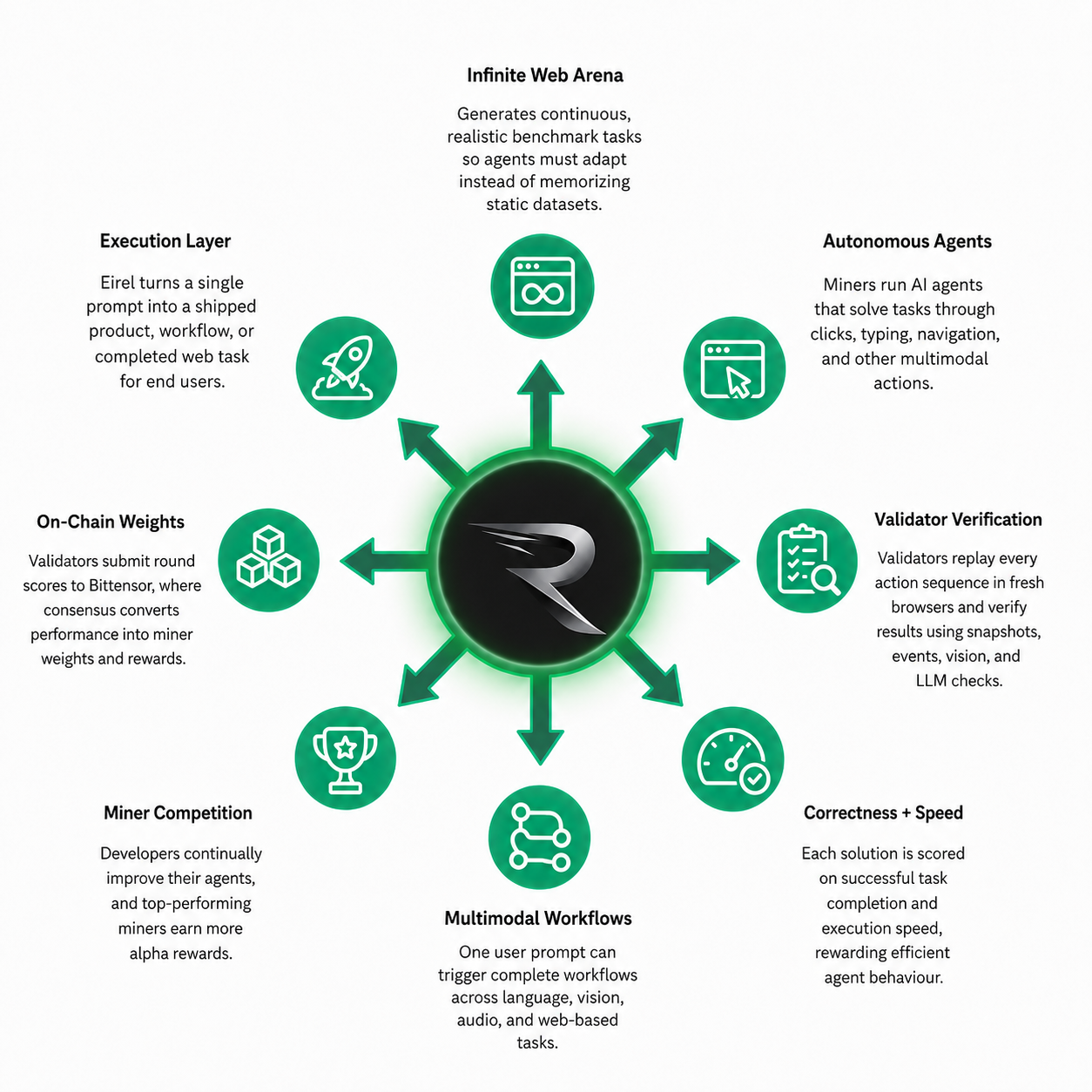
Eirel addresses the challenge of creating robust autonomous web and multimodal AI agents. Traditional AI benchmarks rely on static datasets and fixed tasks, which can be easily memorized by models. In contrast, Eirel uses the Infinite Web Arena (IWA) to generate a continuous stream of novel, realistic tasks as an ongoing benchmark. This means agents must constantly adapt and reason, not just recall a training set. In effect, Eirel’s subnet incentivizes developers to build agents that can autonomously browse and interact with the web or execute other multimodal tasks in real time. Its design principle is to compete AI agents against each other under verified evaluation, turning a single user prompt into a completed project or workflow across language, vision, audio, and web.
Miner-Validator Workflow
As a Bittensor subnet, Eirel follows the standard validator-miner loop but specialized for agent execution. Validators first **generate tasks** using the IWA modules (orchestration of LLMs and synthetic web environments). These tasks are packaged and sent in random batches to the miners. Each **miner** node runs an autonomous agent (the “web agent”) to solve the tasks by producing a sequence of actions (clicks, typing, navigation, etc.). When miners return their proposed action sequences, validators **execute and verify** them: a fresh browser instance is launched, the actions are applied, and after each step a snapshot is taken. Various tests are then run on these snapshots – checking HTML structure, simulating backend events, using vision models to inspect results, or even LLM-based analysis – to determine whether the task was completed correctly. Each task solution earns a score depending on correctness and speed.
Miner and Validator Roles
In practice, **miners** are developers who train and deploy their AI agent models to the network. They receive tasks from validators and attempt to solve them, continually improving their agents over time. The subnet rewards miners whose agents perform well (high correctness and efficiency) on these dynamic tasks. **Validators** are responsible for keeping the subnet honest and useful: they autonomously generate new tasks (using IWA’s benchmark tools), distribute them, and thoroughly evaluate the miners’ solutions. After scoring, validators submit their weight assignments to the Bittensor blockchain at the end of each round. These weights are aggregated (via stake-weighted consensus) to set each miner’s final weight on-chain, meaning high-performing agents earn more influence and more alpha rewards.. In this way, validators enforce the quality standard, and miners are directly incentivized to deliver accurate, fast agent behavior.
End Product for Users
For end users and stakeholders, the output of the Eirel subnet is essentially a decentralized network of competent AI agents. Users interact through a conversational interface: they present a goal or prompt, and behind the scenes competing agents plan and execute a pipeline of actions across multiple modalities. Eirel’s platform promises to “turn a single prompt into a shipped product” – meaning a complete solution (code, content, website tasks, etc.) is produced by the agents and delivered back to the user. For example, a user could tell Eirel to “launch a new marketing campaign” and the agents might autonomously generate visual assets, write copy, schedule posts, and set up analytics – all verified by validators. From an investor’s perspective, this translates into the Eirel (alpha) tokens whose value reflects overall subnet utility. High-performing agents that effectively solve tasks generate more alpha (earned by their miners), and token holders can stake on these validators or agents.
Comparison to Other Subnets
Eirel’s focus on autonomous execution sets it apart from many other Bittensor subnets. Many subnets target specific AI domains (e.g. inference models, text generation, vision) or simple feedforward tasks. By contrast, Eirel is an *execution layer* for complex workflows. To illustrate, SN62 Ridges AI is designed as an agent marketplace specializing in software engineering and coding tasks, whereas Eirel aims to orchestrate agents across any web-based or multimodal job. Similarly, other subnets might fine-tune language models or image models, but Eirel dynamically evaluates iterative action sequences in a web environment. Its adoption of a constantly-changing synthetic benchmark [IWA] makes it more resilient to overfitting or stale solutions. In other words, Eirel combines aspects of reinforcement-style environments with decentralized AI – a capability niche that few other subnets fill. It positions itself as the open competition of AI operator agents, rather than a static model API, hence the tagline of being the “execution layer for multimodal AI workflows”.
Core Problem and Approach
Eirel addresses the challenge of creating robust autonomous web and multimodal AI agents. Traditional AI benchmarks rely on static datasets and fixed tasks, which can be easily memorized by models. In contrast, Eirel uses the Infinite Web Arena (IWA) to generate a continuous stream of novel, realistic tasks as an ongoing benchmark. This means agents must constantly adapt and reason, not just recall a training set. In effect, Eirel’s subnet incentivizes developers to build agents that can autonomously browse and interact with the web or execute other multimodal tasks in real time. Its design principle is to compete AI agents against each other under verified evaluation, turning a single user prompt into a completed project or workflow across language, vision, audio, and web.
Miner-Validator Workflow
As a Bittensor subnet, Eirel follows the standard validator-miner loop but specialized for agent execution. Validators first **generate tasks** using the IWA modules (orchestration of LLMs and synthetic web environments). These tasks are packaged and sent in random batches to the miners. Each **miner** node runs an autonomous agent (the “web agent”) to solve the tasks by producing a sequence of actions (clicks, typing, navigation, etc.). When miners return their proposed action sequences, validators **execute and verify** them: a fresh browser instance is launched, the actions are applied, and after each step a snapshot is taken. Various tests are then run on these snapshots – checking HTML structure, simulating backend events, using vision models to inspect results, or even LLM-based analysis – to determine whether the task was completed correctly. Each task solution earns a score depending on correctness and speed.
Miner and Validator Roles
In practice, **miners** are developers who train and deploy their AI agent models to the network. They receive tasks from validators and attempt to solve them, continually improving their agents over time. The subnet rewards miners whose agents perform well (high correctness and efficiency) on these dynamic tasks. **Validators** are responsible for keeping the subnet honest and useful: they autonomously generate new tasks (using IWA’s benchmark tools), distribute them, and thoroughly evaluate the miners’ solutions. After scoring, validators submit their weight assignments to the Bittensor blockchain at the end of each round. These weights are aggregated (via stake-weighted consensus) to set each miner’s final weight on-chain, meaning high-performing agents earn more influence and more alpha rewards.. In this way, validators enforce the quality standard, and miners are directly incentivized to deliver accurate, fast agent behavior.
End Product for Users
For end users and stakeholders, the output of the Eirel subnet is essentially a decentralized network of competent AI agents. Users interact through a conversational interface: they present a goal or prompt, and behind the scenes competing agents plan and execute a pipeline of actions across multiple modalities. Eirel’s platform promises to “turn a single prompt into a shipped product” – meaning a complete solution (code, content, website tasks, etc.) is produced by the agents and delivered back to the user. For example, a user could tell Eirel to “launch a new marketing campaign” and the agents might autonomously generate visual assets, write copy, schedule posts, and set up analytics – all verified by validators. From an investor’s perspective, this translates into the Eirel (alpha) tokens whose value reflects overall subnet utility. High-performing agents that effectively solve tasks generate more alpha (earned by their miners), and token holders can stake on these validators or agents.
Comparison to Other Subnets
Eirel’s focus on autonomous execution sets it apart from many other Bittensor subnets. Many subnets target specific AI domains (e.g. inference models, text generation, vision) or simple feedforward tasks. By contrast, Eirel is an *execution layer* for complex workflows. To illustrate, SN62 Ridges AI is designed as an agent marketplace specializing in software engineering and coding tasks, whereas Eirel aims to orchestrate agents across any web-based or multimodal job. Similarly, other subnets might fine-tune language models or image models, but Eirel dynamically evaluates iterative action sequences in a web environment. Its adoption of a constantly-changing synthetic benchmark [IWA] makes it more resilient to overfitting or stale solutions. In other words, Eirel combines aspects of reinforcement-style environments with decentralized AI – a capability niche that few other subnets fill. It positions itself as the open competition of AI operator agents, rather than a static model API, hence the tagline of being the “execution layer for multimodal AI workflows”.
Network Status & Live vs In-Development
The Eirel system is *currently live* on the Bittensor mainnet. Validators and miners are active), running rounds of the IWA-based tasks. The core infrastructure – the Infinite Web Arena synthetic environments and the validator/miner protocols – is functional, meaning real submissions can be made and alpha rewards distributed. Meanwhile, additional components are still being built or polished. According to the publicly stated roadmap, the team planned an “AI Agent AppStore” (a marketplace for agents) and a browser extension (the Autoppia “Automata” extension) to launch in Q3 2025. The Autoppia Web Operator (a permissionless agent deployment platform) was slated for Q4 2025. Into 2026, the team rebranded the product as Eirel and unveiled a demo chat interface. However, features like the agent marketplace, premium integrations, and full multimodal pipelines appear still under development.
Technical Architecture
The system architecture combines Bittensor’s blockchain and IPFS with custom AI modules. On-chain, Eirel simply stores validator weights and the content identifiers (CIDs) for evaluation results. Off-chain, *validator nodes* run the core logic: they generate diverse tasks using the IWA modules, dispatch tasks to miners, execute returned action sequences in real browsers (inside Docker “demo web” apps), and run multi-modal tests on the outputs. The *miner nodes* host user-developed agents (written as Bittensor neurons). When assigned tasks, a miner’s agent processes the task (often using embedded LLMs or vision models for understanding), then outputs an ordered list of web actions or API calls. The validator then replays those actions and assigns a score. Periodically (every ~4.8 hours = 1440 blocks), the validators publish their score snapshots to IPFS and commit the CID on-chain. After a short confirmation gap, all validators retrieve each other’s CIDs and perform a stake-weighted score aggregation. Finally, the subnet finalizes the weight settings on the blockchain for that round. This pipeline – managed by the `RoundManager`, `tasks` generator, and `consensus` modules in the code – ensures a fully decentralized, verifiable evaluation every round.
Codebase and Development Activity
The Eirel code (GitHub repo *RendixNetwork/eirel-ai*) is open-source and under active development. It shows dozens of commits each month and multiple active branches (95 commits in the past 30 days, 3 contributors). Development activity metrics indicate the project is very active (3 core developers, 4 stars on GitHub, no unresolved issues). In addition to the main subnet code (written in Python for miners/validators), the wider Autoppia organization maintains related repositories – for example, *autoppia_web_operator* (a TypeScript/React UI) and *autoppia_iwa* (the environment generator HTML). These repos suggest a team working across the full stack: backend agent logic, frontend interfaces, and environment generation.
Integration and Tools
Eirel’s design integrates with other AI tools and data systems. The IWA benchmark uses generative LLMs and programmatic methods to spawn and alter demo websites and tasks. Validators utilize vision models and LLM-based checkers to verify outcomes (e.g. image-based checks or text analysis of webpage text). The documentation explicitly highlights “autonomous interaction with external tools, APIs, and data systems” in the agent workflows. In practice, this means agents can embed calls to other services (like search APIs or knowledge databases) as part of solving tasks. The protocol itself sits atop standard technologies: Bittensor’s TCP protocol with Axon for neuron communication, IPFS for consensus data, and browser automation tools (e.g. Puppeteer/Playwright) for executing the web actions. All of these dependencies are open-source; for example, the `validator/` and `miner/` code in GitHub shows how the Axon call filters requests, manages priorities, and sequences actions on the Chrome instance.
Users and Customers
Eirel’s end users are primarily developers, enterprises, and any parties needing automated workflows. Through the Autoppia ecosystem, users can select or publish AI “workers” in a marketplace. The platform offers an SDK and API (and soon a user-friendly chat/web app) so that businesses can describe objectives and let the agents execute. For example, a retailer might use Eirel to automatically fill out web forms for price comparisons, or a marketer might deploy agents to autonomously generate and schedule content – all achieved by giving a multi-step prompt to the network. The stated customers are builders of AI workflows (“miners” as agents, and integrators who use these agents). In practice, any developer with a Bittensor wallet can become a miner and submit an agent, and any user can stake on validators. Commercial usage would occur via the Autoppia extension and marketplace: for instance, the Autoppia website highlights “Automata” (a browser extension powered by Subnet 36) that end-users can try for web automation tasks. In summary, Eirel targets the decentralized AI ecosystem – miners, builders, and investors in Bittensor – as well as organizations seeking decentralized automation.
Network Status & Live vs In-Development
The Eirel system is *currently live* on the Bittensor mainnet. Validators and miners are active), running rounds of the IWA-based tasks. The core infrastructure – the Infinite Web Arena synthetic environments and the validator/miner protocols – is functional, meaning real submissions can be made and alpha rewards distributed. Meanwhile, additional components are still being built or polished. According to the publicly stated roadmap, the team planned an “AI Agent AppStore” (a marketplace for agents) and a browser extension (the Autoppia “Automata” extension) to launch in Q3 2025. The Autoppia Web Operator (a permissionless agent deployment platform) was slated for Q4 2025. Into 2026, the team rebranded the product as Eirel and unveiled a demo chat interface. However, features like the agent marketplace, premium integrations, and full multimodal pipelines appear still under development.
Technical Architecture
The system architecture combines Bittensor’s blockchain and IPFS with custom AI modules. On-chain, Eirel simply stores validator weights and the content identifiers (CIDs) for evaluation results. Off-chain, *validator nodes* run the core logic: they generate diverse tasks using the IWA modules, dispatch tasks to miners, execute returned action sequences in real browsers (inside Docker “demo web” apps), and run multi-modal tests on the outputs. The *miner nodes* host user-developed agents (written as Bittensor neurons). When assigned tasks, a miner’s agent processes the task (often using embedded LLMs or vision models for understanding), then outputs an ordered list of web actions or API calls. The validator then replays those actions and assigns a score. Periodically (every ~4.8 hours = 1440 blocks), the validators publish their score snapshots to IPFS and commit the CID on-chain. After a short confirmation gap, all validators retrieve each other’s CIDs and perform a stake-weighted score aggregation. Finally, the subnet finalizes the weight settings on the blockchain for that round. This pipeline – managed by the `RoundManager`, `tasks` generator, and `consensus` modules in the code – ensures a fully decentralized, verifiable evaluation every round.
Codebase and Development Activity
The Eirel code (GitHub repo *RendixNetwork/eirel-ai*) is open-source and under active development. It shows dozens of commits each month and multiple active branches (95 commits in the past 30 days, 3 contributors). Development activity metrics indicate the project is very active (3 core developers, 4 stars on GitHub, no unresolved issues). In addition to the main subnet code (written in Python for miners/validators), the wider Autoppia organization maintains related repositories – for example, *autoppia_web_operator* (a TypeScript/React UI) and *autoppia_iwa* (the environment generator HTML). These repos suggest a team working across the full stack: backend agent logic, frontend interfaces, and environment generation.
Integration and Tools
Eirel’s design integrates with other AI tools and data systems. The IWA benchmark uses generative LLMs and programmatic methods to spawn and alter demo websites and tasks. Validators utilize vision models and LLM-based checkers to verify outcomes (e.g. image-based checks or text analysis of webpage text). The documentation explicitly highlights “autonomous interaction with external tools, APIs, and data systems” in the agent workflows. In practice, this means agents can embed calls to other services (like search APIs or knowledge databases) as part of solving tasks. The protocol itself sits atop standard technologies: Bittensor’s TCP protocol with Axon for neuron communication, IPFS for consensus data, and browser automation tools (e.g. Puppeteer/Playwright) for executing the web actions. All of these dependencies are open-source; for example, the `validator/` and `miner/` code in GitHub shows how the Axon call filters requests, manages priorities, and sequences actions on the Chrome instance.
Users and Customers
Eirel’s end users are primarily developers, enterprises, and any parties needing automated workflows. Through the Autoppia ecosystem, users can select or publish AI “workers” in a marketplace. The platform offers an SDK and API (and soon a user-friendly chat/web app) so that businesses can describe objectives and let the agents execute. For example, a retailer might use Eirel to automatically fill out web forms for price comparisons, or a marketer might deploy agents to autonomously generate and schedule content – all achieved by giving a multi-step prompt to the network. The stated customers are builders of AI workflows (“miners” as agents, and integrators who use these agents). In practice, any developer with a Bittensor wallet can become a miner and submit an agent, and any user can stake on validators. Commercial usage would occur via the Autoppia extension and marketplace: for instance, the Autoppia website highlights “Automata” (a browser extension powered by Subnet 36) that end-users can try for web automation tasks. In summary, Eirel targets the decentralized AI ecosystem – miners, builders, and investors in Bittensor – as well as organizations seeking decentralized automation.
Organization and Ownership
The Eirel subnet is developed by *Rendix Srl*, a dev shop specializing in Bittensor subnets. Rendix describes itself as designing “elegant systems” for decentralized AI, pairing expert developers with high-impact ideas. Autoppia was the public-facing product name (a marketplace for AI Workers), and it spearheaded the Web Agents project. The official roadmap emphasizes independent funding and no outside backing, ensuring the creators retain full control. In essence, Eirel is a self-funded team initiative. The company’s materials credit “Rendix” with the network, and indeed press and links refer to Rendix as the entity behind the project. The Eirel website footer also explicitly credits Rendix (©2026 Eirel Network).
Contributors and Expertise
Publicly available data suggests a small core team. The GitHub repo shows 3 active contributors to the subnet code. There are no widely published names of the developers or founders in the documentation. Their Twitter/X presence (Autoppia/@AutoppiaAI) is corporate rather than personal. The technical work implies that the team has expertise in AI agent development, web automation, and blockchain engineering – but individual bios are not listed. (No LinkedIn or About page with personnel was found.)
Background and Partnerships
No external partnerships or backers are explicitly announced. The roadmap’s Q1 2025 entry notes they secured team funding internally. It appears to be an all-hands engineering team rather than a VC-backed startup. The Autoppia ecosystem (AI Workers marketplace, etc.) is effectively a suite of tools built by the same group. In the broader Bittensor community, Eirel (then Autoppia) is respected but not highlighted as an industry-backed project. There’s no public information on corporate partnerships – the emphasis is on being a “permissionless Web Operator” system. Community engagement has been through the Bittensor Discord and X, but no formal collaborators beyond the Rendix team are known from the sources examined.
Organization and Ownership
The Eirel subnet is developed by *Rendix Srl*, a dev shop specializing in Bittensor subnets. Rendix describes itself as designing “elegant systems” for decentralized AI, pairing expert developers with high-impact ideas. Autoppia was the public-facing product name (a marketplace for AI Workers), and it spearheaded the Web Agents project. The official roadmap emphasizes independent funding and no outside backing, ensuring the creators retain full control. In essence, Eirel is a self-funded team initiative. The company’s materials credit “Rendix” with the network, and indeed press and links refer to Rendix as the entity behind the project. The Eirel website footer also explicitly credits Rendix (©2026 Eirel Network).
Contributors and Expertise
Publicly available data suggests a small core team. The GitHub repo shows 3 active contributors to the subnet code. There are no widely published names of the developers or founders in the documentation. Their Twitter/X presence (Autoppia/@AutoppiaAI) is corporate rather than personal. The technical work implies that the team has expertise in AI agent development, web automation, and blockchain engineering – but individual bios are not listed. (No LinkedIn or About page with personnel was found.)
Background and Partnerships
No external partnerships or backers are explicitly announced. The roadmap’s Q1 2025 entry notes they secured team funding internally. It appears to be an all-hands engineering team rather than a VC-backed startup. The Autoppia ecosystem (AI Workers marketplace, etc.) is effectively a suite of tools built by the same group. In the broader Bittensor community, Eirel (then Autoppia) is respected but not highlighted as an industry-backed project. There’s no public information on corporate partnerships – the emphasis is on being a “permissionless Web Operator” system. Community engagement has been through the Bittensor Discord and X, but no formal collaborators beyond the Rendix team are known from the sources examined.
Public Roadmap Milestones
The project has outlined a phased roadmap under its Autoppia Web Agents name (now Eirel). Key milestones include:
Q2 2024: Establish community presence and form mining teams. The team engaged the Bittensor community and built initial mining infrastructure.
Q3 2024: Integrate IWA into a Bittensor subnet. Their Infinite Web Arena benchmark was deployed on-chain, enabling decentralized validation and task execution.
Q1 2025: Finalize team and launch subnet. A skilled team was assembled and internal funding secured (with no reliance on third parties). Late Q1 2025 was planned for final testing and securing a mainnet slot so that SN36 could begin rewarding curacy on launch.
Q2 2025: Iteratively improve the benchmark. As agent capability grows, the IWA tasks were scheduled to evolve with real-world use cases, preventing stagnation.
Q3 2025: Launch external products. An “AI Agent AppStore” and related monetization features were set to go live. This included partnerships to integrate the IWA engine with user-facing tools (e.g. a Chrome extension for autonomously running agents).
Q4 2025: Expand to full Web Operator. The plan was to release the Autoppia Web Operator as a permissionless marketplace for deploying intelligent web agents. This would allow anyone to run or deploy agents without pre-approval. Essentially, this phase aimed to transition from closed tests to a fully open agent-of-agents platform.
Future Outlook: Beyond these 2024–2025 milestones, no detailed public schedule has been posted. The fully realized vision is a decentralized chat/agent layer that can execute tasks across modalities as soon as they are requested. In practice, this means that after launch one would expect Q2–Q3 2026 targets to focus on scaling the network, refining the agent marketplace, and improving usability. However, no new official dates or phases (e.g. a token sale or integration Q2 2026) are available in the sources. Recent updates have been limited to the Eirel website and documentation tweaks. In summary, all confirmed milestones are through 2025; beyond that, the team simply emphasizes achieving an open, multimodal AI execution platform.
Public Roadmap Milestones
The project has outlined a phased roadmap under its Autoppia Web Agents name (now Eirel). Key milestones include:
Q2 2024: Establish community presence and form mining teams. The team engaged the Bittensor community and built initial mining infrastructure.
Q3 2024: Integrate IWA into a Bittensor subnet. Their Infinite Web Arena benchmark was deployed on-chain, enabling decentralized validation and task execution.
Q1 2025: Finalize team and launch subnet. A skilled team was assembled and internal funding secured (with no reliance on third parties). Late Q1 2025 was planned for final testing and securing a mainnet slot so that SN36 could begin rewarding curacy on launch.
Q2 2025: Iteratively improve the benchmark. As agent capability grows, the IWA tasks were scheduled to evolve with real-world use cases, preventing stagnation.
Q3 2025: Launch external products. An “AI Agent AppStore” and related monetization features were set to go live. This included partnerships to integrate the IWA engine with user-facing tools (e.g. a Chrome extension for autonomously running agents).
Q4 2025: Expand to full Web Operator. The plan was to release the Autoppia Web Operator as a permissionless marketplace for deploying intelligent web agents. This would allow anyone to run or deploy agents without pre-approval. Essentially, this phase aimed to transition from closed tests to a fully open agent-of-agents platform.
Future Outlook: Beyond these 2024–2025 milestones, no detailed public schedule has been posted. The fully realized vision is a decentralized chat/agent layer that can execute tasks across modalities as soon as they are requested. In practice, this means that after launch one would expect Q2–Q3 2026 targets to focus on scaling the network, refining the agent marketplace, and improving usability. However, no new official dates or phases (e.g. a token sale or integration Q2 2026) are available in the sources. Recent updates have been limited to the Eirel website and documentation tweaks. In summary, all confirmed milestones are through 2025; beyond that, the team simply emphasizes achieving an open, multimodal AI execution platform.