With the amount of new subnets being added it can be hard to get up to date information across all subnets, so data may be slightly out of date from time to time
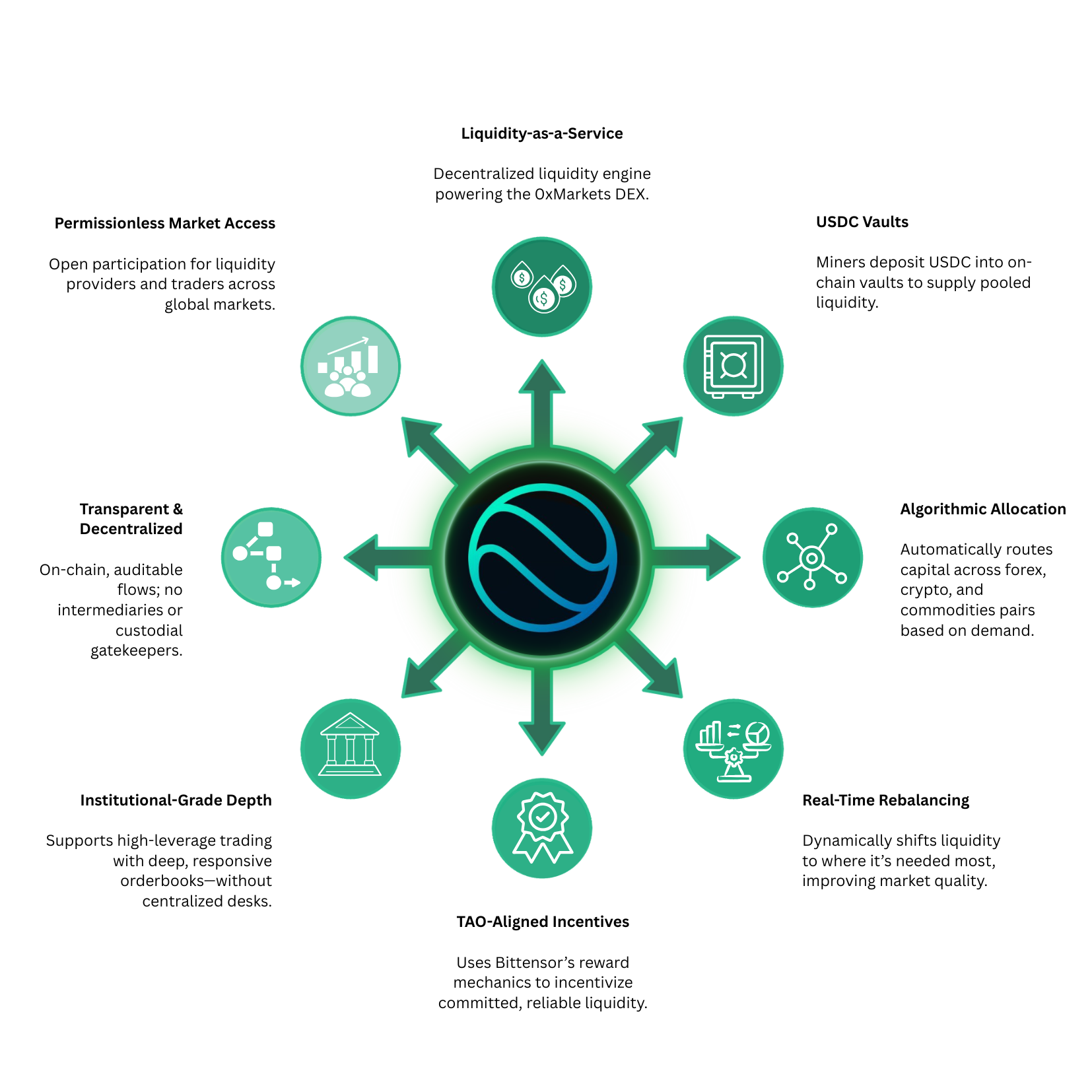
Cartha is a specialized decentralized liquidity engine operating as Subnet 35 on the Bittensor network. In simple terms, Cartha’s role is to provide “Liquidity-as-a-Service” for the 0xMarkets platform. It coordinates a network of participants (called miners in Bittensor terminology) who supply liquidity to 0xMarkets’ decentralized exchange (DEX). These miners deposit capital (USDC stablecoin) into on-chain vaults, and Cartha algorithmically allocates this liquidity to various trading pairs (forex, crypto, commodities) based on demand. By doing so, Cartha ensures that the DEX has deep, dynamic liquidity on tap – comparable to traditional financial markets – but achieved in a decentralized, transparent manner.
In essence, Cartha turns Bittensor’s AI-focused network into a liquidity backbone for trading. It leverages Bittensor’s distributed consensus and reward mechanics (originally designed for incentivizing AI tasks) to instead incentivize liquidity provision. Miners on Cartha are rewarded for committing capital, and Cartha’s protocols can redirect liquidity to where it’s needed most, such as popular forex pairs or volatile markets, in real time. This setup makes 0xMarkets capable of offering high-leverage trading on many assets with institutional-grade depth of liquidity, all without centralized intermediaries. In summary, Cartha acts as the decentralized liquidity engine powering the 0xMarkets DEX, enabling permissionless access to global currency, commodity, and crypto markets with robust liquidity and fair market-making.
(Background: Subnet 35 was previously known as LogicNet, an AI reasoning project by AIT Protocol. That effort stalled in 2025, and the subnet was repurposed under new leadership as “Cartha” to focus on liquidity provisioning. Cartha thus represents a pivot from a pure AI model subnet to a DeFi-oriented subnet, bringing a new use-case into the Bittensor ecosystem.)
Cartha is a specialized decentralized liquidity engine operating as Subnet 35 on the Bittensor network. In simple terms, Cartha’s role is to provide “Liquidity-as-a-Service” for the 0xMarkets platform. It coordinates a network of participants (called miners in Bittensor terminology) who supply liquidity to 0xMarkets’ decentralized exchange (DEX). These miners deposit capital (USDC stablecoin) into on-chain vaults, and Cartha algorithmically allocates this liquidity to various trading pairs (forex, crypto, commodities) based on demand. By doing so, Cartha ensures that the DEX has deep, dynamic liquidity on tap – comparable to traditional financial markets – but achieved in a decentralized, transparent manner.
In essence, Cartha turns Bittensor’s AI-focused network into a liquidity backbone for trading. It leverages Bittensor’s distributed consensus and reward mechanics (originally designed for incentivizing AI tasks) to instead incentivize liquidity provision. Miners on Cartha are rewarded for committing capital, and Cartha’s protocols can redirect liquidity to where it’s needed most, such as popular forex pairs or volatile markets, in real time. This setup makes 0xMarkets capable of offering high-leverage trading on many assets with institutional-grade depth of liquidity, all without centralized intermediaries. In summary, Cartha acts as the decentralized liquidity engine powering the 0xMarkets DEX, enabling permissionless access to global currency, commodity, and crypto markets with robust liquidity and fair market-making.
(Background: Subnet 35 was previously known as LogicNet, an AI reasoning project by AIT Protocol. That effort stalled in 2025, and the subnet was repurposed under new leadership as “Cartha” to focus on liquidity provisioning. Cartha thus represents a pivot from a pure AI model subnet to a DeFi-oriented subnet, bringing a new use-case into the Bittensor ecosystem.)
Cartha’s product is essentially a combination of a decentralized exchange (0xMarkets) and a Bittensor subnet backend that manages liquidity. The 0xMarkets DEX is the user-facing platform where traders can permissionlessly trade perpetual futures on a range of assets – including fiat currencies (forex), cryptocurrencies, and commodities – with leverage up to 500×. The Cartha subnet runs in the background as the liquidity provider network for this DEX. Technically, Cartha is built on Bittensor (a substrate-based decentralized AI blockchain), but it is configured to serve a DeFi purpose: coordinating capital and pricing rather than answering AI queries. The “build” thus involves smart contracts or chain logic for vaults, trading, and governance on the subnet, as well as the integration between Cartha and the DEX interface.
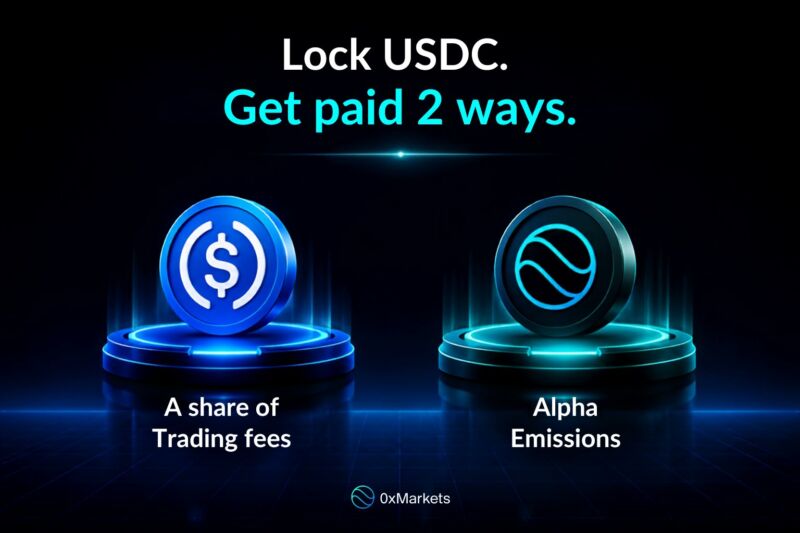
Technical Architecture: On 0xMarkets/Cartha, all markets share a common base collateral of USDC (a stablecoin) for simplicity and stability. Liquidity is segmented into separate vaults per market/pair – for example, one vault for EUR/USD, another for BTC/USD, etc. – which isolates risk per market. Miners (Liquidity Providers) on Cartha deposit USDC into these market-specific vaults, committing liquidity to back traders’ positions. A minimum capital commitment is required (targeting $200k–$1M as the network grows) to ensure substantial liquidity in each vault. Miners lock their funds for fixed epochs (time periods) when they commit to a vault. In return, they earn dual rewards: a share of trading fees from that market, plus emissions of Cartha’s native Alpha token as an incentive. This dual-reward design means liquidity providers earn immediate revenue (fees) as well as protocol-native tokens, aligning their incentives with the platform’s success.
Meanwhile, Traders can open and close perpetual futures positions on the 0xMarkets DEX with up to 500× leverage, using USDC as margin. The DEX offers a fixed trading fee structure and permissionless access – anyone in an allowed jurisdiction can trade without gatekeepers. When traders take positions, they’re effectively trading against the liquidity in the vaults provided by the miners. Cartha’s system dynamically rebalances or allocates liquidity: if one asset pair sees heavy trading demand, Cartha can attract or direct more liquidity to that vault to tighten spreads and maintain deep order book depth. This “programmatic liquidity” management is algorithmic and on-chain, making the market more efficient and transparent than traditional CFD (Contract for Difference) platforms. Notably, pricing data for the DEX comes from external oracles (multiple price feeds from reputable sources), which are then cross-checked by Cartha’s validators to prevent any single oracle from manipulating prices. In case an oracle fails or deviates, fallback oracles provide redundancy, ensuring the platform always has a reliable mark price for each asset.
Key Components of the Cartha/0xMarkets System:
Miners (LPs): These are the nodes/operators who provide liquidity. They deposit USDC into smart-contract vaults corresponding to specific markets (e.g. EUR/USD, BTC/USD). This pooled USDC liquidity is what traders trade against. Miners must maintain a minimum deposit and keep it locked for the duration of an epoch. In return, miners receive 60% of all trading fees generated on the DEX (distributed proportionally) as well as Alpha token rewards based on how much and how long they stake liquidity (their “deposit score”). This setup effectively turns liquidity provision into a mining activity, secured by Bittensor’s consensus (Cartha is secured by Bittensor’s dynamic TAO mechanism).
Traders: End-users of 0xMarkets who can trade perpetual futures on a wide range of assets with high leverage. They use USDC as collateral and can go long or short on supported currency pairs, crypto assets, commodities, etc. The trading experience is meant to resemble a typical perpetual swap exchange: traders pay a small trading fee on each position (a portion of which goes to the liquidity providers as mentioned). There are no centralized intermediaries or KYC on the protocol itself (though front-end access may be geofenced for regulatory compliance). This opens access to global markets for users who might be excluded by traditional brokers, aligning with 0xMarkets’ goal of permissionless, 24/7 access for everyone.
Safety Mechanisms: The Cartha/0xMarkets design places heavy emphasis on security of funds and fairness. Multiple price oracles feed asset prices to the system; validators on Cartha monitor these prices and trading activity. If a trader’s position falls below margin requirements (i.e. they are about to go bankrupt on a trade), the system triggers a liquidation of that position. Validators (who are special participants in the subnet, distinct from liquidity-providing miners) can step in to execute liquidations – essentially closing out the under-collateralized positions to protect the liquidity pool. Validators put up some Alpha token collateral to participate in the liquidation process (which keeps them honest), and they are rewarded with a portion of liquidation fees if they perform liquidations correctly. The liquidation fee is a fixed 10% of the remaining position, which is split as follows: 20% to the validators who execute the liquidations; 50% to an Insurance Pool (a reserves fund to cover any unexpected shortfalls or “black swan” events); and 30% to buy back and burn Alpha tokens (which supports the token’s value). This fee structure not only incentivizes network participants to maintain system health, but also builds a safety net. The Insurance Pool accumulated from liquidations can be tapped (via governance decision) to cover losses if there’s ever a sudden market crash or an unfilled liquidation that leaves a deficit. Together, these measures ensure that the DEX remains solvent and robust even under volatile market conditions.
Governance (Alpha Token & veALPHA): Cartha introduces its own native token, often referred to as Alpha, which underpins the governance and incentive system. Liquidity miners earn Alpha emissions, and holders of Alpha can participate in governance by locking their tokens as veALPHA (vote-escrowed Alpha). The longer a holder locks their Alpha, the greater their voting weight and share of certain protocol fees – this is similar to the veToken models in other DeFi platforms. Governance token holders can vote on proposals to adjust parameters of the system. For example, veALPHA voters can direct more Alpha token emissions toward specific vaults/markets that they want to incentivize (this encourages liquidity to flow to those markets by rewarding their LPs more). They can also vote on fee distributions or protocol settings – for instance, tweaking the percentage of fees that go to the treasury vs. LPs, or adjusting risk parameters over time. This on-chain governance means the community of token holders will influence how Cartha evolves, making the system self-regulating and adaptable. All changes occur transparently via smart contract governance, aligning with the decentralized ethos.
Overall, the product architecture of Cartha + 0xMarkets is an innovative fusion of DeFi and decentralized AI infrastructure. The “front-end” is a perpetual futures DEX where users trade global markets with deep liquidity. The “back-end” is the Cartha subnet, which uses Bittensor’s blockchain and incentive mechanisms to marshal a distributed network of liquidity providers and maintain market stability. By building on Bittensor, Cartha benefits from a robust decentralized network layer (originally designed for AI model consensus) and repurposes it to coordinate capital. This results in a unique build: a trading platform that is decentralized not just in custody, but in its liquidity provisioning and market-making logic, all enforced by blockchain consensus. In summary, the Cartha/0xMarkets product is “a multi-asset (FX, crypto, commodities) perpetual DEX with deep programmatic liquidity provided by a Bittensor subnet”– a first-of-its-kind blend of DeFi and decentralized AI tech.
Cartha’s product is essentially a combination of a decentralized exchange (0xMarkets) and a Bittensor subnet backend that manages liquidity. The 0xMarkets DEX is the user-facing platform where traders can permissionlessly trade perpetual futures on a range of assets – including fiat currencies (forex), cryptocurrencies, and commodities – with leverage up to 500×. The Cartha subnet runs in the background as the liquidity provider network for this DEX. Technically, Cartha is built on Bittensor (a substrate-based decentralized AI blockchain), but it is configured to serve a DeFi purpose: coordinating capital and pricing rather than answering AI queries. The “build” thus involves smart contracts or chain logic for vaults, trading, and governance on the subnet, as well as the integration between Cartha and the DEX interface.
Technical Architecture: On 0xMarkets/Cartha, all markets share a common base collateral of USDC (a stablecoin) for simplicity and stability. Liquidity is segmented into separate vaults per market/pair – for example, one vault for EUR/USD, another for BTC/USD, etc. – which isolates risk per market. Miners (Liquidity Providers) on Cartha deposit USDC into these market-specific vaults, committing liquidity to back traders’ positions. A minimum capital commitment is required (targeting $200k–$1M as the network grows) to ensure substantial liquidity in each vault. Miners lock their funds for fixed epochs (time periods) when they commit to a vault. In return, they earn dual rewards: a share of trading fees from that market, plus emissions of Cartha’s native Alpha token as an incentive. This dual-reward design means liquidity providers earn immediate revenue (fees) as well as protocol-native tokens, aligning their incentives with the platform’s success.
Meanwhile, Traders can open and close perpetual futures positions on the 0xMarkets DEX with up to 500× leverage, using USDC as margin. The DEX offers a fixed trading fee structure and permissionless access – anyone in an allowed jurisdiction can trade without gatekeepers. When traders take positions, they’re effectively trading against the liquidity in the vaults provided by the miners. Cartha’s system dynamically rebalances or allocates liquidity: if one asset pair sees heavy trading demand, Cartha can attract or direct more liquidity to that vault to tighten spreads and maintain deep order book depth. This “programmatic liquidity” management is algorithmic and on-chain, making the market more efficient and transparent than traditional CFD (Contract for Difference) platforms. Notably, pricing data for the DEX comes from external oracles (multiple price feeds from reputable sources), which are then cross-checked by Cartha’s validators to prevent any single oracle from manipulating prices. In case an oracle fails or deviates, fallback oracles provide redundancy, ensuring the platform always has a reliable mark price for each asset.
Key Components of the Cartha/0xMarkets System:
Miners (LPs): These are the nodes/operators who provide liquidity. They deposit USDC into smart-contract vaults corresponding to specific markets (e.g. EUR/USD, BTC/USD). This pooled USDC liquidity is what traders trade against. Miners must maintain a minimum deposit and keep it locked for the duration of an epoch. In return, miners receive 60% of all trading fees generated on the DEX (distributed proportionally) as well as Alpha token rewards based on how much and how long they stake liquidity (their “deposit score”). This setup effectively turns liquidity provision into a mining activity, secured by Bittensor’s consensus (Cartha is secured by Bittensor’s dynamic TAO mechanism).
Traders: End-users of 0xMarkets who can trade perpetual futures on a wide range of assets with high leverage. They use USDC as collateral and can go long or short on supported currency pairs, crypto assets, commodities, etc. The trading experience is meant to resemble a typical perpetual swap exchange: traders pay a small trading fee on each position (a portion of which goes to the liquidity providers as mentioned). There are no centralized intermediaries or KYC on the protocol itself (though front-end access may be geofenced for regulatory compliance). This opens access to global markets for users who might be excluded by traditional brokers, aligning with 0xMarkets’ goal of permissionless, 24/7 access for everyone.
Safety Mechanisms: The Cartha/0xMarkets design places heavy emphasis on security of funds and fairness. Multiple price oracles feed asset prices to the system; validators on Cartha monitor these prices and trading activity. If a trader’s position falls below margin requirements (i.e. they are about to go bankrupt on a trade), the system triggers a liquidation of that position. Validators (who are special participants in the subnet, distinct from liquidity-providing miners) can step in to execute liquidations – essentially closing out the under-collateralized positions to protect the liquidity pool. Validators put up some Alpha token collateral to participate in the liquidation process (which keeps them honest), and they are rewarded with a portion of liquidation fees if they perform liquidations correctly. The liquidation fee is a fixed 10% of the remaining position, which is split as follows: 20% to the validators who execute the liquidations; 50% to an Insurance Pool (a reserves fund to cover any unexpected shortfalls or “black swan” events); and 30% to buy back and burn Alpha tokens (which supports the token’s value). This fee structure not only incentivizes network participants to maintain system health, but also builds a safety net. The Insurance Pool accumulated from liquidations can be tapped (via governance decision) to cover losses if there’s ever a sudden market crash or an unfilled liquidation that leaves a deficit. Together, these measures ensure that the DEX remains solvent and robust even under volatile market conditions.
Governance (Alpha Token & veALPHA): Cartha introduces its own native token, often referred to as Alpha, which underpins the governance and incentive system. Liquidity miners earn Alpha emissions, and holders of Alpha can participate in governance by locking their tokens as veALPHA (vote-escrowed Alpha). The longer a holder locks their Alpha, the greater their voting weight and share of certain protocol fees – this is similar to the veToken models in other DeFi platforms. Governance token holders can vote on proposals to adjust parameters of the system. For example, veALPHA voters can direct more Alpha token emissions toward specific vaults/markets that they want to incentivize (this encourages liquidity to flow to those markets by rewarding their LPs more). They can also vote on fee distributions or protocol settings – for instance, tweaking the percentage of fees that go to the treasury vs. LPs, or adjusting risk parameters over time. This on-chain governance means the community of token holders will influence how Cartha evolves, making the system self-regulating and adaptable. All changes occur transparently via smart contract governance, aligning with the decentralized ethos.
Overall, the product architecture of Cartha + 0xMarkets is an innovative fusion of DeFi and decentralized AI infrastructure. The “front-end” is a perpetual futures DEX where users trade global markets with deep liquidity. The “back-end” is the Cartha subnet, which uses Bittensor’s blockchain and incentive mechanisms to marshal a distributed network of liquidity providers and maintain market stability. By building on Bittensor, Cartha benefits from a robust decentralized network layer (originally designed for AI model consensus) and repurposes it to coordinate capital. This results in a unique build: a trading platform that is decentralized not just in custody, but in its liquidity provisioning and market-making logic, all enforced by blockchain consensus. In summary, the Cartha/0xMarkets product is “a multi-asset (FX, crypto, commodities) perpetual DEX with deep programmatic liquidity provided by a Bittensor subnet”– a first-of-its-kind blend of DeFi and decentralized AI tech.
The Cartha (Subnet 35) and 0xMarkets project is being built by a coalition of experienced teams from both the decentralized finance and decentralized AI communities. It is led by Erkin Kamran, the former CEO of Traze (a traditional FX trading platform). Erkin stepped down from Traze in 2025 to found 0xMarkets, aiming to combine his TradFi expertise with Web3 technology. Under his leadership, the project’s vision is to “level the playing field” in market access by leveraging blockchain-based infrastructure.
The development of Cartha and 0xMarkets is backed by Taoshi and General TAO Ventures, along with other contributors from the Bittensor ecosystem. Taoshi is a leader in DeFi tooling, headed by CEO Arrash Yasavolian – who is a key contributor to 0xMarkets (he was quoted in the project’s announcement emphasizing the need for permissionless, fair trading infrastructure). General TAO Ventures (GTV), co-founded by Mike Grantis, is a venture focused on the intersection of blockchain and AI; GTV has been deeply involved in Bittensor’s growth and partnered in this project to provide both funding and expertise in decentralized AI networks. Mike Grantis (GTV’s co-founder) has highlighted how Bittensor’s incentive mechanisms are being used to solve liquidity challenges in markets that were previously hard to decentralize. The involvement of GTV links back to Bittensor’s roots – in fact, GTV was also an early partner in the original LogicNet project – ensuring that Cartha benefits from seasoned Bittensor developers and researchers.
In addition to these main players, the Contango Digital Assets fund (which is associated with GTV) is mentioned as part of the team’s backing. This indicates strong investor support at the intersection of AI and blockchain. The overall 0xMarkets team is described as drawing on builders from the Taoshi ecosystem, GTV, and the Contango Blockchain×AI fund. This multidisciplinary team combines: expertise in decentralized exchanges and smart contract development (from Taoshi’s DeFi background), expertise in Bittensor’s AI-driven blockchain protocols (from GTV and Bittensor community devs), and traditional market experience (from Erkin Kamran and others in TradFi).
It’s worth noting that Subnet 35’s pivot to Cartha was a community-coordinated effort. After the original LogicNet (AIT Protocol’s project) was discontinued, members of the Bittensor community and the above teams stepped in to repurpose the subnet. This means Cartha’s team also had to overhaul the subnet’s purpose – moving from running AI models to running liquidity pools – a significant technical feat achieved in a short span. The successful transition reflects the strength of the team’s technical talent. As of late 2025, the team has been active in engaging the community via social channels (X/Twitter and Discord) under the handle @0x_Markets and via the Taoshi community. They have also conducted AMA sessions and even appeared on podcasts (e.g. the “Hash Rate” podcast with Mark Jeffrey) to explain Cartha’s design and progress. The combined efforts of this team aim to ensure that Cartha (SN35) not only launches successfully but is robust, secure, and positioned to “disrupt the largest financial market” (the $7.5T daily forex market) by democratizing access.
The Cartha (Subnet 35) and 0xMarkets project is being built by a coalition of experienced teams from both the decentralized finance and decentralized AI communities. It is led by Erkin Kamran, the former CEO of Traze (a traditional FX trading platform). Erkin stepped down from Traze in 2025 to found 0xMarkets, aiming to combine his TradFi expertise with Web3 technology. Under his leadership, the project’s vision is to “level the playing field” in market access by leveraging blockchain-based infrastructure.
The development of Cartha and 0xMarkets is backed by Taoshi and General TAO Ventures, along with other contributors from the Bittensor ecosystem. Taoshi is a leader in DeFi tooling, headed by CEO Arrash Yasavolian – who is a key contributor to 0xMarkets (he was quoted in the project’s announcement emphasizing the need for permissionless, fair trading infrastructure). General TAO Ventures (GTV), co-founded by Mike Grantis, is a venture focused on the intersection of blockchain and AI; GTV has been deeply involved in Bittensor’s growth and partnered in this project to provide both funding and expertise in decentralized AI networks. Mike Grantis (GTV’s co-founder) has highlighted how Bittensor’s incentive mechanisms are being used to solve liquidity challenges in markets that were previously hard to decentralize. The involvement of GTV links back to Bittensor’s roots – in fact, GTV was also an early partner in the original LogicNet project – ensuring that Cartha benefits from seasoned Bittensor developers and researchers.
In addition to these main players, the Contango Digital Assets fund (which is associated with GTV) is mentioned as part of the team’s backing. This indicates strong investor support at the intersection of AI and blockchain. The overall 0xMarkets team is described as drawing on builders from the Taoshi ecosystem, GTV, and the Contango Blockchain×AI fund. This multidisciplinary team combines: expertise in decentralized exchanges and smart contract development (from Taoshi’s DeFi background), expertise in Bittensor’s AI-driven blockchain protocols (from GTV and Bittensor community devs), and traditional market experience (from Erkin Kamran and others in TradFi).
It’s worth noting that Subnet 35’s pivot to Cartha was a community-coordinated effort. After the original LogicNet (AIT Protocol’s project) was discontinued, members of the Bittensor community and the above teams stepped in to repurpose the subnet. This means Cartha’s team also had to overhaul the subnet’s purpose – moving from running AI models to running liquidity pools – a significant technical feat achieved in a short span. The successful transition reflects the strength of the team’s technical talent. As of late 2025, the team has been active in engaging the community via social channels (X/Twitter and Discord) under the handle @0x_Markets and via the Taoshi community. They have also conducted AMA sessions and even appeared on podcasts (e.g. the “Hash Rate” podcast with Mark Jeffrey) to explain Cartha’s design and progress. The combined efforts of this team aim to ensure that Cartha (SN35) not only launches successfully but is robust, secure, and positioned to “disrupt the largest financial market” (the $7.5T daily forex market) by democratizing access.
The Cartha/0xMarkets project is moving rapidly, with a planned launch in the latter part of 2025 and an ambitious roadmap for expansion. According to official announcements, the initial launch of 0xMarkets (powered by Cartha) is slated for 2025, bringing the first decentralized, permissionless trading platform for forex, crypto, and commodities markets online. Upon launch, users will be able to trade major currency pairs, selected cryptocurrencies, and possibly a few commodity markets using the perpetual DEX, with Cartha miners providing liquidity in the form of USDC vaults. The goal at launch is to demonstrate deep liquidity and tight spreads even on typically hard-to-tokenize markets like forex – essentially rivaling traditional CFD platforms from day one.
Short-Term Milestones (late 2025 – early 2026): In the months following launch, the team plans to continuously onboard more asset pairs and refine the platform’s features. High-priority milestones include:
Mid-Term Plans (2026): As the platform matures, 0xMarkets aims to list more complex and diverse assets. The team explicitly plans to offer tokenized stocks and bonds on the DEX in the future. This means users could potentially trade equities (stock indices or major company shares represented as tokens) and even bond markets in a decentralized way. Achieving this will depend on regulatory developments and technological capabilities (for example, finding reliable oracle feeds or tokenization methods for such assets). If realized, it would make 0xMarkets one of the most wide-ranging decentralized trading platforms, covering everything from currencies to commodities to equities within one unified liquidity engine. The broader vision is to turn Cartha into a flexible infrastructure layer for decentralized trading that can adapt as new asset classes are tokenized and as blockchain/AI tech advances.
Long-Term Vision: The roadmap suggests an evolution towards a fully decentralized trading ecosystem governed by its community. As more markets come online, the governance (veALPHA) will play a larger role in steering the platform – for instance, deciding which new asset classes to prioritize or adjusting fee models to stay competitive. The team’s long-term strategy is to continuously lower barriers to entry: enabling participants with even modest capital to become liquidity providers (via user-friendly tooling and perhaps lower minimums over time), and enabling traders worldwide to access markets that were previously off-limits. They envision 0xMarkets and Cartha as the “new layer of financial infrastructure” – one that is decentralized and globally accessible. This includes ongoing R&D to integrate advancements in both AI and blockchain; for example, the team has hinted at integrating Bittensor’s AI capabilities (internally code-named “Glitch” in some discussions) into aspects of Cartha, which could potentially optimize how liquidity is managed or how risk is assessed (though details are still to come).
In summary, the roadmap for Bittensor Subnet 35 – Cartha – and 0xMarkets is focused on launch and rapid expansion: launch the core FX/crypto DEX by end of 2025, expand to commodities in 2026, then pursue tokenized equities/bonds and other real-world assets as the ecosystem grows. Throughout this timeline, the project aims to maintain a high level of community involvement and transparency. Each phase (onboarding new assets, increasing liquidity, adding features) will be governed on-chain and open to Alpha token holders’ input. The ultimate goal is a comprehensive, decentralized trading platform where any permitted user can trade or provide liquidity for virtually any asset class, with Cartha ensuring the markets remain liquid, fair, and resilient. This represents a bold new direction for Bittensor’s technology, repurposing AI-network infrastructure to underpin a next-generation DeFi platform – a vision the team is actively working to turn into reality in the coming months and years.
The Cartha/0xMarkets project is moving rapidly, with a planned launch in the latter part of 2025 and an ambitious roadmap for expansion. According to official announcements, the initial launch of 0xMarkets (powered by Cartha) is slated for 2025, bringing the first decentralized, permissionless trading platform for forex, crypto, and commodities markets online. Upon launch, users will be able to trade major currency pairs, selected cryptocurrencies, and possibly a few commodity markets using the perpetual DEX, with Cartha miners providing liquidity in the form of USDC vaults. The goal at launch is to demonstrate deep liquidity and tight spreads even on typically hard-to-tokenize markets like forex – essentially rivaling traditional CFD platforms from day one.
Short-Term Milestones (late 2025 – early 2026): In the months following launch, the team plans to continuously onboard more asset pairs and refine the platform’s features. High-priority milestones include:
Mid-Term Plans (2026): As the platform matures, 0xMarkets aims to list more complex and diverse assets. The team explicitly plans to offer tokenized stocks and bonds on the DEX in the future. This means users could potentially trade equities (stock indices or major company shares represented as tokens) and even bond markets in a decentralized way. Achieving this will depend on regulatory developments and technological capabilities (for example, finding reliable oracle feeds or tokenization methods for such assets). If realized, it would make 0xMarkets one of the most wide-ranging decentralized trading platforms, covering everything from currencies to commodities to equities within one unified liquidity engine. The broader vision is to turn Cartha into a flexible infrastructure layer for decentralized trading that can adapt as new asset classes are tokenized and as blockchain/AI tech advances.
Long-Term Vision: The roadmap suggests an evolution towards a fully decentralized trading ecosystem governed by its community. As more markets come online, the governance (veALPHA) will play a larger role in steering the platform – for instance, deciding which new asset classes to prioritize or adjusting fee models to stay competitive. The team’s long-term strategy is to continuously lower barriers to entry: enabling participants with even modest capital to become liquidity providers (via user-friendly tooling and perhaps lower minimums over time), and enabling traders worldwide to access markets that were previously off-limits. They envision 0xMarkets and Cartha as the “new layer of financial infrastructure” – one that is decentralized and globally accessible. This includes ongoing R&D to integrate advancements in both AI and blockchain; for example, the team has hinted at integrating Bittensor’s AI capabilities (internally code-named “Glitch” in some discussions) into aspects of Cartha, which could potentially optimize how liquidity is managed or how risk is assessed (though details are still to come).
In summary, the roadmap for Bittensor Subnet 35 – Cartha – and 0xMarkets is focused on launch and rapid expansion: launch the core FX/crypto DEX by end of 2025, expand to commodities in 2026, then pursue tokenized equities/bonds and other real-world assets as the ecosystem grows. Throughout this timeline, the project aims to maintain a high level of community involvement and transparency. Each phase (onboarding new assets, increasing liquidity, adding features) will be governed on-chain and open to Alpha token holders’ input. The ultimate goal is a comprehensive, decentralized trading platform where any permitted user can trade or provide liquidity for virtually any asset class, with Cartha ensuring the markets remain liquid, fair, and resilient. This represents a bold new direction for Bittensor’s technology, repurposing AI-network infrastructure to underpin a next-generation DeFi platform – a vision the team is actively working to turn into reality in the coming months and years.
A special thanks to Mark Jeffrey for his amazing Hash Rate series! In this series, he provides valuable insights into Bittensor Subnets and the world of decentralized AI. Be sure to check out the full series on his YouTube channel for more expert analysis and deep dives.
Recorded September 2025: Mark Jeffrey hosts Arash, Urkin, and Victor to unveil Cartha (Subnet 35) and its first product, ZeroX Markets—a permissionless, on-chain FX perps DEX targeting the $7.5T/day forex market. Built on Base and powered by Cartha’s “liquidity-as-a-service” subnet, traders get high-leverage exposure (goal up to 500x) to pairs like EUR/USD and gold, while “miners” supply USDC liquidity and earn trading fees plus Cartha alpha emissions. Mechanics borrow from GMX: USDC-collateralized pools on both sides, funding fees, liquidations, and fee routing (60% to LPs; 30% to alpha stakers). Lockups (up to ~1 year) and forthcoming vote-escrow governance direct emissions to specific pools, improving depth and predictability. The team contrasts transparent, deterministic DeFi with opaque CFD brokers, and outlines a ~90-day launch goal, pooled minor slots, and integrations with GTV/Tshi’s SN8 and Glitch for trader funding, LP onboarding, and strategy discovery. Ambition: democratize “the house” and funnel real demand back to TAO.
Miners will have a full step-by-step guide and community support to get their setup running.
It still requires some basic technical skills, but SN35 is currently the easiest miner to run on Bittensor, and we’re optimizing around that.
In parallel, we’re actively working on a…
@0xEkxr Will you be integrating no-code (one click) mining setup for non technical liquidity providers?
Cartha Testnet is LIVE ( UID 78)
The liquidity engine behind 0xMarkets is now running on Bittensor’s testnet.
You can begin testing your miners in just a few steps:
Docs + instructions → https://docs.0xmarkets.io/testnet
Need test USDC? Comment here and request in Discord
If you’re…
We're ready to keep shipping. 👨💻
A big week for the entire #Bittensor ecosystem!
We're ready for the halving 💪 @VantaSN8 @0x_Markets
Have you ever wondered how the miners on SN35 work?
We made you a very detailed explainer on it. 👨💻
Let us know if there is any other questions you might have so we can answer them!
New week, more whitelists open.
We're opening some extra spots for the beta whitelist.
Be fast 👇
0xMarkets
Decentralized exchange for commodities and crypto
www.0xmarkets.io