
With the amount of new subnets being added it can be hard to get up to date information across all subnets, so data may be slightly out of date from time to time
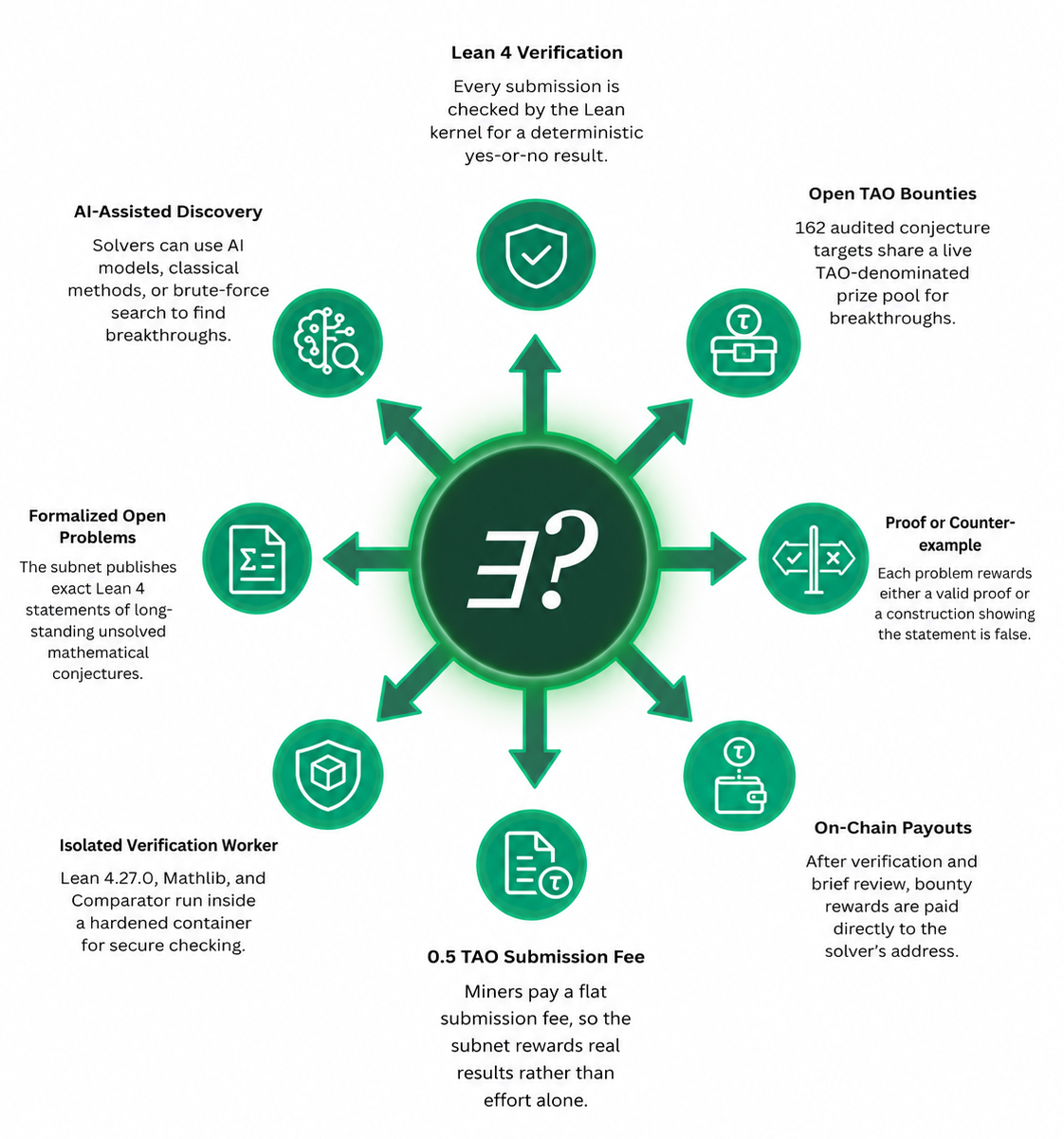
Conjectures (Bittensor Subnet 66) is a decentralised network that offers TAO bounties to anyone who can produce a machine-verified proof — or counterexample — for long-standing unsolved mathematical conjectures. The subnet publishes open problems as exact Lean 4 statements drawn from Google DeepMind’s peer-reviewed formal-conjectures repository, and pays for any result that passes a deterministic kernel check — not a panel of reviewers. The current catalog spans 162 active audited targets, including Erdős problems and Green’s Open Problems, backed by a live prize pool of over $16,000 in TAO-denominated bounties.
The core incentive structure is simple: find a proof or counterexample by any means — AI models, classical methods, or brute-force search — formalise it in Lean, and submit it. What settles the task is the Lean kernel, a mechanical checker that returns a plain yes or no in seconds, regardless of who sent the file or how they found the argument. This asymmetry — where finding a proof can absorb months of compute and checking one takes moments — is exactly what makes it possible to pay strangers for results rather than effort.
Miners on SN66 pay a flat fee of 0.5 TAO per submission. A verification worker passes the submitted Lean file through a hardened, isolated container running the pinned toolchain — Lean 4.27.0, Mathlib, and a custom Comparator module — and returns an immutable verdict. A valid proof enters a brief manual review phase (an anti-gaming precaution expected to be automated over time), after which the bounty is released from the subnet treasury directly to the solver’s payout address, on-chain and auditable.
Each problem carries two independent tasks: one requesting a formal proof, and one requesting a counterexample — a construction showing the statement is false. Both are rewarded independently, and both draw from the same pool, so the subnet is equally receptive to positive and negative resolutions. This makes Conjectures genuinely useful at the frontier: in July 2026, two conjectures that had stood for decades were each resolved by counterexample using AI-assisted search, demonstrating precisely the kind of result the subnet is designed to capture and reward.
Conjectures (Bittensor Subnet 66) is a decentralised network that offers TAO bounties to anyone who can produce a machine-verified proof — or counterexample — for long-standing unsolved mathematical conjectures. The subnet publishes open problems as exact Lean 4 statements drawn from Google DeepMind’s peer-reviewed formal-conjectures repository, and pays for any result that passes a deterministic kernel check — not a panel of reviewers. The current catalog spans 162 active audited targets, including Erdős problems and Green’s Open Problems, backed by a live prize pool of over $16,000 in TAO-denominated bounties.
The core incentive structure is simple: find a proof or counterexample by any means — AI models, classical methods, or brute-force search — formalise it in Lean, and submit it. What settles the task is the Lean kernel, a mechanical checker that returns a plain yes or no in seconds, regardless of who sent the file or how they found the argument. This asymmetry — where finding a proof can absorb months of compute and checking one takes moments — is exactly what makes it possible to pay strangers for results rather than effort.
Miners on SN66 pay a flat fee of 0.5 TAO per submission. A verification worker passes the submitted Lean file through a hardened, isolated container running the pinned toolchain — Lean 4.27.0, Mathlib, and a custom Comparator module — and returns an immutable verdict. A valid proof enters a brief manual review phase (an anti-gaming precaution expected to be automated over time), after which the bounty is released from the subnet treasury directly to the solver’s payout address, on-chain and auditable.
Each problem carries two independent tasks: one requesting a formal proof, and one requesting a counterexample — a construction showing the statement is false. Both are rewarded independently, and both draw from the same pool, so the subnet is equally receptive to positive and negative resolutions. This makes Conjectures genuinely useful at the frontier: in July 2026, two conjectures that had stood for decades were each resolved by counterexample using AI-assisted search, demonstrating precisely the kind of result the subnet is designed to capture and reward.
The product Conjectures delivers is a paid proof-submission and verification pipeline, exposed as a command-line tool and a validator API. A user installs conjectures-miner, selects an open task from the published catalog, writes a Lean file establishing the target statement (or its negation), runs the validator’s own verifier locally for a free pre-check, then pays 0.5 TAO on chain and submits the bundle. The validator confirms payment against finalized chain state, passes the proof through isolated Lean verification, and returns an immutable report — all without inspecting how the proof was found or who the submitter is. There is no registration, no slot to win, and no performance ranking: the fee is the only gate, and a solve is the only reward.
The target users today are Bittensor miners and anyone with the compute and mathematical capability to attack open problems — researchers, AI labs, and independent hackers. The team is actively building toward a broader audience: card and USDC payment for submission fees, USDC payouts, and a browser-based upload path are all planned, so that participation will not require a Bittensor wallet. Once those are in place, the subnet becomes accessible to mathematicians and AI engineers entirely outside the crypto ecosystem.
The longer-term product vision is a sponsored problems marketplace. Universities, research groups, and companies hold open questions they would like settled and no efficient mechanism to attack them at scale. Conjectures is designing an interface where an institution pays the subnet to place its problem in the pool, buying access to a network of capable solvers already running against similar problems — not a larger prize, but a standing place to bring a result. A sponsored problem clears the same admission review as everything else, so the integrity of the verification pipeline is preserved regardless of who funded the question.
Technical architecture spans four independent components that run as separate trust domains: a miner-facing submission API (FastAPI/uvicorn), an asynchronous verification worker that launches one fresh, networkless Lean container per proof, a deposit watcher that reads TAO transfers from finalized chain state and converts them to submission credits, and an emissions worker that submits a single weight per Subnet 66 epoch — directing 100% of emissions to the treasury UID. A shared PostgreSQL store (managed by Flyway migrations) holds submission records, payment state, verification reports, and reward ledger entries. No component that handles proof verification ever holds a wallet key, and no component that holds a wallet key ever touches the proof.
The product Conjectures delivers is a paid proof-submission and verification pipeline, exposed as a command-line tool and a validator API. A user installs conjectures-miner, selects an open task from the published catalog, writes a Lean file establishing the target statement (or its negation), runs the validator’s own verifier locally for a free pre-check, then pays 0.5 TAO on chain and submits the bundle. The validator confirms payment against finalized chain state, passes the proof through isolated Lean verification, and returns an immutable report — all without inspecting how the proof was found or who the submitter is. There is no registration, no slot to win, and no performance ranking: the fee is the only gate, and a solve is the only reward.
The target users today are Bittensor miners and anyone with the compute and mathematical capability to attack open problems — researchers, AI labs, and independent hackers. The team is actively building toward a broader audience: card and USDC payment for submission fees, USDC payouts, and a browser-based upload path are all planned, so that participation will not require a Bittensor wallet. Once those are in place, the subnet becomes accessible to mathematicians and AI engineers entirely outside the crypto ecosystem.
The longer-term product vision is a sponsored problems marketplace. Universities, research groups, and companies hold open questions they would like settled and no efficient mechanism to attack them at scale. Conjectures is designing an interface where an institution pays the subnet to place its problem in the pool, buying access to a network of capable solvers already running against similar problems — not a larger prize, but a standing place to bring a result. A sponsored problem clears the same admission review as everything else, so the integrity of the verification pipeline is preserved regardless of who funded the question.
Technical architecture spans four independent components that run as separate trust domains: a miner-facing submission API (FastAPI/uvicorn), an asynchronous verification worker that launches one fresh, networkless Lean container per proof, a deposit watcher that reads TAO transfers from finalized chain state and converts them to submission credits, and an emissions worker that submits a single weight per Subnet 66 epoch — directing 100% of emissions to the treasury UID. A shared PostgreSQL store (managed by Flyway migrations) holds submission records, payment state, verification reports, and reward ledger entries. No component that handles proof verification ever holds a wallet key, and no component that holds a wallet key ever touches the proof.
Conjectures is the successor to Ninja, a subnet on Bittensor originally built by Arbos, a small team known in the Bittensor builder community under the handles unarbos and unconst. The transition from Ninja to Conjectures represents a full strategic pivot: rather than iterating on Ninja’s previous mechanism, the team rebuilt around mathematical proof verification as the core primitive, anchoring the subnet’s value to something independently checkable — formal theorems — rather than anything that requires validator agreement.
The team operates pseudonymously, consistent with Bittensor culture, and the website does not name individuals. What is on the public record is their engineering output: the conjectures-validator repository is a production-grade Python codebase covering payment confirmation, isolated Lean verification (with Landlock/seccomp sandboxing), durable submission records, deposit watching, and epoch-based emissions — built to a level of security rigor that treats every submitted proof as potentially hostile. The task pipeline integrates directly with Google DeepMind’s formal-conjectures repository, with an auditing layer that checks each statement is still open at its pinned revision before it enters the catalog.
The subnet launched into a favourable moment: in July 2026, two long-standing conjectures — the Jacobian Conjecture in dimension three (open 87 years) and the Dinitz-Garg-Goemans conjecture (open ~30 years) — were each resolved by AI-assisted counterexample search within days of each other, demonstrating that current models can meaningfully contribute to frontier mathematics. Conjectures is the standing infrastructure designed to capture, verify, and reward exactly this kind of result going forward.
Conjectures is the successor to Ninja, a subnet on Bittensor originally built by Arbos, a small team known in the Bittensor builder community under the handles unarbos and unconst. The transition from Ninja to Conjectures represents a full strategic pivot: rather than iterating on Ninja’s previous mechanism, the team rebuilt around mathematical proof verification as the core primitive, anchoring the subnet’s value to something independently checkable — formal theorems — rather than anything that requires validator agreement.
The team operates pseudonymously, consistent with Bittensor culture, and the website does not name individuals. What is on the public record is their engineering output: the conjectures-validator repository is a production-grade Python codebase covering payment confirmation, isolated Lean verification (with Landlock/seccomp sandboxing), durable submission records, deposit watching, and epoch-based emissions — built to a level of security rigor that treats every submitted proof as potentially hostile. The task pipeline integrates directly with Google DeepMind’s formal-conjectures repository, with an auditing layer that checks each statement is still open at its pinned revision before it enters the catalog.
The subnet launched into a favourable moment: in July 2026, two long-standing conjectures — the Jacobian Conjecture in dimension three (open 87 years) and the Dinitz-Garg-Goemans conjecture (open ~30 years) — were each resolved by AI-assisted counterexample search within days of each other, demonstrating that current models can meaningfully contribute to frontier mathematics. Conjectures is the standing infrastructure designed to capture, verify, and reward exactly this kind of result going forward.
The immediate roadmap centres on removing the remaining barriers to participation. Card and USDC payment for submission fees is the highest priority, allowing anyone to attempt a problem without holding TAO. USDC payouts follow, so a solver outside the crypto ecosystem can receive a reward without setting up a Bittensor wallet. Browser-based proof upload is also planned, replacing the current command-line-only path for submitting files.
On the payout side, the manual reward release process — currently signed by hand from a two-of-three multisig — is expected to be replaced by an automated eligibility and scoring system once the team has a real-world sense of how often proofs arrive and what gaming attempts look like. Alongside this, the sponsored problems pathway is being designed: an interface for institutions and research groups to deposit into the treasury and place their own open questions in the catalog, turning Conjectures from a Bittensor-native prize pool into a general marketplace for verified mathematical results.
The problem catalog will grow in parallel. More problem families beyond Erdős are already prepared but deliberately held back until the operational cadence is tested. The team’s stated intent is to keep admission conservative — small batches cleared through the same audit review — rather than listing everything at once against a treasury that has not yet been stress-tested. Each new family admitted will expand the surface of open mathematics that a computational search can be paid to attack.
The immediate roadmap centres on removing the remaining barriers to participation. Card and USDC payment for submission fees is the highest priority, allowing anyone to attempt a problem without holding TAO. USDC payouts follow, so a solver outside the crypto ecosystem can receive a reward without setting up a Bittensor wallet. Browser-based proof upload is also planned, replacing the current command-line-only path for submitting files.
On the payout side, the manual reward release process — currently signed by hand from a two-of-three multisig — is expected to be replaced by an automated eligibility and scoring system once the team has a real-world sense of how often proofs arrive and what gaming attempts look like. Alongside this, the sponsored problems pathway is being designed: an interface for institutions and research groups to deposit into the treasury and place their own open questions in the catalog, turning Conjectures from a Bittensor-native prize pool into a general marketplace for verified mathematical results.
The problem catalog will grow in parallel. More problem families beyond Erdős are already prepared but deliberately held back until the operational cadence is tested. The team’s stated intent is to keep admission conservative — small batches cleared through the same audit review — rather than listing everything at once against a treasury that has not yet been stress-tested. Each new family admitted will expand the surface of open mathematics that a computational search can be paid to attack.