
With the amount of new subnets being added it can be hard to get up to date information across all subnets, so data may be slightly out of date from time to time
Deep Research Subnet:
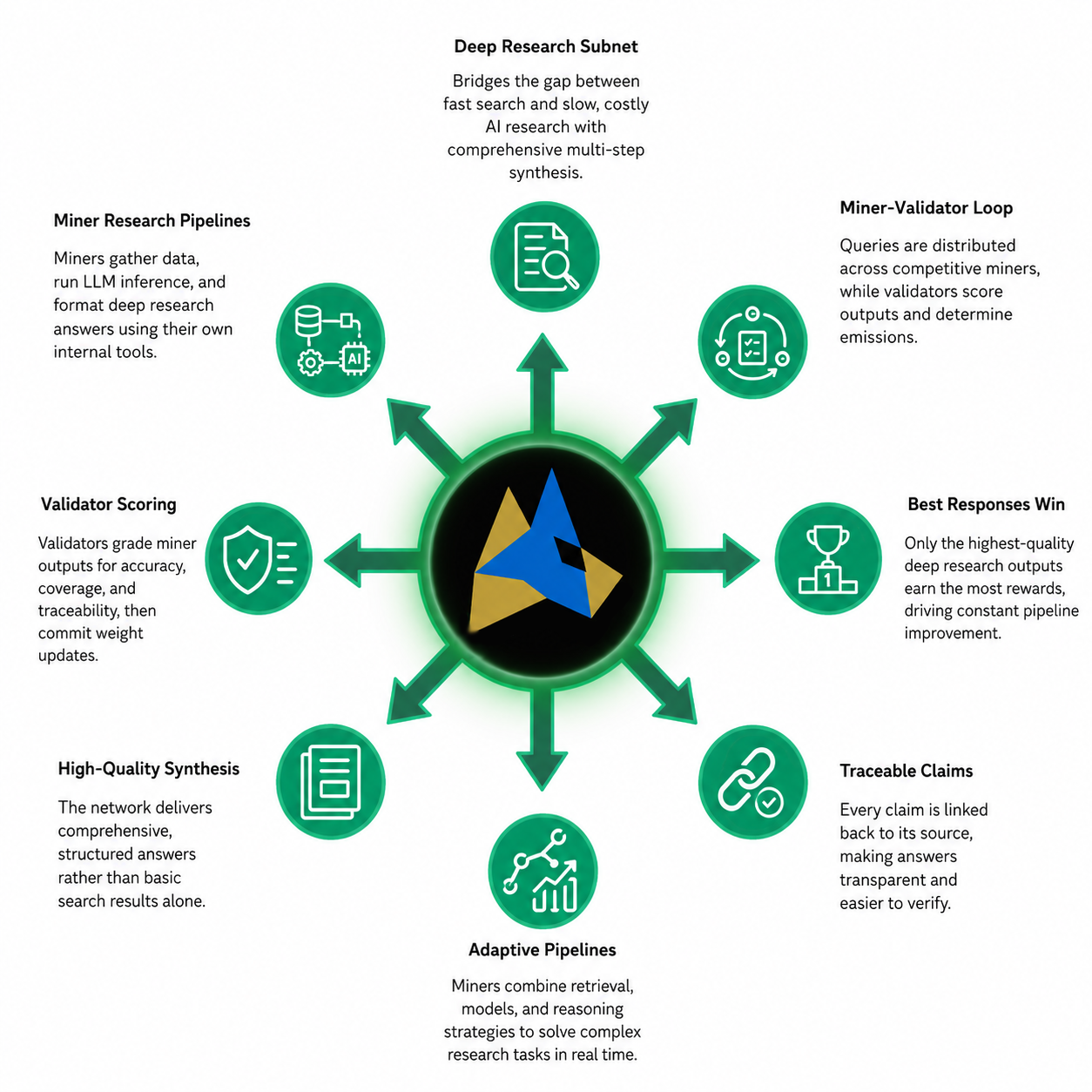
Harnyx (Subnet 67) is a Bittensor‐based network for “deep research” tasks. It addresses the gap between fast web search and slow, expensive AI research. As Harnyx’s site explains, “Basic search APIs are fast but offer no synthesis, no citations, no coverage guarantees”. Harnyx’s goal is to provide comprehensive, multi-step research at low cost, using decentralized incentives.
Miner and Validator Loop:
Harnyx follows Bittensor’s standard incentive model. User queries (via a single API call) are distributed to a competitive swarm of miners. Each miner builds its own research pipeline – selecting models, retrieval methods, and reasoning strategies – to produce an answer. The miners “compete to produce the highest-quality deep research,” and only the best responses earn coin emissions. Validators independently grade the miners’ outputs (initially against known reference answers) and submit scores. This scoring determines how token emissions are shared: higher-quality answers (as judged by validators) get more rewards. In effect, miners adapt their pipelines in real time because the market rewards the first solver to find a better approach.
Miners: Build full research pipelines. They autonomously gather data (e.g. web content, databases), run LLM inference to synthesize answers, and format results according to the query schema. Miners may use multiple models or retrieval tools internally. The Harnyx site explicitly provides a “Miner Guide” link, implying a code module for the mining role. The highest-scoring output from all miners is what the network delivers.
Validators: Secure the network by grading miner outputs. Validators evaluate each miner’s answer quality (initially by comparing to provided answers) and commit weight updates each block. These performance scores feed into Bittensor’s Yuma consensus to allocate the subnet’s emissions. Validators themselves stake and rank via standard Bittensor rules, but their task in Harnyx is specifically to ensure miner research is accurate, comprehensive, and “traceable.” Every claim in a Harnyx answer is linked back to its source, so validators can verify factuality.
User Output and Experience: End users (or AI agents) interact with Harnyx via its API. A single curl call (or SDK call) returns a structured JSON report containing the synthesized answer and source citations. For example, a query to compare two CRM products might return a JSON object like `{
Deep Research Subnet:
Harnyx (Subnet 67) is a Bittensor‐based network for “deep research” tasks. It addresses the gap between fast web search and slow, expensive AI research. As Harnyx’s site explains, “Basic search APIs are fast but offer no synthesis, no citations, no coverage guarantees”. Harnyx’s goal is to provide comprehensive, multi-step research at low cost, using decentralized incentives.
Miner and Validator Loop:
Harnyx follows Bittensor’s standard incentive model. User queries (via a single API call) are distributed to a competitive swarm of miners. Each miner builds its own research pipeline – selecting models, retrieval methods, and reasoning strategies – to produce an answer. The miners “compete to produce the highest-quality deep research,” and only the best responses earn coin emissions. Validators independently grade the miners’ outputs (initially against known reference answers) and submit scores. This scoring determines how token emissions are shared: higher-quality answers (as judged by validators) get more rewards. In effect, miners adapt their pipelines in real time because the market rewards the first solver to find a better approach.
Miners: Build full research pipelines. They autonomously gather data (e.g. web content, databases), run LLM inference to synthesize answers, and format results according to the query schema. Miners may use multiple models or retrieval tools internally. The Harnyx site explicitly provides a “Miner Guide” link, implying a code module for the mining role. The highest-scoring output from all miners is what the network delivers.
Validators: Secure the network by grading miner outputs. Validators evaluate each miner’s answer quality (initially by comparing to provided answers) and commit weight updates each block. These performance scores feed into Bittensor’s Yuma consensus to allocate the subnet’s emissions. Validators themselves stake and rank via standard Bittensor rules, but their task in Harnyx is specifically to ensure miner research is accurate, comprehensive, and “traceable.” Every claim in a Harnyx answer is linked back to its source, so validators can verify factuality.
User Output and Experience: End users (or AI agents) interact with Harnyx via its API. A single curl call (or SDK call) returns a structured JSON report containing the synthesized answer and source citations. For example, a query to compare two CRM products might return a JSON object like `{
Current Status:
The Harnyx subnet is live on Bittensor mainnet (netuid 67). On-chain data shows its alpha token trading at ~0.0077 TAO, with around 650 token holders. (This low price and holder count indicate an early-stage subnet.) The TAO.app interface shows Harnyx parameters like an 0.85% emission rate and ~84% root-share, suggesting slow and low inflation. Alpha supply is currently small (a few tens of thousands) and mostly illiquid. The Harnyx website itself offers a “Join API waitlist” and invites people to “Mine or Validate”, implying that mining/validation tools are active while the public API is in a private/early-access phase.
Technical Architecture:
Harnyx inherits Bittensor’s blockchain infrastructure but runs its core AI logic off-chain. The public GitHub link (on TAO.app) points to a repository (harnyx/harnyx) which appears to follow the standard Bittensor subnet template: separate modules or directories for miners and validators. Although the full code is not publicly visible, the site’s “Miner Guide” and “Validator Guide” pages imply that there are dedicated code stacks for each role. In practice, a miner node likely consists of Python processes that fetch web data, run one or more LLMs (via frameworks like PyTorch or Hugging Face), and then return structured answers to the chain. A validator node would run scoring scripts (potentially also in Python) and submit weight updates. Harnyx is designed as a REST-style API: its website shows usage examples (curl commands) and notes compatibility with agent frameworks. For example, it explicitly lists integration with OpenClaw, LangChain, CrewAI, n8n, and similar tools, meaning developers can wire Harnyx into existing LLM pipelines. The documentation suggests the Harnyx API accepts a query and an output schema, then orchestrates the miner/validator loop behind the scenes to produce the final structured reply.
GitHub and Metrics:
The public repository (harnyx/harnyx) is sparsely documented, so current development activity is unclear. Given the subnet’s novelty, GitHub commits have been minimal. On-chain metrics are available: taostats shows the alpha price, and other dashboards report liquidity. For instance, the liquidity pool currently holds roughly 269 TAO versus ~34.7K α. The 24-hour trading volume has been on the order of a few dozen TAO, indicating low early usage. These numbers (small market cap and liquidity) confirm that Harnyx is still ramping up. The alpha token’s total supply is capped at about 181K, with only ~0.2% currently circulating. Overall, metrics show slow start but no obvious issues (no large number of transactions yet). No external integrations beyond general web data are listed yet – Harnyx would presumably rely on public search or scraping for source material.
End Users:
The intended end users of Harnyx are developers building AI agents and enterprise applications that require reliable research. For example, teams doing market analysis, competitive intelligence, or investment research could use Harnyx to automate information gathering. The structured output format (JSON with fields and citations) is geared toward programmatic consumption, as in RAG systems or agent workflows. No specific commercial partnerships or clients have been announced. The site’s “Backed by” section hints at undisclosed investors or incubators, but there are no confirmed partnerships or alliances in the IA chain community. In effect, Harnyx’s immediate users are likely Bittensor miners, validators, and early-test developers who join the waitlist, rather than a broad customer base. As the subnet matures (Phase 3), target customers could include finance, legal, and consulting firms that need enterprise-grade automated research. But at present, usage is limited to those running Harnyx nodes or hooked into its API.
Current Status:
The Harnyx subnet is live on Bittensor mainnet (netuid 67). On-chain data shows its alpha token trading at ~0.0077 TAO, with around 650 token holders. (This low price and holder count indicate an early-stage subnet.) The TAO.app interface shows Harnyx parameters like an 0.85% emission rate and ~84% root-share, suggesting slow and low inflation. Alpha supply is currently small (a few tens of thousands) and mostly illiquid. The Harnyx website itself offers a “Join API waitlist” and invites people to “Mine or Validate”, implying that mining/validation tools are active while the public API is in a private/early-access phase.
Technical Architecture:
Harnyx inherits Bittensor’s blockchain infrastructure but runs its core AI logic off-chain. The public GitHub link (on TAO.app) points to a repository (harnyx/harnyx) which appears to follow the standard Bittensor subnet template: separate modules or directories for miners and validators. Although the full code is not publicly visible, the site’s “Miner Guide” and “Validator Guide” pages imply that there are dedicated code stacks for each role. In practice, a miner node likely consists of Python processes that fetch web data, run one or more LLMs (via frameworks like PyTorch or Hugging Face), and then return structured answers to the chain. A validator node would run scoring scripts (potentially also in Python) and submit weight updates. Harnyx is designed as a REST-style API: its website shows usage examples (curl commands) and notes compatibility with agent frameworks. For example, it explicitly lists integration with OpenClaw, LangChain, CrewAI, n8n, and similar tools, meaning developers can wire Harnyx into existing LLM pipelines. The documentation suggests the Harnyx API accepts a query and an output schema, then orchestrates the miner/validator loop behind the scenes to produce the final structured reply.
GitHub and Metrics:
The public repository (harnyx/harnyx) is sparsely documented, so current development activity is unclear. Given the subnet’s novelty, GitHub commits have been minimal. On-chain metrics are available: taostats shows the alpha price, and other dashboards report liquidity. For instance, the liquidity pool currently holds roughly 269 TAO versus ~34.7K α. The 24-hour trading volume has been on the order of a few dozen TAO, indicating low early usage. These numbers (small market cap and liquidity) confirm that Harnyx is still ramping up. The alpha token’s total supply is capped at about 181K, with only ~0.2% currently circulating. Overall, metrics show slow start but no obvious issues (no large number of transactions yet). No external integrations beyond general web data are listed yet – Harnyx would presumably rely on public search or scraping for source material.
End Users:
The intended end users of Harnyx are developers building AI agents and enterprise applications that require reliable research. For example, teams doing market analysis, competitive intelligence, or investment research could use Harnyx to automate information gathering. The structured output format (JSON with fields and citations) is geared toward programmatic consumption, as in RAG systems or agent workflows. No specific commercial partnerships or clients have been announced. The site’s “Backed by” section hints at undisclosed investors or incubators, but there are no confirmed partnerships or alliances in the IA chain community. In effect, Harnyx’s immediate users are likely Bittensor miners, validators, and early-test developers who join the waitlist, rather than a broad customer base. As the subnet matures (Phase 3), target customers could include finance, legal, and consulting firms that need enterprise-grade automated research. But at present, usage is limited to those running Harnyx nodes or hooked into its API.
Team and Background:
Bittensor’s documentation emphasizes that each subnet is created by a developer or team who maintains its incentive code off-chain. For Harnyx, this creator is not named. No founders or team members are publicly identified. The TAO.app subnet listing shows an owner key (a blockchain address) but no human names; likewise the website includes a cryptic “Backed by” footer with no further detail. We found no Twitter, LinkedIn, or blog announcements introducing Harnyx’s team. The GitHub repo exists but contains only generic “Miner Guide” and “Validator Guide” references, with no clear attribution of authors. In short, Harnyx appears to be developed by a private (likely small) team or startup, and its members remain anonymous. There are no publicly disclosed advisors or partnerships. The project entered Bittensor only recently – the roadmap cites Feb 2026 papers – so it seems to have launched in late 2025 or early 2026. Any community engagement so far is confined to the Bittensor ecosystem (miners and validators). We did not find any Telegram or Discord for Harnyx, nor did major Bittensor forums discuss it at length yet. In summary, the identities and backgrounds of the Harnyx developers are unavailable from public sources, and nothing suggests outside celebrity backers or well-known crypto funds behind it.
Team and Background:
Bittensor’s documentation emphasizes that each subnet is created by a developer or team who maintains its incentive code off-chain. For Harnyx, this creator is not named. No founders or team members are publicly identified. The TAO.app subnet listing shows an owner key (a blockchain address) but no human names; likewise the website includes a cryptic “Backed by” footer with no further detail. We found no Twitter, LinkedIn, or blog announcements introducing Harnyx’s team. The GitHub repo exists but contains only generic “Miner Guide” and “Validator Guide” references, with no clear attribution of authors. In short, Harnyx appears to be developed by a private (likely small) team or startup, and its members remain anonymous. There are no publicly disclosed advisors or partnerships. The project entered Bittensor only recently – the roadmap cites Feb 2026 papers – so it seems to have launched in late 2025 or early 2026. Any community engagement so far is confined to the Bittensor ecosystem (miners and validators). We did not find any Telegram or Discord for Harnyx, nor did major Bittensor forums discuss it at length yet. In summary, the identities and backgrounds of the Harnyx developers are unavailable from public sources, and nothing suggests outside celebrity backers or well-known crypto funds behind it.
Phase 1 – Reach Parity:
Harnyx’s official roadmap (on its website) describes first achieving parity with existing deep-research benchmarks. Specifically, Phase 1 (“Reach Parity”) calls for matching the quality of leading datasets: the DRACO benchmark (100 tasks on deep research accuracy) and Google DeepMind’s DeepSearchQA (900 multi-step queries). The aim is to hit these reference standards at a significantly lower cost than current APIs. In practical terms, this means miners in Harnyx should be able to perform these complex research tasks and produce answers that pass the established metrics. Once the network consistently delivers industry-level benchmark results, Phase 1 is fulfilled.
Phase 2 – Lead and Define:
After parity is proven, Phase 2 shifts focus beyond static targets. In this stage, miners will be measured directly against each other. The roadmap states miners will “compete head-to-head instead of against fixed reference answers,” so that “novel synthesis emerges from competitive pressure”. In other words, rather than scoring answers against a gold standard, the subnet will reward any miner who can provide a better answer than competitors. This competitive setup is expected to push the subnet’s capabilities forward: miners may find new sources or reasoning paths that were not anticipated by any benchmark. Details are sparse, but the theme is clear – Phase 2 is about innovation and exceeding prior limits by free competition. This likely involves validator scoring schemes that compare peer outputs instead of fixed ground truth.
Phase 3 – Enterprise Readiness:
The final phase concerns robustness and security for high-value use cases. Phase 3 lists features like confidential execution (e.g. trusted hardware enclaves), zero data retention, and formal SLAs. The vision is to make Harnyx suitable for industries (finance, law, consulting) where errors are costly. For example, Phase 3 might involve running miners in secure enclaves so source data remains private, or building monitoring to guarantee uptime. The roadmap text explicitly says Phase 3 will create “the infrastructure that lets agent builders serve finance, legal, and consulting — where research is high-value and the cost of a wrong answer is measured in dollars”. This suggests enterprise customers and stricter guarantees.
Vision and Timelines:
Beyond these phases, Harnyx’s long-term motto is quoted as “Deep enough to trust. Cheap enough to scale”. No specific dates (like “Q2 2026”) are given on the site. The roadmap does not list monthly milestones or alpha releases by date. The most recent content (Feb 2026) already covers the benchmark phase. The development model seems agile: the team is encouraging early access via a waitlist and iterating quickly. In summary, public information only outlines the three-phase plan above and invites users to watch the network evolve. No recent press or announcements detail new phases or partnership deals. The day-to-day updates would likely come through Bittensor community channels, but none have surfaced at writing.
Phase 1 – Reach Parity:
Harnyx’s official roadmap (on its website) describes first achieving parity with existing deep-research benchmarks. Specifically, Phase 1 (“Reach Parity”) calls for matching the quality of leading datasets: the DRACO benchmark (100 tasks on deep research accuracy) and Google DeepMind’s DeepSearchQA (900 multi-step queries). The aim is to hit these reference standards at a significantly lower cost than current APIs. In practical terms, this means miners in Harnyx should be able to perform these complex research tasks and produce answers that pass the established metrics. Once the network consistently delivers industry-level benchmark results, Phase 1 is fulfilled.
Phase 2 – Lead and Define:
After parity is proven, Phase 2 shifts focus beyond static targets. In this stage, miners will be measured directly against each other. The roadmap states miners will “compete head-to-head instead of against fixed reference answers,” so that “novel synthesis emerges from competitive pressure”. In other words, rather than scoring answers against a gold standard, the subnet will reward any miner who can provide a better answer than competitors. This competitive setup is expected to push the subnet’s capabilities forward: miners may find new sources or reasoning paths that were not anticipated by any benchmark. Details are sparse, but the theme is clear – Phase 2 is about innovation and exceeding prior limits by free competition. This likely involves validator scoring schemes that compare peer outputs instead of fixed ground truth.
Phase 3 – Enterprise Readiness:
The final phase concerns robustness and security for high-value use cases. Phase 3 lists features like confidential execution (e.g. trusted hardware enclaves), zero data retention, and formal SLAs. The vision is to make Harnyx suitable for industries (finance, law, consulting) where errors are costly. For example, Phase 3 might involve running miners in secure enclaves so source data remains private, or building monitoring to guarantee uptime. The roadmap text explicitly says Phase 3 will create “the infrastructure that lets agent builders serve finance, legal, and consulting — where research is high-value and the cost of a wrong answer is measured in dollars”. This suggests enterprise customers and stricter guarantees.
Vision and Timelines:
Beyond these phases, Harnyx’s long-term motto is quoted as “Deep enough to trust. Cheap enough to scale”. No specific dates (like “Q2 2026”) are given on the site. The roadmap does not list monthly milestones or alpha releases by date. The most recent content (Feb 2026) already covers the benchmark phase. The development model seems agile: the team is encouraging early access via a waitlist and iterating quickly. In summary, public information only outlines the three-phase plan above and invites users to watch the network evolve. No recent press or announcements detail new phases or partnership deals. The day-to-day updates would likely come through Bittensor community channels, but none have surfaced at writing.