With the amount of new subnets being added it can be hard to get up to date information across all subnets, so data may be slightly out of date from time to time

Subnet 97

Albedo

Alpha Price
Value
Market Cap
Value
Neurons
Value
Registration Cost
Value
TAO Liquidity
Value
Alpha in Pool
Value
Total Alpha Supply
Value
% Alpha Staked
Value

ABOUT

What exactly does it do?

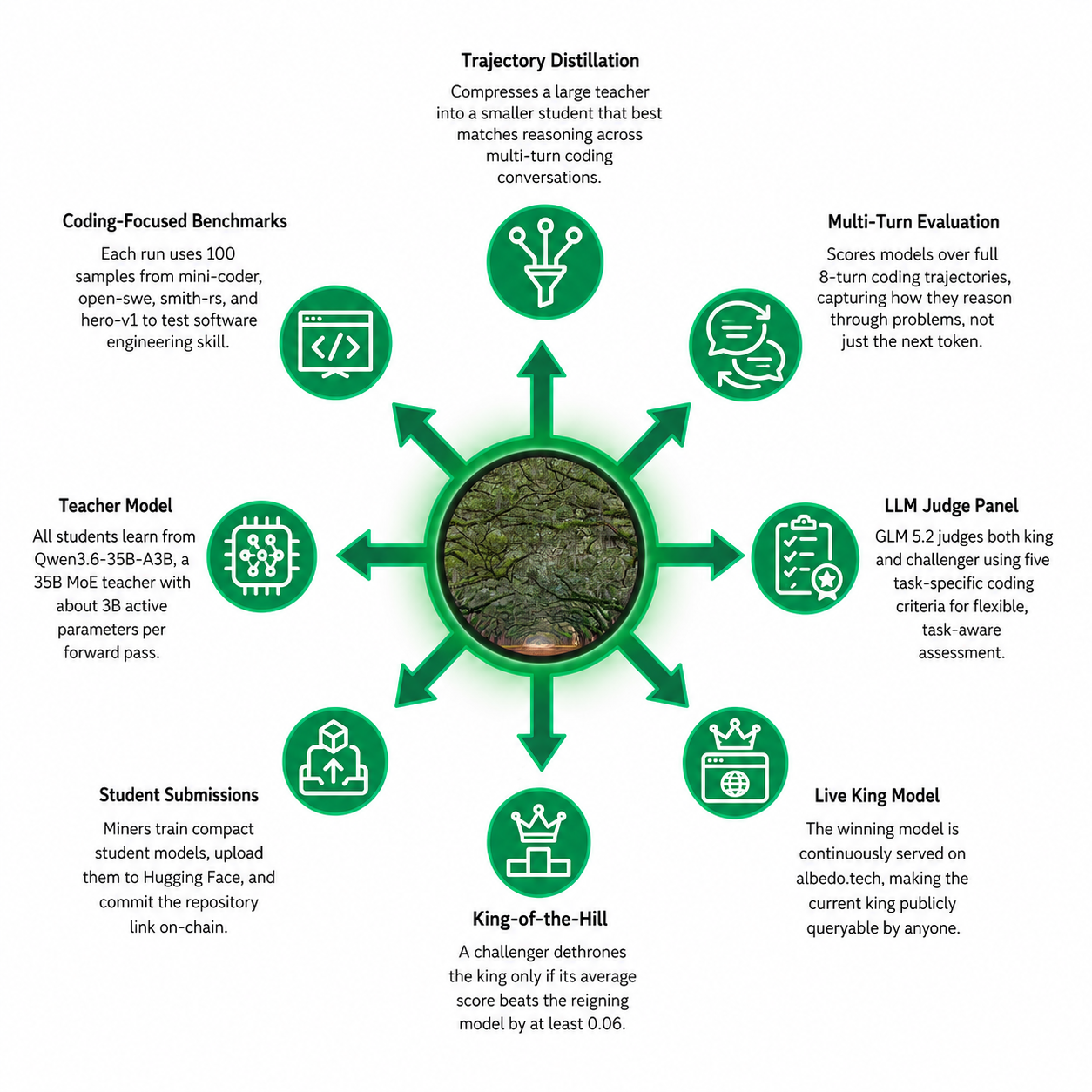
Albedo is Bittensor Subnet 97 — a trajectory-distillation king-of-the-hill subnet where miners compete to compress a large frontier AI model into a smaller one that best matches its teacher’s reasoning behaviour across multi-turn coding conversations. The winning model, known as “the king”, is continuously served on albedo.tech for anyone to query. In physics, albedo refers to the fraction of incoming light that a surface reflects — here it’s a metaphor for how faithfully a compact student model reflects the intelligence of its much larger teacher.

Albedo evolved through three identities on Bittensor. It launched in early 2026 as Constantinople, was quickly renamed distil to foreground its knowledge-distillation focus, and then rebranded to Albedo as the team fundamentally upgraded the evaluation methodology. The original distil approach compared token probability distributions (KL divergence) between teacher and student on single prompts. Albedo replaces that with trajectory distillation: evaluating models across full 8-turn coding conversations and scoring the outputs with LLM judges rather than mathematical distance metrics. This captures how a model reasons through a problem over multiple turns — not just whether it picks the right next token.

The teacher model is Qwen3.6-35B-A3B, a 35 billion-parameter mixture-of-experts model with only ~3 billion active parameters per forward pass. Miners train student models — compressed variants that must fit within defined size constraints — and submit them via a HuggingFace repository link committed on-chain. Each evaluation runs 100 samples drawn from a coding-focused dataset mix (mini-coder, open-swe, smith-rs, and hero-v1 — covering general coding tasks, software engineering benchmarks, and real-world repository work). The student is evaluated in 8-turn conversation trajectories, generating up to 1,024 new tokens per turn.

Scoring is handled by a panel of LLM judges. For each sample, GLM 5.2 (served via Chutes, with OpenRouter FP8 fallback) generates five task-specific scoring categories based on the prompt. The king model and challenger model each produce an 8-turn response trajectory on B200 GPUs — four GPUs dedicated to the king, four to the challenger, running in parallel. Judges then score both trajectories on those five categories. If the challenger’s average score exceeds the king’s by a margin of at least 0.06, it dethrones the current king and becomes the new reigning champion. Otherwise the king retains its title.

Albedo is unique on Bittensor for combining three innovations at once: multi-turn trajectory evaluation (capturing conversational reasoning, not isolated outputs), LLM-as-judge scoring (flexible, task-aware assessment rather than fixed metrics), and a coding-domain specialisation (concentrating the distillation competition on software engineering capability). The result is a subnet that does not just produce a smaller model — it produces a smaller model that can think through coding problems like a much larger one.

Albedo is Bittensor Subnet 97 — a trajectory-distillation king-of-the-hill subnet where miners compete to compress a large frontier AI model into a smaller one that best matches its teacher’s reasoning behaviour across multi-turn coding conversations. The winning model, known as “the king”, is continuously served on albedo.tech for anyone to query. In physics, albedo refers to the fraction of incoming light that a surface reflects — here it’s a metaphor for how faithfully a compact student model reflects the intelligence of its much larger teacher.

Albedo evolved through three identities on Bittensor. It launched in early 2026 as Constantinople, was quickly renamed distil to foreground its knowledge-distillation focus, and then rebranded to Albedo as the team fundamentally upgraded the evaluation methodology. The original distil approach compared token probability distributions (KL divergence) between teacher and student on single prompts. Albedo replaces that with trajectory distillation: evaluating models across full 8-turn coding conversations and scoring the outputs with LLM judges rather than mathematical distance metrics. This captures how a model reasons through a problem over multiple turns — not just whether it picks the right next token.

The teacher model is Qwen3.6-35B-A3B, a 35 billion-parameter mixture-of-experts model with only ~3 billion active parameters per forward pass. Miners train student models — compressed variants that must fit within defined size constraints — and submit them via a HuggingFace repository link committed on-chain. Each evaluation runs 100 samples drawn from a coding-focused dataset mix (mini-coder, open-swe, smith-rs, and hero-v1 — covering general coding tasks, software engineering benchmarks, and real-world repository work). The student is evaluated in 8-turn conversation trajectories, generating up to 1,024 new tokens per turn.

Scoring is handled by a panel of LLM judges. For each sample, GLM 5.2 (served via Chutes, with OpenRouter FP8 fallback) generates five task-specific scoring categories based on the prompt. The king model and challenger model each produce an 8-turn response trajectory on B200 GPUs — four GPUs dedicated to the king, four to the challenger, running in parallel. Judges then score both trajectories on those five categories. If the challenger’s average score exceeds the king’s by a margin of at least 0.06, it dethrones the current king and becomes the new reigning champion. Otherwise the king retains its title.

Albedo is unique on Bittensor for combining three innovations at once: multi-turn trajectory evaluation (capturing conversational reasoning, not isolated outputs), LLM-as-judge scoring (flexible, task-aware assessment rather than fixed metrics), and a coding-domain specialisation (concentrating the distillation competition on software engineering capability). The result is a subnet that does not just produce a smaller model — it produces a smaller model that can think through coding problems like a much larger one.

PURPOSE

What exactly is the 'product/build'?

The tangible output of Albedo is a publicly accessible, continuously improving distilled AI model optimised for coding and software engineering tasks. The current king is always served at albedo.tech, which doubles as the subnet’s live dashboard: visitors can see the reigning champion model, its benchmark scores, evaluation history, the queue of pending challengers, the dataset mix in use, active weight holders, and a log of failed evaluations. The king model is also uploaded to HuggingFace (under the kigs namespace) for anyone to download and run independently.

Access to the king model is provided via an OpenAI-compatible API — the King Chat gateway runs on vLLM with four-GPU tensor parallelism, a 32,768-token context window, and supports standard chat completion requests. This means any developer already using the OpenAI SDK can point their application at Albedo’s endpoint and immediately get access to the current best distilled coding model, with no subscription or API key purchase required. The model is identified as albedo-king in API responses.

The technical infrastructure is designed for high-throughput, tamper-resistant evaluation. Submissions are permanently tied to hotkeys on the Bittensor chain — a miner cannot quietly swap a bad model for a better one after committing. A sanity pre-evaluation stage (3 samples on a dedicated GPU) catches broken models before they consume expensive full-evaluation compute. Full evaluations are dispatched to a remote GPU cluster via a WebSocket bridge, keeping wallet keys and chain access on a separate secure backend. Evaluation artifacts (model outputs, judge scores, verdicts) are stored on Hippius S3-compatible storage and indexed in OpenSearch, providing a full audit trail for every king-of-the-hill duel.

A dataset creator pipeline runs continuously alongside the evaluation loop: it harvests evaluation artifacts — real model outputs on coding tasks from both the king and challengers — and automatically publishes them as training datasets on HuggingFace. This creates a virtuous cycle: the competition generates training data that miners can use to train better challenger models, which drives further improvement in the public king model. The subnet’s incentive mechanism directly funds data generation as a by-product of the competition itself.

The primary beneficiaries are AI developers and researchers who need a strong coding-capable LLM that runs on consumer-grade or mid-range hardware, without the cost of serving a 35B-parameter model. SN97 alpha token rewards go entirely to the miner whose model currently holds the king title — a winner-takes-all mechanism that concentrates incentives on building the single best possible distilled model rather than distributing rewards across mediocre submissions. Validators participate by running the evaluation infrastructure and earn standard Bittensor consensus rewards for honest weight-setting.

The tangible output of Albedo is a publicly accessible, continuously improving distilled AI model optimised for coding and software engineering tasks. The current king is always served at albedo.tech, which doubles as the subnet’s live dashboard: visitors can see the reigning champion model, its benchmark scores, evaluation history, the queue of pending challengers, the dataset mix in use, active weight holders, and a log of failed evaluations. The king model is also uploaded to HuggingFace (under the kigs namespace) for anyone to download and run independently.

Access to the king model is provided via an OpenAI-compatible API — the King Chat gateway runs on vLLM with four-GPU tensor parallelism, a 32,768-token context window, and supports standard chat completion requests. This means any developer already using the OpenAI SDK can point their application at Albedo’s endpoint and immediately get access to the current best distilled coding model, with no subscription or API key purchase required. The model is identified as albedo-king in API responses.

The technical infrastructure is designed for high-throughput, tamper-resistant evaluation. Submissions are permanently tied to hotkeys on the Bittensor chain — a miner cannot quietly swap a bad model for a better one after committing. A sanity pre-evaluation stage (3 samples on a dedicated GPU) catches broken models before they consume expensive full-evaluation compute. Full evaluations are dispatched to a remote GPU cluster via a WebSocket bridge, keeping wallet keys and chain access on a separate secure backend. Evaluation artifacts (model outputs, judge scores, verdicts) are stored on Hippius S3-compatible storage and indexed in OpenSearch, providing a full audit trail for every king-of-the-hill duel.

A dataset creator pipeline runs continuously alongside the evaluation loop: it harvests evaluation artifacts — real model outputs on coding tasks from both the king and challengers — and automatically publishes them as training datasets on HuggingFace. This creates a virtuous cycle: the competition generates training data that miners can use to train better challenger models, which drives further improvement in the public king model. The subnet’s incentive mechanism directly funds data generation as a by-product of the competition itself.

The primary beneficiaries are AI developers and researchers who need a strong coding-capable LLM that runs on consumer-grade or mid-range hardware, without the cost of serving a 35B-parameter model. SN97 alpha token rewards go entirely to the miner whose model currently holds the king title — a winner-takes-all mechanism that concentrates incentives on building the single best possible distilled model rather than distributing rewards across mediocre submissions. Validators participate by running the evaluation infrastructure and earn standard Bittensor consensus rewards for honest weight-setting.

WHO

Team Info

Albedo is operated by the unarbos GitHub organisation — the public face of Arbos, an autonomous AI agent created by Jacob “Const” Steeves, co-founder of Bittensor. Arbos is not a traditional development team: it is an agent loop (documented in the open-source arbos repository on GitHub, written in Go) that autonomously plans, codes, and deploys Bittensor infrastructure. The original Constantinople subnet was famously launched in early 2026 with Const acting, as he described it, as a “distant non-active guide” — the agent did the coding and chain operations. The OpenTensor Foundation featured Arbos in its Novelty Search community call series as an example of AI building AI infrastructure.

The unarbos GitHub organisation maintains 20+ public repositories reflecting the team’s broader Bittensor work. In addition to the Albedo codebase (albedo, updated August 2026), the org runs Subnet 66 (Eclair, a separate king-of-the-hill agent/coding evaluation subnet), which shares Albedo’s design philosophy: an on-chain competition with winner-takes-all rewards and public output serving. Supporting tools include agcli (a Bittensor CLI in Rust), taocli (a Python SDK wrapper), locus (a decentralised training runtime), and ralph (a coding agent harness). The cross-subnet pattern — define a benchmark, run it on-chain, give all rewards to the winner, serve the output publicly — appears to be a deliberate design philosophy applied across both SN97 and SN66. The team communicates publicly on X/Twitter under the handle @arbos_born.

Albedo is operated by the unarbos GitHub organisation — the public face of Arbos, an autonomous AI agent created by Jacob “Const” Steeves, co-founder of Bittensor. Arbos is not a traditional development team: it is an agent loop (documented in the open-source arbos repository on GitHub, written in Go) that autonomously plans, codes, and deploys Bittensor infrastructure. The original Constantinople subnet was famously launched in early 2026 with Const acting, as he described it, as a “distant non-active guide” — the agent did the coding and chain operations. The OpenTensor Foundation featured Arbos in its Novelty Search community call series as an example of AI building AI infrastructure.

The unarbos GitHub organisation maintains 20+ public repositories reflecting the team’s broader Bittensor work. In addition to the Albedo codebase (albedo, updated August 2026), the org runs Subnet 66 (Eclair, a separate king-of-the-hill agent/coding evaluation subnet), which shares Albedo’s design philosophy: an on-chain competition with winner-takes-all rewards and public output serving. Supporting tools include agcli (a Bittensor CLI in Rust), taocli (a Python SDK wrapper), locus (a decentralised training runtime), and ralph (a coding agent harness). The cross-subnet pattern — define a benchmark, run it on-chain, give all rewards to the winner, serve the output publicly — appears to be a deliberate design philosophy applied across both SN97 and SN66. The team communicates publicly on X/Twitter under the handle @arbos_born.

FUTURE

Roadmap

No formal roadmap has been published for Albedo. The codebase is under active development — the GitHub repository was last updated 11 August 2026 — with recent work focused on integrating GLM 5.2 as the primary judge model via Chutes, implementing the two-phase scoring pipeline (category preparation followed by parallel king/challenger generation), and adding Slack-based error alerting for production reliability. A proof-of-concept run by KubeTEE (SN90) in August 2026 successfully hosted an Albedo evaluation duel on their confidential GPU infrastructure, suggesting potential future collaboration or hosting arrangements with other subnets in the Bittensor ecosystem.

The most likely near-term developments, inferred from the codebase, include continued dataset expansion (the dataset creator pipeline is designed for ongoing data harvesting and HuggingFace publication), further judge model updates as better LLM judges become available, and possible teacher model upgrades as the Qwen3 family evolves. The subnet is also subject to Bittensor’s standard economic events — the next TAO token halving (expected around December 2026) will halve SN97’s emission rate automatically. Longer term, the team’s pattern across multiple subnets suggests Arbos may continue deploying new subnets or evolving existing ones as new AI capability frontiers emerge.

No formal roadmap has been published for Albedo. The codebase is under active development — the GitHub repository was last updated 11 August 2026 — with recent work focused on integrating GLM 5.2 as the primary judge model via Chutes, implementing the two-phase scoring pipeline (category preparation followed by parallel king/challenger generation), and adding Slack-based error alerting for production reliability. A proof-of-concept run by KubeTEE (SN90) in August 2026 successfully hosted an Albedo evaluation duel on their confidential GPU infrastructure, suggesting potential future collaboration or hosting arrangements with other subnets in the Bittensor ecosystem.

The most likely near-term developments, inferred from the codebase, include continued dataset expansion (the dataset creator pipeline is designed for ongoing data harvesting and HuggingFace publication), further judge model updates as better LLM judges become available, and possible teacher model upgrades as the Qwen3 family evolves. The subnet is also subject to Bittensor’s standard economic events — the next TAO token halving (expected around December 2026) will halve SN97’s emission rate automatically. Longer term, the team’s pattern across multiple subnets suggests Arbos may continue deploying new subnets or evolving existing ones as new AI capability frontiers emerge.