
With the amount of new subnets being added it can be hard to get up to date information across all subnets, so data may be slightly out of date from time to time
Purpose and Problem:
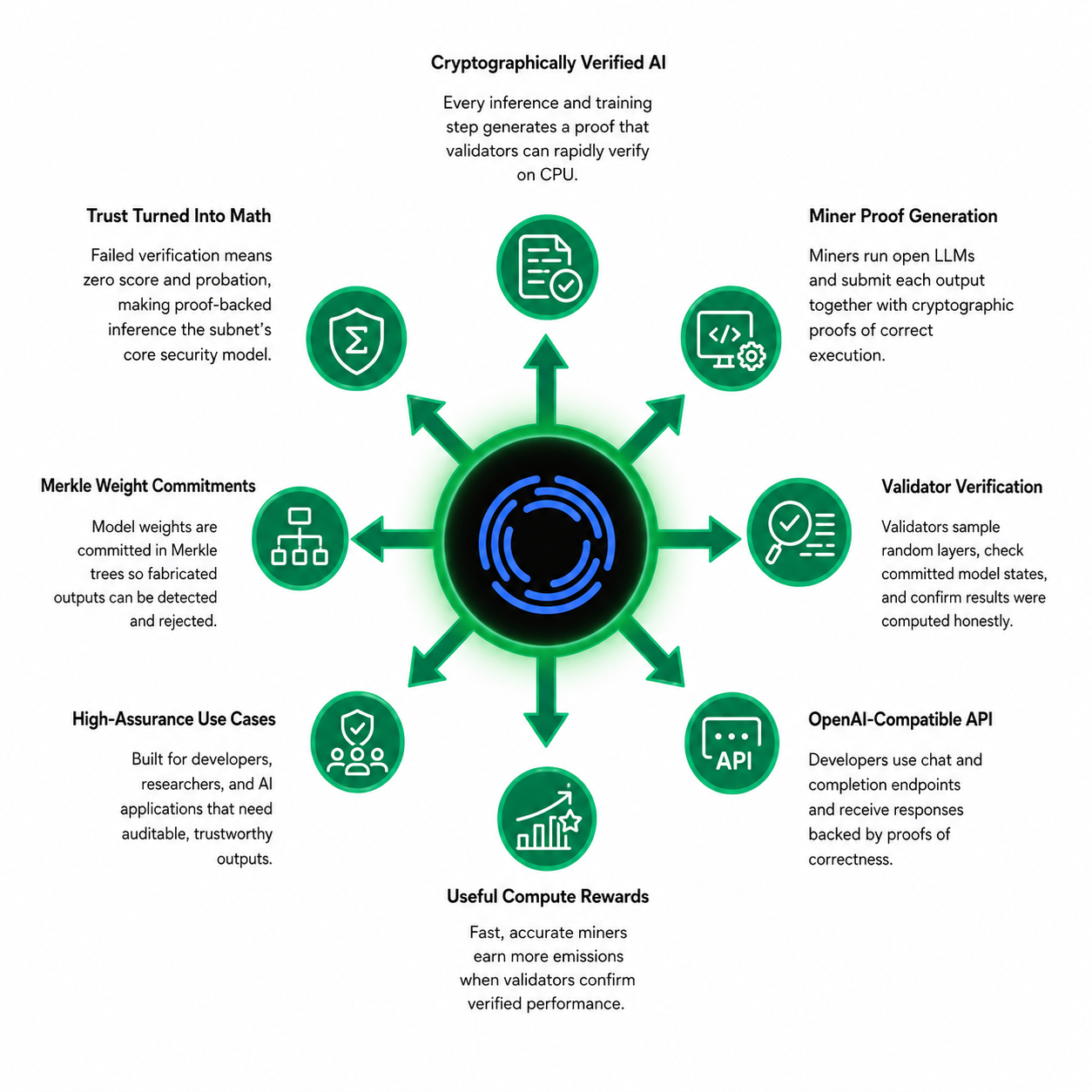
Verathos is built to provide cryptographically verified AI on Bittensor Subnet 96. Every inference (and training step) generates a proof that validators can rapidly check on CPU. By committing model weights in Merkle trees and sampling random layers to verify each response, the network ensures that no miner can fabricate results. Any node that fails verification is immediately penalized (score zero and probation). This approach solves the fundamental trust problem in AI compute – Verathos “turns trust into math” and can be thought of as a ZK-inspired layer ensuring each FLOP is correct. According to project descriptions, this makes Verathos the first subnet focused on proving every computation step rather than merely serving model outputs.
Incentive Loop (Miners and Validators):
Miners on Verathos run AI models to produce answers (or train updates) and simultaneously compute the required cryptographic proofs. For example, developers can run any open LLM (Llama, Qwen, etc.) with standard tooling (like vLLM) and submit each output plus a proof. Validators then fetch the committed model snapshot (via Merkle roots) and recompute random layers of the inference on CPU to confirm correctness. Based on this evaluation, validators award each miner a score according to accuracy and performance. Stakers have delegated TAO to these validators, so when an epoch’s emissions are distributed, the fastest and most accurate miners receive the largest rewards. In this way, the protocol rewards useful compute: miners contribute computational power to AI inference and training, while validators verify results and distribute tokens according to contribution.
Output Service and Users:
The end service of Verathos is an OpenAI-compatible REST API. Clients can use this API to make chat or completion calls as they would to any LLM; each response is accompanied by a cryptographic proof of correctness. The public chat interface (verathos.ai/chat) and API were launched for inference on mainnet. Users pay in TAO or stablecoins (USDC or x402 via on-chain vouchers) per request. Integrations exist for common AI frameworks: for example, a LangChain connector package is available. The primary beneficiaries are developers, researchers, and AI-driven applications requiring high-assurance computation – essentially anyone who needs auditably correct AI outputs. In the long term Verathos envisions a decentralized marketplace of verified AI services. As an investor write-up notes, Verathos represents “a new class of subnet” that proves every FLOP, effectively becoming “the ZK layer for AI compute”.
Purpose and Problem:
Verathos is built to provide cryptographically verified AI on Bittensor Subnet 96. Every inference (and training step) generates a proof that validators can rapidly check on CPU. By committing model weights in Merkle trees and sampling random layers to verify each response, the network ensures that no miner can fabricate results. Any node that fails verification is immediately penalized (score zero and probation). This approach solves the fundamental trust problem in AI compute – Verathos “turns trust into math” and can be thought of as a ZK-inspired layer ensuring each FLOP is correct. According to project descriptions, this makes Verathos the first subnet focused on proving every computation step rather than merely serving model outputs.
Incentive Loop (Miners and Validators):
Miners on Verathos run AI models to produce answers (or train updates) and simultaneously compute the required cryptographic proofs. For example, developers can run any open LLM (Llama, Qwen, etc.) with standard tooling (like vLLM) and submit each output plus a proof. Validators then fetch the committed model snapshot (via Merkle roots) and recompute random layers of the inference on CPU to confirm correctness. Based on this evaluation, validators award each miner a score according to accuracy and performance. Stakers have delegated TAO to these validators, so when an epoch’s emissions are distributed, the fastest and most accurate miners receive the largest rewards. In this way, the protocol rewards useful compute: miners contribute computational power to AI inference and training, while validators verify results and distribute tokens according to contribution.
Output Service and Users:
The end service of Verathos is an OpenAI-compatible REST API. Clients can use this API to make chat or completion calls as they would to any LLM; each response is accompanied by a cryptographic proof of correctness. The public chat interface (verathos.ai/chat) and API were launched for inference on mainnet. Users pay in TAO or stablecoins (USDC or x402 via on-chain vouchers) per request. Integrations exist for common AI frameworks: for example, a LangChain connector package is available. The primary beneficiaries are developers, researchers, and AI-driven applications requiring high-assurance computation – essentially anyone who needs auditably correct AI outputs. In the long term Verathos envisions a decentralized marketplace of verified AI services. As an investor write-up notes, Verathos represents “a new class of subnet” that proves every FLOP, effectively becoming “the ZK layer for AI compute”.
Current Status and Architecture:
Verified inference and the chat API are live (the Verathos chat at verathos.ai/chat is operational). Verified training support is on the roadmap. The architecture uses the Bittensor blockchain to anchor model commitments: model weights and updates are Merkle-committed on-chain, miners run the AI computation off-chain, and validators fetch and verify them. The GitHub repo ‘verathos-ai/verathos’ (the subnet’s codebase) shows active development: one contributor, one commit in the last 30 days (mid-April 2026). The repo likely includes code for miner and validator nodes, as well as the API server.
Network Metrics:
Early network stats are modest. Explorers report roughly 11 active miners, 23 validators, and about 595,623 TAO staked in total (as of May 2026). Total value locked (TVL) is ~3.42τ (with an 18% owner cut) reflecting initial activity. The SN96 alpha token traded around $5–6 in early May after launch (all-time high ~$6.67 on May 5, 2026). Emissions follow the standard Bittensor schedule (360 TAO per epoch distributed by validators).
Integrations and APIs:
Verathos connects to modern AI tooling. It provides an OpenAI-compatible REST API out of the box. It supports payments in USDC (via on-chain mechanisms) as noted by project announcements. For developers, a LangChain provider package (‘langchain-verathos’, v0.1.0 released May 2, 2026) is available. LiteLLM and other agents (ElizaOS, OpenClaw) have also added Verathos adapters.
Current Status and Architecture:
Verified inference and the chat API are live (the Verathos chat at verathos.ai/chat is operational). Verified training support is on the roadmap. The architecture uses the Bittensor blockchain to anchor model commitments: model weights and updates are Merkle-committed on-chain, miners run the AI computation off-chain, and validators fetch and verify them. The GitHub repo ‘verathos-ai/verathos’ (the subnet’s codebase) shows active development: one contributor, one commit in the last 30 days (mid-April 2026). The repo likely includes code for miner and validator nodes, as well as the API server.
Network Metrics:
Early network stats are modest. Explorers report roughly 11 active miners, 23 validators, and about 595,623 TAO staked in total (as of May 2026). Total value locked (TVL) is ~3.42τ (with an 18% owner cut) reflecting initial activity. The SN96 alpha token traded around $5–6 in early May after launch (all-time high ~$6.67 on May 5, 2026). Emissions follow the standard Bittensor schedule (360 TAO per epoch distributed by validators).
Integrations and APIs:
Verathos connects to modern AI tooling. It provides an OpenAI-compatible REST API out of the box. It supports payments in USDC (via on-chain mechanisms) as noted by project announcements. For developers, a LangChain provider package (‘langchain-verathos’, v0.1.0 released May 2, 2026) is available. LiteLLM and other agents (ElizaOS, OpenClaw) have also added Verathos adapters.
Verathos has no public team listing. The GitHub repo shows only one contributor (handle “Keplerteron1”) with minimal commits, and no personal identities have been revealed. The subnet was introduced in spring 2026 via an X (Twitter) announcement, but the core developers remain pseudonymous. Updates appear on the Verathos X account (@verathos_ai) and in Bittensor community channels; there is no dedicated Discord or Medium blog for the project. No specific investors or partners for Verathos have been disclosed beyond general Bittensor community support.
Verathos has no public team listing. The GitHub repo shows only one contributor (handle “Keplerteron1”) with minimal commits, and no personal identities have been revealed. The subnet was introduced in spring 2026 via an X (Twitter) announcement, but the core developers remain pseudonymous. Updates appear on the Verathos X account (@verathos_ai) and in Bittensor community channels; there is no dedicated Discord or Medium blog for the project. No specific investors or partners for Verathos have been disclosed beyond general Bittensor community support.
The Verathos team has outlined a phased rollout. Stage 1 (verified inference) is complete: the OpenAI-compatible chat and API endpoints are live on mainnet. The next milestones are verified training (proof-based model fine-tuning) and hardware-secure inference. In particular, support for Trusted Execution Environments (Intel TDX, AMD SEV(-SNP), NVIDIA Confidential Compute) is documented and expected soon. No strict dates have been given, but the emphasis is on building a new kind of network – as one summary put it, Verathos is not just “serving text” but proving every computation, acting as “the ZK layer for AI compute”. In the long term the vision is a fully decentralized AI marketplace with transparent models and results. The token’s peak in early May 2026 suggests market interest; future updates will likely be announced via the project’s Twitter and Bittensor forums.
The Verathos team has outlined a phased rollout. Stage 1 (verified inference) is complete: the OpenAI-compatible chat and API endpoints are live on mainnet. The next milestones are verified training (proof-based model fine-tuning) and hardware-secure inference. In particular, support for Trusted Execution Environments (Intel TDX, AMD SEV(-SNP), NVIDIA Confidential Compute) is documented and expected soon. No strict dates have been given, but the emphasis is on building a new kind of network – as one summary put it, Verathos is not just “serving text” but proving every computation, acting as “the ZK layer for AI compute”. In the long term the vision is a fully decentralized AI marketplace with transparent models and results. The token’s peak in early May 2026 suggests market interest; future updates will likely be announced via the project’s Twitter and Bittensor forums.