With the amount of new subnets being added it can be hard to get up to date information across all subnets, so data may be slightly out of date from time to time

Subnet 95

Actual

Alpha Price
Value
Market Cap
Value
Neurons
Value
Registration Cost
Value
TAO Liquidity
Value
Alpha in Pool
Value
Total Alpha Supply
Value
% Alpha Staked
Value

ABOUT

What exactly does it do?

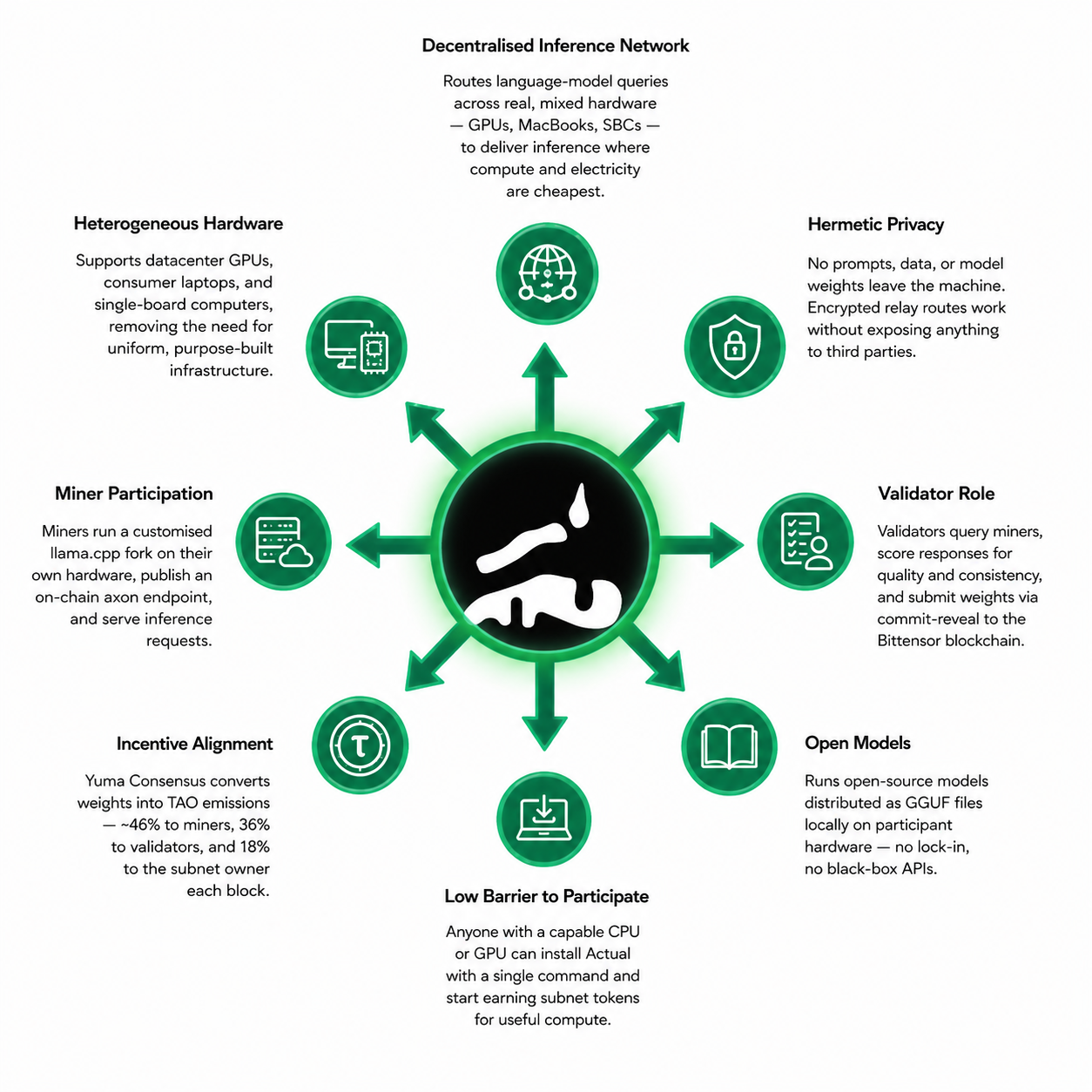
Actual (Bittensor Subnet 95) is a decentralised, heterogeneous AI inference network that routes language-model queries across the real, mixed hardware that participants already own — from datacenter GPUs to consumer MacBooks and single-board computers. Rather than demanding uniform, purpose-built clusters, Actual distributes inference work to wherever compute and electricity are cheapest, using an encrypted relay to link machines without exposing any prompts or model weights to third parties. The project is operated by Actual Computer Inc., a Venice, California company, and sits on Bittensor under the on-chain symbol a (Nion).

At the subnet level, miners run a customised fork of the popular llama.cpp inference engine on their own hardware. Each miner publishes an on-chain axon endpoint and awaits incoming inference requests. Validators query those endpoints, score the responses for quality and consistency, and submit weight vectors to the Bittensor blockchain via commit-reveal. Yuma Consensus then translates those weights into TAO emissions — split approximately 46% to miners, 36% to validators, and 18% to the subnet owner each block — directly aligning hardware contributors with the quality of service they provide.

What makes Actual distinctive within Bittensor is its commitment to hermetic privacy: no prompts and no data ever leave the contributing machine. Users interact with open-source models (distributed as GGUF files) running entirely on local hardware, with the subnet’s encrypted relay serving only as a routing layer. This stands in contrast to cloud inference providers, where every query is visible to a third-party operator. Actual’s architecture makes it viable for privacy-sensitive use cases — regulated industries, personal data, confidential research — that cloud APIs cannot serve.

Because the network accepts heterogeneous hardware, the barrier to participation is low. Anyone with a capable CPU or GPU can install Actual with a single command and immediately begin contributing compute to the subnet, earning subnet tokens in proportion to the quality and volume of inference work they complete.

Actual (Bittensor Subnet 95) is a decentralised, heterogeneous AI inference network that routes language-model queries across the real, mixed hardware that participants already own — from datacenter GPUs to consumer MacBooks and single-board computers. Rather than demanding uniform, purpose-built clusters, Actual distributes inference work to wherever compute and electricity are cheapest, using an encrypted relay to link machines without exposing any prompts or model weights to third parties. The project is operated by Actual Computer Inc., a Venice, California company, and sits on Bittensor under the on-chain symbol a (Nion).

At the subnet level, miners run a customised fork of the popular llama.cpp inference engine on their own hardware. Each miner publishes an on-chain axon endpoint and awaits incoming inference requests. Validators query those endpoints, score the responses for quality and consistency, and submit weight vectors to the Bittensor blockchain via commit-reveal. Yuma Consensus then translates those weights into TAO emissions — split approximately 46% to miners, 36% to validators, and 18% to the subnet owner each block — directly aligning hardware contributors with the quality of service they provide.

What makes Actual distinctive within Bittensor is its commitment to hermetic privacy: no prompts and no data ever leave the contributing machine. Users interact with open-source models (distributed as GGUF files) running entirely on local hardware, with the subnet’s encrypted relay serving only as a routing layer. This stands in contrast to cloud inference providers, where every query is visible to a third-party operator. Actual’s architecture makes it viable for privacy-sensitive use cases — regulated industries, personal data, confidential research — that cloud APIs cannot serve.

Because the network accepts heterogeneous hardware, the barrier to participation is low. Anyone with a capable CPU or GPU can install Actual with a single command and immediately begin contributing compute to the subnet, earning subnet tokens in proportion to the quality and volume of inference work they complete.

PURPOSE

What exactly is the 'product/build'?

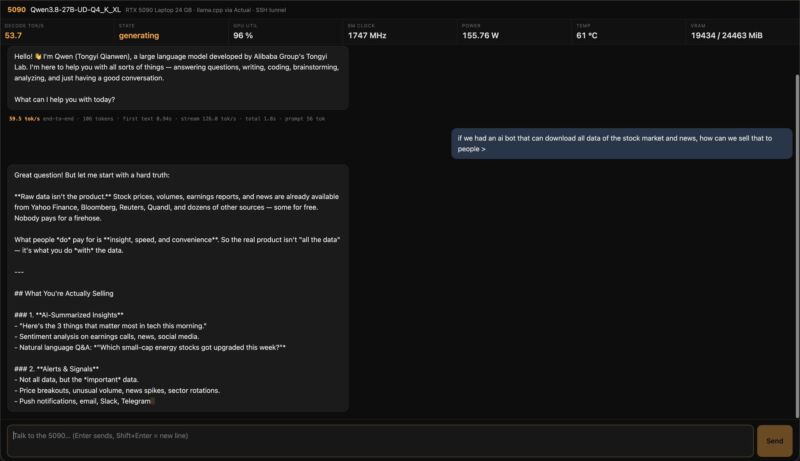
The primary product is a lightweight, cross-platform local inference daemon that converts consumer and professional hardware into an always-available AI backend. Installation takes a single command — curl -fsSL "https://actual.inc/install" | bash — after which the device authenticates at actual.inc/device and begins participating in the subnet. The daemon runs silently in the background, serving inference requests both locally (via http://127.0.0.1:8080) and remotely through Actual’s encrypted relay, so the user can reach their own hardware from anywhere in the world without configuring VPNs, port-forwarding, or complex networking.

Actual exposes a standard LLM-compatible API endpoint, making it a drop-in replacement for cloud providers in any tool that supports custom base URLs. The most prominent integration is with Hermes Agent by Nous Research — the most-used global AI agent by token consumption on OpenRouter, processing over a trillion daily tokens. Hermes users can point their agent at Actual using a simple ACTUAL_API_KEY environment variable for the hosted relay, or ACTUAL_BASE_URL=http://127.0.0.1:8080 for fully local operation without any key. Actual Computer was added as a first-class native Hermes inference provider in August 2026, generating over 320,000 impressions in its first week on X.

The technical foundation is a fork of llama.cpp (available at github.com/actual-computer/llama.cpp), customised to support Actual’s heterogeneous routing and the subnet’s incentive loop. Supported hardware spans Windows, macOS, and Linux; AMD Radeon GPUs were added as a supported target in May 2026, broadening the range of participating machines. A curated model hub at models.actual.inc offers pre-quantised GGUF files optimised for Actual’s runtime, including same-day support for major model releases — the team shipped Meta’s Muse Glimmer 30B model quantised under 20 GB with speculative decoding on day zero.

Beyond personal inference, Actual offers an optional compute-pool layer: contributors can dedicate idle GPU or CPU cycles to a shared pool that serves upstream provider demand, earning additional token rewards. This transforms the subnet from a personal productivity tool into a marketplace for distributed inference capacity — one where the Bittensor incentive mechanism automatically rewards quality and punishes unreliable nodes, removing the need for centralised SLA enforcement.

The primary product is a lightweight, cross-platform local inference daemon that converts consumer and professional hardware into an always-available AI backend. Installation takes a single command — curl -fsSL "https://actual.inc/install" | bash — after which the device authenticates at actual.inc/device and begins participating in the subnet. The daemon runs silently in the background, serving inference requests both locally (via http://127.0.0.1:8080) and remotely through Actual’s encrypted relay, so the user can reach their own hardware from anywhere in the world without configuring VPNs, port-forwarding, or complex networking.

Actual exposes a standard LLM-compatible API endpoint, making it a drop-in replacement for cloud providers in any tool that supports custom base URLs. The most prominent integration is with Hermes Agent by Nous Research — the most-used global AI agent by token consumption on OpenRouter, processing over a trillion daily tokens. Hermes users can point their agent at Actual using a simple ACTUAL_API_KEY environment variable for the hosted relay, or ACTUAL_BASE_URL=http://127.0.0.1:8080 for fully local operation without any key. Actual Computer was added as a first-class native Hermes inference provider in August 2026, generating over 320,000 impressions in its first week on X.

The technical foundation is a fork of llama.cpp (available at github.com/actual-computer/llama.cpp), customised to support Actual’s heterogeneous routing and the subnet’s incentive loop. Supported hardware spans Windows, macOS, and Linux; AMD Radeon GPUs were added as a supported target in May 2026, broadening the range of participating machines. A curated model hub at models.actual.inc offers pre-quantised GGUF files optimised for Actual’s runtime, including same-day support for major model releases — the team shipped Meta’s Muse Glimmer 30B model quantised under 20 GB with speculative decoding on day zero.

Beyond personal inference, Actual offers an optional compute-pool layer: contributors can dedicate idle GPU or CPU cycles to a shared pool that serves upstream provider demand, earning additional token rewards. This transforms the subnet from a personal productivity tool into a marketplace for distributed inference capacity — one where the Bittensor incentive mechanism automatically rewards quality and punishes unreliable nodes, removing the need for centralised SLA enforcement.

WHO

Team Info

Tom A. Lynch is the CEO and subnet owner of Actual Computer Inc. His professional background is in building large-scale server infrastructure for AI model training, and he approaches the inference cost problem through an energy-economics lens — framing the question not as a software challenge but as a question of where electricity is cheapest and compute is most idle. Lynch is active on X as @Tom_A_Lynch and has been transparent about product direction in the Bittensor Discord. He has described the Hermes Agent integration as a long-standing goal and uses the tool personally every day, underscoring that Actual is built by practitioners for practitioners.

The wider team at Actual Computer Inc., based in Venice, California, also includes Sam McCabe and Justin Bennington as listed employees, and Steve Sperandeo as an advisor. The project attracted early community attention partly because the @actualinc X account is followed by Jack Clark, co-founder of Anthropic — a signal that the broader AI research community is watching. The team deliberately maintains a low-noise public profile, preferring to let product updates and integrations speak for themselves rather than running aggressive marketing campaigns.

Actual Computer Inc. was incorporated as a private company and registered its Bittensor subnet in mid-2025. Since launch, the subnet token price surged over 110% in the weeks following October 2025 as early community members discovered the project, driven largely by word-of-mouth and technical credibility rather than paid promotion. The team has indicated ongoing hiring and art-direction work as the product moves toward a wider public beta.

Tom A. Lynch is the CEO and subnet owner of Actual Computer Inc. His professional background is in building large-scale server infrastructure for AI model training, and he approaches the inference cost problem through an energy-economics lens — framing the question not as a software challenge but as a question of where electricity is cheapest and compute is most idle. Lynch is active on X as @Tom_A_Lynch and has been transparent about product direction in the Bittensor Discord. He has described the Hermes Agent integration as a long-standing goal and uses the tool personally every day, underscoring that Actual is built by practitioners for practitioners.

The wider team at Actual Computer Inc., based in Venice, California, also includes Sam McCabe and Justin Bennington as listed employees, and Steve Sperandeo as an advisor. The project attracted early community attention partly because the @actualinc X account is followed by Jack Clark, co-founder of Anthropic — a signal that the broader AI research community is watching. The team deliberately maintains a low-noise public profile, preferring to let product updates and integrations speak for themselves rather than running aggressive marketing campaigns.

Actual Computer Inc. was incorporated as a private company and registered its Bittensor subnet in mid-2025. Since launch, the subnet token price surged over 110% in the weeks following October 2025 as early community members discovered the project, driven largely by word-of-mouth and technical credibility rather than paid promotion. The team has indicated ongoing hiring and art-direction work as the product moves toward a wider public beta.

FUTURE

Roadmap

Actual Computer has been transparent about its near-term build priorities, even without a formal published roadmap. In May 2026 the team shipped AMD GPU support, making Radeon hardware a first-class mining option, and launched a curated model hub at models.actual.inc to simplify model discovery and deployment. The Hermes Agent integration — merged in August 2026 — represents the project’s first major third-party ecosystem partnership, confirming that Actual’s API is stable enough for production agent workloads.

Looking ahead, the team has signalled plans to expand the upstream compute-pool, connecting Actual’s distributed hardware supply to commercial inference demand from external providers. Mining rewards for contributors are expected to increase materially as pool demand grows. A full public beta has been confirmed, moving beyond the current closed-access sign-up flow, with the Bittensor subnet infrastructure serving as the production backbone. Additional model-specific optimisations — including speculative decoding improvements and expanded quantisation options — are on the technical roadmap as the team broadens hardware compatibility.

The broader strategic vision is to make local inference the default, not the exception: every machine with a capable chip becomes a thinking computer, and the Bittensor network coordinates that compute into a reliable, privacy-preserving alternative to centralised cloud AI. Actual’s position as a first-class Hermes provider, combined with day-zero support for major model releases, shows the team is executing on that vision with meaningful velocity.

Actual Computer has been transparent about its near-term build priorities, even without a formal published roadmap. In May 2026 the team shipped AMD GPU support, making Radeon hardware a first-class mining option, and launched a curated model hub at models.actual.inc to simplify model discovery and deployment. The Hermes Agent integration — merged in August 2026 — represents the project’s first major third-party ecosystem partnership, confirming that Actual’s API is stable enough for production agent workloads.

Looking ahead, the team has signalled plans to expand the upstream compute-pool, connecting Actual’s distributed hardware supply to commercial inference demand from external providers. Mining rewards for contributors are expected to increase materially as pool demand grows. A full public beta has been confirmed, moving beyond the current closed-access sign-up flow, with the Bittensor subnet infrastructure serving as the production backbone. Additional model-specific optimisations — including speculative decoding improvements and expanded quantisation options — are on the technical roadmap as the team broadens hardware compatibility.

The broader strategic vision is to make local inference the default, not the exception: every machine with a capable chip becomes a thinking computer, and the Bittensor network coordinates that compute into a reliable, privacy-preserving alternative to centralised cloud AI. Actual’s position as a first-class Hermes provider, combined with day-zero support for major model releases, shows the team is executing on that vision with meaningful velocity.