
With the amount of new subnets being added it can be hard to get up to date information across all subnets, so data may be slightly out of date from time to time
Orion is Bittensor’s Subnet 27, a purpose-built data-mining network operated by SILX AI. Launched on 12 July 2026 following SILX’s acquisition and rebranding of the slot, Orion functions as a decentralised pipeline for generating, discovering, and curating large-scale, high-quality AI training datasets. Rather than training models directly, Orion supplies the raw fuel — rich, verified textual data — that downstream foundation-model training runs depend on, including SILX’s own Quasar model on Subnet 24 and Bittensor’s Subnet 3.
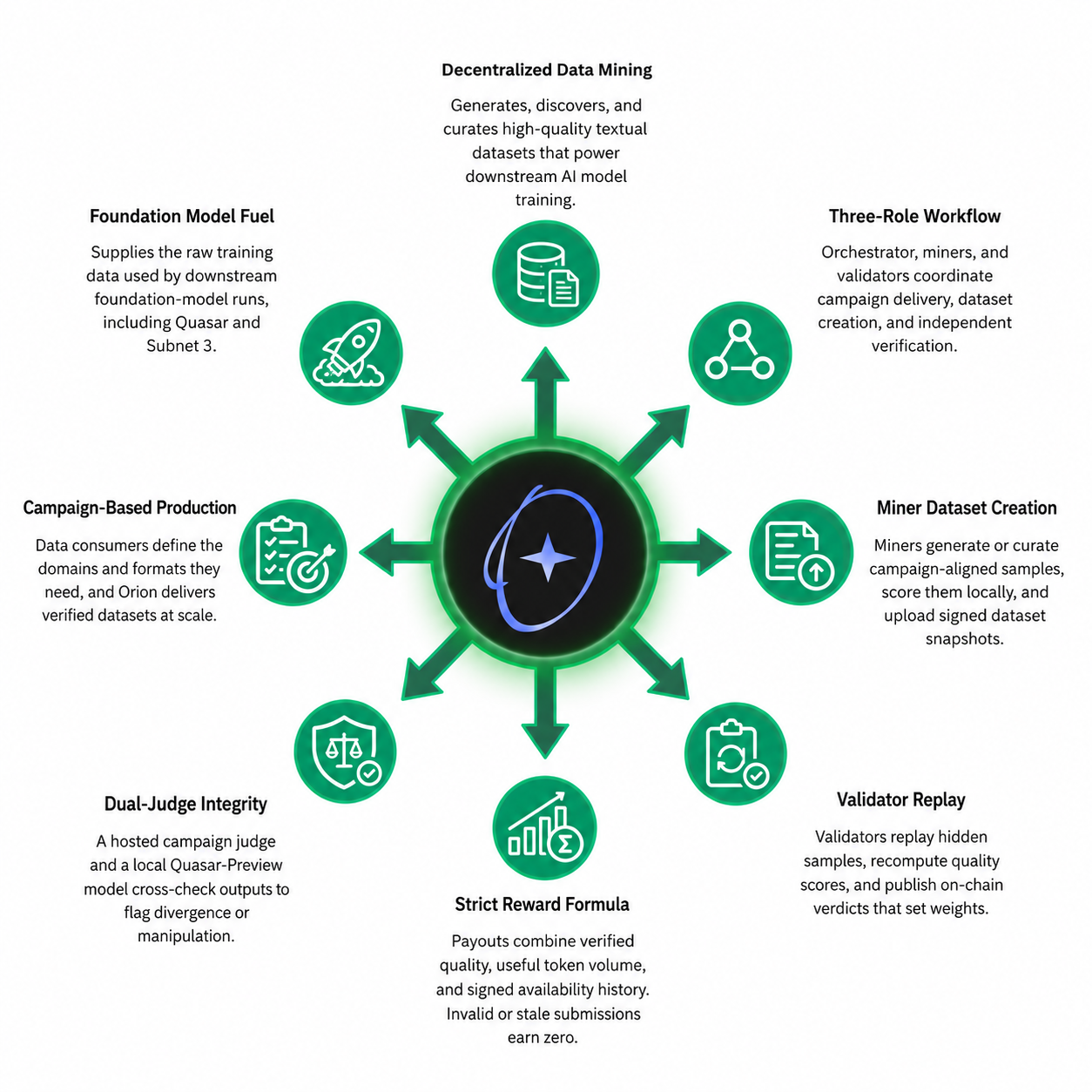
The subnet works through a coordinated three-role architecture. The orchestrator publishes signed data campaigns that define exactly what kind of content is needed (for example, coding problems, mathematical reasoning, technical documentation, or general knowledge), assigns work to registered miners, issues scoped access grants to S3 storage, and manages campaign progression. Miners receive real data batches, generate or curate textual samples aligned to the campaign brief, evaluate their output using both a campaign-pinned hosted judge model and a local copy of SILX’s Quasar-Preview model running on their own GPU, and then upload a single signed dataset snapshot per assignment. Validators independently replay a hidden sample from each miner’s submission, recompute quality scores, and publish on-chain verdicts that set Bittensor weights for the round.
Scoring is deliberately strict to ensure only genuinely useful data is rewarded. A miner’s payout is calculated from the product of its verified quality score and the volume of useful tokens produced, then multiplied by the miner’s signed availability history. Invalid, duplicated, stale, or unverifiable submissions receive zero reward. The dual-judge approach — comparing the campaign-pinned hosted model against the miner’s local Quasar run — provides an additional layer of integrity, flagging divergence that may indicate faulty or manipulated outputs.
What makes Orion distinctive on Bittensor is its campaign abstraction. Instead of a fixed task baked into the subnet, data consumers can specify exactly what domains and formats they need through a campaign configuration, and the entire miner-validator-orchestrator machinery delivers verified datasets at scale. The current mainnet pilot focuses on coding, mathematics, technical data, and general knowledge — domains that are particularly valuable for pretraining and fine-tuning large language models. This flexible architecture means Orion can pivot to new data types as demand evolves, making it a general-purpose data production layer for the Bittensor ecosystem.
Orion is Bittensor’s Subnet 27, a purpose-built data-mining network operated by SILX AI. Launched on 12 July 2026 following SILX’s acquisition and rebranding of the slot, Orion functions as a decentralised pipeline for generating, discovering, and curating large-scale, high-quality AI training datasets. Rather than training models directly, Orion supplies the raw fuel — rich, verified textual data — that downstream foundation-model training runs depend on, including SILX’s own Quasar model on Subnet 24 and Bittensor’s Subnet 3.
The subnet works through a coordinated three-role architecture. The orchestrator publishes signed data campaigns that define exactly what kind of content is needed (for example, coding problems, mathematical reasoning, technical documentation, or general knowledge), assigns work to registered miners, issues scoped access grants to S3 storage, and manages campaign progression. Miners receive real data batches, generate or curate textual samples aligned to the campaign brief, evaluate their output using both a campaign-pinned hosted judge model and a local copy of SILX’s Quasar-Preview model running on their own GPU, and then upload a single signed dataset snapshot per assignment. Validators independently replay a hidden sample from each miner’s submission, recompute quality scores, and publish on-chain verdicts that set Bittensor weights for the round.
Scoring is deliberately strict to ensure only genuinely useful data is rewarded. A miner’s payout is calculated from the product of its verified quality score and the volume of useful tokens produced, then multiplied by the miner’s signed availability history. Invalid, duplicated, stale, or unverifiable submissions receive zero reward. The dual-judge approach — comparing the campaign-pinned hosted model against the miner’s local Quasar run — provides an additional layer of integrity, flagging divergence that may indicate faulty or manipulated outputs.
What makes Orion distinctive on Bittensor is its campaign abstraction. Instead of a fixed task baked into the subnet, data consumers can specify exactly what domains and formats they need through a campaign configuration, and the entire miner-validator-orchestrator machinery delivers verified datasets at scale. The current mainnet pilot focuses on coding, mathematics, technical data, and general knowledge — domains that are particularly valuable for pretraining and fine-tuning large language models. This flexible architecture means Orion can pivot to new data types as demand evolves, making it a general-purpose data production layer for the Bittensor ecosystem.
SILX AI is building a suite of open-weight, long-context foundation models under the Quasar brand — large language models engineered to process millions of tokens in a single forward pass by eliminating the positional embedding bottlenecks that constrain conventional architectures. Orion exists as the supply chain for this ambition: a decentralised engine that can generate hundreds of billions of tokens of verified training data at a cost SILX estimates is ten times lower than centralised alternatives. Where a comparable centrally produced data campaign might cost over $100,000, Orion’s incentive mechanism targets sub-$10,000 per campaign by distributing the work across competing Bittensor miners.
The commercial product roadmap extends well beyond SILX’s own model training. A standalone data marketplace is planned — a service that exposes Orion’s incentive mechanism to external AI developers and companies that need large volumes of domain-specific training data without building the infrastructure themselves. Target customers include enterprises working in legal research, code analysis, scientific literature, and other fields that require AI models to reason over very long documents. The beta of this commercial data product was scheduled for August 2026, representing the subnet’s transition from an internal toolchain to a revenue-generating business.
Technically, each campaign is tied to an S3 storage region (currently eu-central-1) where miners upload signed dataset snapshots and validators retrieve hidden samples for independent verification. The orchestrator coordinates all storage grants, ensuring miners cannot access each other’s work and validators cannot be anticipated. This architecture produces a publicly auditable record of every accepted data contribution, which is itself a differentiator for enterprise customers who need provenance and reproducibility in training data. Bittensor token incentives align miner behaviour with data quality: only submissions that pass validator replay earn TAO-denominated rewards, so the network naturally surfaces and retains miners producing the most useful output.
Orion also serves as infrastructure for Bittensor’s broader ecosystem. As a data supplier to Subnet 3 and potentially other subnets, it creates a flywheel dynamic: higher-quality data flowing from Orion strengthens models across multiple subnets, which in turn attracts more miners and validators to Orion, further reducing per-token costs. SILX has also announced a partnership with Adaption Labs to incorporate state-of-the-art adaptive synthetic data techniques into the campaign pipeline, broadening the diversity and quality of datasets Orion can produce.
SILX AI is building a suite of open-weight, long-context foundation models under the Quasar brand — large language models engineered to process millions of tokens in a single forward pass by eliminating the positional embedding bottlenecks that constrain conventional architectures. Orion exists as the supply chain for this ambition: a decentralised engine that can generate hundreds of billions of tokens of verified training data at a cost SILX estimates is ten times lower than centralised alternatives. Where a comparable centrally produced data campaign might cost over $100,000, Orion’s incentive mechanism targets sub-$10,000 per campaign by distributing the work across competing Bittensor miners.
The commercial product roadmap extends well beyond SILX’s own model training. A standalone data marketplace is planned — a service that exposes Orion’s incentive mechanism to external AI developers and companies that need large volumes of domain-specific training data without building the infrastructure themselves. Target customers include enterprises working in legal research, code analysis, scientific literature, and other fields that require AI models to reason over very long documents. The beta of this commercial data product was scheduled for August 2026, representing the subnet’s transition from an internal toolchain to a revenue-generating business.
Technically, each campaign is tied to an S3 storage region (currently eu-central-1) where miners upload signed dataset snapshots and validators retrieve hidden samples for independent verification. The orchestrator coordinates all storage grants, ensuring miners cannot access each other’s work and validators cannot be anticipated. This architecture produces a publicly auditable record of every accepted data contribution, which is itself a differentiator for enterprise customers who need provenance and reproducibility in training data. Bittensor token incentives align miner behaviour with data quality: only submissions that pass validator replay earn TAO-denominated rewards, so the network naturally surfaces and retains miners producing the most useful output.
Orion also serves as infrastructure for Bittensor’s broader ecosystem. As a data supplier to Subnet 3 and potentially other subnets, it creates a flywheel dynamic: higher-quality data flowing from Orion strengthens models across multiple subnets, which in turn attracts more miners and validators to Orion, further reducing per-token costs. SILX has also announced a partnership with Adaption Labs to incorporate state-of-the-art adaptive synthetic data techniques into the campaign pipeline, broadening the diversity and quality of datasets Orion can produce.
SILX AI was founded by Eyad Gomaa (CEO) and Youssef Farahat (CTO), both of whom came to the long-context AI problem from a deep research background in neural network architectures. Eyad, based in the San Francisco Bay Area, is the principal researcher behind Quasar’s novel continuous-time attention mechanism — an architectural approach that eliminates positional embeddings to allow models to scale context lengths from thousands to millions of tokens. Youssef, a researcher and developer who has run AI models locally and repeatedly encountered the frustration of arbitrary context limits, co-leads the technical direction and model development. The two co-founded SILX AI in mid-2025 with the conviction that long-term memory is a prerequisite for any genuinely capable AI system. The company operates as an open-source research lab, releasing model weights under Apache 2.0 and publishing architectural research publicly.
The broader SILX AI team includes engineers and researchers such as Ahmed Abd-Elaziz and Mohamed Ashraf, who have contributed to model operations and the Quasar-Preview release. Eyad Gomaa has also published independent research, including TARS, a small model that outperforms larger models on fewer training tokens, demonstrating the team’s focus on architectural efficiency rather than simply scaling parameters. The Orion subnet slot was secured with support from Mark Creaser and Siam Kidd of DSV Fund, who backed the project during the acquisition of Subnet 27, and the launch involved close collaboration with Bittensor co-founders during negotiations. Community and ecosystem figures have described the SILX team as unusually technically credible for a project at this stage.
SILX AI’s mission is explicitly philosophical as well as technical: the team believes AI should be open, accessible, and working for individuals rather than extracting value from them. By releasing Quasar under permissive licences, enabling inference on consumer-grade GPUs, and building Orion as a public data infrastructure layer, SILX positions itself against the centralised, closed-access model of mainstream AI development. The Quasar X account (@QuasarModels) is the team’s primary public communications channel, where Eyad and colleagues share training progress, benchmark results, and product announcements.
SILX AI was founded by Eyad Gomaa (CEO) and Youssef Farahat (CTO), both of whom came to the long-context AI problem from a deep research background in neural network architectures. Eyad, based in the San Francisco Bay Area, is the principal researcher behind Quasar’s novel continuous-time attention mechanism — an architectural approach that eliminates positional embeddings to allow models to scale context lengths from thousands to millions of tokens. Youssef, a researcher and developer who has run AI models locally and repeatedly encountered the frustration of arbitrary context limits, co-leads the technical direction and model development. The two co-founded SILX AI in mid-2025 with the conviction that long-term memory is a prerequisite for any genuinely capable AI system. The company operates as an open-source research lab, releasing model weights under Apache 2.0 and publishing architectural research publicly.
The broader SILX AI team includes engineers and researchers such as Ahmed Abd-Elaziz and Mohamed Ashraf, who have contributed to model operations and the Quasar-Preview release. Eyad Gomaa has also published independent research, including TARS, a small model that outperforms larger models on fewer training tokens, demonstrating the team’s focus on architectural efficiency rather than simply scaling parameters. The Orion subnet slot was secured with support from Mark Creaser and Siam Kidd of DSV Fund, who backed the project during the acquisition of Subnet 27, and the launch involved close collaboration with Bittensor co-founders during negotiations. Community and ecosystem figures have described the SILX team as unusually technically credible for a project at this stage.
SILX AI’s mission is explicitly philosophical as well as technical: the team believes AI should be open, accessible, and working for individuals rather than extracting value from them. By releasing Quasar under permissive licences, enabling inference on consumer-grade GPUs, and building Orion as a public data infrastructure layer, SILX positions itself against the centralised, closed-access model of mainstream AI development. The Quasar X account (@QuasarModels) is the team’s primary public communications channel, where Eyad and colleagues share training progress, benchmark results, and product announcements.
Orion launched on the Bittensor Finney mainnet on 12 July 2026, with the initial pilot campaign covering coding, mathematics, technical documentation, and general knowledge. The immediate near-term milestone is the release of a commercial data product beta — a service allowing external AI developers to commission and receive verified training datasets through Orion’s incentive pipeline — targeted for August 2026. This marks Orion’s transition from an internal data supply chain for Quasar into a revenue-generating product for the wider AI market.
In parallel, Quasar’s own training run on Subnet 24 is ongoing, with a target of completing more than 10 trillion additional pretraining tokens on the Quasar-Preview model through decentralised miner contributions. Early benchmark results already show measurable improvements in MMLU, MMLU-Pro, GPQA, and ARC Challenge scores at roughly 10% completion of the current run, validating that Orion-supplied data translates into real model improvements. Longer term, SILX plans to expand campaign domains, deepen the partnership with Adaption Labs for adaptive synthetic data, and build out the orchestrator to support multiple concurrent campaigns serving different customers simultaneously.
Orion launched on the Bittensor Finney mainnet on 12 July 2026, with the initial pilot campaign covering coding, mathematics, technical documentation, and general knowledge. The immediate near-term milestone is the release of a commercial data product beta — a service allowing external AI developers to commission and receive verified training datasets through Orion’s incentive pipeline — targeted for August 2026. This marks Orion’s transition from an internal data supply chain for Quasar into a revenue-generating product for the wider AI market.
In parallel, Quasar’s own training run on Subnet 24 is ongoing, with a target of completing more than 10 trillion additional pretraining tokens on the Quasar-Preview model through decentralised miner contributions. Early benchmark results already show measurable improvements in MMLU, MMLU-Pro, GPQA, and ARC Challenge scores at roughly 10% completion of the current run, validating that Orion-supplied data translates into real model improvements. Longer term, SILX plans to expand campaign domains, deepen the partnership with Adaption Labs for adaptive synthetic data, and build out the orchestrator to support multiple concurrent campaigns serving different customers simultaneously.