With the amount of new subnets being added it can be hard to get up to date information across all subnets, so data may be slightly out of date from time to time
Synth is a Bittensor subnet (SN50) developed by Mode Network that produces synthetic cryptocurrency price-path data for forecasting. It generates probabilistic forecasts of asset prices (initially Bitcoin, and now also Ethereum) and makes this data available to AI agents and LLMs for better decision-making. Unlike traditional models that give a single prediction, Synth captures the full probability distribution of future prices by having multiple AI “miners” propose simulated price paths. Built on Bittensor, Synth fosters a competitive, self-optimizing ecosystem: hundreds of AI models continuously compete to produce the most accurate synthetic price distributions. In Mode’s own words, Synth delivers “the world’s most powerful synthetic price data” to enable accurate forecasting and probabilistic reasoning. By exposing agents to a wide range of market scenarios (including extreme events), Synth aims to overcome the biases and gaps of historical financial data and drive a new AI-native data layer for decentralized finance.
The Synth Subnet aspires to become the leading provider of synthetic price data for AI-driven trading agents, serving as an essential resource for options trading and portfolio management. By offering deep insights into price probability distributions, it aims to revolutionise data-driven financial decision-making.
Synth is a Bittensor subnet (SN50) developed by Mode Network that produces synthetic cryptocurrency price-path data for forecasting. It generates probabilistic forecasts of asset prices (initially Bitcoin, and now also Ethereum) and makes this data available to AI agents and LLMs for better decision-making. Unlike traditional models that give a single prediction, Synth captures the full probability distribution of future prices by having multiple AI “miners” propose simulated price paths. Built on Bittensor, Synth fosters a competitive, self-optimizing ecosystem: hundreds of AI models continuously compete to produce the most accurate synthetic price distributions. In Mode’s own words, Synth delivers “the world’s most powerful synthetic price data” to enable accurate forecasting and probabilistic reasoning. By exposing agents to a wide range of market scenarios (including extreme events), Synth aims to overcome the biases and gaps of historical financial data and drive a new AI-native data layer for decentralized finance.
The Synth Subnet aspires to become the leading provider of synthetic price data for AI-driven trading agents, serving as an essential resource for options trading and portfolio management. By offering deep insights into price probability distributions, it aims to revolutionise data-driven financial decision-making.
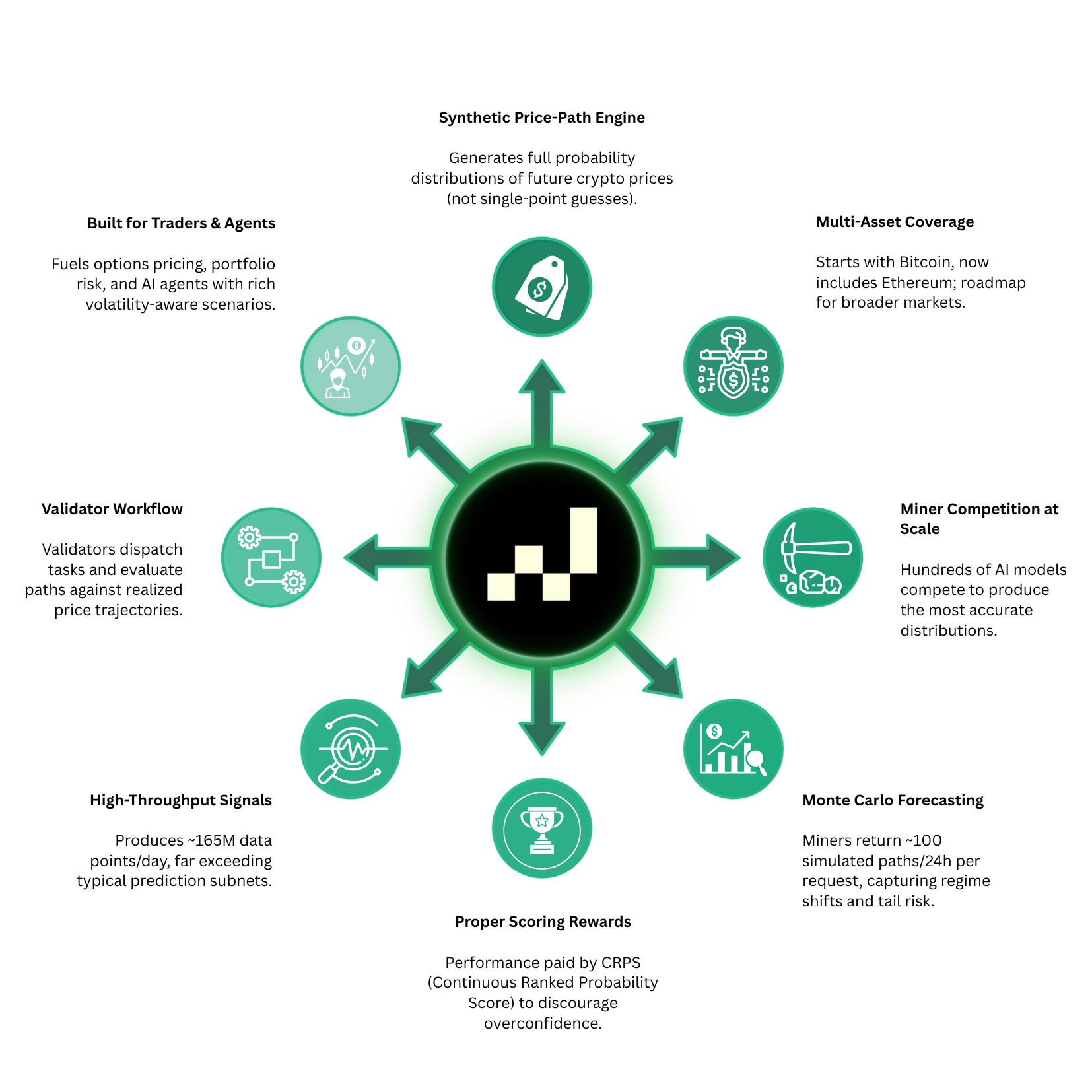
Synth is a decentralized prediction engine built on the BitTensor network, designed to create a powerful forecasting tool for financial markets. The “product” is a system that incentivizes miners to build probabilistic models based on historical data using Monte Carlo simulations, producing a variety of potential price paths for assets like Bitcoin. These simulated paths model the dynamic price movement of assets, accounting for volatility, price clustering, long-tail risks (like Black Swan events), and sudden shifts in price.
Miners are incentivized based on how accurately their predictions align with actual future prices, but instead of a simple price target, they are assessed on how well they predict entire price paths over time. This process is made possible by a scoring system that rewards miners for providing probability distributions, not point predictions, allowing for a much richer understanding of future price behavior.
The system generates an impressive 165 million data points per day, compared to the 10,000 data points typical in other price prediction subnets. The platform’s architecture allows validators to send requests to miners, who respond by generating predictions in the form of 100 simulated paths of Bitcoin’s price over the next 24 hours. Every 24 hours, those paths are evaluated against the actual Bitcoin price path to see how accurate each miner’s prediction was.
Miners’ performance is rated based on a proper scoring rule, namely the Continuous Ranked Probability Score (CRPS). This scoring rule helps to avoid common pitfalls in other predictive models that may rely on overconfident predictions, thereby enabling a fairer and more robust way of rewarding the best models. Additionally, because the system models volatility as well as price, it captures the probability distributions that describe the most likely movements, making it incredibly useful for traders and investors in managing their portfolios.
Technical Architecture
Synth Subnet architecture overview. In the Synth subnet, participants interact via two primary roles on the Bittensor blockchain: miners (who produce forecasts) and validators (who score forecasts). Miners submit their price-path predictions on-chain, validators fetch these predictions and compare them to live market prices (e.g. via a Pyth oracle), then compute CRPS scores and update rewards.
Synth is implemented as a Bittensor subnet (SN50) on the Bittensor network. As such, it inherits Bittensor’s distributed consensus (known as Yuma consensus) for ranking and rewarding contributions. Miner predictions are recorded on the subnet’s chain, and the CRPS scoring and emissions logic run according to Bittensor’s protocol. In effect, Synth’s intelligent forecasts become digital commodities on-chain. The subnet also provides client libraries and plugins, so on-chain agents (like Mode’s AI trading terminal) can query Synth forecasts directly. Mode has indicated that Synth’s live forecasts will be fed into its AI Terminal and trading agents for real-time risk assessment.
On the developer side, Synth’s GitHub docs outline the architecture: a loop where the validator requests predictions, miners respond with price-path arrays, and the validator runs a “prediction results” validation function before storing the data. Errors are logged and correct results are archived. Over time, the built-in scoring and leaderboard logic continuously evaluates each miner. Because the network is permissionless, any qualified model can participate. Mode Network has also created a dedicated discussion channel on the Bittensor Discord for Synth, fostering community participation.
Features and Use Cases
High-Fidelity Synthetic Data: Synth’s product is a rich probabilistic price dataset. By generating many possible future paths, Synth exposes AI models to scenarios (including extreme events) that may be absent in historical data. This synthetic data is intended for training and augmenting financial AI agents. For example, AI agents can consume Synth-generated paths during offline training to better learn market dynamics under uncertainty.
DeFi Agent Support: The subnet is explicitly designed to improve “forecasting and probabilistic reasoning of Agents and LLMs across decentralized finance”. In practice, Synth forecasts can be used by autonomous trading agents to make decisions. For instance, a DeFi agent might query Synth for the probability distribution of BTC prices over the next hour and adjust its trading or hedging strategy accordingly. Synth forecasts could also feed into on-chain risk protocols (e.g. predicting collateral liquidation risk).
Financial Applications: The synthetic distributions enable advanced financial modeling. Agents and analysts can use Synth’s data for option pricing (Monte Carlo simulations of price distributions), portfolio optimization, and risk management. The Synth website highlights specific use cases:
Institutional users can integrate Synth’s data into their own AI systems to enhance forecasting reliability, while retail traders can use the Synth interface (via LLM or dashboards) to receive actionable tips and probability-based insights.
Competitive Data Layer: Because data scientists and teams can submit their own models, Synth creates a marketplace of forecasting algorithms. Top performers (miners) see their models rewarded and their outputs become part of the public synthetic dataset. This competitive aspect aims to continuously refine the data quality. Mode’s blog emphasizes that Synth “incentivizes miners to continuously submit synthetic models which capture the full distribution of possible price movements” – effectively crowdsourcing the creation of high-quality synthetic data.
Synth is a decentralized prediction engine built on the BitTensor network, designed to create a powerful forecasting tool for financial markets. The “product” is a system that incentivizes miners to build probabilistic models based on historical data using Monte Carlo simulations, producing a variety of potential price paths for assets like Bitcoin. These simulated paths model the dynamic price movement of assets, accounting for volatility, price clustering, long-tail risks (like Black Swan events), and sudden shifts in price.
Miners are incentivized based on how accurately their predictions align with actual future prices, but instead of a simple price target, they are assessed on how well they predict entire price paths over time. This process is made possible by a scoring system that rewards miners for providing probability distributions, not point predictions, allowing for a much richer understanding of future price behavior.
The system generates an impressive 165 million data points per day, compared to the 10,000 data points typical in other price prediction subnets. The platform’s architecture allows validators to send requests to miners, who respond by generating predictions in the form of 100 simulated paths of Bitcoin’s price over the next 24 hours. Every 24 hours, those paths are evaluated against the actual Bitcoin price path to see how accurate each miner’s prediction was.
Miners’ performance is rated based on a proper scoring rule, namely the Continuous Ranked Probability Score (CRPS). This scoring rule helps to avoid common pitfalls in other predictive models that may rely on overconfident predictions, thereby enabling a fairer and more robust way of rewarding the best models. Additionally, because the system models volatility as well as price, it captures the probability distributions that describe the most likely movements, making it incredibly useful for traders and investors in managing their portfolios.
Technical Architecture
Synth Subnet architecture overview. In the Synth subnet, participants interact via two primary roles on the Bittensor blockchain: miners (who produce forecasts) and validators (who score forecasts). Miners submit their price-path predictions on-chain, validators fetch these predictions and compare them to live market prices (e.g. via a Pyth oracle), then compute CRPS scores and update rewards.
Synth is implemented as a Bittensor subnet (SN50) on the Bittensor network. As such, it inherits Bittensor’s distributed consensus (known as Yuma consensus) for ranking and rewarding contributions. Miner predictions are recorded on the subnet’s chain, and the CRPS scoring and emissions logic run according to Bittensor’s protocol. In effect, Synth’s intelligent forecasts become digital commodities on-chain. The subnet also provides client libraries and plugins, so on-chain agents (like Mode’s AI trading terminal) can query Synth forecasts directly. Mode has indicated that Synth’s live forecasts will be fed into its AI Terminal and trading agents for real-time risk assessment.
On the developer side, Synth’s GitHub docs outline the architecture: a loop where the validator requests predictions, miners respond with price-path arrays, and the validator runs a “prediction results” validation function before storing the data. Errors are logged and correct results are archived. Over time, the built-in scoring and leaderboard logic continuously evaluates each miner. Because the network is permissionless, any qualified model can participate. Mode Network has also created a dedicated discussion channel on the Bittensor Discord for Synth, fostering community participation.
Features and Use Cases
High-Fidelity Synthetic Data: Synth’s product is a rich probabilistic price dataset. By generating many possible future paths, Synth exposes AI models to scenarios (including extreme events) that may be absent in historical data. This synthetic data is intended for training and augmenting financial AI agents. For example, AI agents can consume Synth-generated paths during offline training to better learn market dynamics under uncertainty.
DeFi Agent Support: The subnet is explicitly designed to improve “forecasting and probabilistic reasoning of Agents and LLMs across decentralized finance”. In practice, Synth forecasts can be used by autonomous trading agents to make decisions. For instance, a DeFi agent might query Synth for the probability distribution of BTC prices over the next hour and adjust its trading or hedging strategy accordingly. Synth forecasts could also feed into on-chain risk protocols (e.g. predicting collateral liquidation risk).
Financial Applications: The synthetic distributions enable advanced financial modeling. Agents and analysts can use Synth’s data for option pricing (Monte Carlo simulations of price distributions), portfolio optimization, and risk management. The Synth website highlights specific use cases:
Institutional users can integrate Synth’s data into their own AI systems to enhance forecasting reliability, while retail traders can use the Synth interface (via LLM or dashboards) to receive actionable tips and probability-based insights.
Competitive Data Layer: Because data scientists and teams can submit their own models, Synth creates a marketplace of forecasting algorithms. Top performers (miners) see their models rewarded and their outputs become part of the public synthetic dataset. This competitive aspect aims to continuously refine the data quality. Mode’s blog emphasizes that Synth “incentivizes miners to continuously submit synthetic models which capture the full distribution of possible price movements” – effectively crowdsourcing the creation of high-quality synthetic data.
The Synth team is led by James, a crypto finance veteran with eight years of experience, including founding the project Mode, which focuses on AI and DeFi intersections. Sam is the lead on quantitative modeling, having previously worked on sports betting markets and algorithmic trading. His expertise in physics underpins the team’s approach to applying statistical models to finance. Nathan is the lead architect, specializing in decentralized applications, wallets, and bridges, while Stas is a large systems expert, ensuring the stability and scalability of the platform.
Davide, a new addition to the team, is responsible for quantum finance research, overseeing much of the academic and practical research into financial systems and models. Amber manages the strategic development and business outreach, playing a crucial role in partnerships and ecosystem expansion. The team also collaborates with GTV, a key partner who has supported them with launching and scaling the subnet on BitTensor.
Together, the team brings a wealth of experience in decentralized finance, quantitative finance, machine learning, and large system architecture, positioning them to tackle one of the most complex and difficult challenges in finance: forecasting future market movements in a decentralized way.
The Synth team is led by James, a crypto finance veteran with eight years of experience, including founding the project Mode, which focuses on AI and DeFi intersections. Sam is the lead on quantitative modeling, having previously worked on sports betting markets and algorithmic trading. His expertise in physics underpins the team’s approach to applying statistical models to finance. Nathan is the lead architect, specializing in decentralized applications, wallets, and bridges, while Stas is a large systems expert, ensuring the stability and scalability of the platform.
Davide, a new addition to the team, is responsible for quantum finance research, overseeing much of the academic and practical research into financial systems and models. Amber manages the strategic development and business outreach, playing a crucial role in partnerships and ecosystem expansion. The team also collaborates with GTV, a key partner who has supported them with launching and scaling the subnet on BitTensor.
Together, the team brings a wealth of experience in decentralized finance, quantitative finance, machine learning, and large system architecture, positioning them to tackle one of the most complex and difficult challenges in finance: forecasting future market movements in a decentralized way.
The roadmap for Synth revolves around expanding its capabilities, improving model accuracy, integrating additional assets, and building commercial partnerships. The first milestone, achieved in Q1, was perfecting the core system and testing it against the Bitcoin market. The team is particularly excited about their ability to accurately model volatility, which is crucial for the future of crypto trading and decision-making.
In Q2, the focus shifts to integrating Ethereum into the system, allowing miners to start predicting Ethereum’s price paths in addition to Bitcoin. This integration will begin in the next few days, giving miners the opportunity to adapt their models for Ethereum price forecasts. Beyond that, Synth will focus on refining its scoring mechanism and extending the prediction system to incorporate correlations between Bitcoin and Ethereum prices, which will make the predictions even more useful for traders looking to hedge or speculate across multiple assets simultaneously.
Further into the future, Synth plans to integrate more assets, including commodities like gold and silver, which will be easier to model compared to assets like equities that have shorter trading hours. As they expand into these markets, the team is also looking into modeling indexes such as the S&P 500 and individual stocks, driven by demand from institutional investors.
Looking further ahead, the goal is to expand Synth’s applications beyond crypto finance. By Q3/Q4, Synth will move into other verticals such as weather forecasting, energy pricing, and even health predictions, leveraging its robust probabilistic model-building system. The broader vision for Synth is to become a data layer for AI decision-making across multiple industries, creating a universal forecasting engine for any time series data. This long-term roadmap envisions powering autonomous AI systems across various industries, with Synth providing the probabilistic models needed for their decision-making processes.
By 2026, Synth aims to have evolved into a system that powers artificial general intelligence (AGI) decision-making across all sectors, providing insights into anything from weather forecasts to traffic patterns, leveraging synthetic data and advanced probabilistic models to make better decisions.
The team also plans to integrate their data into external AI tools and platforms, offering a competitive edge over traditional models. By enabling access to the data via APIs and making it available to platforms such as large-scale exchanges or decentralized finance applications, Synth aims to tap into the growing need for probabilistic forecasting in AI.
In addition to this, there is an ongoing focus on improving the miner ecosystem, ensuring they continually develop better predictive models. The team acknowledges that in its infancy, the subnet has been fairly generous with rewarding miners but plans to refine the reward distribution over time, ensuring that top-performing miners are more heavily incentivized and that lower-performing miners are encouraged to improve their models. This dynamic approach to rewards will encourage consistent performance improvement and higher-quality predictions.
Key Highlights of the Roadmap Include:
The roadmap for Synth revolves around expanding its capabilities, improving model accuracy, integrating additional assets, and building commercial partnerships. The first milestone, achieved in Q1, was perfecting the core system and testing it against the Bitcoin market. The team is particularly excited about their ability to accurately model volatility, which is crucial for the future of crypto trading and decision-making.
In Q2, the focus shifts to integrating Ethereum into the system, allowing miners to start predicting Ethereum’s price paths in addition to Bitcoin. This integration will begin in the next few days, giving miners the opportunity to adapt their models for Ethereum price forecasts. Beyond that, Synth will focus on refining its scoring mechanism and extending the prediction system to incorporate correlations between Bitcoin and Ethereum prices, which will make the predictions even more useful for traders looking to hedge or speculate across multiple assets simultaneously.
Further into the future, Synth plans to integrate more assets, including commodities like gold and silver, which will be easier to model compared to assets like equities that have shorter trading hours. As they expand into these markets, the team is also looking into modeling indexes such as the S&P 500 and individual stocks, driven by demand from institutional investors.
Looking further ahead, the goal is to expand Synth’s applications beyond crypto finance. By Q3/Q4, Synth will move into other verticals such as weather forecasting, energy pricing, and even health predictions, leveraging its robust probabilistic model-building system. The broader vision for Synth is to become a data layer for AI decision-making across multiple industries, creating a universal forecasting engine for any time series data. This long-term roadmap envisions powering autonomous AI systems across various industries, with Synth providing the probabilistic models needed for their decision-making processes.
By 2026, Synth aims to have evolved into a system that powers artificial general intelligence (AGI) decision-making across all sectors, providing insights into anything from weather forecasts to traffic patterns, leveraging synthetic data and advanced probabilistic models to make better decisions.
The team also plans to integrate their data into external AI tools and platforms, offering a competitive edge over traditional models. By enabling access to the data via APIs and making it available to platforms such as large-scale exchanges or decentralized finance applications, Synth aims to tap into the growing need for probabilistic forecasting in AI.
In addition to this, there is an ongoing focus on improving the miner ecosystem, ensuring they continually develop better predictive models. The team acknowledges that in its infancy, the subnet has been fairly generous with rewarding miners but plans to refine the reward distribution over time, ensuring that top-performing miners are more heavily incentivized and that lower-performing miners are encouraged to improve their models. This dynamic approach to rewards will encourage consistent performance improvement and higher-quality predictions.
Key Highlights of the Roadmap Include:
A big thank you to Tao Stats for producing these insightful videos in the Novelty Search series. We appreciate the opportunity to dive deep into the groundbreaking work being done by Subnets within Bittensor! Check out some of their other videos HERE.
In this session, the team behind the Synth subnet discusses their innovative approach to price prediction using decentralized AI models. They explain how their system uses Monte Carlo simulations to generate synthetic price paths for assets like Bitcoin, modeling not just single-point price predictions but the full range of possible future price movements. The team delves into the complexities of predicting financial markets, discussing how their scoring system incentivizes miners to generate probabilistic forecasts, accounting for volatility and extreme price events. They also explore the technical architecture behind the system, the performance of miners, and the potential use cases for Synth’s data in areas like crypto trading, options pricing, liquidation probabilities, and liquidity provision. Looking ahead, the team outlines their roadmap, which includes expanding to new assets, industries, and eventually powering AI systems with synthetic data across various sectors.
A special thanks to Mark Jeffrey for his amazing Hash Rate series! In this series, he provides valuable insights into Bittensor Subnets and the world of decentralized AI. Be sure to check out the full series on his YouTube channel for more expert analysis and deep dives.
In this mid-2025 episode of Hash Rate, Mark Jeffrey is joined by James Ross from Subnet 50 Synth to explore the innovative work Synth is doing in the world of crypto and financial markets. Synth is a subnet that uses Monte Carlo simulations to create probabilistic price forecasts for assets like Bitcoin and Ethereum. Rather than predicting a single price point, Synth models a range of possible price paths and probabilities, providing a more nuanced view of market volatility. James explains how Synth’s data-driven approach is reshaping how people think about risk management and forecasting, especially for institutional clients and AI systems. The conversation also touches on the differences between Synth’s probabilistic models and other prediction models, particularly the innovative scoring mechanisms and the intense competition among miners that powers their data. Lastly, James shares insights into the future direction of Synth, including potential expansions into commodities and equities, and how their platform could become a crucial data layer for AIs and financial institutions alike.
Novelty Search is great, but for most investors trying to understand Bittensor, the technical depth is a wall, not a bridge. If we’re going to attract investment into this ecosystem then we need more people to understand it! That’s why Siam Kidd and Mark Creaser from DSV Fund have launched Revenue Search, where they ask the simple questions that investors want to know the answers to.
Recorded in July 2025, this Revenue Search episode features James Ross, co-founder of Synth—a Bittensor subnet focused on predictive volatility modeling for financial assets. Rather than making simple price predictions (e.g., “BTC will be $63K tomorrow”), Synth’s miners submit 100 full price paths every 5 minutes, competing to model the volatility distribution of assets like Bitcoin, Ethereum, and soon gold. This synthetic data is especially valuable because It avoids overfitting to historical data (a common flaw in finance), It simulates extreme edge cases and rare events and it improves continuously as miners compete, with performance currently beating standard benchmarks (e.g., 30% better than geometric Brownian motion). Synth’s core business model is API access—institutions like hedge funds, DeFi protocols, and trading desks pay to integrate this data into their risk models, agent-based trading, and dashboard tools. They also plan to monetize custom tooling and analytics for risk management (e.g., liquidation forecasting, stop-loss positioning).
Recorded in September 2025, this Revenue Search episode welcomes back James, co-founder of Synth, to share major updates on the subnet’s progress. Synth has evolved from improving miner data quality to actively monetizing its AI-driven asset forecasting engine, which models volatility and price paths for assets like BTC, ETH, SOL, and gold. James explains how Synth is now deploying its data into trading strategies across prediction markets such as PolyMarket, options platforms like Deribit and Bybit, and institutional venues like Koshi, with public wallets soon to demonstrate profitability. The team is also onboarding top crypto ecosystems, charging integration fees to add their assets into Synth’s dashboards and forecasting models. Looking ahead, James outlines plans for scaling into higher-frequency markets, strategic buybacks to support alpha value, and the push to secure a top-10 subnet position before the upcoming halving.
Recorded October 2025, Mark once again discusses Synth (Subnet 50), a decentralized, on-chain quant network where 200+ miners submit probabilistic “price cones” for assets (currently BTC, ETH, SOL, and gold; expanding toward the top 25), with a meta-scorer reweighting miners by long-run accuracy—cutting GBM error ~33% since January. In a 4-week Polymarket trial, a $2k account using Synth signals executed ~12k trades (~$500k volume) and returned ~110%, while subnet emissions have paid miners >$2M since February. Outputs power edges for prediction markets, DeFi perps risk control (liquidation avoidance), Uniswap v3 LP range placement, and on-chain agents; the team is tightening horizons for higher-frequency signals. The narrow “alpha signals/alt data” TAM is ~$2.5B, with a broader ~$44B opportunity as retail, DeFi protocols, and autonomous systems adopt hedge-fund-grade forecasting.
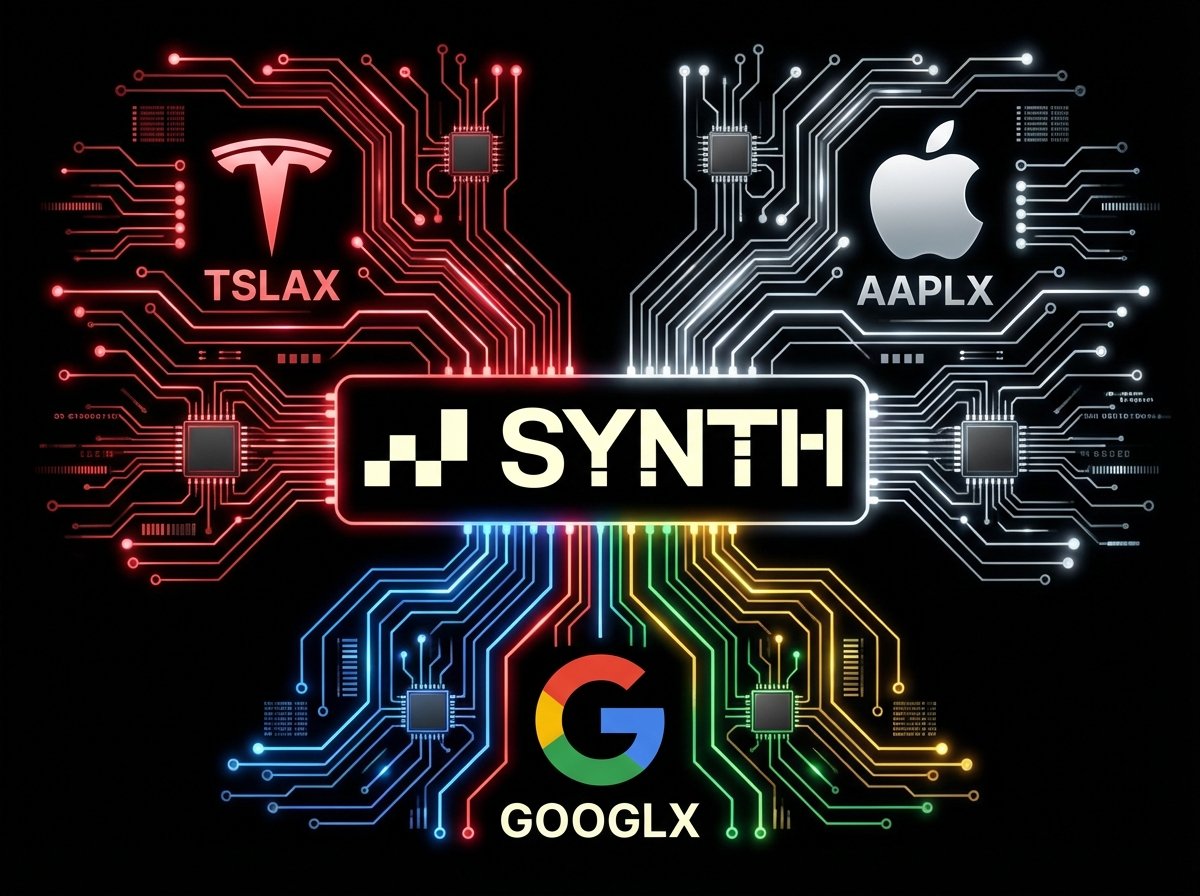
Synth expands its tokenized equity coverage.
New predictions are live for TSLAX, AAPLX, and GOOGLX.
Probabilistic forecasts, available via the Synth API.
API subscribers can now trade these tokenized stocks with always-on intelligence.
🔗https://dashboard.synthdata.co
http://x.com/i/article/2016031205188366336
After 100s of requests Synth API is now live and enables you to:
- Build Polymarket bots that query forecasts → compute fair probabilities → place/adjust orders
- Create options dashboards that flag “vol mispricing” in real time
- Integrate into vault logic that
http://x.com/i/article/2016170814844841985
@SynthdataCo is one of the most undervalued SN's in my opinion. I think it's one of the few subnets that has the juice to climb back to to ATH and more.
A subnet offering, ever evolving trading data in a world where AI agents are in constant battle for information, context,
http://x.com/i/article/2012978225450823680