
With the amount of new subnets being added it can be hard to get up to date information across all subnets, so data may be slightly out of date from time to time
Provenonce operates Bittensor Subnet 87 (SN87) as Agentic Coordination Infrastructure — the trust layer for the era of AI that actually does work. Its flagship protocol, Proof of Assurance, addresses a fundamental gap: as AI moves from chat interfaces into enterprise operations, organisations need more than a plausible output. They need proof that an AI workflow was completed correctly. Proof of Assurance turns structured workflow execution into verifiable, scoreable evidence — and uses Bittensor’s native incentives to reward miners who deliver it.
The protocol runs on a three-stage loop. First, a Canonical Path Contract is established before any execution begins. This contract defines the task, the rules, and the expected evidence — so correctness is specified upfront rather than debated after the fact. Think of it as a formal specification layer for agentic work: discovery-pitch, lead-meeting, board-reporting workflows all expressed as structured, executable contracts.
Second, miners execute the workflow and produce an Evidence Bundle — not a self-reported claim about the work, but a structured record assembled from the run itself. In a live demonstration from Proof of Talk in Paris, five miners ran the same workflow in parallel; only those producing verified, complete execution earned a high score.
Third, validators evaluate each Evidence Bundle against the requirements in the Canonical Path Contract and produce an Assurance Score. This score directly drives reward distribution, aligning miner incentives with genuine, correct execution. Because many independent validators score the evidence, assurance is decentralised — it does not depend on any single party’s judgment or brand. Verification lives in the protocol, not behind a vendor wall, making it reusable across the Bittensor network.
Provenonce’s V0 scope is deliberately focused: structured workflows where requirements can be specified in advance and evidence can be evaluated systematically. This is the space where assurance is most tractable today. The broader vision is for Proof of Assurance to become a verifiable commodity layer inside Bittensor’s market for useful work — defined before execution, evidenced during the run, scored by validators, and rewarded when the work checks out.
Provenonce operates Bittensor Subnet 87 (SN87) as Agentic Coordination Infrastructure — the trust layer for the era of AI that actually does work. Its flagship protocol, Proof of Assurance, addresses a fundamental gap: as AI moves from chat interfaces into enterprise operations, organisations need more than a plausible output. They need proof that an AI workflow was completed correctly. Proof of Assurance turns structured workflow execution into verifiable, scoreable evidence — and uses Bittensor’s native incentives to reward miners who deliver it.
The protocol runs on a three-stage loop. First, a Canonical Path Contract is established before any execution begins. This contract defines the task, the rules, and the expected evidence — so correctness is specified upfront rather than debated after the fact. Think of it as a formal specification layer for agentic work: discovery-pitch, lead-meeting, board-reporting workflows all expressed as structured, executable contracts.
Second, miners execute the workflow and produce an Evidence Bundle — not a self-reported claim about the work, but a structured record assembled from the run itself. In a live demonstration from Proof of Talk in Paris, five miners ran the same workflow in parallel; only those producing verified, complete execution earned a high score.
Third, validators evaluate each Evidence Bundle against the requirements in the Canonical Path Contract and produce an Assurance Score. This score directly drives reward distribution, aligning miner incentives with genuine, correct execution. Because many independent validators score the evidence, assurance is decentralised — it does not depend on any single party’s judgment or brand. Verification lives in the protocol, not behind a vendor wall, making it reusable across the Bittensor network.
Provenonce’s V0 scope is deliberately focused: structured workflows where requirements can be specified in advance and evidence can be evaluated systematically. This is the space where assurance is most tractable today. The broader vision is for Proof of Assurance to become a verifiable commodity layer inside Bittensor’s market for useful work — defined before execution, evidenced during the run, scored by validators, and rewarded when the work checks out.
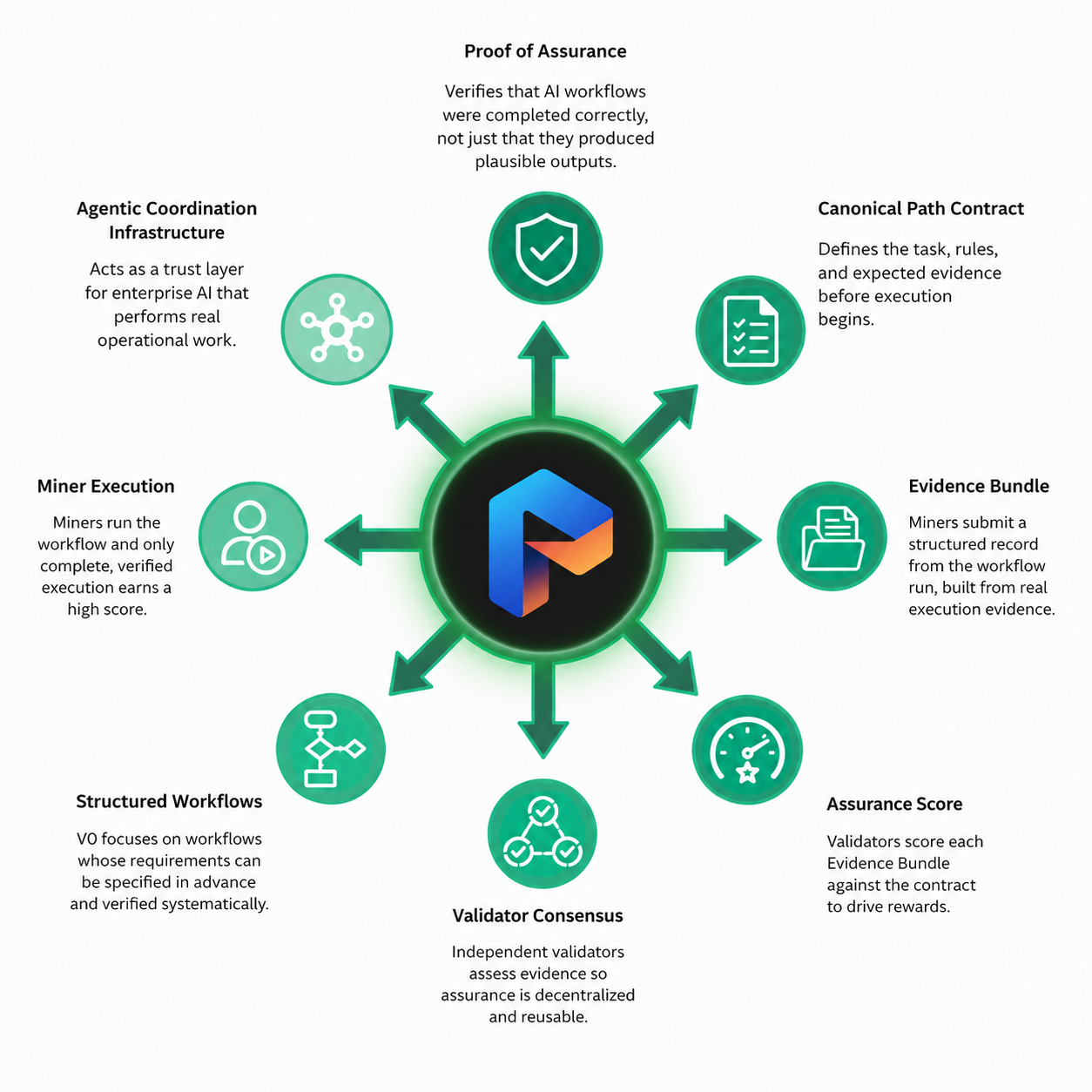
The product is Proof of Assurance — a Bittensor subnet protocol that makes agentic workflow execution verifiable and rewardable. At the enterprise level it closes the audit gap that opens whenever an AI agent is handed a real task: rather than trusting a model’s self-reported output, a customer receives a cryptographically-grounded Evidence Bundle that validators have scored against a predefined Canonical Path Contract. The result is an assurance artefact — evidence that the work happened, in the right sequence, meeting the defined criteria.
The platform’s target customers are two-sided. On the enterprise side, these are organisations moving AI from assistants into workflows — sales pipelines, research processes, board reporting, compliance checks — where a plausible output is insufficient and verifiable execution is essential. On the subnet side, the customers are Bittensor subnet owners who need better primitives for evaluating miner work quality beyond simple output comparison. Proof of Assurance provides a shared protocol that serves both simultaneously.
Technically, Provenonce describes four coordination primitives that power the kernel: Canonical Path Contracts that encode structured workflows; five canonical behavioural identities (Sage, Logos, Minerva, Glyph, Phoenix) that govern how agents behave in predictable, versioned ways rather than improvising; tenant-scoped knowledge stores and credential vaults so agent capabilities are customised per customer without leaking across tenants; and the evidence and scoring infrastructure that closes the loop into Bittensor. This layered architecture means Provenonce can serve enterprise customers through a product interface while simultaneously publishing the verification layer as an open, incentive-aligned subnet.
Provenonce partnered with Bitstarter Ltd. to co-announce SN87 and is actively working with the Bittensor ecosystem to define the launch path for Proof of Assurance. The subnet currently runs 12 validators with miner onboarding underway, reflecting a careful approach to launch — building credibility and specification rigour before scaling out compute.
The subnet’s economic model is straightforward: TAO rewards flow to miners who produce high-scoring Evidence Bundles, as judged by independent validators. This alignment means economic incentives track genuine correctness rather than volume or superficial output quality — a significant departure from subnets where gaming the scoring function is easier than doing the actual work.
The product is Proof of Assurance — a Bittensor subnet protocol that makes agentic workflow execution verifiable and rewardable. At the enterprise level it closes the audit gap that opens whenever an AI agent is handed a real task: rather than trusting a model’s self-reported output, a customer receives a cryptographically-grounded Evidence Bundle that validators have scored against a predefined Canonical Path Contract. The result is an assurance artefact — evidence that the work happened, in the right sequence, meeting the defined criteria.
The platform’s target customers are two-sided. On the enterprise side, these are organisations moving AI from assistants into workflows — sales pipelines, research processes, board reporting, compliance checks — where a plausible output is insufficient and verifiable execution is essential. On the subnet side, the customers are Bittensor subnet owners who need better primitives for evaluating miner work quality beyond simple output comparison. Proof of Assurance provides a shared protocol that serves both simultaneously.
Technically, Provenonce describes four coordination primitives that power the kernel: Canonical Path Contracts that encode structured workflows; five canonical behavioural identities (Sage, Logos, Minerva, Glyph, Phoenix) that govern how agents behave in predictable, versioned ways rather than improvising; tenant-scoped knowledge stores and credential vaults so agent capabilities are customised per customer without leaking across tenants; and the evidence and scoring infrastructure that closes the loop into Bittensor. This layered architecture means Provenonce can serve enterprise customers through a product interface while simultaneously publishing the verification layer as an open, incentive-aligned subnet.
Provenonce partnered with Bitstarter Ltd. to co-announce SN87 and is actively working with the Bittensor ecosystem to define the launch path for Proof of Assurance. The subnet currently runs 12 validators with miner onboarding underway, reflecting a careful approach to launch — building credibility and specification rigour before scaling out compute.
The subnet’s economic model is straightforward: TAO rewards flow to miners who produce high-scoring Evidence Bundles, as judged by independent validators. This alignment means economic incentives track genuine correctness rather than volume or superficial output quality — a significant departure from subnets where gaming the scoring function is easier than doing the actual work.
Provenonce was founded by Will O’Brien, who serves as Founder and CEO. O’Brien brings one of the most directly relevant track records in crypto to this problem: he is the co-founder and former CEO of BitGo, the institutional digital asset custody platform that became the foundational trust layer for Bitcoin’s entry into institutional finance. He is also an LP and Senior Strategic Advisor to Blockchain Capital, one of the most established venture firms in the blockchain space. His career is defined by a recurring thesis — that trust layers unlock markets — first demonstrated at BitGo for custody, now being applied to AI execution via Provenonce.
O’Brien presented Proof of Assurance personally at Proof of Pitch during Proof of Talk in Paris in June 2026, taking the project to the finals and finishing runner-up in the live crowdfund with nearly 300 TAO pledged by the audience. This hands-on presence at a competitive Bittensor ecosystem event signals a founding team willing to put the concept in front of the community before the subnet is fully live. Provenonce is working with Bitstarter Ltd. as a strategic launch partner — Bitstarter co-announced SN87 and is collaborating on the right path to bring Proof of Assurance to production on Bittensor.
Beyond Will O’Brien, the broader Provenonce team has not been named publicly at this stage. The company operates a GitHub organisation at github.com/provenonce, with public repositories expected as the subnet matures toward its formal launch. Given the depth of the Proof of Assurance protocol — the Canonical Path Contract spec, Evidence Bundle schema, and Assurance Scoring system — a technically credible team is clearly at work behind the scenes, even if the company has chosen to keep the full roster private during the pre-launch phase.
Provenonce was founded by Will O’Brien, who serves as Founder and CEO. O’Brien brings one of the most directly relevant track records in crypto to this problem: he is the co-founder and former CEO of BitGo, the institutional digital asset custody platform that became the foundational trust layer for Bitcoin’s entry into institutional finance. He is also an LP and Senior Strategic Advisor to Blockchain Capital, one of the most established venture firms in the blockchain space. His career is defined by a recurring thesis — that trust layers unlock markets — first demonstrated at BitGo for custody, now being applied to AI execution via Provenonce.
O’Brien presented Proof of Assurance personally at Proof of Pitch during Proof of Talk in Paris in June 2026, taking the project to the finals and finishing runner-up in the live crowdfund with nearly 300 TAO pledged by the audience. This hands-on presence at a competitive Bittensor ecosystem event signals a founding team willing to put the concept in front of the community before the subnet is fully live. Provenonce is working with Bitstarter Ltd. as a strategic launch partner — Bitstarter co-announced SN87 and is collaborating on the right path to bring Proof of Assurance to production on Bittensor.
Beyond Will O’Brien, the broader Provenonce team has not been named publicly at this stage. The company operates a GitHub organisation at github.com/provenonce, with public repositories expected as the subnet matures toward its formal launch. Given the depth of the Proof of Assurance protocol — the Canonical Path Contract spec, Evidence Bundle schema, and Assurance Scoring system — a technically credible team is clearly at work behind the scenes, even if the company has chosen to keep the full roster private during the pre-launch phase.
Proof of Assurance is in active pre-launch on Bittensor SN87. The immediate priority following the Proof of Talk event in Paris (June 2026) is working through the launch path in collaboration with Bitstarter Ltd. and the broader Bittensor ecosystem. The subnet is registered and live — 12 validators are active — and the team is building toward full miner onboarding with the Canonical Path Contract and Evidence Bundle specifications in place. V0 is deliberately scoped to structured workflows where requirements can be specified in advance; this disciplined starting point is by design, ensuring the scoring infrastructure is robust before expanding to more complex agentic tasks.
Beyond V0, the Provenonce roadmap points toward making Proof of Assurance a general-purpose verification layer for the Bittensor network — a reusable, credibly neutral protocol that subnet owners across the ecosystem can draw on to strengthen their own work-verification primitives. Provenonce has signalled plans to expand the canonical workflow library (Canonical Path Contracts for discovery-pitch, lead-meeting, big-board scenarios and beyond), grow the set of governed agent identities (Sage, Logos, Minerva, Glyph, Phoenix), and evolve the tenant-scoped knowledge and credential infrastructure that makes the platform enterprise-deployable. The company’s stated thesis is that verification needs to live in a protocol, not behind a brand — and that as that protocol matures, it can be applied progressively to more complex classes of agentic work.
Proof of Assurance is in active pre-launch on Bittensor SN87. The immediate priority following the Proof of Talk event in Paris (June 2026) is working through the launch path in collaboration with Bitstarter Ltd. and the broader Bittensor ecosystem. The subnet is registered and live — 12 validators are active — and the team is building toward full miner onboarding with the Canonical Path Contract and Evidence Bundle specifications in place. V0 is deliberately scoped to structured workflows where requirements can be specified in advance; this disciplined starting point is by design, ensuring the scoring infrastructure is robust before expanding to more complex agentic tasks.
Beyond V0, the Provenonce roadmap points toward making Proof of Assurance a general-purpose verification layer for the Bittensor network — a reusable, credibly neutral protocol that subnet owners across the ecosystem can draw on to strengthen their own work-verification primitives. Provenonce has signalled plans to expand the canonical workflow library (Canonical Path Contracts for discovery-pitch, lead-meeting, big-board scenarios and beyond), grow the set of governed agent identities (Sage, Logos, Minerva, Glyph, Phoenix), and evolve the tenant-scoped knowledge and credential infrastructure that makes the platform enterprise-deployable. The company’s stated thesis is that verification needs to live in a protocol, not behind a brand — and that as that protocol matures, it can be applied progressively to more complex classes of agentic work.