
With the amount of new subnets being added it can be hard to get up to date information across all subnets, so data may be slightly out of date from time to time
What exactly does it do? Platform is a specialized subnet on the Bittensor blockchain designed to drive collaborative AI research through parallel challenges. In practice, it hosts multiple simultaneous AI “challenge” tasks on the network, where participating miners can compete and cooperate on diverse AI problems. As described in the official repository, “Platform is a Bittensor subnet built to advance collaborative AI research through multiple simultaneous challenges powered by sub-subnet technology”. In other words, it creates isolated sub-networks (sub-subnets) for each challenge, enabling secure, confidential execution and transparent evaluation of AI tasks across the network. This structure ensures that miners collectively pursue the most efficient and innovative solutions to each challenge while maintaining data privacy.
Platform leverages Bittensor’s dynamic subnet model to enable multiple concurrent AI training/evaluation tasks. It orchestrates secure, trust-minimized AI competitions on-chain, advancing decentralized machine learning research.
What exactly does it do? Platform is a specialized subnet on the Bittensor blockchain designed to drive collaborative AI research through parallel challenges. In practice, it hosts multiple simultaneous AI “challenge” tasks on the network, where participating miners can compete and cooperate on diverse AI problems. As described in the official repository, “Platform is a Bittensor subnet built to advance collaborative AI research through multiple simultaneous challenges powered by sub-subnet technology”. In other words, it creates isolated sub-networks (sub-subnets) for each challenge, enabling secure, confidential execution and transparent evaluation of AI tasks across the network. This structure ensures that miners collectively pursue the most efficient and innovative solutions to each challenge while maintaining data privacy.
Platform leverages Bittensor’s dynamic subnet model to enable multiple concurrent AI training/evaluation tasks. It orchestrates secure, trust-minimized AI competitions on-chain, advancing decentralized machine learning research.
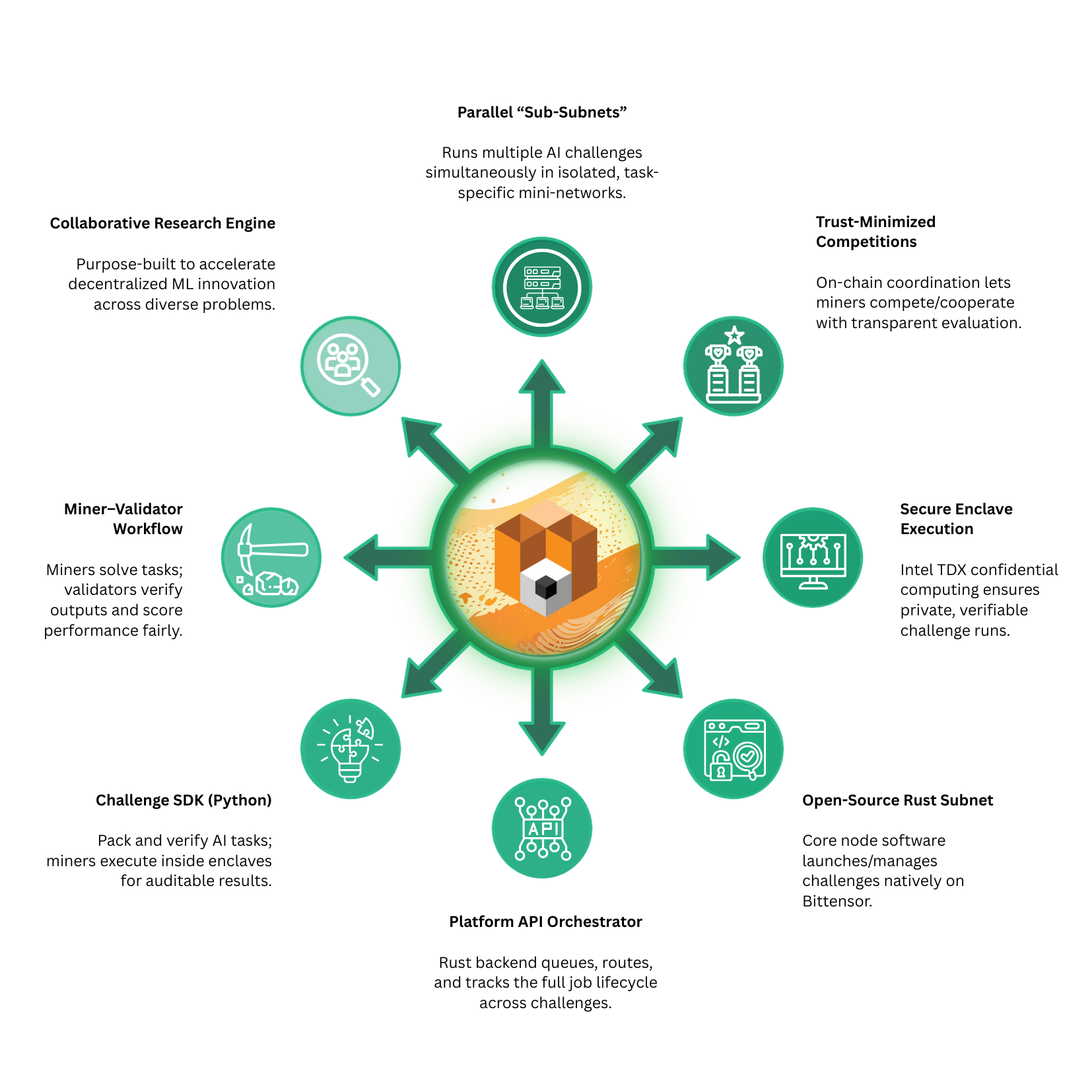
The Platform project consists of several open-source components that together implement this subnet:
Platform Subnet (Rust): The core Bittensor subnet software (written in Rust) that miners run. This implements the logic for launching and managing parallel challenge tasks on-chain. (See the GitHub README: “Platform is a Bittensor subnet built to advance collaborative AI research through multiple simultaneous challenges…”.)
Platform API (Rust): An open-source orchestration layer (platform-api) serving as the central coordination hub for SN100. It exposes api.platform.network and manages the full lifecycle of jobs across sub-subnets – from submission to validation – ensuring transparent execution and communication between miners and validators. Essentially, this backend service queues and routes challenge jobs, collects results, and maintains network state.
Challenge SDK (Python): A trustless confidential computing framework (challenge repo) for the Platform network, built with Intel TDX (Trusted Domain Extensions). This SDK enables secure enclave execution of AI evaluation jobs. In practice, a challenge creator can package an AI task, and miners will run it inside hardware enclaves; the SDK ensures results are verifiable and confidential.
All of these components are published under the Cortex Foundation’s GitHub (CortexLM) and are designed to interoperate: the Rust-based Subnet code and API for on-chain coordination, plus the Python SDK for off-chain secure computations. (See each repo’s description for details.)
The Platform project consists of several open-source components that together implement this subnet:
Platform Subnet (Rust): The core Bittensor subnet software (written in Rust) that miners run. This implements the logic for launching and managing parallel challenge tasks on-chain. (See the GitHub README: “Platform is a Bittensor subnet built to advance collaborative AI research through multiple simultaneous challenges…”.)
Platform API (Rust): An open-source orchestration layer (platform-api) serving as the central coordination hub for SN100. It exposes api.platform.network and manages the full lifecycle of jobs across sub-subnets – from submission to validation – ensuring transparent execution and communication between miners and validators. Essentially, this backend service queues and routes challenge jobs, collects results, and maintains network state.
Challenge SDK (Python): A trustless confidential computing framework (challenge repo) for the Platform network, built with Intel TDX (Trusted Domain Extensions). This SDK enables secure enclave execution of AI evaluation jobs. In practice, a challenge creator can package an AI task, and miners will run it inside hardware enclaves; the SDK ensures results are verifiable and confidential.
All of these components are published under the Cortex Foundation’s GitHub (CortexLM) and are designed to interoperate: the Rust-based Subnet code and API for on-chain coordination, plus the Python SDK for off-chain secure computations. (See each repo’s description for details.)
Platform was developed by the Cortex Foundation (GitHub org CortexLM), a team focused on building tools for Bittensor and decentralized AI. The GitHub repositories show that Platform was authored by the Cortex Foundation team. Key contributors listed on the Platform repo include GitHub users “Echo” (EchoBT) and “alpha1122x”.
Organization: Cortex Foundation (CortexLM) – a technology team dedicated to advancing decentralized AI and Bittensor tools.
Contributors: Active developers on the Platform project (per GitHub) include the user “Echo” (EchoBT) and “alpha1122x”. (No personal names are publicly listed; these appear to be the handles of core developers.)
No additional team members or advisors are explicitly documented. (The Cortex Foundation’s public profiles emphasize their role in supporting Bittensor development, but do not list all developers by name.)
Platform was developed by the Cortex Foundation (GitHub org CortexLM), a team focused on building tools for Bittensor and decentralized AI. The GitHub repositories show that Platform was authored by the Cortex Foundation team. Key contributors listed on the Platform repo include GitHub users “Echo” (EchoBT) and “alpha1122x”.
Organization: Cortex Foundation (CortexLM) – a technology team dedicated to advancing decentralized AI and Bittensor tools.
Contributors: Active developers on the Platform project (per GitHub) include the user “Echo” (EchoBT) and “alpha1122x”. (No personal names are publicly listed; these appear to be the handles of core developers.)
No additional team members or advisors are explicitly documented. (The Cortex Foundation’s public profiles emphasize their role in supporting Bittensor development, but do not list all developers by name.)
As of late 2025, no formal public roadmap has been published for Platform. The project appears to be in early development, with initial code releases in November 2025. For example, all three key repos (Platform, Platform-API, Challenge SDK) show first commits or updates dated Nov 3, 2025. This suggests the team has only just launched the codebases.
Initial launch (Nov 2025): Core code for the Subnet, API, and SDK was published around Nov 3, 2025.
Future plans: No detailed timeline or feature list is publicly available. Presumably, upcoming work will involve completing the Platform API, deploying the subnet on testnet/mainnet, and building user interfaces, but these are not yet documented.
As of late 2025, no formal public roadmap has been published for Platform. The project appears to be in early development, with initial code releases in November 2025. For example, all three key repos (Platform, Platform-API, Challenge SDK) show first commits or updates dated Nov 3, 2025. This suggests the team has only just launched the codebases.
Initial launch (Nov 2025): Core code for the Subnet, API, and SDK was published around Nov 3, 2025.
Future plans: No detailed timeline or feature list is publicly available. Presumably, upcoming work will involve completing the Platform API, deploying the subnet on testnet/mainnet, and building user interfaces, but these are not yet documented.