
With the amount of new subnets being added it can be hard to get up to date information across all subnets, so data may be slightly out of date from time to time
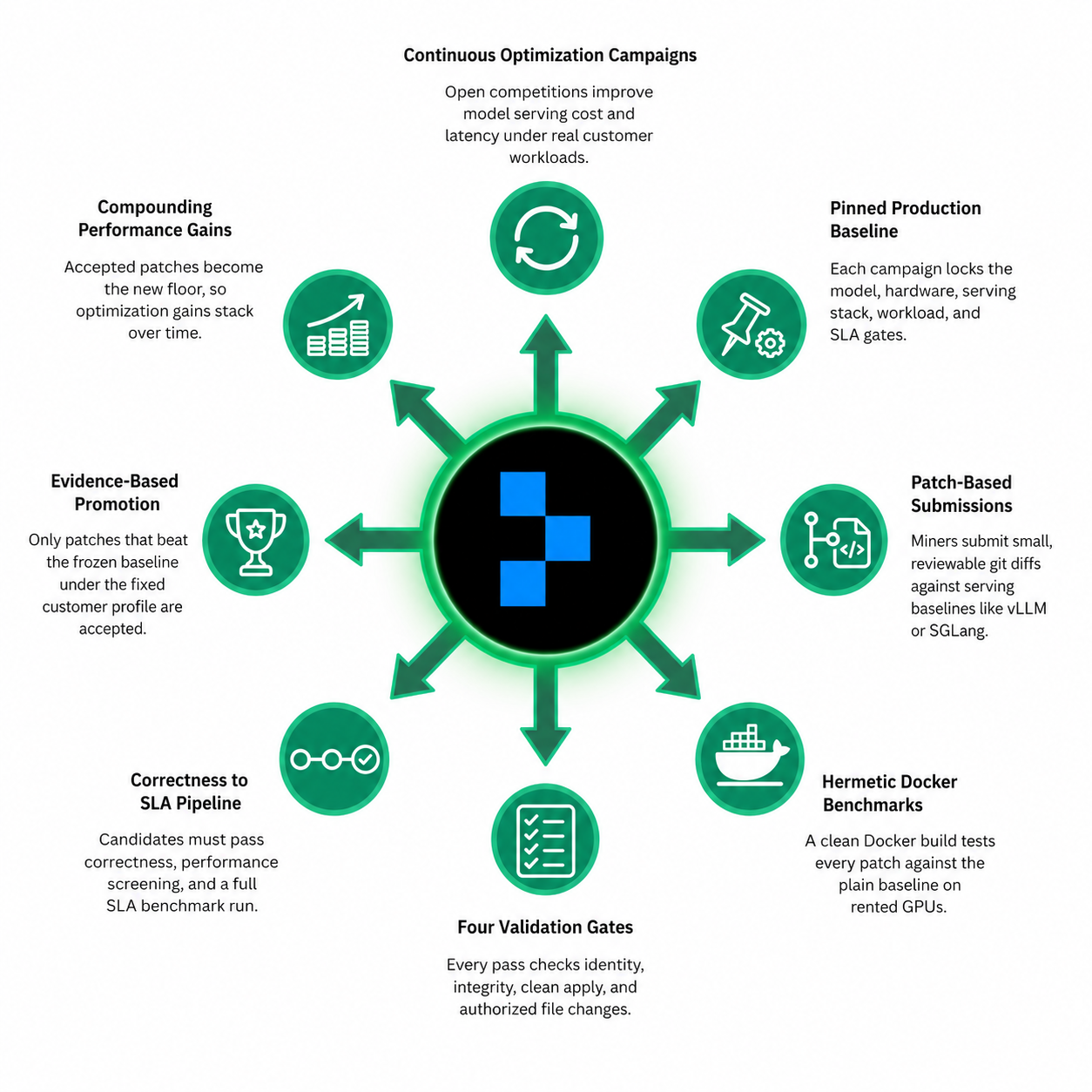
Pareton (Bittensor Subnet 10) runs continuous inference-optimization campaigns. Models are converging in quality; cost and latency are where teams still win or lose. Pareton turns that problem into an open competition: miners submit small, reviewable git patches against a pinned serving baseline (vLLM, SGLang, etc.), and Pareton only keeps changes that beat the baseline under a frozen customer profile.
Each campaign locks the production setup before submissions open: model and revision, hardware SKU, serving config, workload, and the SLA gates the customer will not break. One success metric sets the goal, usually GPU-hours saved at SLA. Miners do not invent their own bench. They compete on that fixed yardstick.
A submission is one unified git diff. Pareton’s worker picks up the commitment, checks integrity and path allowlists, builds a hermetic Docker image with the patch applied, and benches the candidate against the plain baseline on rented GPUs: correctness first, then a performance screen, then a full SLA run on the same workload. Each validation pass applies four gates: identity verification (patch signed by contributor), integrity check (hash matches), base-apply (patch cleanly applies to baseline), and surface check (no unauthorized file changes). Promote on evidence, or reject and move on.
Accepted patches become the new floor, so gains compound instead of expiring. Research into the platform has surfaced example metrics from early campaigns: a candidate patch reduced GPU-hours by 7%, increased throughput by 8%, and shaved 30 ms off p99 time-to-first-token under fixed SLA gates — illustrating how incremental patches add up to meaningful savings over time.
That is the product in one sentence: a closed-loop search over real serving engines, scored against real customer SLAs, with the baseline only moving forward.
Pareton (Bittensor Subnet 10) runs continuous inference-optimization campaigns. Models are converging in quality; cost and latency are where teams still win or lose. Pareton turns that problem into an open competition: miners submit small, reviewable git patches against a pinned serving baseline (vLLM, SGLang, etc.), and Pareton only keeps changes that beat the baseline under a frozen customer profile.
Each campaign locks the production setup before submissions open: model and revision, hardware SKU, serving config, workload, and the SLA gates the customer will not break. One success metric sets the goal, usually GPU-hours saved at SLA. Miners do not invent their own bench. They compete on that fixed yardstick.
A submission is one unified git diff. Pareton’s worker picks up the commitment, checks integrity and path allowlists, builds a hermetic Docker image with the patch applied, and benches the candidate against the plain baseline on rented GPUs: correctness first, then a performance screen, then a full SLA run on the same workload. Each validation pass applies four gates: identity verification (patch signed by contributor), integrity check (hash matches), base-apply (patch cleanly applies to baseline), and surface check (no unauthorized file changes). Promote on evidence, or reject and move on.
Accepted patches become the new floor, so gains compound instead of expiring. Research into the platform has surfaced example metrics from early campaigns: a candidate patch reduced GPU-hours by 7%, increased throughput by 8%, and shaved 30 ms off p99 time-to-first-token under fixed SLA gates — illustrating how incremental patches add up to meaningful savings over time.
That is the product in one sentence: a closed-loop search over real serving engines, scored against real customer SLAs, with the baseline only moving forward.
The business product is a continuous optimization service for production LLM inference. A customer (or partner) brings a real serving setup: model, hardware, stack, traffic shape, and the latency/quality gates they will not break. Pareton turns that into a live campaign. An open network of contributors then competes to find cheaper or faster configs that still clear those gates.
The customer gets a compounding baseline: each accepted change becomes the new floor, so GPU-hour savings and latency gains accumulate instead of sitting in a one-off eng sprint. The success metric is usually GPU-hours saved at SLA (or a close cousin like throughput under a p99 cap).
The commercial wedge is simple: inference is becoming most of AI spend, model quality is converging, and no small team can exhaust the search space of kernels, batching, caching, quantization, and scheduling by hand. Pareton productizes that search as shared infrastructure, with evidence attached to every promotion.
Pareton operates within Bittensor’s dynamic-TAO (dTAO) framework, which ties a subnet’s token value to TAO liquidity. This means emission rewards have real economic value and token price movements reflect growing demand for optimized inference capacity. The result is a tight alignment between on-chain incentives and off-chain compute savings — miners are rewarded in proportion to the GPU-hours they actually save for customers.
The business product is a continuous optimization service for production LLM inference. A customer (or partner) brings a real serving setup: model, hardware, stack, traffic shape, and the latency/quality gates they will not break. Pareton turns that into a live campaign. An open network of contributors then competes to find cheaper or faster configs that still clear those gates.
The customer gets a compounding baseline: each accepted change becomes the new floor, so GPU-hour savings and latency gains accumulate instead of sitting in a one-off eng sprint. The success metric is usually GPU-hours saved at SLA (or a close cousin like throughput under a p99 cap).
The commercial wedge is simple: inference is becoming most of AI spend, model quality is converging, and no small team can exhaust the search space of kernels, batching, caching, quantization, and scheduling by hand. Pareton productizes that search as shared infrastructure, with evidence attached to every promotion.
Pareton operates within Bittensor’s dynamic-TAO (dTAO) framework, which ties a subnet’s token value to TAO liquidity. This means emission rewards have real economic value and token price movements reflect growing demand for optimized inference capacity. The result is a tight alignment between on-chain incentives and off-chain compute savings — miners are rewarded in proportion to the GPU-hours they actually save for customers.
Xavier Lyu, Founder: Xavier was previously a Research Engineer at the Opentensor Foundation and co-designed aspects of Bittensor’s dTAO mechanism. Before that he was at Pantera Capital for 2.5 years. He initially joined as a Quantitative Developer working on data pipelines and ML ops and later transitioned to a fundamental investment analyst at the same hedge fund. He also interned on DeFi data engineering at Coinbase. He holds a B.S. in Computer Science from Cornell University.
The core Pareton GitHub repository reflects an active engineering team, with hundreds of commits across the campaigns engine, hermetic builder, gate/validation system, bench infrastructure, and GPU orchestration layer. The project also maintains a forked vLLM inference engine and a Next.js frontend powering the public dashboard and documentation site.
Xavier Lyu, Founder: Xavier was previously a Research Engineer at the Opentensor Foundation and co-designed aspects of Bittensor’s dTAO mechanism. Before that he was at Pantera Capital for 2.5 years. He initially joined as a Quantitative Developer working on data pipelines and ML ops and later transitioned to a fundamental investment analyst at the same hedge fund. He also interned on DeFi data engineering at Coinbase. He holds a B.S. in Computer Science from Cornell University.
The core Pareton GitHub repository reflects an active engineering team, with hundreds of commits across the campaigns engine, hermetic builder, gate/validation system, bench infrastructure, and GPU orchestration layer. The project also maintains a forked vLLM inference engine and a Next.js frontend powering the public dashboard and documentation site.
Pareton is in active development, with its core campaign engine, hermetic build system, and benchmarking infrastructure already under construction on GitHub. The team is focused on bringing on-chain scoring to maturity, launching the public campaigns dashboard, and onboarding the first enterprise pilot customers with real production inference profiles.
Near-term milestones include the public availability of the documentation site at pareton.ai/docs, full activation of the live campaign dashboard, and expanded GPU orchestration support for a wider range of hardware SKUs. As the platform matures, Pareton aims to grow the miner network and widen campaign coverage to additional serving frameworks beyond vLLM and SGLang. More details on formal roadmap stages will be published as the project moves from alpha toward broader availability.
Pareton is in active development, with its core campaign engine, hermetic build system, and benchmarking infrastructure already under construction on GitHub. The team is focused on bringing on-chain scoring to maturity, launching the public campaigns dashboard, and onboarding the first enterprise pilot customers with real production inference profiles.
Near-term milestones include the public availability of the documentation site at pareton.ai/docs, full activation of the live campaign dashboard, and expanded GPU orchestration support for a wider range of hardware SKUs. As the platform matures, Pareton aims to grow the miner network and widen campaign coverage to additional serving frameworks beyond vLLM and SGLang. More details on formal roadmap stages will be published as the project moves from alpha toward broader availability.