
With the amount of new subnets being added it can be hard to get up to date information across all subnets, so data may be slightly out of date from time to time
What is NIOME and the Problem It Solves
NIOME is a decentralized AI subnet (Subnet 55) on the Bittensor network that generates high-fidelity synthetic genomic data for precision medicine research. By replacing real human genomes with statistically accurate synthetic profiles, NIOME addresses the critical data bottleneck in pharmaceutical and biomedical research, where access to large, diverse genomic datasets is restricted by privacy regulations, consent requirements, and breach risks
Subnet Architecture and Learning Loop
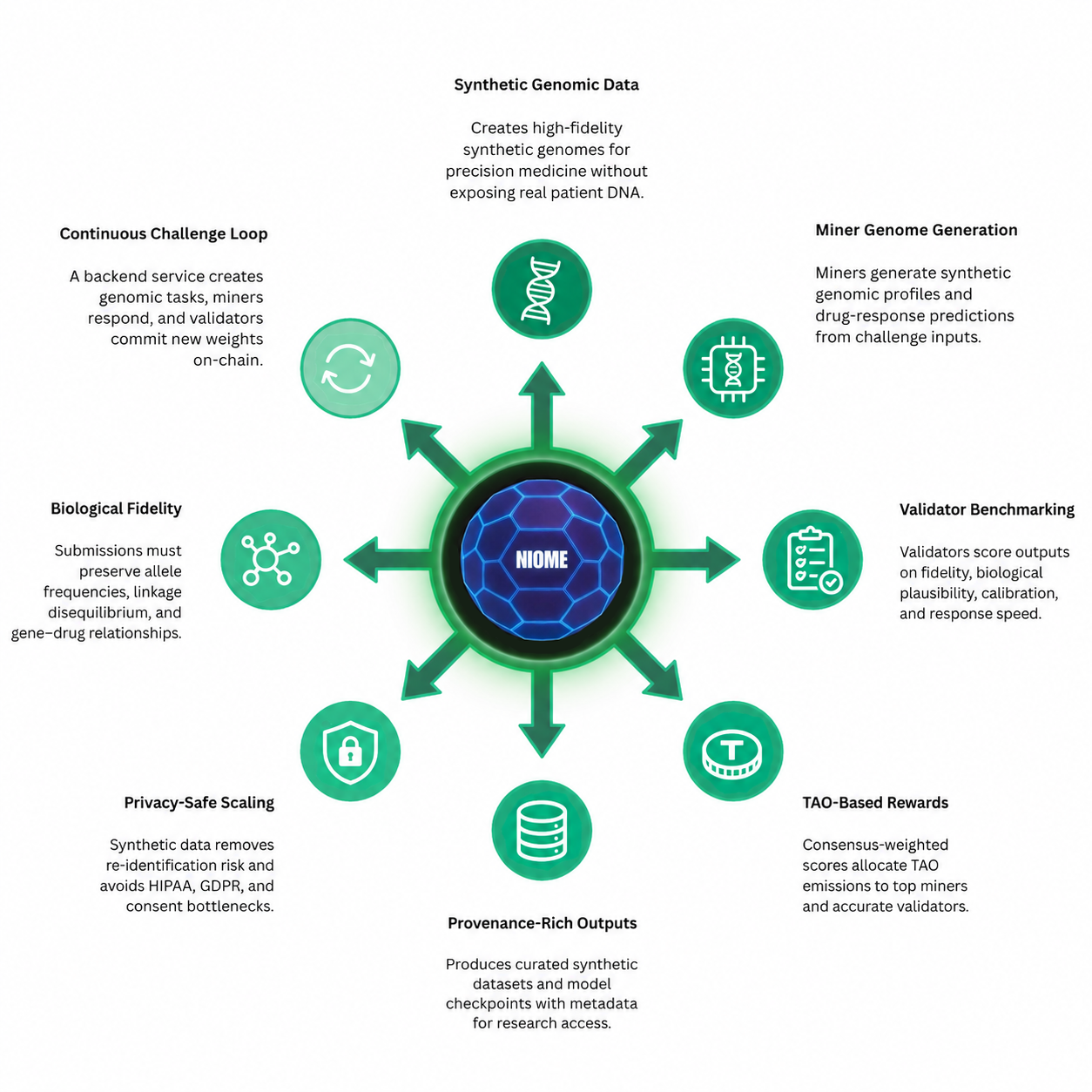
NIOME implements a continuous challenge-response loop on Bittensor: a backend service produces synthetic genomic simulation tasks, validators fetch and broadcast these tasks to miners, miners run generative models to produce synthetic genomes or drug-response predictions, and validators evaluate outputs against held-out benchmarks using statistical fidelity and biological plausibility metrics. Validators then commit weight updates to the Bittensor blockchain, and the network’s consensus mechanism translates these weight vectors into token emissions for both miners and validators
Role of Miners
Miners in NIOME run advanced AI models to generate synthetic genomic profiles or pharmacogenomic predictions based on challenge inputs (e.g., variant frequencies, drug contexts, covariates). Each miner submission must preserve key biological patterns such as allele frequencies, linkage disequilibrium, and gene–drug response relationships while ensuring no individual’s actual DNA is reproduced. Successful miners return probability vectors or genome feature objects to validators for scoring
Role of Validators
Validators synthesize genomic challenges using a reproducible pipeline (population sampling, correlated variant operators, phenotype mapping via reference simulators, noise injection) and score miner outputs using loss functions (e.g., cross-entropy with calibration and latency penalties). Validator scores are tracked via exponential moving averages to stabilize updates, and periodic weight submissions drive the on-chain consensus that allocates emissions. Validators may also enforce anti-gaming measures like random task perturbations and consensus-weighted validation to maintain subnet integrity
Value Production
The end products of NIOME’s subnet are (1) continuously curated synthetic genomic datasets with comprehensive provenance metadata, and (2) performance-weighted model weight vectors that can seed foundation models for genomic intelligence. Researchers and pharmaceutical clients can query validator gateways or stake tokens to access dataset tiers and model checkpoints, enabling large-scale drug response modeling and personalized medicine studies without real patient data exposure
Incentive Mechanism and Rewards
NIOME incentives are denominated in TAO tokens. Emissions are distributed proportionally to consensus-aggregated validator weights: high-quality miner submissions yield greater weight contributions, and validators earn rewards for accurate scoring and anti-gaming enforcement. Optionally, NIOME supports parallel incentive channels (e.g., accuracy vs. calibration) for nuanced token allocation
Comparison to Centralized Alternatives
Unlike centralized genomic databases (e.g., 23andMe) which are constrained by IRB approvals, consent management, and breach liabilities, NIOME’s synthetic data approach incurs zero re-identification risk, bypasses regulatory overhead (GDPR, HIPAA), and enables rapid, unlimited scaling. This decentralized, token-incentivized framework democratizes genomic AI research and aligns participant incentives directly with performance rather than data custody
What is NIOME and the Problem It Solves
NIOME is a decentralized AI subnet (Subnet 55) on the Bittensor network that generates high-fidelity synthetic genomic data for precision medicine research. By replacing real human genomes with statistically accurate synthetic profiles, NIOME addresses the critical data bottleneck in pharmaceutical and biomedical research, where access to large, diverse genomic datasets is restricted by privacy regulations, consent requirements, and breach risks
Subnet Architecture and Learning Loop
NIOME implements a continuous challenge-response loop on Bittensor: a backend service produces synthetic genomic simulation tasks, validators fetch and broadcast these tasks to miners, miners run generative models to produce synthetic genomes or drug-response predictions, and validators evaluate outputs against held-out benchmarks using statistical fidelity and biological plausibility metrics. Validators then commit weight updates to the Bittensor blockchain, and the network’s consensus mechanism translates these weight vectors into token emissions for both miners and validators
Role of Miners
Miners in NIOME run advanced AI models to generate synthetic genomic profiles or pharmacogenomic predictions based on challenge inputs (e.g., variant frequencies, drug contexts, covariates). Each miner submission must preserve key biological patterns such as allele frequencies, linkage disequilibrium, and gene–drug response relationships while ensuring no individual’s actual DNA is reproduced. Successful miners return probability vectors or genome feature objects to validators for scoring
Role of Validators
Validators synthesize genomic challenges using a reproducible pipeline (population sampling, correlated variant operators, phenotype mapping via reference simulators, noise injection) and score miner outputs using loss functions (e.g., cross-entropy with calibration and latency penalties). Validator scores are tracked via exponential moving averages to stabilize updates, and periodic weight submissions drive the on-chain consensus that allocates emissions. Validators may also enforce anti-gaming measures like random task perturbations and consensus-weighted validation to maintain subnet integrity
Value Production
The end products of NIOME’s subnet are (1) continuously curated synthetic genomic datasets with comprehensive provenance metadata, and (2) performance-weighted model weight vectors that can seed foundation models for genomic intelligence. Researchers and pharmaceutical clients can query validator gateways or stake tokens to access dataset tiers and model checkpoints, enabling large-scale drug response modeling and personalized medicine studies without real patient data exposure
Incentive Mechanism and Rewards
NIOME incentives are denominated in TAO tokens. Emissions are distributed proportionally to consensus-aggregated validator weights: high-quality miner submissions yield greater weight contributions, and validators earn rewards for accurate scoring and anti-gaming enforcement. Optionally, NIOME supports parallel incentive channels (e.g., accuracy vs. calibration) for nuanced token allocation
Comparison to Centralized Alternatives
Unlike centralized genomic databases (e.g., 23andMe) which are constrained by IRB approvals, consent management, and breach liabilities, NIOME’s synthetic data approach incurs zero re-identification risk, bypasses regulatory overhead (GDPR, HIPAA), and enables rapid, unlimited scaling. This decentralized, token-incentivized framework democratizes genomic AI research and aligns participant incentives directly with performance rather than data custody
Current Status and Roadmap Milestones
NIOME’s public testnet launched in Q1 2026, and documentation for miner and validator setup is available via the GitHub repository and the NIOME site. Mainnet staking and alpha emissions for Subnet 55 are live on Bittensor, with additional features (e.g., multi-task objectives, privacy audits) under active development
Technical Architecture
The NIOME subnet architecture comprises a backend challenge generation service, validator nodes implementing synthetic data pipelines and scoring functions, miner clients running generative models, and Bittensor-coordinated on-chain consensus. The repository’s docs/ folder contains task schemas and guides, neurons/ houses core client implementations, and scripts/ automates deployment and CI workflows
GitHub Repository Structure
The public repository (github.com/genomesio/subnet-niome) features 54 commits, 1 star, and 2 watchers under an MIT license (Opentensor Foundation). Key directories include:
• .circleci and .github for CI configurations
• docs/ for whitepaper and guides
• neurons/ for miner and validator code
• niome_subnet/ for subnet definitions
• scripts/ for environment setup
• tests/ and verify/ for QA modules
The codebase is 94.7% Python and 5.3% Shell
Project Metrics and Alpha Emissions
Backprop Finance reports NIOME trading at ~0.0041 TAO per alpha token (~$0.73), with a fully diluted valuation of $15.4 million, market cap $3.02 million, circulating supply 4.12 million alpha tokens, and liquidity of 1.75 million alpha / 7.13k TAO. Taostats indicates a serving rate limit of 50 tasks per epoch and displays distribution competitiveness via miner incentive curves
Validator Scoring Mechanism
Validators compute a per-challenge loss (e.g., cross-entropy combined with latency penalties) and aggregate scores using exponential moving averages. Weight vectors are submitted on-chain and merged by Bittensor’s consensus engine, yielding dynamic emissions allocation that penalizes validators diverging from consensus to maintain subnet integrity
APIs, SDKs, and Integration
NIOME provides a RESTful API for customised cohort requests (VCF, PLINK, custom formats). Developers can access real-time subnet and staking data via the Taostats API (dash.taostats.io/subnets/55) or use the Bittensor CLI (btcli) to list subnets, stake TAO, and monitor miner/validator performance programmatically
Current Status and Roadmap Milestones
NIOME’s public testnet launched in Q1 2026, and documentation for miner and validator setup is available via the GitHub repository and the NIOME site. Mainnet staking and alpha emissions for Subnet 55 are live on Bittensor, with additional features (e.g., multi-task objectives, privacy audits) under active development
Technical Architecture
The NIOME subnet architecture comprises a backend challenge generation service, validator nodes implementing synthetic data pipelines and scoring functions, miner clients running generative models, and Bittensor-coordinated on-chain consensus. The repository’s docs/ folder contains task schemas and guides, neurons/ houses core client implementations, and scripts/ automates deployment and CI workflows
GitHub Repository Structure
The public repository (github.com/genomesio/subnet-niome) features 54 commits, 1 star, and 2 watchers under an MIT license (Opentensor Foundation). Key directories include:
• .circleci and .github for CI configurations
• docs/ for whitepaper and guides
• neurons/ for miner and validator code
• niome_subnet/ for subnet definitions
• scripts/ for environment setup
• tests/ and verify/ for QA modules
The codebase is 94.7% Python and 5.3% Shell
Project Metrics and Alpha Emissions
Backprop Finance reports NIOME trading at ~0.0041 TAO per alpha token (~$0.73), with a fully diluted valuation of $15.4 million, market cap $3.02 million, circulating supply 4.12 million alpha tokens, and liquidity of 1.75 million alpha / 7.13k TAO. Taostats indicates a serving rate limit of 50 tasks per epoch and displays distribution competitiveness via miner incentive curves
Validator Scoring Mechanism
Validators compute a per-challenge loss (e.g., cross-entropy combined with latency penalties) and aggregate scores using exponential moving averages. Weight vectors are submitted on-chain and merged by Bittensor’s consensus engine, yielding dynamic emissions allocation that penalizes validators diverging from consensus to maintain subnet integrity
APIs, SDKs, and Integration
NIOME provides a RESTful API for customised cohort requests (VCF, PLINK, custom formats). Developers can access real-time subnet and staking data via the Taostats API (dash.taostats.io/subnets/55) or use the Bittensor CLI (btcli) to list subnets, stake TAO, and monitor miner/validator performance programmatically
Core Development and Maintainers
NIOME is developed by Genomes.io, a DeSci infrastructure platform founded by Aldo de Pape (CEO), focusing on decentralized genomic data monetization. Genomes.io joined the Bittensor ecosystem in early 2025 and authors the primary subnet code under the Opentensor Foundation’s MIT license
Yuma Accelerator and Strategic Partners
The subnet is incubated by YumaGroup, a Bittensor subnet accelerator led by Evan Malanga (CRO). Yuma announced NIOME’s integration into its accelerator in January 2026 and provides technical, operational, and community support via its X account @YumaGroup
Community Contributors and Backers
The GitHub repository lists contributions by the Genomes.io engineering team and core Bittensor community developers. Subnet governance is overseen by the Opentensor Foundation, with backers including Digital Currency Group, General TAO Ventures, Pantera Capital, Modular Capital, AMD, and Consensys Tachyon as highlighted on the NIOME site
Public Identity and Engagement
GenomesDAO’s X account (@GenomesDAO) has over 21k followers, 12k tweets, and joined in October 2016. The Telegram group (genomesdotio) hosts 2.2k+ members, and the subnet maintains an active Discord community at discord.com/invite/2r79NxbxMk and a project blog at blog.genomes.io
Collaborations and Interviews
NIOME has been featured in YumaGroup webinars and developer interviews on subnet design and Bittensor incentives. Advocates like Jeff Schvey (@jeff_schvey) and Barry Silbert (@BarrySilbert) have publicly endorsed NIOME as a leading genomic AI subnet
Core Development and Maintainers
NIOME is developed by Genomes.io, a DeSci infrastructure platform founded by Aldo de Pape (CEO), focusing on decentralized genomic data monetization. Genomes.io joined the Bittensor ecosystem in early 2025 and authors the primary subnet code under the Opentensor Foundation’s MIT license
Yuma Accelerator and Strategic Partners
The subnet is incubated by YumaGroup, a Bittensor subnet accelerator led by Evan Malanga (CRO). Yuma announced NIOME’s integration into its accelerator in January 2026 and provides technical, operational, and community support via its X account @YumaGroup
Community Contributors and Backers
The GitHub repository lists contributions by the Genomes.io engineering team and core Bittensor community developers. Subnet governance is overseen by the Opentensor Foundation, with backers including Digital Currency Group, General TAO Ventures, Pantera Capital, Modular Capital, AMD, and Consensys Tachyon as highlighted on the NIOME site
Public Identity and Engagement
GenomesDAO’s X account (@GenomesDAO) has over 21k followers, 12k tweets, and joined in October 2016. The Telegram group (genomesdotio) hosts 2.2k+ members, and the subnet maintains an active Discord community at discord.com/invite/2r79NxbxMk and a project blog at blog.genomes.io
Collaborations and Interviews
NIOME has been featured in YumaGroup webinars and developer interviews on subnet design and Bittensor incentives. Advocates like Jeff Schvey (@jeff_schvey) and Barry Silbert (@BarrySilbert) have publicly endorsed NIOME as a leading genomic AI subnet
Testnet and Mainnet Launch
NIOME launched its public testnet in Q1 2026, with testnet access via waitlist. Mainnet alpha emissions for Subnet 55 went live shortly thereafter, enabling TAO staking to earn alpha tokens. This timeline is specified in the NIOME whitepaper v1.1 (February 2026) and on the official site
Phase 1: Pharmacogene Library Expansion
Completed milestones include the initial pharmacogene panel (CYP2D6, CYP2C9, CYP3A4/3A5, TPMT, SLCO1B1, DPYD) and the deployment of core challenge-response mechanics for single-gene drug response prediction, as delivered in early subnet epochs
Phase 2: Multi-Task Objectives and Richer Label Spaces
Under development are continuous dose-response simulations, time-to-event toxicity modeling, and multi-gene drug interactions to capture complex pharmacogenomic relationships. These features will roll out in staged epochs following governance votes
Phase 3: Privacy Audits and Community Modules
Upcoming items include membership-inference and overfitting detection audits on calibration data, publication of privacy risk reports, and integration of external public resources via reproducible mapping modules. Community-contributed simulator plugins will be validated and incorporated upon proposal approval
Phase 4: Emission Mechanism Evolution
Future enhancements will explore compatibility with dTao-driven emission allocation models and market-based subnet valuation, aligning with Bittensor’s BIT-0016 network cleanup to enable dynamic incentive mechanisms
Vision and Governance
The fully realized vision for NIOME is a self-reinforcing research commons: open competition for model quality, coupled with transparent curation of synthetic genomic datasets and foundation models. Governance through on-chain proposals, versioned benchmarks, and migration guides will ensure ongoing subnet integrity and comparability across upgrades
Testnet and Mainnet Launch
NIOME launched its public testnet in Q1 2026, with testnet access via waitlist. Mainnet alpha emissions for Subnet 55 went live shortly thereafter, enabling TAO staking to earn alpha tokens. This timeline is specified in the NIOME whitepaper v1.1 (February 2026) and on the official site
Phase 1: Pharmacogene Library Expansion
Completed milestones include the initial pharmacogene panel (CYP2D6, CYP2C9, CYP3A4/3A5, TPMT, SLCO1B1, DPYD) and the deployment of core challenge-response mechanics for single-gene drug response prediction, as delivered in early subnet epochs
Phase 2: Multi-Task Objectives and Richer Label Spaces
Under development are continuous dose-response simulations, time-to-event toxicity modeling, and multi-gene drug interactions to capture complex pharmacogenomic relationships. These features will roll out in staged epochs following governance votes
Phase 3: Privacy Audits and Community Modules
Upcoming items include membership-inference and overfitting detection audits on calibration data, publication of privacy risk reports, and integration of external public resources via reproducible mapping modules. Community-contributed simulator plugins will be validated and incorporated upon proposal approval
Phase 4: Emission Mechanism Evolution
Future enhancements will explore compatibility with dTao-driven emission allocation models and market-based subnet valuation, aligning with Bittensor’s BIT-0016 network cleanup to enable dynamic incentive mechanisms
Vision and Governance
The fully realized vision for NIOME is a self-reinforcing research commons: open competition for model quality, coupled with transparent curation of synthetic genomic datasets and foundation models. Governance through on-chain proposals, versioned benchmarks, and migration guides will ensure ongoing subnet integrity and comparability across upgrades
Novelty Search is great, but for most investors trying to understand Bittensor, the technical depth is a wall, not a bridge. If we’re going to attract investment into this ecosystem then we need more people to understand it! That’s why Siam Kidd and Mark Creaser from DSV Fund have launched Revenue Search, where they ask the simple questions that investors want to know the answers to.
In this Revenue Search recorded May 2026, the hosts sit down with Aldo from Subnet 55 (NIOME / “Neural Intelligence in Omics”)—a project tackling one of the messiest problems in biotech: how to make genomic/biodata usable for research and AI without turning it into a privacy and cybersecurity nightmare. Aldo walks through why the status quo is broken, pointing to repeated breaches and misuse across the industry (from direct-to-consumer testing firms to major institutions), and makes the case that “compliance” doesn’t equal “security” when hackers are actively targeting sensitive health data.