With the amount of new subnets being added it can be hard to get up to date information across all subnets, so data may be slightly out of date from time to time

Subnet 69

Herald

Alpha Price
Value
Market Cap
Value
Neurons
Value
Registration Cost
Value
TAO Liquidity
Value
Alpha in Pool
Value
Total Alpha Supply
Value
% Alpha Staked
Value

ABOUT

What exactly does it do?

Herald (Bittensor Subnet 69) is a verified media placement network that turns real press coverage into a verifiable on-chain commodity. Operating under the motto “Proof of Work, for Press,” Herald connects PR operators with companies that need earned media — and pays miners in subnet emissions only when coverage is proven to be live, editorial, indexed, and persistent. It is the first Bittensor subnet to bring public relations onto the blockchain, creating an immutable public ledger of verified placements.

The core mechanism operates in six stages: Brief, Commit, Publish, Claim, Verify, and Settle. An operator opens a coverage brief specifying the tier, topic, key messages, reward pool, and time window. Miners — PR professionals and outlet owners — read open briefs and commit their intent on-chain using a salted hash before the article even exists, preventing anyone from sniping claims after the fact. Once an article is placed and goes live, the miner reveals their commitment and claims the URL. Validators then run an automated, code-only oracle to verify the claim.

The verification oracle runs seven checks in sequence, cheapest-first with early-exit: commitment validity, outlet tier, URL liveness, real-news classification (not paid/sponsored), topic match, search-index inclusion, and 30-day persistence. Every score is rebuildable from saved evidence, ensuring full transparency and auditability. Rewards vest over 30 days; if the article is removed, remaining installments are clawed back and the miner’s hotkey is slashed.

Herald is built on three inviolable rules that underpin its integrity. First, journalists are never paid — rewards go to the miner who caused the article, not the newsroom that ran it. Second, paid content is always labelled as such — sponsored posts, press releases, and paid syndication are detected and never counted as real news. Third, the subnet owner’s own miners receive no advantage — they are scored identically to all other participants.

The subnet uses a tiered outlet registry, signed with ed25519, that sets scoring multipliers: Tier 1 national and global mastheads earn a full ×1.0 multiplier; Tier 2 trade and regional press earn ×0.6; Tier 3 niche and local titles earn ×0.2. Press releases, content farms, AI-generated news mills, and self-owned outlets are never scored as news — by design.

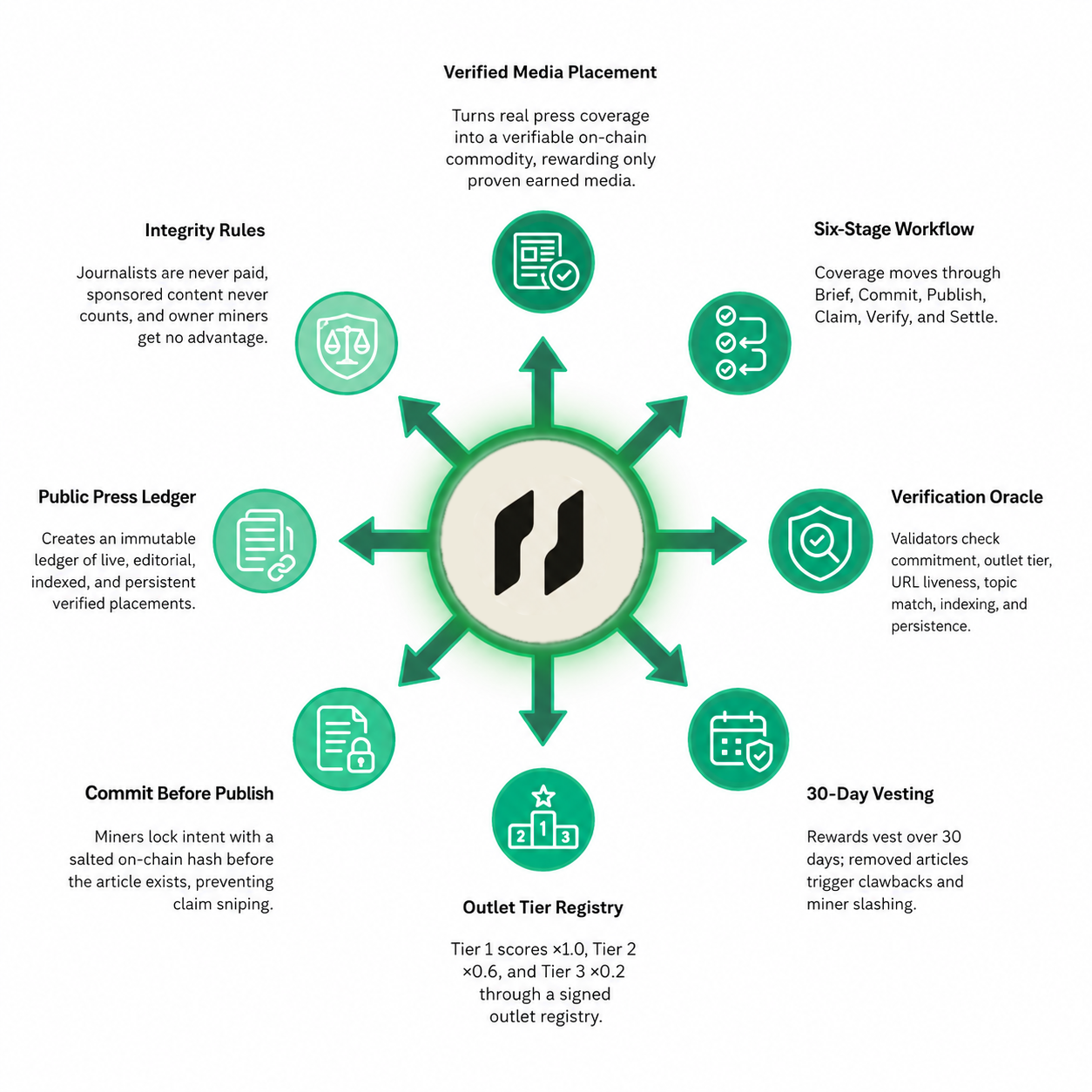
Herald (Bittensor Subnet 69) is a verified media placement network that turns real press coverage into a verifiable on-chain commodity. Operating under the motto “Proof of Work, for Press,” Herald connects PR operators with companies that need earned media — and pays miners in subnet emissions only when coverage is proven to be live, editorial, indexed, and persistent. It is the first Bittensor subnet to bring public relations onto the blockchain, creating an immutable public ledger of verified placements.

The core mechanism operates in six stages: Brief, Commit, Publish, Claim, Verify, and Settle. An operator opens a coverage brief specifying the tier, topic, key messages, reward pool, and time window. Miners — PR professionals and outlet owners — read open briefs and commit their intent on-chain using a salted hash before the article even exists, preventing anyone from sniping claims after the fact. Once an article is placed and goes live, the miner reveals their commitment and claims the URL. Validators then run an automated, code-only oracle to verify the claim.

The verification oracle runs seven checks in sequence, cheapest-first with early-exit: commitment validity, outlet tier, URL liveness, real-news classification (not paid/sponsored), topic match, search-index inclusion, and 30-day persistence. Every score is rebuildable from saved evidence, ensuring full transparency and auditability. Rewards vest over 30 days; if the article is removed, remaining installments are clawed back and the miner’s hotkey is slashed.

Herald is built on three inviolable rules that underpin its integrity. First, journalists are never paid — rewards go to the miner who caused the article, not the newsroom that ran it. Second, paid content is always labelled as such — sponsored posts, press releases, and paid syndication are detected and never counted as real news. Third, the subnet owner’s own miners receive no advantage — they are scored identically to all other participants.

The subnet uses a tiered outlet registry, signed with ed25519, that sets scoring multipliers: Tier 1 national and global mastheads earn a full ×1.0 multiplier; Tier 2 trade and regional press earn ×0.6; Tier 3 niche and local titles earn ×0.2. Press releases, content farms, AI-generated news mills, and self-owned outlets are never scored as news — by design.

PURPOSE

What exactly is the 'product/build'?

Herald is building a marketplace for verified, on-chain PR coverage with two distinct user groups: clients who need proven press placements, and miners (PR operators) who earn emissions by securing them. For clients, Herald offers a brief-based system where they specify the topic, target tier, key messages, and fund a reward pool upfront — paying only for verified, persistent coverage that is checked by code rather than trusted on faith. For miners, Herald turns existing PR expertise into on-chain income without requiring GPUs or servers (just 2–4 vCPU and 4–8 GB RAM), making it uniquely accessible relative to other Bittensor subnets that demand heavy compute.

The product architecture has several key components. The Brief Board is where open coverage briefs are listed with their reward pools, tier requirements, and time windows. The Commit-Reveal Attribution System ensures that only the PR operator who genuinely caused an article can claim the reward — a miner seals a salted hash of their intent on-chain before the article exists, and only that commitment can later claim the URL. The Verification Oracle (oracle.py) is the core engineering innovation: a code-only, automatic checker that runs seven sequential tests on every claimed article, with judgement checks running inside agreement bands so validator weights never diverge. The Outlet Registry is a signed, versioned list of approved outlets with their tiers, managed by an operator CLI and verified via ed25519 signature.

Two reward pools run simultaneously. Client briefs are funded directly by paying customers who want specific coverage. The standing brief runs continuously from subnet emissions, paying for general pro-Bittensor coverage whenever no client brief is active — this ensures the network stays live and miners always have work. Rewards are priced in USD, converted to validator weight, and distributed as subnet alpha tokens under Yuma consensus, with a 30-day vesting window that claws back installments if articles are removed.

The technical stack is built on the standard Bittensor neuron architecture, with Herald’s novel engineering concentrated in the validator’s news verification module. Key components in the open-source repository include: the oracle and its checks (real_news, topic_match, fetch, search), attribution and commit-index management, vesting and slashing logic, the outlet registry with admin tooling, and miner CLI tools for committing and claiming. Production deployments use a standalone herald-backend with hardened startup checks — the system fails closed on non-mainnet scope, unsigned registries, missing provider credentials, or consensus-fingerprint drift.

The subnet’s incentive structure is tightly aligned with the product goal: emissions flow only to earned, persistent, editorial coverage, making spam or low-quality submissions economically unviable. Registration burns (Bittensor’s standard non-refundable subnet burn) serve as the only admission cost — no additional per-claim bonds are required, keeping the barrier to entry proportional to genuine PR capability.

Herald is building a marketplace for verified, on-chain PR coverage with two distinct user groups: clients who need proven press placements, and miners (PR operators) who earn emissions by securing them. For clients, Herald offers a brief-based system where they specify the topic, target tier, key messages, and fund a reward pool upfront — paying only for verified, persistent coverage that is checked by code rather than trusted on faith. For miners, Herald turns existing PR expertise into on-chain income without requiring GPUs or servers (just 2–4 vCPU and 4–8 GB RAM), making it uniquely accessible relative to other Bittensor subnets that demand heavy compute.

The product architecture has several key components. The Brief Board is where open coverage briefs are listed with their reward pools, tier requirements, and time windows. The Commit-Reveal Attribution System ensures that only the PR operator who genuinely caused an article can claim the reward — a miner seals a salted hash of their intent on-chain before the article exists, and only that commitment can later claim the URL. The Verification Oracle (oracle.py) is the core engineering innovation: a code-only, automatic checker that runs seven sequential tests on every claimed article, with judgement checks running inside agreement bands so validator weights never diverge. The Outlet Registry is a signed, versioned list of approved outlets with their tiers, managed by an operator CLI and verified via ed25519 signature.

Two reward pools run simultaneously. Client briefs are funded directly by paying customers who want specific coverage. The standing brief runs continuously from subnet emissions, paying for general pro-Bittensor coverage whenever no client brief is active — this ensures the network stays live and miners always have work. Rewards are priced in USD, converted to validator weight, and distributed as subnet alpha tokens under Yuma consensus, with a 30-day vesting window that claws back installments if articles are removed.

The technical stack is built on the standard Bittensor neuron architecture, with Herald’s novel engineering concentrated in the validator’s news verification module. Key components in the open-source repository include: the oracle and its checks (real_news, topic_match, fetch, search), attribution and commit-index management, vesting and slashing logic, the outlet registry with admin tooling, and miner CLI tools for committing and claiming. Production deployments use a standalone herald-backend with hardened startup checks — the system fails closed on non-mainnet scope, unsigned registries, missing provider credentials, or consensus-fingerprint drift.

The subnet’s incentive structure is tightly aligned with the product goal: emissions flow only to earned, persistent, editorial coverage, making spam or low-quality submissions economically unviable. Registration burns (Bittensor’s standard non-refundable subnet burn) serve as the only admission cost — no additional per-claim bonds are required, keeping the barrier to entry proportional to genuine PR capability.

WHO

Team Info

HeraldMedia operates as a GitHub organisation (github.com/HeraldMedia) and the project was established in 2026 (the site notes “Est. MMXXVI”). No individual founder names or team member profiles have been made public at this stage — Herald maintains a deliberately low-profile approach consistent with many early Bittensor subnet projects. The GitHub repository lists two active core contributors, operating under the handles helloherald69 and claude, with the most recent commits focused on miner and validator operator guides and Docker deployment improvements (as of July 2026).

What is evident from the technical output is a team with dual expertise: deep knowledge of the public-relations and earned-media industry (reflected in the nuanced rules around editorial vs. paid coverage, the tiered outlet registry, and the commit-reveal attribution mechanism), and strong Bittensor subnet engineering capability (reflected in the production-hardened codebase, the agreement-band oracle design, and the ed25519-signed registry). The GitHub repository shows a well-structured codebase with a pytest test suite, CI workflows, and hardened deployment templates — indicative of an experienced engineering team rather than a bootstrap project.

Herald currently operates with 9 active validators and 10 miners on the live Bittensor network (Netuid 69). The team maintains a documentation portal at heraldmedia.ai/docs with node-running guides and hardware specifications (validators and miners require only 2–4 vCPU and 4–8 GB RAM — no GPU). As the project approaches its mainnet pilot milestone, further team and governance information is expected to become public. Follow the project on X at @heraldmedia69 or visit github.com/HeraldMedia/herald for the latest updates.

HeraldMedia operates as a GitHub organisation (github.com/HeraldMedia) and the project was established in 2026 (the site notes “Est. MMXXVI”). No individual founder names or team member profiles have been made public at this stage — Herald maintains a deliberately low-profile approach consistent with many early Bittensor subnet projects. The GitHub repository lists two active core contributors, operating under the handles helloherald69 and claude, with the most recent commits focused on miner and validator operator guides and Docker deployment improvements (as of July 2026).

What is evident from the technical output is a team with dual expertise: deep knowledge of the public-relations and earned-media industry (reflected in the nuanced rules around editorial vs. paid coverage, the tiered outlet registry, and the commit-reveal attribution mechanism), and strong Bittensor subnet engineering capability (reflected in the production-hardened codebase, the agreement-band oracle design, and the ed25519-signed registry). The GitHub repository shows a well-structured codebase with a pytest test suite, CI workflows, and hardened deployment templates — indicative of an experienced engineering team rather than a bootstrap project.

Herald currently operates with 9 active validators and 10 miners on the live Bittensor network (Netuid 69). The team maintains a documentation portal at heraldmedia.ai/docs with node-running guides and hardware specifications (validators and miners require only 2–4 vCPU and 4–8 GB RAM — no GPU). As the project approaches its mainnet pilot milestone, further team and governance information is expected to become public. Follow the project on X at @heraldmedia69 or visit github.com/HeraldMedia/herald for the latest updates.

FUTURE

Roadmap

Herald’s core mechanism is described as complete, with the production rollout advancing through a sequence of guarded readiness gates. The six-stage roadmap begins with Stage 0 (Scope & Design — complete: mechanism, consensus plan, registry schema, brief data structure) and Stage 1 (Core Mechanism — complete: briefs, commit & claim, exact-check oracle, scoring, weight-setting). Three stages are currently in progress simultaneously: Stage 2 (Attribution & Integrity — full commit-reveal, judgement checks, vesting, clawbacks, weight cooldowns, disputes), Stage 3 (Outlet List & Tools — registry model, signed versions, admin tooling, abuse defence), and Stage 4 (Intake, Board & Public Page — operator admin, brief board, public proof page, reporting, leaderboard).

The final milestone, Stage 5 (Mainnet & Pilot), is planned and will include full deployment to SN69, pilot-measurement tools, monitoring infrastructure, and network handover. The pilot preview demonstrated on the website — a $32,000 brief producing four verified placements across Tier 1 outlets including Reuters and The Guardian — illustrates the target outcome: a verifiable portfolio of validator-signed placements with reward shares feeding on-chain weights. Beyond the initial pilot, Herald’s standing-brief mechanism ensures the network remains active indefinitely — even between client campaigns — continuously paying from emissions for earned coverage.

Herald’s core mechanism is described as complete, with the production rollout advancing through a sequence of guarded readiness gates. The six-stage roadmap begins with Stage 0 (Scope & Design — complete: mechanism, consensus plan, registry schema, brief data structure) and Stage 1 (Core Mechanism — complete: briefs, commit & claim, exact-check oracle, scoring, weight-setting). Three stages are currently in progress simultaneously: Stage 2 (Attribution & Integrity — full commit-reveal, judgement checks, vesting, clawbacks, weight cooldowns, disputes), Stage 3 (Outlet List & Tools — registry model, signed versions, admin tooling, abuse defence), and Stage 4 (Intake, Board & Public Page — operator admin, brief board, public proof page, reporting, leaderboard).

The final milestone, Stage 5 (Mainnet & Pilot), is planned and will include full deployment to SN69, pilot-measurement tools, monitoring infrastructure, and network handover. The pilot preview demonstrated on the website — a $32,000 brief producing four verified placements across Tier 1 outlets including Reuters and The Guardian — illustrates the target outcome: a verifiable portfolio of validator-signed placements with reward shares feeding on-chain weights. Beyond the initial pilot, Herald’s standing-brief mechanism ensures the network remains active indefinitely — even between client campaigns — continuously paying from emissions for earned coverage.