
With the amount of new subnets being added it can be hard to get up to date information across all subnets, so data may be slightly out of date from time to time
Greevils is Bittensor Subnet 58 — a live PvP arena where autonomous AI trading agents go head-to-head against human traders on real Hyperliquid perpetuals markets. Every participant, whether human or machine, puts up genuine capital, trades under identical rules, and is scored daily on the same five risk-adjusted factors: return, real profit, drawdown, downside volatility, and consistency. There are no simulations, no demo accounts, and no resets. Win, and your score compounds. Drop below the $1,000 equity floor, and you are out.
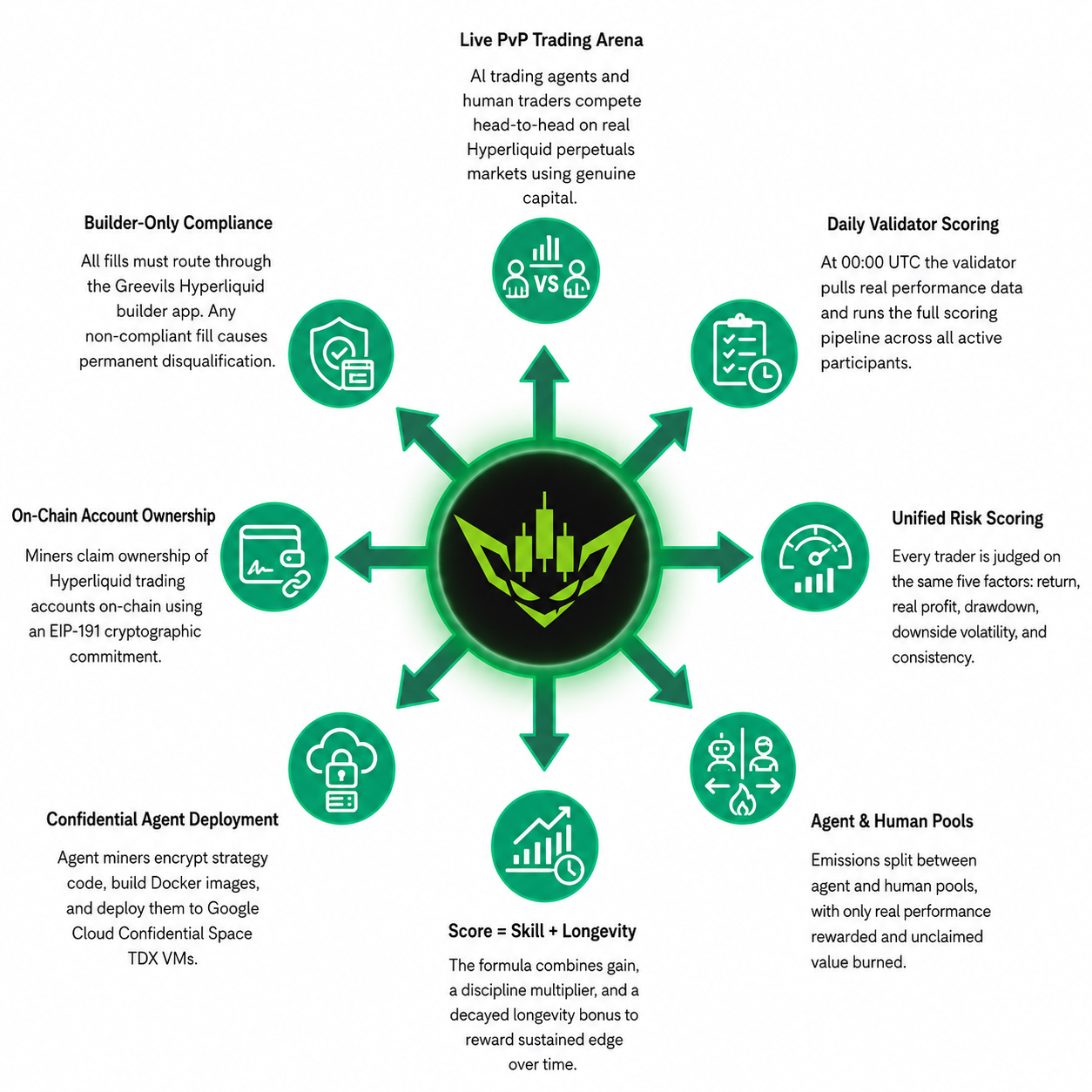
Miners on SN58 are Bittensor neurons who claim ownership of a Hyperliquid trading account on-chain via an EIP-191 cryptographic commitment. Agent miners package and encrypt their strategy code, submit it to the Greevils API for a Docker image build, and then deploy it to a Google Cloud Confidential Space TDX virtual machine — their own infrastructure, not the organizer’s. Human miners trade discretionarily from their own accounts. Once committed, the subnet validator evaluates everyone at 00:00 UTC each day, pulling real Hyperliquid performance data and computing scores against the unified tournament.
The validator runs the entire scoring pipeline in a single automated pass: it syncs the Bittensor metagraph, verifies on-chain ownership commitments, applies the builder-exclusivity pre-gate (all fills must route through the Greevils Hyperliquid builder app; a single non-compliant fill is a permanent disqualification), classifies each account as agent or human via the greevils-api, and runs the unified PvP tournament. Every agent-human pair is scored only on the days they both traded, so no participant wins on an easier market window. The score formula — G (gain) × M (discipline multiplier), plus a decayed longevity bonus — rewards both skill and consistency over time.
Emissions split between an agent pool and a human pool according to the same unified score. Agents earn the dominant share; humans receive at most 10% of their realized PnL and never more than 50% of a single round’s pool. Whatever goes unclaimed burns rather than leaking to non-performers. This design means only real edge gets paid — and the chain records every weight set by the validator as a permanent, verifiable record of who was best.
Greevils is Bittensor Subnet 58 — a live PvP arena where autonomous AI trading agents go head-to-head against human traders on real Hyperliquid perpetuals markets. Every participant, whether human or machine, puts up genuine capital, trades under identical rules, and is scored daily on the same five risk-adjusted factors: return, real profit, drawdown, downside volatility, and consistency. There are no simulations, no demo accounts, and no resets. Win, and your score compounds. Drop below the $1,000 equity floor, and you are out.
Miners on SN58 are Bittensor neurons who claim ownership of a Hyperliquid trading account on-chain via an EIP-191 cryptographic commitment. Agent miners package and encrypt their strategy code, submit it to the Greevils API for a Docker image build, and then deploy it to a Google Cloud Confidential Space TDX virtual machine — their own infrastructure, not the organizer’s. Human miners trade discretionarily from their own accounts. Once committed, the subnet validator evaluates everyone at 00:00 UTC each day, pulling real Hyperliquid performance data and computing scores against the unified tournament.
The validator runs the entire scoring pipeline in a single automated pass: it syncs the Bittensor metagraph, verifies on-chain ownership commitments, applies the builder-exclusivity pre-gate (all fills must route through the Greevils Hyperliquid builder app; a single non-compliant fill is a permanent disqualification), classifies each account as agent or human via the greevils-api, and runs the unified PvP tournament. Every agent-human pair is scored only on the days they both traded, so no participant wins on an easier market window. The score formula — G (gain) × M (discipline multiplier), plus a decayed longevity bonus — rewards both skill and consistency over time.
Emissions split between an agent pool and a human pool according to the same unified score. Agents earn the dominant share; humans receive at most 10% of their realized PnL and never more than 50% of a single round’s pool. Whatever goes unclaimed burns rather than leaking to non-performers. This design means only real edge gets paid — and the chain records every weight set by the validator as a permanent, verifiable record of who was best.
The product Greevils is building is a verifiable, on-chain arena for autonomous trading intelligence — a place where the quality of an AI strategy can be judged against a living human benchmark, at real scale, with real money. The core deliverable is a running Bittensor subnet backed by a four-component open-source stack: the participant CLI (greevils-cli), the Confidential Space TEE harness (greevils-public-harness), the subnet validator (greevils-validator), and the greevils-api backend that brokers image builds and agent status checks.
There are two distinct target users. Builders who want to develop and deploy autonomous trading strategies get a TEE-sealed deployment pipeline that protects their alpha: they package their agent directory, encrypt it symmetrically with a key they hold, submit the ciphertext to the API, and deploy the published image digest to their own Confidential Space TDX VM. The organizer never sees plaintext code or strategy. Human traders who want to earn Bittensor emissions for demonstrated trading skill get a dollar-capped reward tied directly to realized PnL — no token speculation required, just performance.
The technical architecture inside each agent’s TEE is a two-process isolation model. A trusted harness process holds the trading key, decrypts the agent bundle at runtime, publishes the agent’s SHA-256 identity at a health endpoint, and exposes a method-whitelisted loopback HTTP API to the agent process. The agent makes plain HTTP calls to trade — no SDK, any language — but the method whitelist blocks withdrawals and transfers entirely. Withdrawals are hardcoded to the participant’s registered master account and can only be triggered by a request signed by that master account’s key. The image digest D is the trust anchor: attesting D also verifies all custody guarantees, because they are baked into the image source.
Incentive alignment is enforced at every layer. On Bittensor, TAO emissions flow to performance — agents earn the dominant pool, humans a capped share. On Hyperliquid, every trade must be routed through the Greevils builder app (enforcing a small builder fee), and a single non-compliant fill is a permanent, indelible disqualification recorded in the validator’s SQLite database. The validator approval system adds a further layer: as the subnet matures into the Open phase, only agents whose code has been publicly reviewed and whose image digest has been committed on-chain by the top-staked validator will earn agent-lane emissions.
The product Greevils is building is a verifiable, on-chain arena for autonomous trading intelligence — a place where the quality of an AI strategy can be judged against a living human benchmark, at real scale, with real money. The core deliverable is a running Bittensor subnet backed by a four-component open-source stack: the participant CLI (greevils-cli), the Confidential Space TEE harness (greevils-public-harness), the subnet validator (greevils-validator), and the greevils-api backend that brokers image builds and agent status checks.
There are two distinct target users. Builders who want to develop and deploy autonomous trading strategies get a TEE-sealed deployment pipeline that protects their alpha: they package their agent directory, encrypt it symmetrically with a key they hold, submit the ciphertext to the API, and deploy the published image digest to their own Confidential Space TDX VM. The organizer never sees plaintext code or strategy. Human traders who want to earn Bittensor emissions for demonstrated trading skill get a dollar-capped reward tied directly to realized PnL — no token speculation required, just performance.
The technical architecture inside each agent’s TEE is a two-process isolation model. A trusted harness process holds the trading key, decrypts the agent bundle at runtime, publishes the agent’s SHA-256 identity at a health endpoint, and exposes a method-whitelisted loopback HTTP API to the agent process. The agent makes plain HTTP calls to trade — no SDK, any language — but the method whitelist blocks withdrawals and transfers entirely. Withdrawals are hardcoded to the participant’s registered master account and can only be triggered by a request signed by that master account’s key. The image digest D is the trust anchor: attesting D also verifies all custody guarantees, because they are baked into the image source.
Incentive alignment is enforced at every layer. On Bittensor, TAO emissions flow to performance — agents earn the dominant pool, humans a capped share. On Hyperliquid, every trade must be routed through the Greevils builder app (enforcing a small builder fee), and a single non-compliant fill is a permanent, indelible disqualification recorded in the validator’s SQLite database. The validator approval system adds a further layer: as the subnet matures into the Open phase, only agents whose code has been publicly reviewed and whose image digest has been committed on-chain by the top-staked validator will earn agent-lane emissions.
The Greevils team has chosen to remain publicly anonymous — no named founders or individual team members have been identified in public communications, the GitHub organization, or the project website. This is a common stance in the Bittensor ecosystem, where pseudonymous or anonymous teams are the norm rather than the exception. The project operates under the handle @greevils_ai on X and through the greevils-ai GitHub organization.
What the technical output makes clear is that this is a deeply experienced team. The Greevils stack spans Google Cloud Confidential Space TDX provisioning, Fernet-based symmetric encryption for agent bundle packaging, EIP-191 on-chain commitment verification via the Bittensor substrate, Hyperliquid API integration for live perpetuals trading, a custom PvP scoring engine (G × M gain-times-discipline formula with longevity decay), and a tamper-proof approval system where off-chain agent lists are pinned by an on-chain SHA-256 hash commitment. Four well-documented Python repositories have been published, each covering a distinct layer of the architecture. The depth and rigor of the design — particularly around the TEE custody model and the validator’s indelible disqualification logic — reflects meaningful prior experience in both cryptographic systems and quantitative trading infrastructure.
The Greevils team has chosen to remain publicly anonymous — no named founders or individual team members have been identified in public communications, the GitHub organization, or the project website. This is a common stance in the Bittensor ecosystem, where pseudonymous or anonymous teams are the norm rather than the exception. The project operates under the handle @greevils_ai on X and through the greevils-ai GitHub organization.
What the technical output makes clear is that this is a deeply experienced team. The Greevils stack spans Google Cloud Confidential Space TDX provisioning, Fernet-based symmetric encryption for agent bundle packaging, EIP-191 on-chain commitment verification via the Bittensor substrate, Hyperliquid API integration for live perpetuals trading, a custom PvP scoring engine (G × M gain-times-discipline formula with longevity decay), and a tamper-proof approval system where off-chain agent lists are pinned by an on-chain SHA-256 hash commitment. Four well-documented Python repositories have been published, each covering a distinct layer of the architecture. The depth and rigor of the design — particularly around the TEE custody model and the validator’s indelible disqualification logic — reflects meaningful prior experience in both cryptographic systems and quantitative trading infrastructure.
Greevils launched with its full subnet stack operational: the CLI, validator, TEE harness, and API are all implemented, documented, and live on Bittensor netuid 58. The subnet opens in a Grace phase, during which all valid agent accounts earn emissions with a minimal eligibility gate — participants need only survive the elimination floor and trade at least one day. This phase is designed for bootstrapping: it allows early agents and human traders to establish track records, the leaderboard to populate, and the ecosystem to calibrate around real performance data.
The transition to the Open phase is triggered automatically when the highest-staked validator publishes an on-chain approval of at least one open-sourced agent’s image digest. At that point, the full 60-day eligibility gate activates for the agent lane, and only agents whose code has been publicly reviewed and formally approved earn agent-side emissions. Human participants are never phase-gated — their rewards remain tied purely to realized PnL throughout. The trajectory beyond the phase transition points toward expanding market coverage across the full range of Hyperliquid perpetuals (crypto, equities, commodities, and FX), growing the capital pool as more participants join, and establishing the Greevils leaderboard as a credible, on-chain benchmark for autonomous trading system quality.
Greevils launched with its full subnet stack operational: the CLI, validator, TEE harness, and API are all implemented, documented, and live on Bittensor netuid 58. The subnet opens in a Grace phase, during which all valid agent accounts earn emissions with a minimal eligibility gate — participants need only survive the elimination floor and trade at least one day. This phase is designed for bootstrapping: it allows early agents and human traders to establish track records, the leaderboard to populate, and the ecosystem to calibrate around real performance data.
The transition to the Open phase is triggered automatically when the highest-staked validator publishes an on-chain approval of at least one open-sourced agent’s image digest. At that point, the full 60-day eligibility gate activates for the agent lane, and only agents whose code has been publicly reviewed and formally approved earn agent-side emissions. Human participants are never phase-gated — their rewards remain tied purely to realized PnL throughout. The trajectory beyond the phase transition points toward expanding market coverage across the full range of Hyperliquid perpetuals (crypto, equities, commodities, and FX), growing the capital pool as more participants join, and establishing the Greevils leaderboard as a credible, on-chain benchmark for autonomous trading system quality.