
With the amount of new subnets being added it can be hard to get up to date information across all subnets, so data may be slightly out of date from time to time
Glyph (Bittensor Subnet 117) is a decentralised lossless neural text compression network. Where traditional compression relies on hand-crafted rules, Glyph incentivises open competition to discover neural models — called codecs — that learn efficient, semantic-preserving representations of text. The subnet functions as a perpetual, decentralised Hutter Prize: codecs are submitted by miners, evaluated continuously on fresh data by validators, and the best performer earns TAO rewards until a superior model dethrones it.
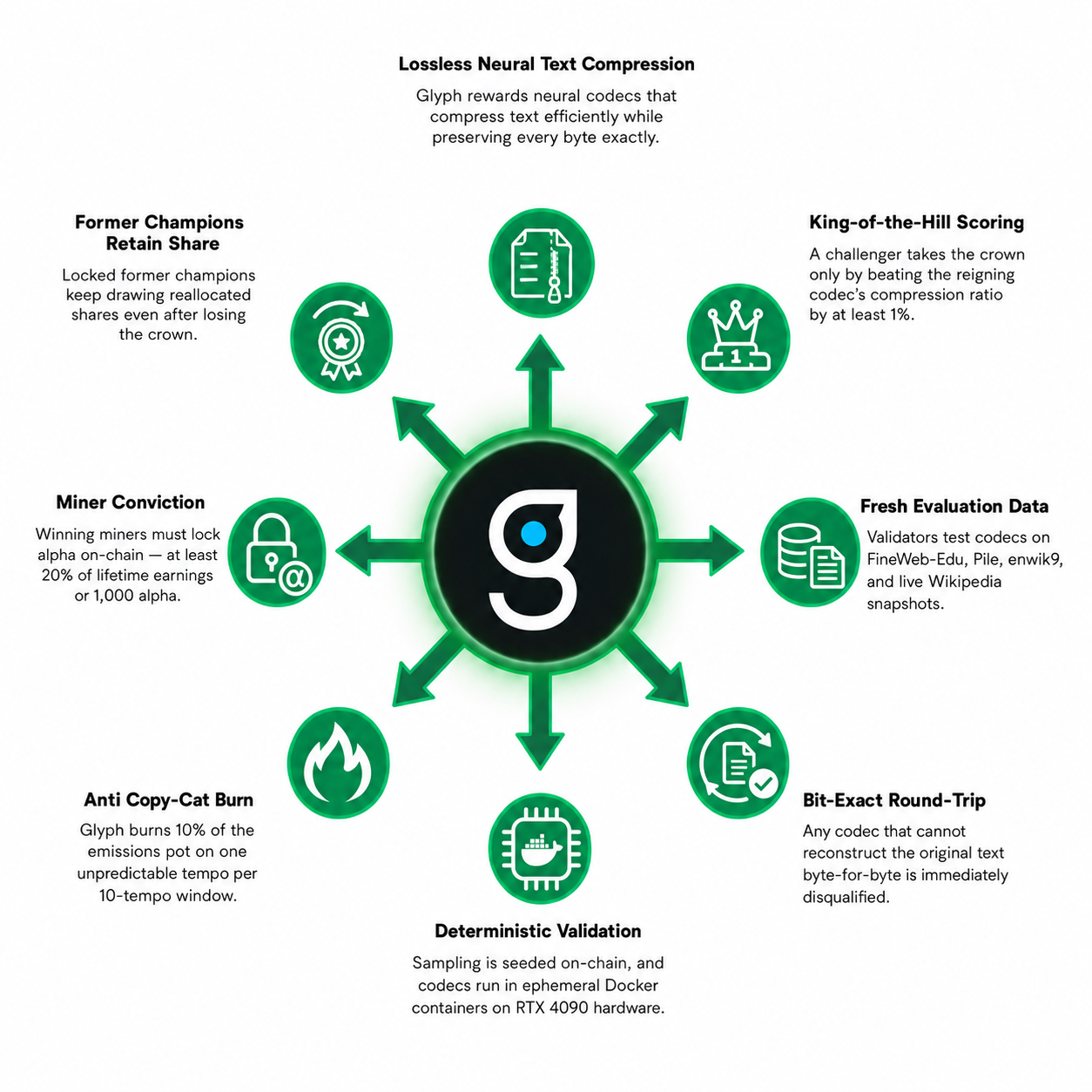
The core mechanic is a king-of-the-hill scoring system. A challenger codec takes the top position only if it beats the reigning champion’s compression ratio by at least 1% (relative). This threshold, known as epsilon, ensures that only genuine improvements propagate forward — marginal tweaks earn marginal shares, while a 5% leap can take the entire emissions pot. Identical-block challengers are processed as a sequential gauntlet in commit order, so the earliest legitimate improvement wins rather than allowing later submitters to free-ride on someone else’s round.
Validators evaluate every committed codec on streams of fresh text drawn from HuggingFace’s FineWeb-Edu and Pile datasets, a fixed enwik9 benchmark window, and a per-round live Wikipedia snapshot — text that no pre-committed model could have memorised. The corpus is seeded by an on-chain beacon, making sampling deterministic yet unguessable in advance. Codecs are executed in ephemeral Docker containers on RTX 4090 hardware, with hardware checks enforced so all validators run the same compute environment. Results are compared by compression ratio (compressed bytes divided by raw bytes — lower is better) with a hard bit-exact round-trip gate; any codec that cannot reconstruct the original byte-for-byte is immediately disqualified.
To prevent the network from becoming dominated by copy-cat validators, Glyph burns 10% of the emissions pot on one unpredictable tempo per 10-tempo window. Additionally, a Miner Conviction mechanism requires winning miners to lock a portion of their earned alpha on-chain — at least the greater of 20% of lifetime earnings or 1,000 alpha — ensuring that participants who claim rewards have meaningful skin in the game. Former champions that remain locked continue to draw from reallocated shares even after losing the crown, giving long-term contributors an ongoing incentive to maintain quality codecs.
Glyph (Bittensor Subnet 117) is a decentralised lossless neural text compression network. Where traditional compression relies on hand-crafted rules, Glyph incentivises open competition to discover neural models — called codecs — that learn efficient, semantic-preserving representations of text. The subnet functions as a perpetual, decentralised Hutter Prize: codecs are submitted by miners, evaluated continuously on fresh data by validators, and the best performer earns TAO rewards until a superior model dethrones it.
The core mechanic is a king-of-the-hill scoring system. A challenger codec takes the top position only if it beats the reigning champion’s compression ratio by at least 1% (relative). This threshold, known as epsilon, ensures that only genuine improvements propagate forward — marginal tweaks earn marginal shares, while a 5% leap can take the entire emissions pot. Identical-block challengers are processed as a sequential gauntlet in commit order, so the earliest legitimate improvement wins rather than allowing later submitters to free-ride on someone else’s round.
Validators evaluate every committed codec on streams of fresh text drawn from HuggingFace’s FineWeb-Edu and Pile datasets, a fixed enwik9 benchmark window, and a per-round live Wikipedia snapshot — text that no pre-committed model could have memorised. The corpus is seeded by an on-chain beacon, making sampling deterministic yet unguessable in advance. Codecs are executed in ephemeral Docker containers on RTX 4090 hardware, with hardware checks enforced so all validators run the same compute environment. Results are compared by compression ratio (compressed bytes divided by raw bytes — lower is better) with a hard bit-exact round-trip gate; any codec that cannot reconstruct the original byte-for-byte is immediately disqualified.
To prevent the network from becoming dominated by copy-cat validators, Glyph burns 10% of the emissions pot on one unpredictable tempo per 10-tempo window. Additionally, a Miner Conviction mechanism requires winning miners to lock a portion of their earned alpha on-chain — at least the greater of 20% of lifetime earnings or 1,000 alpha — ensuring that participants who claim rewards have meaningful skin in the game. Former champions that remain locked continue to draw from reallocated shares even after losing the crown, giving long-term contributors an ongoing incentive to maintain quality codecs.
Glyph Research provides the tooling, evaluation infrastructure, and network incentives to build a continuously improving neural text compression ecosystem. The primary deliverable is the glyph-subnet software suite, an open-source Python project licensed under MIT. It includes a miner CLI (glyph-miner) for building, checking, publishing, and committing codecs; a validator orchestrator (glyph-validator) for running continuous round-based evaluation; a corpus builder (glyph-oracle) for generating fresh evaluation text; and a weight-setter daemon (glyph-weight-setter) that settles on-chain rewards. All components are PM2-compatible and support auto-updating deployments via a bundled shell script.
The product addresses a real infrastructure challenge for AI developers: large language models and multi-agent systems routinely exchange or process massive text payloads, much of which contains semantic redundancy. Neural compression allows those payloads to be represented as compact latent vectors rather than raw token streams. Glyph’s three headline use-cases are long-context document compression (demonstrated as reducing 15,290 tokens to 1,195 compressed tokens), AI-agent communication (exchanging semantic coordinates instead of raw messages, cutting latency by up to 84%), and large-scale language infrastructure (demonstrated storage ratio of 12.7:1 with 91% bandwidth cost reduction). The target audience is AI infrastructure engineers, distributed systems builders, and Bittensor miners and validators looking to contribute to and earn from an applied research network.
The evaluation architecture is deliberately permissionless. Every validator assembles its own live corpus from public HuggingFace datasets, keyed by the round’s beacon hash, with no owner-run oracle process and no shared corpus file to maintain. Codec artifacts are published to HuggingFace Hub as pinned-revision repositories and must conform to a simple manifest contract: a manifest.json declaring compress and decompress entrypoints, the entrypoint scripts, and any model weights — all within a 10 GiB size cap, with no outbound network access permitted during evaluation. Codecs that need custom CUDA builds or compiled extensions may ship their own Docker image. Resource caps of 24 GiB VRAM and 32 GiB RAM are enforced during evaluation.
The subnet integrates with Chutes (SN64) as an optional serverless GPU evaluation backend, HuggingFace Hub for corpus streaming and artifact hosting, blockmachine.io for rapid metagraph backfill, and WandB for optional experiment tracking. These integrations are all opt-in; the default path requires only a local Docker installation with an RTX 4090 and the Bittensor network connection. This design keeps barriers to validation low while ensuring hardware-comparable benchmarking across all validators.
Glyph Research provides the tooling, evaluation infrastructure, and network incentives to build a continuously improving neural text compression ecosystem. The primary deliverable is the glyph-subnet software suite, an open-source Python project licensed under MIT. It includes a miner CLI (glyph-miner) for building, checking, publishing, and committing codecs; a validator orchestrator (glyph-validator) for running continuous round-based evaluation; a corpus builder (glyph-oracle) for generating fresh evaluation text; and a weight-setter daemon (glyph-weight-setter) that settles on-chain rewards. All components are PM2-compatible and support auto-updating deployments via a bundled shell script.
The product addresses a real infrastructure challenge for AI developers: large language models and multi-agent systems routinely exchange or process massive text payloads, much of which contains semantic redundancy. Neural compression allows those payloads to be represented as compact latent vectors rather than raw token streams. Glyph’s three headline use-cases are long-context document compression (demonstrated as reducing 15,290 tokens to 1,195 compressed tokens), AI-agent communication (exchanging semantic coordinates instead of raw messages, cutting latency by up to 84%), and large-scale language infrastructure (demonstrated storage ratio of 12.7:1 with 91% bandwidth cost reduction). The target audience is AI infrastructure engineers, distributed systems builders, and Bittensor miners and validators looking to contribute to and earn from an applied research network.
The evaluation architecture is deliberately permissionless. Every validator assembles its own live corpus from public HuggingFace datasets, keyed by the round’s beacon hash, with no owner-run oracle process and no shared corpus file to maintain. Codec artifacts are published to HuggingFace Hub as pinned-revision repositories and must conform to a simple manifest contract: a manifest.json declaring compress and decompress entrypoints, the entrypoint scripts, and any model weights — all within a 10 GiB size cap, with no outbound network access permitted during evaluation. Codecs that need custom CUDA builds or compiled extensions may ship their own Docker image. Resource caps of 24 GiB VRAM and 32 GiB RAM are enforced during evaluation.
The subnet integrates with Chutes (SN64) as an optional serverless GPU evaluation backend, HuggingFace Hub for corpus streaming and artifact hosting, blockmachine.io for rapid metagraph backfill, and WandB for optional experiment tracking. These integrations are all opt-in; the default path requires only a local Docker installation with an RTX 4090 and the Bittensor network connection. This design keeps barriers to validation low while ensuring hardware-comparable benchmarking across all validators.
Glyph Research operates under a pseudonymous structure: no individual names are listed on the website, the GitHub organisation shows no public members, and the official contact is [email protected]. This is not unusual in the Bittensor ecosystem, where many subnet teams maintain privacy during early development phases. On Twitter/X, the project launched under the @glyphresearch handle in July 2026, and internal chain data shows that the team has locked 100% of owner alpha perpetually — a public commitment signal that the founders are not planning an early exit.
What is visible through public artefacts is that the glyph-subnet codebase is technically sophisticated: it covers a custom chain adapter, a weight-setter daemon, a king-of-the-hill reign worker, secure artifact precheck, corpus streaming, and a full CLI — all coordinated with Bittensor’s commit-reveal weight system and Conviction lock enforcement. Repository activity from SubnetRadar records approximately 100 commits in the 30 days following launch and at least two active contributors. The team’s decision to open-source the entire stack under an MIT licence and provide a working offline demo mode underscores a research-first posture. Until the team chooses to identify themselves publicly, the project is best understood through its technical output and on-chain behaviour.
Glyph Research operates under a pseudonymous structure: no individual names are listed on the website, the GitHub organisation shows no public members, and the official contact is [email protected]. This is not unusual in the Bittensor ecosystem, where many subnet teams maintain privacy during early development phases. On Twitter/X, the project launched under the @glyphresearch handle in July 2026, and internal chain data shows that the team has locked 100% of owner alpha perpetually — a public commitment signal that the founders are not planning an early exit.
What is visible through public artefacts is that the glyph-subnet codebase is technically sophisticated: it covers a custom chain adapter, a weight-setter daemon, a king-of-the-hill reign worker, secure artifact precheck, corpus streaming, and a full CLI — all coordinated with Bittensor’s commit-reveal weight system and Conviction lock enforcement. Repository activity from SubnetRadar records approximately 100 commits in the 30 days following launch and at least two active contributors. The team’s decision to open-source the entire stack under an MIT licence and provide a working offline demo mode underscores a research-first posture. Until the team chooses to identify themselves publicly, the project is best understood through its technical output and on-chain behaviour.
Glyph has not published a formal versioned roadmap, but the subnet’s Scientific Frontiers section outlines active research priorities across four tracks. In the neural representations track, the team is exploring continuous latent manifolds, self-supervised dictionary learning, and linguistic codebooks — techniques that could substantially reduce the entropy of compressed representations beyond what current arithmetic coders achieve. In the semantic compression track, work centres on vector-quantised autoencoders, cross-attention context mappings, and zero-shot reconstruction validation, all aimed at guaranteeing that compressed text retains its full downstream utility for LLM inference pipelines.
The language efficiency track focuses on variable token-rate coding, information density estimation, and recursive context-aware projection — capabilities that would allow a codec to allocate compression budget dynamically based on the semantic density of different text regions. The open research track targets open benchmark suites and cross-subnet model migration, which would allow codec architectures from Glyph to be tested against or ported to other Bittensor subnets. In parallel, the team has flagged that Bittensor’s network upgrades will require corresponding updates to Glyph’s CLI and chain-adapter components, suggesting ongoing maintenance and compatibility engineering as a near-term commitment.
Glyph has not published a formal versioned roadmap, but the subnet’s Scientific Frontiers section outlines active research priorities across four tracks. In the neural representations track, the team is exploring continuous latent manifolds, self-supervised dictionary learning, and linguistic codebooks — techniques that could substantially reduce the entropy of compressed representations beyond what current arithmetic coders achieve. In the semantic compression track, work centres on vector-quantised autoencoders, cross-attention context mappings, and zero-shot reconstruction validation, all aimed at guaranteeing that compressed text retains its full downstream utility for LLM inference pipelines.
The language efficiency track focuses on variable token-rate coding, information density estimation, and recursive context-aware projection — capabilities that would allow a codec to allocate compression budget dynamically based on the semantic density of different text regions. The open research track targets open benchmark suites and cross-subnet model migration, which would allow codec architectures from Glyph to be tested against or ported to other Bittensor subnets. In parallel, the team has flagged that Bittensor’s network upgrades will require corresponding updates to Glyph’s CLI and chain-adapter components, suggesting ongoing maintenance and compatibility engineering as a near-term commitment.