
With the amount of new subnets being added it can be hard to get up to date information across all subnets, so data may be slightly out of date from time to time
Purpose and Overview
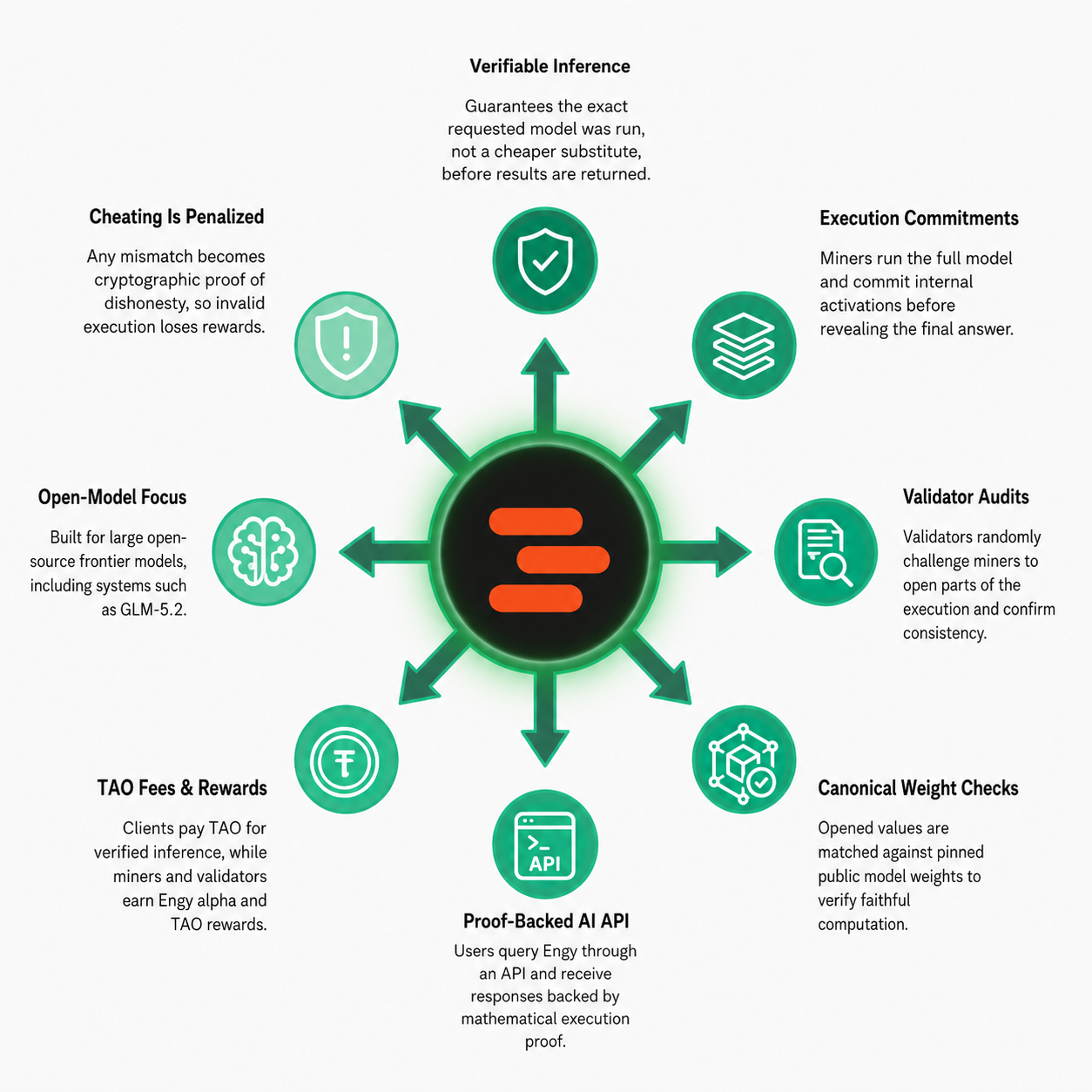
Engy (Subnet 53) on Bittensor is designed to provide verifiably correct inference of large open-source models. It solves the problem of trusting remote AI computation. When a user pays for inference, Engy ensures by cryptographic proof that the exact model (such as GLM-5.2) was run, not a cheaper or substituted computation. In practical terms, Engy combines Bittensor’s economic layers with a novel verification: miners execute the full model and commit internal activations, while validators audit parts of that execution to confirm consistency. This provides a transparent guarantee that the published model weights produced the answer). Thus, the end product is an answer from the requested model, backed by verifiable execution on-chain.
Mining and Validation Loop
As a Bittensor subnet, Engy uses the standard miner/validator cycle but with a cryptographic audit. Miner nodes listen for inference requests and execute the model upon request. Before revealing results, a miner commits to its computation (e.g. hashing or Merkle-committing each layer’s outputs). Validators then randomly challenge miners to open parts of these commitments. If the revealed values align with the canonical model weights (pinned by a public Merkle root), the computation is verified as honest. A mismatch is cryptographic proof of cheating, so misbehaving miners are penalized by the reward mechanism. In effect, miners earn most when correctly executing the model and passing the validator checks, while validators simply award or withhold rewards based on the proof of correct execution.
Outputs and Rewards
From a user perspective, Engy appears as a reliable AI API with built-in proof. A client sends a query (via Engy’s API) and receives the model’s response, along with the certainty that the computation was done faithfully. Under the hood, users pay TAO fees to access the model. For investors and miners, the “product” is the Engy alpha token and TAO rewards. Engy has an 18% owner cut of mining rewards, with the rest distributed to miners/validators. For example, Engy’s alpha currently trades around $2.62 (0.0136 TAO) and roughly 22.6K TAO is locked in its liquidity pool, reflecting its on-chain economy. Thus miners (who stake Engy) earn alpha by providing proofs of inference, and end-users (AI developers or services) get guaranteed outputs—a combination that distinguishes Engy’s offering from ordinary inference networks.
Comparison to Other Subnets
Engy’s approach is unique but has parallels. For instance, the Omron subnet (SN2) also uses cryptographic proofs to verify that miners executed specific AI models as claimed. However, Engy specifically targets “frontier” open models and uses a Merkle-commit audit method, whereas Omron employs general zero-knowledge proofs. Unlike trading-focused subnets (such as Efficient Frontier by SignalPlus) or generic prediction tasks, Engy’s sole purpose is correct model inference.; Engy repurposes that slot for AI tasks.) In summary, Engy’s defining feature is verifiability: other Bittensor subnets might focus on speed or different tasks, but Engy ensures trust mathematically. Even SubnetRadar notes Engy’s “Verified inference” tagline. At present, Engy’s metric for “real work” is 0%, indicating it relies entirely on proof-of-execution rather than traditional validator scoring.
Purpose and Overview
Engy (Subnet 53) on Bittensor is designed to provide verifiably correct inference of large open-source models. It solves the problem of trusting remote AI computation. When a user pays for inference, Engy ensures by cryptographic proof that the exact model (such as GLM-5.2) was run, not a cheaper or substituted computation. In practical terms, Engy combines Bittensor’s economic layers with a novel verification: miners execute the full model and commit internal activations, while validators audit parts of that execution to confirm consistency. This provides a transparent guarantee that the published model weights produced the answer). Thus, the end product is an answer from the requested model, backed by verifiable execution on-chain.
Mining and Validation Loop
As a Bittensor subnet, Engy uses the standard miner/validator cycle but with a cryptographic audit. Miner nodes listen for inference requests and execute the model upon request. Before revealing results, a miner commits to its computation (e.g. hashing or Merkle-committing each layer’s outputs). Validators then randomly challenge miners to open parts of these commitments. If the revealed values align with the canonical model weights (pinned by a public Merkle root), the computation is verified as honest. A mismatch is cryptographic proof of cheating, so misbehaving miners are penalized by the reward mechanism. In effect, miners earn most when correctly executing the model and passing the validator checks, while validators simply award or withhold rewards based on the proof of correct execution.
Outputs and Rewards
From a user perspective, Engy appears as a reliable AI API with built-in proof. A client sends a query (via Engy’s API) and receives the model’s response, along with the certainty that the computation was done faithfully. Under the hood, users pay TAO fees to access the model. For investors and miners, the “product” is the Engy alpha token and TAO rewards. Engy has an 18% owner cut of mining rewards, with the rest distributed to miners/validators. For example, Engy’s alpha currently trades around $2.62 (0.0136 TAO) and roughly 22.6K TAO is locked in its liquidity pool, reflecting its on-chain economy. Thus miners (who stake Engy) earn alpha by providing proofs of inference, and end-users (AI developers or services) get guaranteed outputs—a combination that distinguishes Engy’s offering from ordinary inference networks.
Comparison to Other Subnets
Engy’s approach is unique but has parallels. For instance, the Omron subnet (SN2) also uses cryptographic proofs to verify that miners executed specific AI models as claimed. However, Engy specifically targets “frontier” open models and uses a Merkle-commit audit method, whereas Omron employs general zero-knowledge proofs. Unlike trading-focused subnets (such as Efficient Frontier by SignalPlus) or generic prediction tasks, Engy’s sole purpose is correct model inference.; Engy repurposes that slot for AI tasks.) In summary, Engy’s defining feature is verifiability: other Bittensor subnets might focus on speed or different tasks, but Engy ensures trust mathematically. Even SubnetRadar notes Engy’s “Verified inference” tagline. At present, Engy’s metric for “real work” is 0%, indicating it relies entirely on proof-of-execution rather than traditional validator scoring.
Current Status vs Development
Engy is fully live on the Bittensor mainnet. Its subnet page shows registration is open and all 256 neuron slots are filled, indicating maximum participation. The network is actively producing blocks), though new miners can still register. In development, the Engy team continues refining the code: the public GitHub repo (hanlinai/engy) shows two commits in the past month (latest just a day ago). No separate testbed or staging phase is evident – updates appear to be released directly on mainnet.
Architecture
Engy’s architecture combines Bittensor’s chain with a standard AI inference stack. On-chain, the subnet simply uses Bittensor’s Commit-Reveal system (Engy has commit-reveal enabled v3, 1-epoch). Off-chain, each miner runs a GPU-serving model (e.g. GLM-5.2) and code to produce Merkle commitments of activations. The Engy codebase (not shown here) would include miner and validator loops and the network protocol logic. The GitHub activity listing shows only one contributor (renning222, likely Ning Ren). This team has also built the TrajectoryRL subnet (SN11) for optimized model agents, reflecting experience in on-chain ML. The owner cut is fixed at 18%, so Hanlin AI collects that fraction of earnings by design.
Integration / Interfaces
Engy provides a standard HTTP API for end users. Its documentation shows how to integrate Engy with popular AI client tools. For example, in a Claude (Anthropic) client, one sets the environment variable ANTHROPIC_BASE_URL to https://api.engy.ai (with model “glm-5.2”). Similarly, an OpenAI-compatible client can send requests to https://api.engy.ai/v1/chat/completions (with an API key from Engy). In practice, this means developers can plug Engy into existing frameworks by simply rerouting their API calls. No other external integrations or partnerships are documented – Engy’s service is self-contained, serving inference via its Bittensor network.
Repository Activity and Metrics
The Engy repository (GitHub hanlinai/engy) hosts the code implementing the subnet. While we can’t browse it here, Bittensor’s UI shows the repo has had 2 commits in the last 30 days, indicating ongoing development. Key components likely include the AI model code and the commit/reveal logic. On-chain metrics give a sense of Engy’s size: SubnetRadar shows Engy’s alpha price at ~$2.62 (0.0136 TAO) with a market cap around $13.9M. About 1.7M of the 5.06M total Engy tokens are staked in the pool, and roughly 22.6K TAO is locked in liquidity (TVL ~45K TAO). Emissions are 0.50 TAO per block (≈360 ENG/epoch), yielding very high raw APYs today (ؘ~1132% reported). These figures imply a modest but active economy – Engy is generating traffic and block rewards, but it remains a smaller subnet by volume. The APIs and economic parameters all feed into the same end: enabling verified inference as the subnet’s utility.
Current Status vs Development
Engy is fully live on the Bittensor mainnet. Its subnet page shows registration is open and all 256 neuron slots are filled, indicating maximum participation. The network is actively producing blocks), though new miners can still register. In development, the Engy team continues refining the code: the public GitHub repo (hanlinai/engy) shows two commits in the past month (latest just a day ago). No separate testbed or staging phase is evident – updates appear to be released directly on mainnet.
Architecture
Engy’s architecture combines Bittensor’s chain with a standard AI inference stack. On-chain, the subnet simply uses Bittensor’s Commit-Reveal system (Engy has commit-reveal enabled v3, 1-epoch). Off-chain, each miner runs a GPU-serving model (e.g. GLM-5.2) and code to produce Merkle commitments of activations. The Engy codebase (not shown here) would include miner and validator loops and the network protocol logic. The GitHub activity listing shows only one contributor (renning222, likely Ning Ren). This team has also built the TrajectoryRL subnet (SN11) for optimized model agents, reflecting experience in on-chain ML. The owner cut is fixed at 18%, so Hanlin AI collects that fraction of earnings by design.
Integration / Interfaces
Engy provides a standard HTTP API for end users. Its documentation shows how to integrate Engy with popular AI client tools. For example, in a Claude (Anthropic) client, one sets the environment variable ANTHROPIC_BASE_URL to https://api.engy.ai (with model “glm-5.2”). Similarly, an OpenAI-compatible client can send requests to https://api.engy.ai/v1/chat/completions (with an API key from Engy). In practice, this means developers can plug Engy into existing frameworks by simply rerouting their API calls. No other external integrations or partnerships are documented – Engy’s service is self-contained, serving inference via its Bittensor network.
Repository Activity and Metrics
The Engy repository (GitHub hanlinai/engy) hosts the code implementing the subnet. While we can’t browse it here, Bittensor’s UI shows the repo has had 2 commits in the last 30 days, indicating ongoing development. Key components likely include the AI model code and the commit/reveal logic. On-chain metrics give a sense of Engy’s size: SubnetRadar shows Engy’s alpha price at ~$2.62 (0.0136 TAO) with a market cap around $13.9M. About 1.7M of the 5.06M total Engy tokens are staked in the pool, and roughly 22.6K TAO is locked in liquidity (TVL ~45K TAO). Emissions are 0.50 TAO per block (≈360 ENG/epoch), yielding very high raw APYs today (ؘ~1132% reported). These figures imply a modest but active economy – Engy is generating traffic and block rewards, but it remains a smaller subnet by volume. The APIs and economic parameters all feed into the same end: enabling verified inference as the subnet’s utility.
Key Team Members
Engy is developed by Hanlin AI, a startup focused on AI platforms. The founder and lead engineer is Ning Ren – a former Google AI engineer – who heads Hanlin AI. On GitHub, the user “renning222” (presumably Ning) is listed as the top contributor to Engy. Hanlin AI’s core team, though small, also built the TrajectoryRL subnet (SN11) for on-chain model training, demonstrating relevant expertise. Hanlin’s ownership of Engy is indicated by the on-chain “owner cut” and by the repository maintenance.
SignalPlus Origins
Originally, Subnet 53 was “Efficient Frontier”, a project by SignalPlus (a crypto-trading tech company founded by ex-Goldman Sachs/Morgan Stanley traders). SignalPlus designed it to rank crypto trading strategies via real PnL data. The SignalPlus team (including partner Augustine Fan) publicly represented the subnet early on. With Engy’s launch, the subnet’s control appears to have shifted to Hanlin AI. (No new external investors or partners for Engy have been announced – it’s essentially an internal Hanlin initiative.)
Community and Partnerships
Engy currently has little public marketing beyond the official site and Bittensor listing. Besides Ning Ren’s portfolio page, the team has not launched a dedicated Twitter/X or blog for Engy. It does not maintain a separate Discord or Telegram; discussion likely happens in the main Bittensor channels. No strategic partnerships or integrations (outside of the API hooks) have been disclosed. In the Bittensor ecosystem, Engy is simply used like any other subnet, so community engagement related to Engy specifically is limited to those mining or tracking SN53. The one notable person still linked to the subnet in community material is Augustine Fan – but his role was tied to the earlier trading incarnation, not the new inference focus.
Key Team Members
Engy is developed by Hanlin AI, a startup focused on AI platforms. The founder and lead engineer is Ning Ren – a former Google AI engineer – who heads Hanlin AI. On GitHub, the user “renning222” (presumably Ning) is listed as the top contributor to Engy. Hanlin AI’s core team, though small, also built the TrajectoryRL subnet (SN11) for on-chain model training, demonstrating relevant expertise. Hanlin’s ownership of Engy is indicated by the on-chain “owner cut” and by the repository maintenance.
SignalPlus Origins
Originally, Subnet 53 was “Efficient Frontier”, a project by SignalPlus (a crypto-trading tech company founded by ex-Goldman Sachs/Morgan Stanley traders). SignalPlus designed it to rank crypto trading strategies via real PnL data. The SignalPlus team (including partner Augustine Fan) publicly represented the subnet early on. With Engy’s launch, the subnet’s control appears to have shifted to Hanlin AI. (No new external investors or partners for Engy have been announced – it’s essentially an internal Hanlin initiative.)
Community and Partnerships
Engy currently has little public marketing beyond the official site and Bittensor listing. Besides Ning Ren’s portfolio page, the team has not launched a dedicated Twitter/X or blog for Engy. It does not maintain a separate Discord or Telegram; discussion likely happens in the main Bittensor channels. No strategic partnerships or integrations (outside of the API hooks) have been disclosed. In the Bittensor ecosystem, Engy is simply used like any other subnet, so community engagement related to Engy specifically is limited to those mining or tracking SN53. The one notable person still linked to the subnet in community material is Augustine Fan – but his role was tied to the earlier trading incarnation, not the new inference focus.
No Official Roadmap Announced
As of mid-2026, Engy has published no formal roadmap or timeline. Its website and docs describe only the current service (running “frontier” models like GLM-5.2) with no mention of future phases. The Bittensor explorer shows Engy in epoch 246 of 360, but this is just a progress indicator for the ongoing cycle, not a roadmap. No whitepaper or blog post detailing Engy’s development stages could be found.
Recent Activity
The only clues about future work come from the code repository. As noted, the GitHub has seen active commits – two in the past month, one as recent as yesterday – suggesting incremental updates. However, none of this is announced in advance; there are no release notes or issue tracker visible. In short, development is happening quietly under the hood, with improvements landing continuously rather than via public milestones.
Future Vision
The envisioned long-term goal for Engy is clear: to become a widely-accessible, low-cost marketplace for provable AI inference. The founder has mentioned aiming for the “lowest cost tier” of verified model serving, implying plans to scale with consumer GPUs. A fully realized Engy might support multiple models and seamless integration with AI platforms, effectively acting as a decentralized AI compute cloud. But as of now no specific targets or dates for 2026+ have been announced. Stakeholders will likely watch Hanlin AI’s channels and Bittensor news feeds for any upcoming project milestones or expansions.
No Official Roadmap Announced
As of mid-2026, Engy has published no formal roadmap or timeline. Its website and docs describe only the current service (running “frontier” models like GLM-5.2) with no mention of future phases. The Bittensor explorer shows Engy in epoch 246 of 360, but this is just a progress indicator for the ongoing cycle, not a roadmap. No whitepaper or blog post detailing Engy’s development stages could be found.
Recent Activity
The only clues about future work come from the code repository. As noted, the GitHub has seen active commits – two in the past month, one as recent as yesterday – suggesting incremental updates. However, none of this is announced in advance; there are no release notes or issue tracker visible. In short, development is happening quietly under the hood, with improvements landing continuously rather than via public milestones.
Future Vision
The envisioned long-term goal for Engy is clear: to become a widely-accessible, low-cost marketplace for provable AI inference. The founder has mentioned aiming for the “lowest cost tier” of verified model serving, implying plans to scale with consumer GPUs. A fully realized Engy might support multiple models and seamless integration with AI platforms, effectively acting as a decentralized AI compute cloud. But as of now no specific targets or dates for 2026+ have been announced. Stakeholders will likely watch Hanlin AI’s channels and Bittensor news feeds for any upcoming project milestones or expansions.